

White-Label VoIP Providers: Build a Branded Business
Choosing the right white-label VoIP provider determines whether you build a branded business asset or stay a forgettable middleman.
- White-label, reseller, and agent models differ in margin, brand ownership, and control over the customer relationship.
- Branding and customer ownership are the real prize: white-label keeps every interaction under your name, not your supplier’s.
- MSPs can layer voice onto existing IT services and turn it into predictable recurring revenue with strong margins.
- The connectivity layer matters as much as the platform because call quality and reliability decide whether customers stay.
If you want margin, brand equity, and long-term leverage, evaluate providers by how much of the customer relationship they actually let you own.
Expanding a telecom or IT business means adding services that scale without heavy infrastructure spend. White-label VoIP services give resellers a way to brand and sell cloud communications under their own name, with no softswitch to buy and no engineering team to staff. You keep the customer relationship, set your own pricing, and add a recurring revenue stream to the business you already run.
Demand keeps climbing. The VoIP market is projected to reach $389 billion by 2034, up from roughly $176 billion in 2025, as businesses replace legacy phone systems with flexible, cloud-based communication. For telecom agents, IT consultants, and managed service providers, the question is which of the white-label VoIP providers will let you build a real brand rather than resell someone else’s.
What Are White-Label VoIP Providers?
White-label VoIP providers supply the technology, network, and back-office systems that let you sell branded voice services without building the platform yourself. You put your logo on the portal, set your prices, and own the customer account, while the provider handles switching, number management, billing infrastructure, and compliance behind the scenes. The model removes the two biggest barriers to entering the market: capital cost and technical complexity.
This approach differs from simply reselling a finished product. With a true white-label arrangement, your customers see your brand at every touchpoint. The underlying provider stays invisible, which means you control the experience, the relationship, and the renewal.
White-Label vs. Private-Label: Is There a Difference?
People often use “white-label” and “private-label” interchangeably, and in practice, the overlap is large. White-label generally describes rebranding a ready-made service as your own, while private-label can imply deeper customization or a more exclusive arrangement with the provider. Both let you sell communications under your own name without developing the technology from scratch. What matters for your business is how much branding control, pricing freedom, and account ownership the agreement grants you.
How Do White-Label, Reseller, and Agent Models Compare?
Resellers frequently confuse three models that look similar on the surface but produce very different outcomes. Each one carries a distinct trade-off between effort, control, and earnings. Understanding where they diverge helps you choose the path that fits your goals.
| Model | What You Control | Margin Profile | Best Fit |
| Agent / Referral | Little beyond the referral itself | Lowest, commission-based | Consultants who want passive commissions with zero operations |
| Traditional Reseller | Limited branding and pricing | Moderate | Businesses adding voice quickly with set packaging |
| White-Label Platform | Branding, pricing, support, account | Highest potential | MSPs building voice as an owned line of business |
Why Branding Ownership Changes the Economics
In an agent program, you refer a customer and collect a commission, but you don’t own the relationship, pricing, or support experience. The provider’s brand sits in front of your customer, and your influence ends at the introduction. That keeps your workload light, which suits some consultants, yet it caps your upside and leaves your business exposed if the provider changes terms.
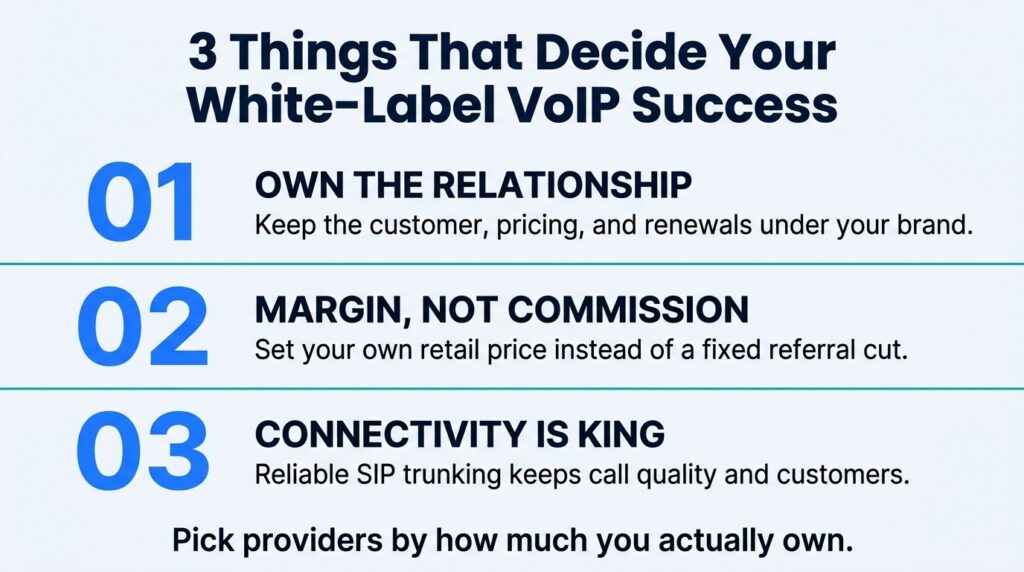
With a white-label platform, you own the customer account, set your own rates, and deliver support under your name, so the recurring revenue and the brand equity accrue to you. The work is greater, but so is the long-term value of the book of business you’re building. For most MSPs and telecom resellers, that ownership turns voice from a side commission into a durable asset.
How Does White-Label VoIP Protect Your Brand?
Your customers should associate reliable communications with your company, not with a vendor they’ve never heard of. White-label delivery keeps your brand on the portal, in the invoices, in the support tickets, and on every customer-facing screen. That consistency builds trust and makes your services harder to displace.
You Own the Customer Relationship
When the service carries your name, renewals and upsells flow back to you rather than to an upstream supplier. You decide how to package features, where to set prices, and how to handle support escalations. This control lets you differentiate on service quality and responsiveness, which are often the deciding factors when a business chooses a communications partner. Over time, an owned customer base becomes one of the most valuable parts of your company.
Branding Builds Stickiness and Referrals
A fully branded experience reinforces your position as the single source for a customer’s communication needs, which reduces churn and increases the lifetime value of each account. Customers who see only your brand are also more likely to refer you by name. That word-of-mouth marketing compounds, lowering your acquisition costs as the business grows.
How Can MSPs Use White-Label VoIP Providers?
Managed service providers are uniquely positioned to add voice because they already manage the networks, security, and support relationships their clients depend on. White-label VoIP providers let MSPs fold communications into an existing service stack rather than bolting on an unrelated product. The result is a more complete offering and a stickier client relationship.

Layering Voice Onto Existing IT Services
An MSP that already handles a client’s infrastructure can add branded voice with minimal friction. Look for platforms that integrate with the tools you run daily, including PSA and RMM systems, CRM platforms, and help desk software, so voice fits your workflows instead of creating a separate silo. Billing automation and multi-tenant management matter here too, since they let you serve many clients without adding administrative overhead. The smoother the integration, the faster voice becomes a profit center.
Real MSP Scenarios
Consider an MSP serving small professional firms that need reliable phones, voicemail-to-email, and call routing across hybrid teams. By offering a branded VoIP service, that MSP captures revenue it previously sent to an outside phone vendor and keeps the client inside its own ecosystem. A larger IT consultancy might bundle voice with security and cloud management as a single monthly contract, increasing deal size and retention. In both cases, the branded experience and the recurring billing strengthen the core business.
How Much Recurring Revenue Can White-Label VoIP Generate?
Voice services are billed monthly, which makes them a natural source of predictable recurring revenue. The size of that revenue depends on your pricing, your margins, and how efficiently you can onboard and support customers. White-label models tend to offer the strongest margins because you set the retail price rather than accepting a fixed commission.
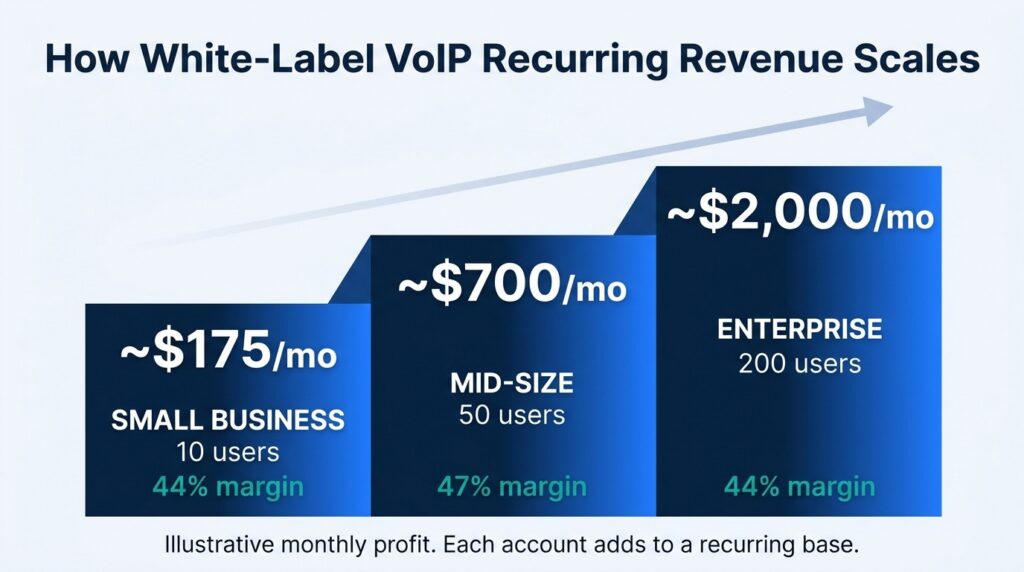
Quality platforms commonly support healthy profit margins once you control retail pricing. The figures below are illustrative rather than guaranteed, but they show how the math can work.
Sample Margin Scenarios
Margins vary by deal size and the features you bundle, yet the pattern is consistent. You mark up the platform and connectivity cost, then keep the difference as monthly profit. Scale that across dozens of accounts, and the recurring total grows steadily without proportional increases in your workload. The key is choosing a provider with transparent pricing so your margins stay predictable.
Hypothetical monthly profit at different account sizes:
- Small business (10 users): roughly $175 monthly profit at a 44% margin
- Mid-size business (50 users): roughly $700 monthly profit at a 47% margin
- Enterprise account (200 users): roughly $2,000 monthly profit at a 44% margin
Predictable Growth Over Time
Because each new customer adds to a recurring base, revenue compounds as you retain accounts and add new ones. A reseller who signs a handful of customers in the first year can build that into a meaningful monthly base by year three, simply by keeping churn low and steadily onboarding. The move toward cloud communications supports this trajectory, with hosted PBX leading market adoption as more businesses retire legacy systems. Predictable billing makes the model attractive to anyone building long-term enterprise value.
What Features Should You Look for in White-Label VoIP Platforms?
Not every platform that advertises white-label capability delivers a complete, brandable business. When you evaluate white-label VoIP providers, weigh the features that directly affect your margins, branding, and ability to support customers. The following priorities separate a true partner from rebranded dial tone.
- Full branding control. Your logo, domain, and customer portals should be entirely yours, with no trace of the underlying provider during normal operation.
- Transparent, predictable pricing. Clear wholesale rates with no hidden fees let you protect your margins and quote customers with confidence.
- Reliable connectivity and uptime. Tier-1 network quality and strong uptime guarantees keep calls clear and customers satisfied.
- Flexible terms. No long-term contracts or large minimum commitments mean you can scale at your own pace.
- Integration and automation. API access plus billing automation and integrations with your existing tools reduce administrative overhead.
- Hands-off compliance and billing. A provider that manages taxes, regulatory compliance, and billing frees you to focus on selling and supporting.
- Responsive partner support. Around-the-clock technical help and dedicated account management protect your brand when issues arise.
A useful next step is to map these features against your current SIP trunk reseller program goals so you can see where a platform strengthens or limits your plans.
Why Does SIP Trunking Determine White-Label VoIP Success?
A white-label VoIP platform handles the interface, features, and management tools, yet it’s only half of a complete service. The other half is the connectivity that carries every call to the public phone network. Even the most polished platform underperforms without dependable SIP trunking underneath it.
Connectivity Decides Call Quality and Retention
The SIP trunk provider directly shapes voice clarity, reliability, and uptime, which are the factors customers notice first and complain about loudest. Number portability, E911 support, and CNAM are non-negotiable elements that the connectivity layer must handle correctly. When you pair a branded platform with strong wholesale SIP trunking, you deliver a complete, reliable service under your own name. Carefully choosing both components lets you compete on quality rather than price alone.
Building a Complete, Branded Solution
The strongest resellers treat the platform and connectivity as a single integrated offering. When the two cleanly work together, you get advanced PBX features, consistent uptime, and simple management from a single relationship. That integration also means one vendor to coordinate rather than several, which reduces complexity and support headaches. Understanding how white-label solutions work across industries can help you tailor the offering to your specific market.
Frequently Asked Questions About White-Label VoIP Providers
What’s the difference between a white-label and a reseller VoIP program?
A traditional reseller program usually requires you to sell a provider’s pre-set packages, pricing, and branding, which limits how much you can differentiate. A white-label program lets you rebrand the entire service as your own, set your prices, and own the customer relationship. The white-label approach generally offers stronger margins and more brand equity, while traditional reselling trades control for simplicity.
Do I need both a VoIP platform and a SIP trunk provider?
For a complete white-label offering, you typically need both. The platform supplies the user interface, calling features, and management tools, while the SIP trunk handles the connection to the public phone network. Some providers bundle both, which simplifies vendor management and helps ensure the two layers work together reliably.
How quickly can MSPs start earning revenue from white-label VoIP?
Many MSPs begin generating revenue within 60 to 90 days of launching branded voice services. The timeline depends on existing customer relationships, sales readiness, and how smoothly the platform onboards. MSPs with an established client base often move fastest because they can introduce voice to customers who already trust them.
What’s the best quality VoIP service for resellers?
The best quality VoIP service delivers clear, reliable voice with minimal latency and strong uptime, backed by solid network architecture. Reliable infrastructure is sometimes provided through established managed technology providers with carrier-grade networks. Look for comprehensive service level agreements and the modern features your customers expect, including call routing, voicemail, and conferencing.
Can I keep my own branding across billing and support?
Yes. A genuine white-label arrangement extends your branding across every customer touchpoint, including portals, invoices, and support interactions. This consistency reinforces your brand and keeps the upstream provider invisible to your customers. Confirm the extent of branding control before signing, since it varies between providers.
Build a Branded Communications Business That Lasts
The white-label opportunity rewards resellers who own the brand, pricing, and customer relationship rather than settling for a commission. By pairing a feature-rich, brandable platform with dependable SIP connectivity, you deliver a complete communication service under your own name and turn it into predictable recurring revenue. The providers that give you the most control are the ones worth building a business around.
SIPTRUNK gives resellers the foundation they need, with reliable connectivity, hands-off billing and taxes, no contracts, and 24/7 expert support behind your brand. Get started with SIPTRUNK today and start building a branded communications offering that grows with you.

Mitch leads the Sales team at BCM One, overseeing revenue growth through cloud voice services across brands like SIPTRUNK, SIP.US, and Flowroute. With a focus on partner enablement and customer success, he helps businesses identify the right communication solutions within BCM One’s extensive portfolio. Mitch brings years of experience in channel sales and cloud-based telecom to every conversation.