

10 SIP Trunking Features to Keep Customers Happy (2026 Update)
The SIP trunking features you offer determine whether customers stay or leave. Resellers who prioritize reliability, call quality, and responsive support build lasting relationships that generate predictable recurring revenue.
- Uptime guarantees of 99.99% or higher have become the baseline expectation, with customers increasingly demanding geo-redundant failover protection.
- Quality of Service optimization directly impacts call clarity, and businesses immediately notice when voice quality degrades during peak hours.
- Instant provisioning and transparent pricing differentiate top resellers from competitors who still operate with legacy deployment timelines.
- The resellers capturing the largest share of the growing SIP market focus on customer experience, not just competitive rates.
Evaluate your current feature set against these 10 essentials to identify gaps that may be costing you customer retention.
The SIP trunking market continues its expansion, with industry analysts projecting growth from $73.14 billion in 2025 to $181.58 billion by 2031. For telecom agents, IT consultants, VARs, and managed service providers building a SIP trunk reseller practice, this growth equals opportunity. The resellers who thrive understand which SIP trunking features matter most to business customers and consistently deliver on those expectations.
Customer satisfaction in telecommunications hinges on reliability and responsiveness. A single dropped call during a critical sales conversation or a service outage during peak business hours can damage your reputation and send customers searching for alternatives. The features outlined below are the foundation of customer retention for SIP trunk resellers in 2026.
Which SIP Trunking Features Matter Most to Business Customers?
Business customers evaluating SIP trunking providers focus on outcomes rather than technical specifications. They want calls that connect reliably, audio that sounds clear, and problems that get resolved quickly. The following 10 features translate directly into those outcomes, making them essential considerations for any reseller building a sustainable practice.
Understanding these SIP trunking features also helps resellers effectively communicate value during the sales process. Rather than leading with price, successful resellers demonstrate how their offering addresses the specific concerns that keep IT directors and business owners awake at night.
Feature 1: Guaranteed Uptime and Reliability
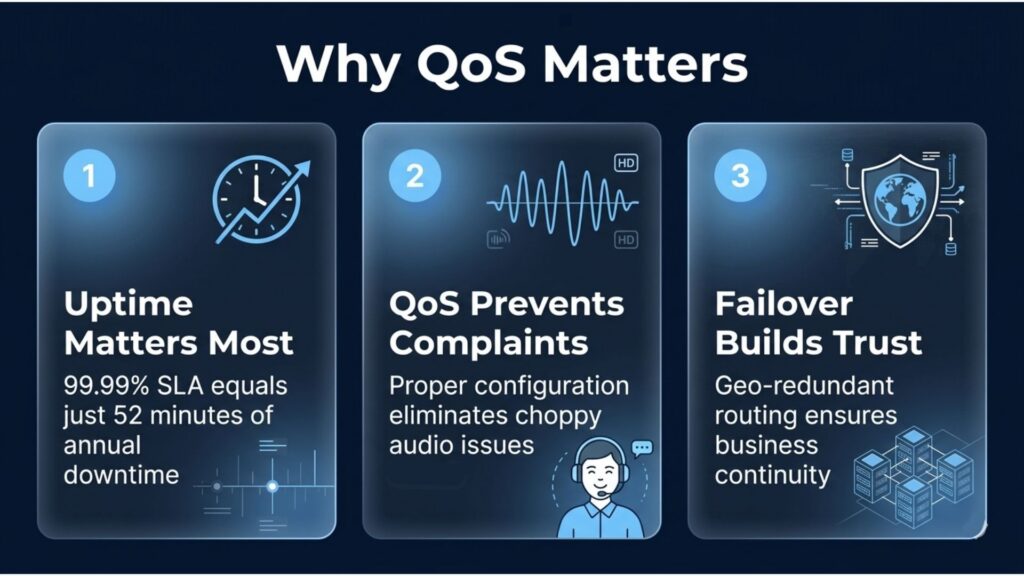
Uptime guarantees formalized in Service Level Agreements provide accountability for SIP trunk reliability commitments. Business customers expect 99.99% uptime or higher, which translates to approximately 52 minutes of allowable downtime per year. Enterprise-grade providers operating Tier-1 network infrastructure with redundant connections to major carriers consistently meet these standards.
Communication failures during critical business moments can result in lost sales, damaged customer relationships, and decreased employee productivity. Resellers who partner with providers offering documented uptime guarantees and meaningful service credits for failures position themselves as reliable partners rather than vendors.
When evaluating potential providers, ask about their network architecture, data center locations, and upstream carrier relationships. Providers operating multiple geographically distributed points of presence offer stronger protection against regional infrastructure failures than those anchored to a single location.
Feature 2: Automatic Failover and Redundancy
Automatic failover capabilities ensure call continuity when network issues affect the primary connection path. Advanced SIP trunking systems continuously monitor connection quality and instantly redirect calls to backup trunks when problems occur. With sub-second switchover times, customers rarely notice the transition.
Primary and secondary trunk configurations on separate networks provide the foundation for robust disaster recovery. When the primary path fails, calls automatically reroute through backup infrastructure without requiring manual intervention. Some configurations include PSTN backup routing that forwards calls to traditional telephone numbers when IP-based routing fails completely, ensuring critical communications continue even during complete internet outages.
For resellers serving businesses with mission-critical voice requirements, failover protection is a major differentiator. Contact centers, healthcare providers, and financial services firms can’t afford communication interruptions, making redundancy features a key selling point for these verticals.
Feature 3: Quality of Service Optimization
Quality of Service configuration ensures voice packets receive network priority over less time-sensitive data traffic. When a large file download competes with an active phone call for available bandwidth, proper QoS settings guarantee the call maintains clarity while the download simply takes longer to complete. This SIP trunk quality optimization is essential for customer satisfaction.
Voice communication operates under constraints that differ from typical data transfers. Delays of even 150 milliseconds create awkward pauses and cross-talk that damage professional interactions. QoS policies applied at the router level, using DSCP EF (46) marking for RTP traffic, prevent bandwidth competition from affecting voice quality during periods of high network utilization.
Resellers who help customers properly configure QoS eliminate one of the most common sources of voice quality complaints. Many businesses experiencing choppy audio or dropped syllables discover that proper traffic prioritization resolves issues they assumed required expensive bandwidth upgrades. Offering QoS assessment and configuration guidance as part of your service package adds value.
Feature 4: Instant Provisioning and Fast Setup
The ability to activate new accounts and phone numbers within minutes eliminates delays that frustrate customers and slow sales cycles. Modern SIP trunking platforms enable resellers to provision services, port existing numbers, and configure routing rules through intuitive self-service portals rather than waiting for manual carrier processes.
Fast setup matters when serving businesses migrating from legacy systems or expanding to new locations. A customer opening a new office location expects phone service to be operational on day one, not weeks later. Resellers with instant provisioning capabilities capture opportunities that competitors with slower deployment timelines can’t serve.
Simplified onboarding also reduces your operational burden. Platforms designed for reseller efficiency allow you to scale your customer base without proportionally increasing administrative overhead, improving margins as your practice grows.
Feature 5: Scalability Without Contracts
Businesses grow and contract based on seasonal demands, market conditions, and strategic decisions. SIP trunking should accommodate these changes without penalties or complex renegotiations. The ability to add or remove channels on demand, often through a simple portal adjustment, provides the flexibility modern businesses expect.
Burstable capacity allows customers to exceed their committed channel counts during peak periods without service interruptions. Rather than provisioning for maximum possible demand and paying for unused capacity year-round, businesses pay for what they typically use while retaining the ability to scale up when needed.
No-contract terms remove barriers to customer acquisition while demonstrating confidence in your service quality. Customers locked into long-term agreements with competitors become prospects the moment their service disappoints. Offering month-to-month flexibility positions you to capture those opportunities.
Feature 6: Competitive and Transparent Pricing
Cost savings remain a primary driver of SIP trunking adoption, with businesses regularly achieving 25% to 65% reductions compared to traditional PRI lines. However, pricing transparency matters as much as the rates themselves. Hidden fees for E911 service, caller ID transmission, or number porting erode trust and create billing disputes that damage customer relationships.
Successful resellers provide clear pricing documentation that accounts for all potential charges. Customers appreciate understanding their total cost of ownership before signing, even if a competitor offers a slightly lower headline rate with hidden add-ons. Transparent pricing structures also simplify your quoting process and reduce time spent explaining unexpected charges.
Consider how your pricing model aligns with customer usage patterns. Metered plans work well for businesses with variable call volumes, while unlimited options suit high-volume users who value predictability. Offering both options allows you to effectively serve diverse customer needs.

Feature 7: Broad PBX Compatibility
SIP trunking solutions must integrate with the phone systems customers already operate. Compatibility with popular platforms, including Asterisk, FreePBX, 3CX, Cisco, and Avaya, enables you to serve customers regardless of their existing infrastructure investments. For older analog systems, multi-port analog telephone adapters provide cost-effective integration without requiring complete system replacement.
Certified interoperability testing eliminates uncertainty during deployment. When your provider maintains documented compatibility with specific PBX platforms, you avoid the troubleshooting challenges that arise from untested configurations. This confidence allows you to quote projects accurately and deliver on your commitments.
Broad compatibility also expands your addressable market. Rather than declining opportunities because a prospect uses an unfamiliar phone system, you can serve virtually any business with standards-compliant equipment.
Feature 8: 24/7 Technical Support
Technical issues don’t observe business hours. A SIP trunk failure at 6 AM requires immediate attention, not a response when the support team arrives at 9 AM. Customers expect access to knowledgeable SIP trunk support engineers around the clock, with escalation paths that ensure critical problems receive appropriate attention based on severity.
Support quality directly impacts customer satisfaction and retention. A single poorly handled outage can undo months of reliable service in the customer’s perception. Resellers should evaluate potential providers based on support responsiveness, technical expertise, and the availability of dedicated account resources for their practice.
Your own support capabilities also matter. Customers often contact their reseller first when issues arise. Having access to comprehensive documentation, diagnostic tools, and responsive escalation channels from your provider allows you to resolve problems quickly and maintain customer confidence in your service.
Feature 9: Security and Compliance Features
Modern SIP trunking requires robust security measures to protect against call fraud, eavesdropping, and service abuse. Session Border Controllers function as specialized firewalls for SIP traffic, providing encryption, topology hiding, and anomaly detection. TLS and SRTP encryption protect signaling and media streams from interception.
STIR/SHAKEN compliance has become essential as carriers implement caller ID authentication requirements. Calls without proper attestation trigger warnings or are blocked, directly impacting customers who rely on outbound calling for sales or customer service. Ensure your provider includes full STIR/SHAKEN digital signing in their standard offering rather than charging premium fees for compliance.
Industry-specific requirements add another layer of complexity. Healthcare organizations need HIPAA-compliant communication channels, financial services firms require call recording retention policies, and businesses accepting credit card payments must address PCI-DSS considerations. Providers offering compliance-ready features simplify your ability to serve regulated industries.
Feature 10: Easy-to-Use Management Platform
Both resellers and their end customers need intuitive interfaces for managing accounts, viewing usage, and making configuration changes. Self-service portals that enable common tasks without requiring support tickets improve efficiency for everyone involved.
Real-time call data records with comprehensive analytics help customers monitor usage patterns and identify optimization opportunities. Resellers benefit from consolidated reporting across their entire customer base, simplifying billing reconciliation and enabling proactive account management.
The platform experience often determines customer satisfaction more than technical capabilities. A powerful system that requires specialized expertise to navigate creates friction and a support burden. Prioritize providers whose platforms balance functionality with accessibility.
Why Do SIP Trunking Features Impact Customer Retention?
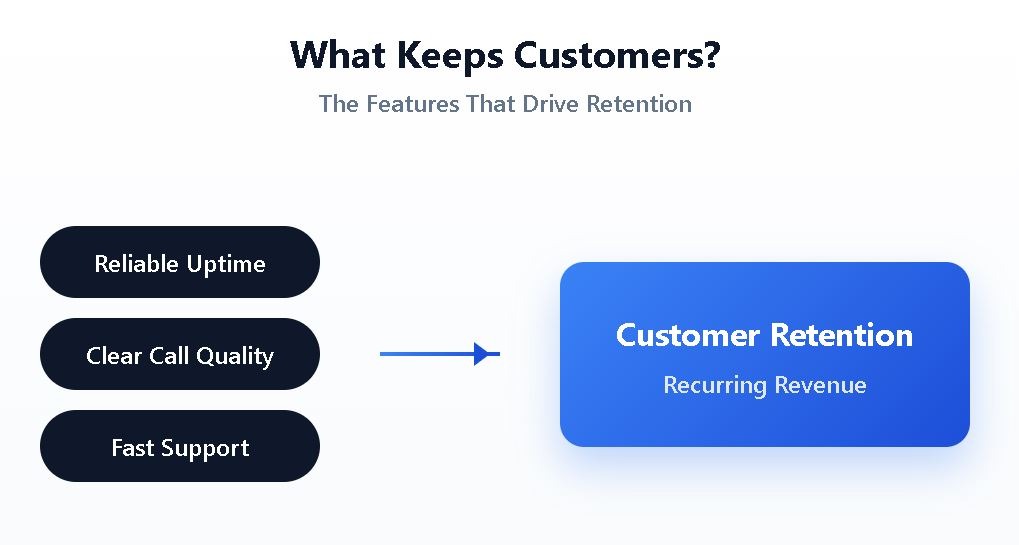
Businesses experiencing reliable service, clear call quality, and responsive support have no reason to evaluate alternatives. Those encountering repeated issues, confusing billing, or unresolved technical problems actively seek replacements.
The features outlined above address the primary reasons customers leave their current providers. Reliability failures prompt immediate searches for alternatives. Poor call quality generates complaints from employees and customers alike. Slow support responses create frustration that accumulates over time. Resellers who deliver consistently on these fundamentals build practices with predictable recurring revenue and strong referral pipelines.
Invest time in evaluating features before selecting a SIP partner. The right foundation enables you to confidently make commitments and consistently deliver on customer expectations.
Frequently Asked Questions
What is the most important SIP trunking feature for reliability?
Automatic failover with geo-redundant infrastructure provides the strongest foundation for reliable service. While uptime guarantees establish accountability, failover mechanisms determine what happens when primary systems experience problems. Providers operating multiple data center locations with automatic traffic rerouting maintain service continuity through regional outages, carrier failures, and network disruptions that would interrupt single-point-of-failure configurations.
How does QoS affect SIP trunk call quality?
Quality of Service configuration determines whether voice traffic receives priority treatment on customer networks. Without proper QoS settings, voice packets compete equally with file downloads, video streams, and other data traffic for available bandwidth. During periods of network congestion, this competition creates audio problems, including choppy sound, dropped syllables, and noticeable delays. Proper QoS marking ensures voice packets move to the front of the queue regardless of other network activity.
What uptime guarantee should resellers expect from providers?
Resellers should accept nothing less than 99.99% uptime guarantees formalized in Service Level Agreements with meaningful service credits for failures. This standard permits approximately 52 minutes of downtime annually. Enterprise-grade providers operating Tier-1 network infrastructure routinely achieve 99.999% availability, allowing only about five minutes of downtime per year.
Partner With a Platform Built for Reseller Success
The SIP trunking features that keep customers happy require infrastructure, expertise, and ongoing investment that few resellers can develop independently. Partnering with a provider designed specifically for channel success helps you to deliver enterprise-grade capabilities under your own brand while focusing on customer relationships rather than network operations.
SIPTRUNK provides the comprehensive platform, Tier-1 network infrastructure, and reseller-focused support that enable telecom agents, IT consultants, VARs, and MSPs to build thriving SIP trunking practices. Get started today to explore how the right partnership can accelerate your success in this growing market.

Mitch leads the Sales team at BCM One, overseeing revenue growth through cloud voice services across brands like SIPTRUNK, SIP.US, and Flowroute. With a focus on partner enablement and customer success, he helps businesses identify the right communication solutions within BCM One’s extensive portfolio. Mitch brings years of experience in channel sales and cloud-based telecom to every conversation.