

White-Label SIP Trunking: What It Is and Why You Need It
White-label SIP trunking lets resellers offer enterprise-grade voice services under their own brand without infrastructure investment.
- Build brand equity by keeping your name front and center with every customer interaction.
- Control pricing, margins, and customer relationships completely.
- Generate predictable recurring revenue with minimal operational overhead.
- Scale faster than traditional agent or referral programs allow.
For resellers ready to own their telecommunications business, white-label SIP offers the clearest path to sustainable growth.
The SIP trunking market is projected to reach $181.58 billion by 2031, growing at a CAGR of 16.38%. This expansion creates exceptional opportunities for telecom agents, IT consultants, and managed service providers who want to capture recurring revenue in the voice communications space through white-label VoIP and SIP reseller programs.
Yet how do you offer sophisticated communication services without investing millions in infrastructure, technical staff, and network operations? The answer lies in white-label SIP trunking, a business model that empowers resellers to deliver carrier-grade voice services under their own brand while a platform partner handles the technical complexity behind the scenes.
This guide explains what white-label SIP is, how the business model works, and why it’s a compelling opportunity for resellers seeking sustainable, scalable revenue streams.
What Is White-Label SIP Trunking?
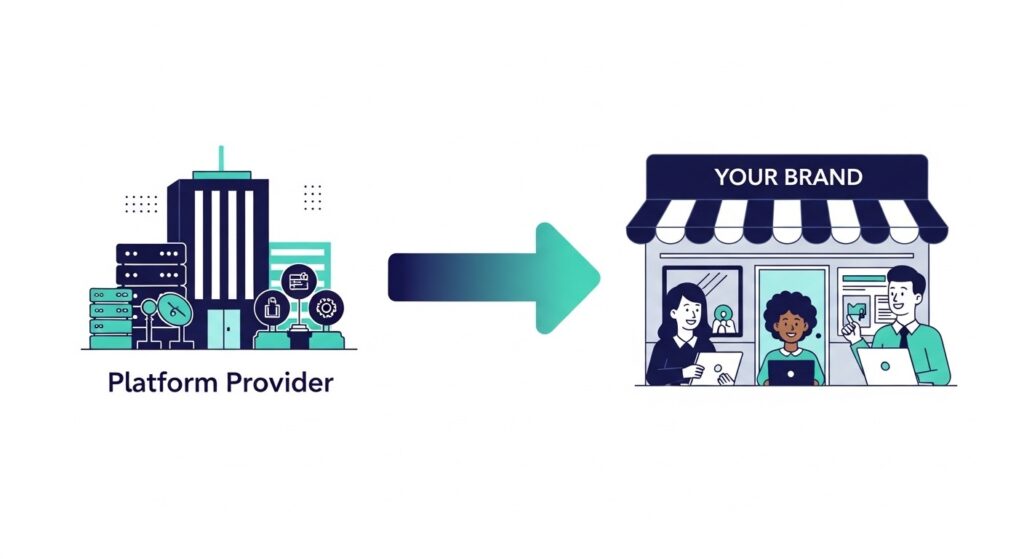
White-label SIP trunking is a partnership model where a platform provider delivers the technical infrastructure, network connectivity, and backend systems required for SIP trunk services, while resellers sell those services under their own brand name. Your customers interact exclusively with your company throughout the sales process, onboarding, billing, and ongoing support. The platform provider remains invisible.
To understand the value, it helps to grasp what SIP trunking actually does. Session Initiation Protocol (SIP) trunking replaces traditional phone lines by transmitting voice, video, and messaging data over internet connections. Instead of paying for physical copper lines or expensive PRI circuits, businesses connect their existing phone systems to the public telephone network through virtual SIP channels. The VoIP services market reached $167.3 billion in 2024, with SIP trunking representing over 32% of the total market share.
For resellers, white-label SIP means you can offer this modern communication solution without building your own softswitch, negotiating carrier interconnections, or maintaining a 24/7 network operations center. You focus on sales, customer relationships, and growing your business. Your platform partner focuses on keeping the technology running flawlessly.
How Does the White-Label Business Model Work?
The white-label business model operates on a straightforward division of responsibilities. Understanding who handles what helps resellers evaluate whether this approach fits their business goals and capabilities.
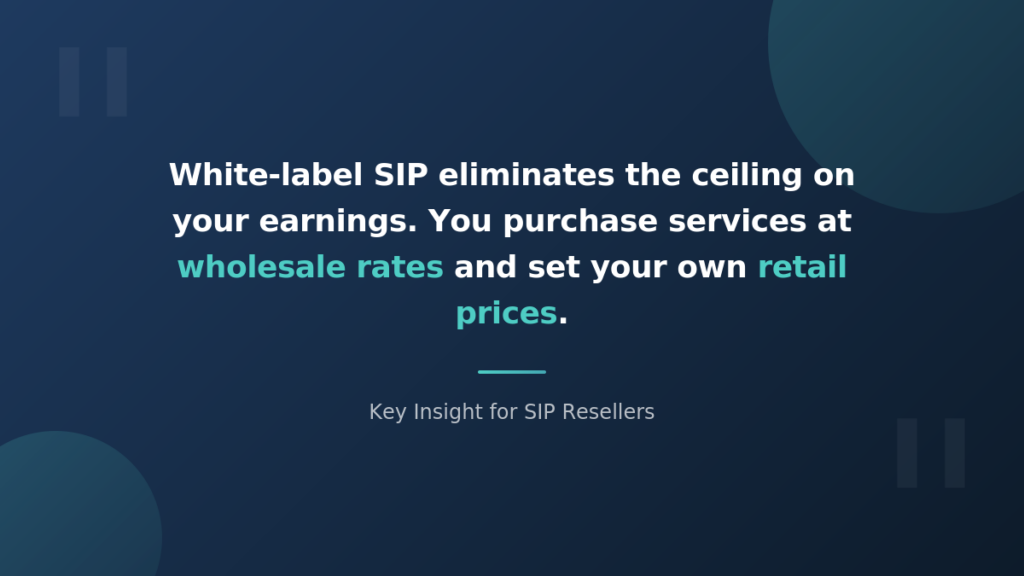
You purchase SIP trunking services at wholesale rates from your platform partner. You then resell those services to your customers at prices you determine, keeping the margin as profit. Unlike traditional agent or referral programs, where you earn a fixed commission, white-label arrangements give you complete control over your pricing strategy, service packaging, and profit margins.
What Does the Platform Provider Handle?
The platform provider manages everything related to the technical infrastructure and network operations. This includes maintaining carrier relationships and interconnections that enable calls to reach the public telephone network. It also encompasses operating the softswitch technology that routes calls, managing number inventory and porting processes, ensuring regulatory compliance for E911 and CNAM services, providing backend technical support for complex issues, and handling network monitoring and uptime guarantees.
Your platform partner invests in the expensive infrastructure, specialized engineering talent, and ongoing maintenance that would otherwise require substantial capital expenditure. This investment happens behind the scenes, invisible to your customers.
What Does the Reseller Handle?
As the reseller, you own the customer-facing aspects of the business. You control branding and market positioning, sales and lead generation activities, customer onboarding and relationship management, pricing and packaging decisions, first-line customer support, and marketing and business development.
The division creates a powerful synergy. You bring market knowledge, customer relationships, and sales expertise. Your platform partner brings technical excellence and operational scale. Together, you deliver a complete solution that neither could offer independently.
What Are the Key Benefits of White-Label SIP for Resellers?
White-label SIP trunking offers distinct advantages over other reseller models. These benefits compound over time, making white-label arrangements increasingly valuable as your customer base grows.
Complete Brand Control
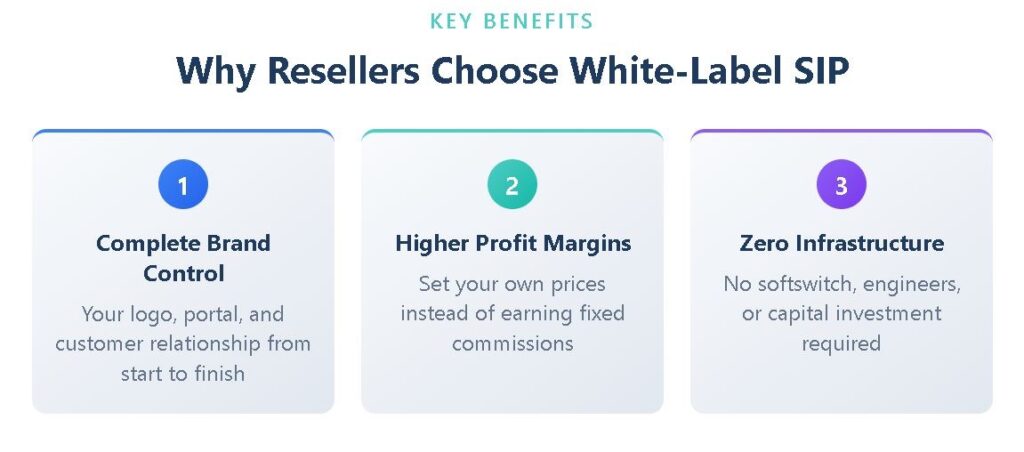
Every touchpoint with your customer displays your brand. Your logo appears on portals, invoices, and documentation. Customers call your support line and interact with your team. This complete brand control builds long-term customer loyalty that belongs to your business.
When you operate as an agent or referral partner, customers ultimately know they’re buying from someone else. That awareness creates vulnerability. Customers can bypass you and go directly to the provider. With white-label SIP, that path doesn’t exist. Your customers see only your brand, creating sticky relationships that increase customer lifetime value.
Higher Profit Margins
Traditional reseller programs pay fixed commissions, often in the range of 10–20% of monthly recurring revenue. Those commissions cap your earnings, regardless of the value you provide to customers or the efficiency of your operations.
White-label SIP eliminates that ceiling. You purchase services at wholesale rates and set your own retail prices. If you serve a specialized market willing to pay premium prices for expert service, you capture that premium entirely. If you want to compete aggressively on price to win volume, you have that flexibility too. Your margins reflect your strategy, not a provider’s commission table.
Predictable Recurring Revenue
SIP trunking operates on a subscription model. Customers pay monthly fees for their channels and usage. Once you acquire a customer, that revenue continues month after month for as long as they remain satisfied with your service.
This recurring revenue model transforms your business economics. Instead of constantly hunting for new projects, you build an asset that automatically generates income. Each customer you add increases your monthly baseline. Over time, that baseline grows substantial enough to fund operations, hire staff, and invest in growth.
No Infrastructure Investment Required
Building your own SIP trunking operation would require purchasing softswitch technology, negotiating carrier interconnections, hiring network engineers, establishing a 24/7 operations center, and maintaining compliance with telecommunications regulations. The upfront investment would run into hundreds of thousands of dollars, with ongoing operational costs adding more.
White-label SIP eliminates those requirements. You start selling with no capital expenditure beyond normal business operations. Your platform partner has already made the infrastructure investment. You leverage that investment without bearing its cost.
Scalability Without Complexity
Adding customers to a white-label SIP business doesn’t require proportional increases in technical staff or infrastructure. The platform handles provisioning, call routing, and network operations regardless of whether you have 10 customers or 10,000 customers.
This scalability means your margins can actually improve as you grow. Fixed costs like sales and marketing spread across a larger revenue base. Variable costs remain consistent on a per-customer basis. The economics reward growth rather than punishing it.
How Does White Label Compare to Other Reseller Programs?
Resellers have multiple options for entering the SIP trunking market. Understanding how white label compares to alternatives helps you choose the right approach for your business.
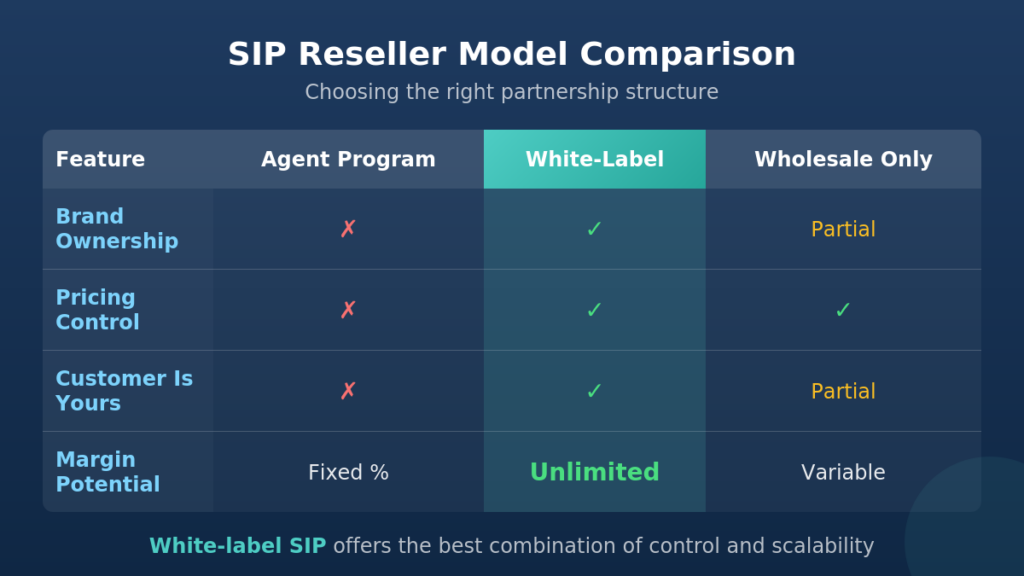
Agent and referral programs offer the lowest barrier to entry. You refer customers to a provider and receive a commission when they sign up. However, you have no control over pricing, the customer relationship ultimately belongs to the provider, and your commission is fixed regardless of the value you deliver. These programs work well for generating supplemental income but limit your ability to build a substantial business.
Wholesale-only arrangements give you better pricing than retail but don’t include white-labeling. Your customers know they’re using another provider’s service, even if they purchase through you. This creates the same vulnerability as agent programs, where customers can eventually bypass you.
White-label SIP combines the best elements of both approaches. You get wholesale pricing that enables healthy margins. You also get complete brand control that makes customers yours, not the platform provider’s. The combination creates a defensible business with growth potential that neither alternative offers. For those evaluating options, understanding everything about SIP trunk reselling provides an essential foundation of knowledge.
The following comparison highlights the key differences:
- Brand Ownership: White-label gives you complete control; agent programs give you none; wholesale gives you partial control.
- Pricing Control: White-label lets you set prices; agent programs use fixed commissions; wholesale offers some flexibility.
- Customer Relationship: White-label means customers are yours; agent programs mean customers belong to the provider.
- Margin Potential: White-label offers unlimited upside; agent programs have fixed ceilings; wholesale falls in between.
Who Should Consider a White-Label SIP Trunking Provider?
White-label SIP makes sense for several types of businesses seeking to expand their service offerings without building technical infrastructure.
Telecom agents and brokers who currently sell connectivity services can add voice to their portfolio. Existing customer relationships provide immediate sales opportunities, and white-label SIP fits naturally alongside internet and data services.
IT consultants and managed service providers already manage technology for business clients. Adding SIP trunking creates another recurring revenue stream while solving a genuine customer need. Clients increasingly expect their IT partner to handle communications alongside other technology services.
Value-added resellers and distributors who sell phone systems, unified communications platforms, or collaboration tools need SIP trunking to complete their solutions. White-label arrangements let them offer everything under one brand rather than sending customers to outside providers for dial tone.
Master agents and channel partners can expand their portfolio offerings to downstream agents. White-label SIP becomes another product that their agent network can sell, creating leverage across the entire organization. Many have found success by learning how to make money as a SIP provider and then scaling through their existing partner relationships.

What Should You Look for in a SIP Trunking Partner?
Choosing the right platform partner determines much of your success. Whether you’re evaluating white-label VoIP platforms or dedicated SIP trunking providers, several factors distinguish excellent partners from adequate ones.
Network Reliability and Call Quality
Your customers will judge your service primarily on whether calls connect reliably and sound clear. Your platform partner’s network infrastructure directly determines that experience. Look for providers with Tier-1 carrier relationships, geographically distributed points of presence, and documented uptime guarantees backed by service level agreements.
Pricing Transparency and Flexibility
Hidden fees erode margins and create customer service headaches. The best platform partners offer straightforward pricing with no surprise charges for features, porting, or support. Wholesale rates should be competitive enough to support healthy retail margins across different customer segments.
Ease of Provisioning and Management
Your operational efficiency depends on how easily you can add customers, provision numbers, and manage accounts. User-friendly control panels with self-service capabilities let you handle routine tasks without waiting for support tickets. Look for platforms designed specifically for resellers rather than adapted from retail consumer interfaces.
Support and Training Resources
Even experienced telecom professionals encounter situations requiring platform expertise. Your partner should provide responsive technical support for escalated issues, comprehensive documentation, and training resources that help you serve customers confidently. The best partners treat your success as their success, investing in your growth rather than treating support as a cost center.
Frequently Asked Questions
Do I need technical expertise to resell SIP trunking? A basic understanding of how SIP trunking works helps you explain benefits to customers and troubleshoot common issues. Your platform partner handles the deep technical work. Many successful resellers come from sales or business backgrounds rather than technical ones.
How quickly can I start selling after signing up? Most white-label platforms enable you to start selling within days. Provisioning new customers typically takes minutes once you understand the process. The limiting factor is usually your own sales and marketing efforts rather than technical setup.
What equipment do my customers need? Customers need an internet connection and either IP phones, a compatible PBX system, or softphone applications. Most modern phone systems work with SIP trunking. Customers with older analog equipment may need adapters or session border controllers, which your platform partner can typically provide or recommend.
Can I set my own prices and create custom packages? Yes. White-label arrangements give you complete control over pricing and packaging. You can create unlimited channels plans, metered usage plans, bundled packages, or any combination that serves your target market. Your margins depend on the difference between your wholesale cost and retail price, which you determine. This flexibility is one of the primary advantages of a comprehensive SIP reseller program over fixed-commission alternatives.
Start Building Your White-Label SIP Business Today
The SIP trunking market continues to expand as businesses replace legacy phone systems with modern, flexible communication solutions. Resellers who position themselves now can capture substantial recurring revenue while helping customers modernize their telecom infrastructure.
SIPTRUNK provides a comprehensive white-label platform designed specifically for resellers. With no contracts, automated billing and provisioning, and 24/7 expert support, the platform removes barriers that typically slow reseller growth. Get started today and discover why leading telecom professionals choose SIPTRUNK for their white-label SIP trunking needs.

Mitch leads the Sales team at BCM One, overseeing revenue growth through cloud voice services across brands like SIPTRUNK, SIP.US, and Flowroute. With a focus on partner enablement and customer success, he helps businesses identify the right communication solutions within BCM One’s extensive portfolio. Mitch brings years of experience in channel sales and cloud-based telecom to every conversation.