

SIP Trunk Reselling: Everything You Need to Know for Success
The current market brings unprecedented opportunities for SIP trunk reselling with streamlined onboarding and automation.
- Market size reached $13.85 billion in 2024 with growth rates exceeding 11% annually.
- Automated partner onboarding reduces time-to-market compared to manual processes.
- White-label SIP platforms eliminate infrastructure investment requirements.
- New compliance standards create competitive advantages for prepared resellers.
Partner with compliant providers now to capitalize on the digital transformation driving massive demand.
The telecom reseller game has completely changed. If you’ve been sitting on the sidelines watching the SIP trunk reselling opportunity, now is your year to jump in. The market dynamics have never been more favorable for resellers ready to capitalize on businesses ditching their legacy phone systems.
The global SIP trunking market reached $13.85 billion in 2024 and is projected to grow at over 11.48% annually through 2032. That growth is driven by digital transformation, hybrid work models, and the final nail in the coffin for traditional phone infrastructure.
What makes this opportunity even sweeter? Modern SIP trunk reselling has evolved beyond the days of complex technical setup and lengthy onboarding processes. Today’s platforms have automated away most of the headaches that used to keep resellers away from this lucrative market.
What Is SIP Trunk Reselling?
SIP trunk reselling looks different from even just two years ago. You’re still purchasing bulk SIP trunks from a provider and reselling them to your clients at a markup. But the similarities to old-school reselling end there.
Today’s SIP trunk resellers operate more like technology consultants than traditional telecom agents, focusing on how to sell SIP trunks as comprehensive communication solutions rather than simple phone line replacements. You’re helping businesses modernize their communications without the massive capital investments. Your clients get enterprise-grade voice services, advanced features like video conferencing and unified communications, and attractive cost savings compared to traditional phone systems.
The real game-changer is how white-label SIP platforms have simplified this opportunity. These platforms handle all the technical heavy lifting (network infrastructure, compliance, billing systems, and 24/7 support) while you focus on building relationships and growing your business.
Why Is Now the Perfect Time to Start Reselling SIP Trunks?
Several market forces have created the best opportunity window in telecom reselling. Here’s why smart resellers are moving now.
The hybrid workforce revolution has changed how businesses think about communication. Organizations across all industries are adopting cloud-based strategies to support distributed teams. Remote and hybrid work models demand systems that work seamlessly across locations and devices, making SIP solutions essential.
Traditional phone infrastructure is literally being shut down. European countries are decommissioning analog lines, Canada has set copper retirement deadlines, and even in the U.S., major carriers are pushing customers toward digital alternatives.
Compliance has also shifted in resellers’ favor. New FCC regulations require enhanced STIR/SHAKEN standards, but savvy resellers who partner with compliant providers gain an advantage. While competitors scramble to meet compliance requirements, prepared resellers are positioned to capture market share from unprepared providers.
Most importantly, the barriers to entry have practically disappeared. Modern SIP reseller programs offer automated onboarding, streamlined billing systems, and comprehensive support that eliminates the technical complexity. You can sell SIP trunk services within hours of signing up with the right platform.
How Do Modern Partner Onboarding Processes Work?
Modern partner onboarding features automation and streamlined processes that get you to market faster than ever. Leading platforms use automated partner onboarding systems that dramatically reduce your time-to-market compared to traditional manual processes. Instead of procedures that could take months, you’re looking at hours or days to be fully operational and selling to customers.
First, you complete a digital application that instantly verifies your business information and qualification status. No more waiting weeks for credit checks and manual approvals. Algorithmic processing gives you real-time feedback on your application status.
Automated Training and Platform Setup
Instead of attending lengthy in-person sessions or complicated webinars, you get access to personalized learning modules that adapt to your experience level and business focus. These streamlined learning programs deliver exactly the training you need without wasting time on irrelevant content.
Platform setup happens simultaneously. While you’re completing training modules, automated systems are configuring your branded portal, billing integration, and customer management tools. By the time you finish training, your entire sales and support infrastructure is ready to go.

The most advanced platforms include automated compliance verification. Instead of manually reviewing documentation and hoping you’re meeting requirements, built-in systems ensure you’re compliant with STIR/SHAKEN standards and other FCC regulations from day one.
What Are the Benefits of Automation in SIP Reseller Programs?
Automation has transformed every aspect of running a successful SIP reseller business, eliminating the operational headaches that used to eat into profit margins and slow down growth. Smart resellers are leveraging these automated capabilities to scale faster while maintaining better customer relationships.
Streamlined Billing and Customer Management
Automated billing and taxation lead to massive time savings. Instead of manually calculating usage charges, managing invoices, and dealing with complex tax compliance across different jurisdictions, automated systems handle everything. Your customers get accurate, timely billing while you avoid the administrative nightmare that used to consume hours every month.
Customer provisioning happens instantly instead of requiring manual intervention. When a client needs additional channels or wants to port phone numbers, automated systems handle the entire process. What used to take days or weeks now happens in minutes, dramatically improving customer satisfaction while reducing your support burden.
Real-time usage monitoring and alerts keep you ahead of customer needs. Automated systems track usage patterns and proactively notify you when customers are approaching plan limits or experiencing usage spikes. You can offer proactive customer service and take advantage of upselling opportunities that manual monitoring would miss.
Compliance and Monitoring Automation
Automated compliance management ensures you stay compliant with evolving regulations without constant manual oversight. Systems automatically update to meet new requirements, monitor call authentication standards, and generate required compliance reports. You can eliminate compliance risk while focusing on mastering how to sell SIP trunks effectively and building stronger customer relationships.
How to Choose the Right SIP Reseller Program
Selecting the right SIP reseller program requires evaluating factors that weren’t even considerations just a few years ago. The wrong choice can limit your growth potential or expose you to compliance risks.
Core Platform Requirements
Compliance capabilities should top your list. With new FCC regulations, your chosen platform must demonstrate full STIR/SHAKEN compliance with provider-owned certificates and independent attestation. Ask for specific documentation and compliance reports.
Automation depth makes or breaks operational efficiency. Look beyond basic automated billing to platforms offering comprehensive automation across customer provisioning, usage monitoring, compliance reporting, and partner onboarding. Advanced platforms automate most routine operational tasks, allowing you to focus on revenue-generating activities.
White-label capabilities determine your brand control and profit potential. True white-label programs let you brand every customer touchpoint (portals, billing, support communications, and phone system interfaces). Anything less limits your ability to build brand loyalty and charge premium pricing.
Integration and Support Considerations
Integration flexibility affects your ability to serve diverse customer needs. Modern platforms integrate seamlessly with popular business applications, CRM systems, and existing phone equipment. The broader the compatibility, the larger your addressable market becomes.
Support quality and availability directly impact customer satisfaction. Look for platforms offering 24/7 technical support, dedicated partner success teams, and comprehensive training resources. When your customers have problems, they’re calling you first. Make sure you have the backing to resolve issues quickly.
Pricing transparency determines your profitability. Avoid platforms with hidden fees, complex pricing structures, or poor margin visibility. The best programs offer clear wholesale pricing, transparent fee structures, and tools to calculate your profit margins in real-time.
What Compliance Requirements Must SIP Resellers Meet?
Compliance for SIP trunk reselling has become more stringent, but these requirements also create competitive advantages for prepared resellers. Understanding and meeting these standards positions your business as a trusted, professional partner.
STIR/SHAKEN and Robocall Standards
STIR/SHAKEN compliance is the most significant regulatory change affecting SIP resellers. Effective June 2025, all voice service providers must implement enhanced authentication standards using provider-owned certificates. Your wholesale provider can’t rely on third-party authentication services. They must independently verify and attest to call authenticity.
Reseller partners with compliant wholesale providers can guarantee customers that their calls meet the highest authentication standards, reducing robocall risks and improving call completion rates. Meanwhile, resellers with non-compliant providers face service disruptions and potential customer losses.
Robocall mitigation requirements have also been strengthened. All providers must maintain updated filings in the FCC’s robocall mitigation database, explaining their compliance status and mitigation strategies. Your wholesale provider should have completed these submissions and be able to provide documentation proving their compliance status.

Emergency Services and Data Protection
Emergency services compliance remains critical. Your platform must support Enhanced 911 (E911) services with accurate location information for every endpoint. It’s a legal requirement that protects both your customers and your business from liability.
Customer data protection has evolved beyond basic privacy requirements. With increasing focus on communication security, especially in regulated industries like healthcare and finance, your platform should offer encrypted communications and comprehensive audit trails.
The key is partnering with wholesale providers who treat compliance as a core competency rather than an afterthought. Look for providers who proactively communicate regulatory changes, provide compliance documentation, and demonstrate ongoing investment in meeting evolving standards.
How Much Can Your Clients Save with SIP Trunking?
The cost savings potential of SIP trunking continues to be one of the most compelling selling points for resellers. As traditional telecom costs rise and SIP technology becomes more efficient, the gap has widened.
Direct Cost Reductions
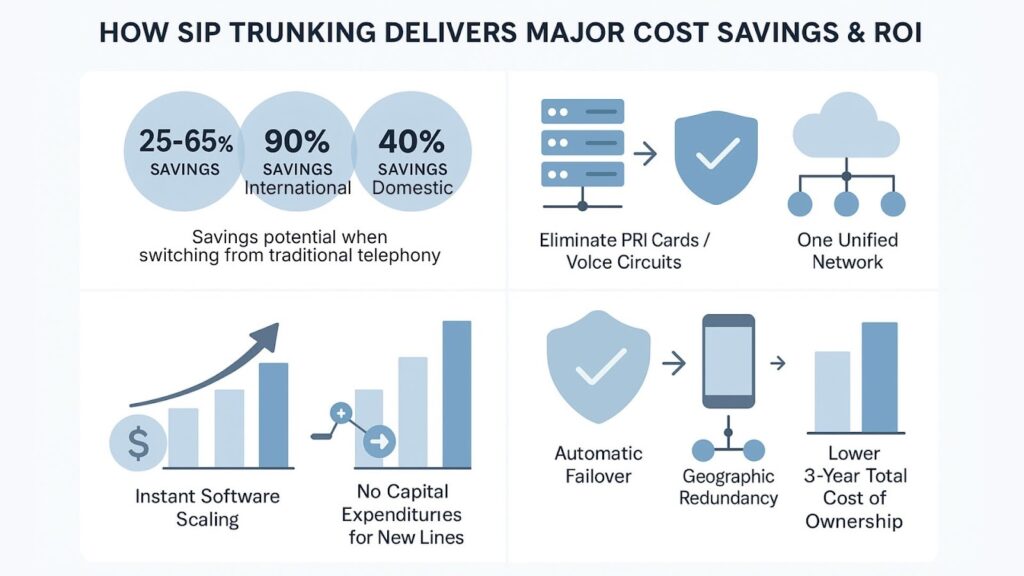
Local and long-distance calling savings remain substantial. Businesses switching to SIP trunking can save between 25% and 65% on their communication costs compared to traditional phone systems. For companies with long-distance calling, savings can reach 90% on international calls and 40% on domestic calls by routing them as internet traffic rather than traditional circuit-switched calls.
Operational and Infrastructure Savings
SIP trunking eliminates the need for separate voice and data networks, reducing redundant infrastructure costs. Companies no longer need to purchase and maintain costly PRI cards, channel service units, or dedicated voice circuits.
Scalability savings become greater as businesses grow. Traditional phone systems require expensive hardware additions for each new line or location. SIP trunking scales instantly through software provisioning, allowing businesses to add capacity in real-time without capital expenditures.
Maintenance cost reduction offers ongoing value. SIP trunk providers handle all infrastructure maintenance, software updates, and technical support, eliminating the need for in-house telecom expertise.
Business Continuity and ROI
Disaster recovery capabilities that would cost thousands to implement with traditional systems come standard with modern SIP trunking. Automatic call forwarding, instant failover to mobile devices, and geographic redundancy protect businesses from costly communication outages.
The total cost of ownership comparison often reveals substantial savings over three years when factoring in reduced infrastructure, maintenance, and operational costs. For resellers, these dramatic savings create compelling ROI presentations that virtually sell themselves.
FAQ: Common Questions About SIP Trunk Reselling
How long does modern partner onboarding take? Modern automated onboarding processes typically take 24–48 hours from application to being fully operational. This includes application approval, training completion, platform setup, and compliance verification. Some platforms offer same-day onboarding for qualified partners.
What automation tools are essential for SIP resellers? Essential automation includes automated billing and taxation, customer provisioning, usage monitoring, compliance reporting, and lead management. Advanced platforms also offer automated marketing campaign management, customer lifecycle automation, and predictive analytics for upselling opportunities.
How do compliance requirements affect existing resellers? Existing resellers must verify their wholesale provider’s compliance with enhanced STIR/SHAKEN standards. Non-compliant providers face service disruptions and penalties, potentially affecting reseller operations. Switching to compliant providers ensures business continuity and competitive advantage.
Can small resellers compete with larger telecommunications companies? Absolutely. Modern white-label platforms level the playing field by providing enterprise-grade capabilities without infrastructure investment. Small resellers often outperform larger companies through personalized service, faster decision-making, and specialized market focus.
What factors determine reseller success in the SIP trunking market? Success depends on choosing compliant wholesale providers, leveraging automation tools, focusing on specific market segments, and providing exceptional customer service. Resellers who combine technical expertise with strong customer relationships typically achieve the highest growth rates.
Growing Your SIP Trunk Reselling Business Has Never Been Easier
SIP trunk reselling is one of the most accessible and profitable opportunities in the industry. Market demand, technological advancement, and reduced barriers to entry have created ideal conditions for building a successful reseller business.
The automated onboarding processes, compliance support, and white-label capabilities available eliminate the traditional obstacles that kept many potential resellers out of this market. You no longer need deep technical expertise, significant capital investment, or complex operational infrastructure to offer enterprise-grade communication solutions.
SIPTRUNK provides the comprehensive white-label platform, automated onboarding, and ongoing support needed to build a successful telecommunications reseller business. Our proven platform eliminates technical complexity while maximizing your profit potential and market opportunity. Get started today and discover why thousands of successful resellers trust SIPTRUNK to power their growing telecommunications businesses.

Mitch leads the Sales team at BCM One, overseeing revenue growth through cloud voice services across brands like SIPTRUNK, SIP.US, and Flowroute. With a focus on partner enablement and customer success, he helps businesses identify the right communication solutions within BCM One’s extensive portfolio. Mitch brings years of experience in channel sales and cloud-based telecom to every conversation.