

How SaaS Resellers Make Money: Revenue Models Explained
SaaS resellers generate revenue through three primary models: subscription markups, commission structures, and licensing fees.
- Most profitable resellers combine multiple revenue streams.
- White-label programs offer superior margins compared to simple commissions.
- Telecom-enhanced platforms provide the infrastructure backbone for scalable growth.
Focus on long-term recurring revenue rather than one-time commissions for sustainable business growth.
The SaaS gold rush is far from over. With worldwide SaaS spending expected to hit $300 billion, smart resellers are positioning themselves to capture their share of this expanding pie. But not all SaaS reseller revenue models are the same, and understanding the difference between a quick commission and sustainable recurring income can make or break your business.
Whether you’re a telecom agent looking to diversify, an IT consultant expanding your service stack, or a seasoned reseller evaluating new opportunities, mastering SaaS reseller revenue models builds predictable, scalable income streams that compound over time.
What Are SaaS Reseller Revenue Models?
SaaS reseller revenue models are the financial foundation of your reselling business. These models determine how you get paid, when you get paid, and most importantly, how much you can realistically earn from each customer relationship.
The SaaS industry has evolved beyond simple affiliate commissions. Successful resellers operate sophisticated revenue engines that blend multiple income streams, leverage white-label branding, and capitalize on the recurring nature of subscription software. With companies now using an average of 112 SaaS applications, the demand for trusted reseller partners has never been higher.
Most SaaS reseller revenue falls into three core categories: commission-based earnings, subscription markup models, and licensing arrangements. The most successful resellers don’t pick just one. Instead, they build diversified portfolios that maximize both immediate cash flow and long-term recurring income.
How Does Commission-Based SaaS Revenue Work?
Commission-based SaaS revenue is straightforward: you refer customers, they sign up, and you earn a percentage. The structure of those commissions, however, determines whether you’re building a business or just earning occasional payments.

Standard SaaS commission rates typically range from 20–30% but vary based on factors like deal size, customer segment, and your relationship with the vendor. The key distinction lies between one-time and recurring commission structures.
One-time commissions might look attractive upfront, but recurring commissions build wealth. An example is earning $500 on a $2,000 annual software deal. On the other hand, a 25% recurring commission on that same deal generates $500 annually for as long as the customer remains active. This cycle is where the real money lives in the reseller profit model.
Performance Tiers and Payment Timing
Performance tiers add another opportunity. Many SaaS companies offer escalating commission rates based on volume. Start at 20%, hit certain monthly targets, and suddenly you’re earning 30% or even 35%. Volume incentives reward consistency and provide clear benchmarks for growth.
Payment timing also varies. About 70% of SaaS companies handle collections directly and pay resellers commissions, while 30% allow resellers to collect payments and remit the balance. The first model reduces administrative burden but may delay payments, while the second gives immediate cash flow control but requires more operational overhead.
What Makes Subscription Markup Models Profitable?
Subscription markup models are a popular option for resellers looking to maximize SaaS earnings. Instead of earning commissions on someone else’s pricing, you control the customer relationship and set your own prices through white-label programs.
Here’s how subscription markups work: you purchase SaaS licenses at wholesale rates and resell them at market prices. If you buy licenses for $70 and sell them for $100, you’ve got a 30% margin. Unlike commission models, you own that pricing relationship, enabling you to adjust, bundle, and optimize based on market conditions.
Customer lifetime value calculations are essential in subscription models. That $30 monthly margin per customer multiplies over time. Scale that across 100 customers, and you’re looking at substantial annual recurring revenue. The compound effect of these SaaS margins creates exponential growth potential.
Successful subscription markup strategies require understanding your cost structure and market positioning. While exact benchmarks vary, subscription models typically provide superior white-label SaaS earnings compared to simple commission arrangements because you control pricing, branding, and customer relationships.
White-label programs offer additional benefits beyond pricing control. You get branded interfaces, custom domain hosting, and the ability to integrate with your existing service offerings. When evaluating white-label SaaS programs, look for providers that offer comprehensive branding capabilities, not just logo placement.
When Do Licensing Revenue Models Make Sense?
Licensing models are the enterprise tier of SaaS reselling. Instead of monthly subscriptions, you’re dealing with annual contracts, custom implementations, and higher touch sales processes. The revenue potential is significant, but so are the requirements.
One-time licensing fees can generate immediate revenue for enterprise software deployments. But the real value often comes from ongoing maintenance and support contracts, which typically range from 10% to 25% annually.
Value-added service integration is where licensing models excel. You’re not just reselling software; you’re providing implementation, training, customization, and ongoing support. These services often carry higher SaaS margins than the software itself and create significant switching costs for customers.
Custom solution development is the premium tier of licensing revenue. When you can modify or extend SaaS platforms to meet specific customer requirements, you’re no longer competing on price. You’re providing unique value that commands premium pricing.
The challenge with licensing models is longer sales cycles and higher support requirements. Enterprise deals might take up to a year to close, and customers expect dedicated account management. But for resellers who can handle this complexity, the revenue potential exceeds subscription or commission models.
Top 5 SaaS Reseller Revenue Strategies
Smart resellers build diversified portfolios that maximize both immediate cash flow and long-term growth. These strategies consistently generate the highest returns:
1. Diversify Revenue Streams: Combine commission, subscription, and licensing models strategically. Commission provides quick wins and cash flow, subscription models build predictable recurring revenue, and licensing creates high-value enterprise relationships. This approach hedges against market changes and provides multiple growth levers.
2. Focus on Recurring Models: One-time commissions are nice, but recurring revenue builds businesses. Prioritize programs that pay ongoing commissions or markup models that generate monthly income. The compound effect of recurring revenue creates exponential growth over time. Each new customer adds to your baseline revenue.

3. Add Infrastructure Services: SaaS applications need underlying infrastructure, including reliable internet connections, secure networks, and communication platforms. Resellers who can provide the foundation that makes SaaS work have competitive advantages and additional revenue opportunities.
4. Leverage White-Label Branding: When you control the brand relationship, you control customer experience, pricing, and long-term value. White-label programs let you build equity in your own brand while providing software solutions. This revenue model is particularly powerful for establishing thought leadership and customer loyalty in specific markets.
5. Target Niche Markets: Generic SaaS reselling becomes a race to the bottom. Specializing in specific industries, use cases, or customer segments lets you command premium pricing and build deep expertise. Whether it’s healthcare, manufacturing, or professional services, niche specialization creates defensible competitive positions.
How Do Telecom Platforms Support SaaS Revenue Growth?
Every software application depends on a reliable communication infrastructure. Video conferencing tools need stable connections. Cloud-based phone systems require SIP trunking. Collaboration platforms depend on unified communications.
This synergy creates a valuable opportunity for resellers who understand the relationship between telecom infrastructure and SaaS performance. When you can provide both the communication foundation and the software applications that run on top of it, you’ve created a comprehensive solution that’s difficult for competitors to replicate.
Communication infrastructure services often carry different margin profiles than SaaS applications due to the specialized nature of the technology and higher switching costs for customers. The integration opportunities are substantial. Unified communications platforms that combine voice, video, messaging, and collaboration tools provide multiple revenue streams from each customer relationship.
For resellers serious about maximizing SaaS reseller revenue opportunities, understanding communication infrastructure is essential. The most successful SaaS businesses are built on reliable, scalable communication foundations, and resellers who can provide both elements capture more customer value.
What Revenue Model Should You Choose?
The best approach depends on your business goals, market position, and risk tolerance. Here’s a practical framework:
- Start with commission models if you’re new to SaaS reselling or testing new markets. They require minimal upfront investment and provide immediate feedback on market demand. Use commission programs to learn customer needs and build initial revenue.
- Scale with subscription models once you’ve identified profitable customer segments and proven market demand. White-label programs require more operational complexity but provide much higher long-term value. This transition often represents the difference between side income and serious business revenue.
- Add licensing models for enterprise opportunities and high-value customers. These deals require more resources and longer sales cycles, but they can generate more revenue than dozens of smaller subscription customers.
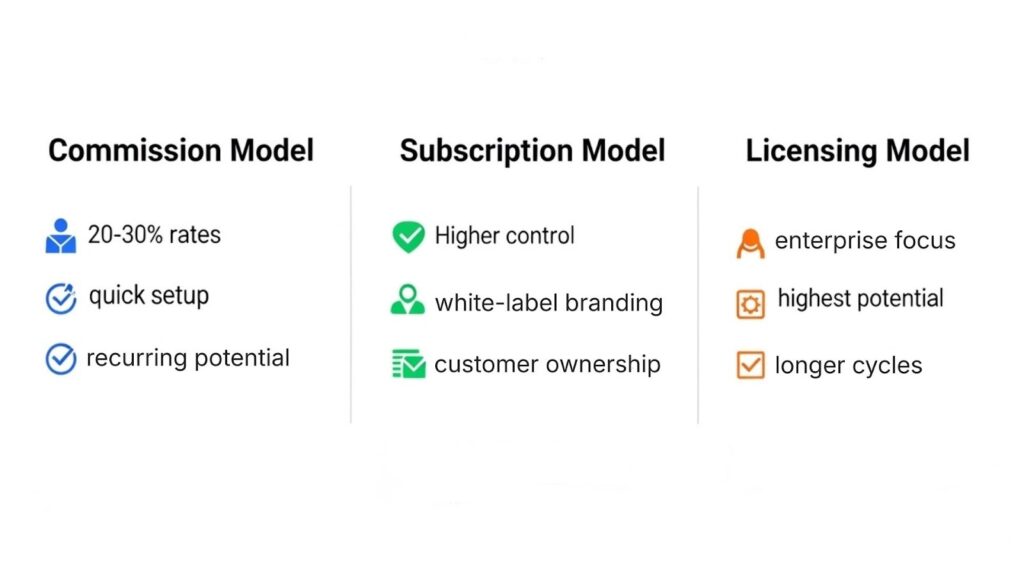
The risk-versus-reward calculation varies across models. Commission programs offer the lowest risk but also the lowest control and long-term value. Subscription models require more operational investment but provide predictable recurring revenue and brand equity. Licensing models demand the highest resources but can generate enterprise-level returns.
Frequently Asked Questions
What’s the average SaaS reseller profit margin? SaaS reseller margins typically range from 20–30% for commission programs. White-label subscription models generally provide superior margins compared to commission arrangements. Enterprise licensing can offer the highest margins but requires more resources and longer sales cycles.
How long does it take to see recurring revenue? Most SaaS commission programs pay monthly, so you’ll see initial revenue within 30–60 days. Building substantial recurring revenue typically takes consistent sales activity, depending on your target market and sales volume.
Can you combine multiple revenue models? Absolutely. The most successful resellers operate hybrid models that combine commissions, subscriptions, and licensing depending on customer needs and deal characteristics. This diversification provides multiple growth levers and hedges against market changes.
Building Sustainable SaaS Revenue
The SaaS reseller market rewards those who think strategically about revenue models and customer relationships. While commission programs provide accessible entry points, the real wealth-building opportunities lie in recurring subscription models and comprehensive service offerings that combine software with essential infrastructure.
For resellers looking to maximize their revenue opportunities, consider how communication services integrate with software applications. SIPTRUNK’s comprehensive reseller platform provides the telecom infrastructure foundation that makes modern SaaS applications work reliably and efficiently, enabling resellers to offer complete communication solutions under their own brand. Get started today and discover how the right infrastructure partner can enhance your SaaS reseller revenue potential.

Mitch leads the Sales team at BCM One, overseeing revenue growth through cloud voice services across brands like SIPTRUNK, SIP.US, and Flowroute. With a focus on partner enablement and customer success, he helps businesses identify the right communication solutions within BCM One’s extensive portfolio. Mitch brings years of experience in channel sales and cloud-based telecom to every conversation.