

SIP Trunk Failover: A Dealer’s Continuity Playbook
Voice continuity is a design decision, not a product feature, and the dealer who designs it well owns the account.
- Outages are expensive. More than half of organizations report their most recent major outage cost over $100,000, and connectivity failures are causing longer disruptions than before.
- Most continuity plans protect the wrong layer. Carrier redundancy means little if the customer has a single internet circuit, one power feed, and an unprotected PBX.
- Failover that has never been tested is an assumption. Quarterly, documented testing separates a resilient deployment from a hopeful one.
- Continuity is sellable. Redundant voice paths, tiered recovery objectives, and scheduled testing are billable, and they lift retention.
If you can’t tell a customer exactly what happens to their inbound calls in the first 60 seconds of a carrier failure, you don’t have a continuity plan yet.
When a customer’s phones go silent, they don’t call the carrier. They call you. SIP trunk failover is the set of routing decisions that determines whether that conversation is a two-minute status update or a two-day escalation.
The exposure is documented. According to data center outage research, 57% of respondents said their most recent major outage cost more than $100,000, and one in five reported losses above $1 million for the second consecutive year. The same research found failures tied to fiber and connectivity are becoming more prominent and more likely to cause extended disruptions. Voice is the first service a customer notices going down and the last one they’ll forgive you for losing, so building on a reseller-focused SIP trunking platform with layered redundancy gives you something to design against instead of something to apologize for.
What Is SIP Trunk Failover, and Why Does It Belong in Your Service Offering?
SIP trunk failover is the automatic rerouting of voice traffic to an alternate path when the primary path becomes unavailable. That path might be a second gateway, a trunk on a separate carrier network, a forwarding destination on the public telephone network, or a mobile endpoint.
How Does Failover Differ From Simple Call Forwarding?
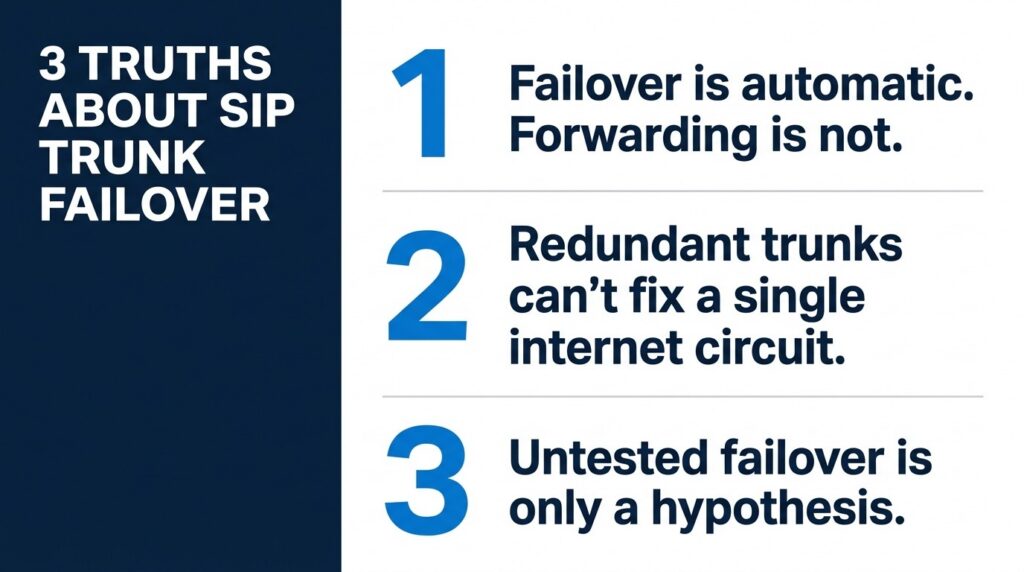
Call forwarding is a static instruction someone has to log in and change while the outage is already underway, and the calls lost during those 20 minutes are gone permanently. True failover is condition-driven, so the platform detects that equipment has stopped responding and applies an alternate route on its own.
Why Does Voice Continuity Land on the Dealer’s Desk?
Your customer bought a phone system from you, not a network topology, so when calls fail, they experience one vendor relationship, and that vendor is you. That’s an exposure if you haven’t designed for it and leverage if you have. Dealers helping customers modernize legacy PBX systems are already positioned to audit the surrounding failure points, which extends naturally into any SIP trunk reseller program conversation you’re having anyway.
Which Failure Scenarios Must a VoIP Business Continuity Plan Cover?
A credible VoIP business continuity plan starts by naming every layer that can fail independently. Most plans cover one or two and assume the rest will hold.
| Failure layer | Typical trigger | What the customer experiences | Primary mitigation | Practical owner |
| Carrier or upstream network | Fiber cut, gateway fault, routing issue | Calls fail or return a rapid busy tone | Trunks on separate carrier networks | Platform provider |
| Customer internet access | ISP outage, circuit degradation | Registration drops, one-way audio | Secondary circuit or wireless backup | Dealer and customer |
| Site power | Utility failure, UPS exhaustion | Total loss of phones on site | Battery backup, generator, cloud endpoints | Dealer and customer |
| PBX or SBC | Hardware fault, failed update, misconfiguration | Inbound calls unanswered | Redundant appliance or PSTN backup routing | Dealer |
| Endpoints | Handset failure, LAN switch fault | Individual users unreachable | Softphone and mobile fallback | Dealer |
| Site or regional event | Weather, fire, building access loss | Office unreachable entirely | Geographic redundancy and remote routing | Dealer and platform |
Working this grid with a customer is the fastest way to expose gaps. It also reframes SIP trunk disaster recovery as a shared responsibility rather than something the carrier is supposed to handle.
Carrier and Upstream Network Failures
A single upstream network, however well engineered, remains a single dependency, and fiber cuts don’t respect service level agreements. The mitigation is structural because the customer needs a path that doesn’t traverse the failed network at all. Federal outage reporting requirements adopted in 2024 oblige wireline, wireless, and interconnected VoIP providers to report infrastructure status during declared disaster events, a useful signal when comparing providers.
Internet Access and Power Failures at the Customer Site
Dealers often skip this layer, and it’s the one that fails most frequently because a customer with beautifully redundant trunks and one cable modem has bought redundancy they can’t use. A secondary broadband circuit from a different provider, a wireless backup connection with automatic cutover, and a UPS sized for the network gear will cover most site incidents.
PBX, SBC, and Endpoint Failures
Equipment inside the building fails on its own schedule, whether that’s a PBX locking up after a firmware update or a switch taking a floor offline without touching the WAN. The most valuable protection is a routing rule that fires when the equipment stops responding entirely, redirecting inbound calls to a predefined destination. Pair that with softphone access for critical users, and you’ve covered the system and the people depending on it.
How Does Geographic Redundancy Change the Risk?
Geographic redundancy means that the alternate voice path terminates somewhere that the primary failure can’t reach. Two trunks sharing a facility, a fiber route, or a power grid aren’t redundant in any meaningful sense because one regional event takes both.
What Does a Redundant Voice Path Actually Look Like?
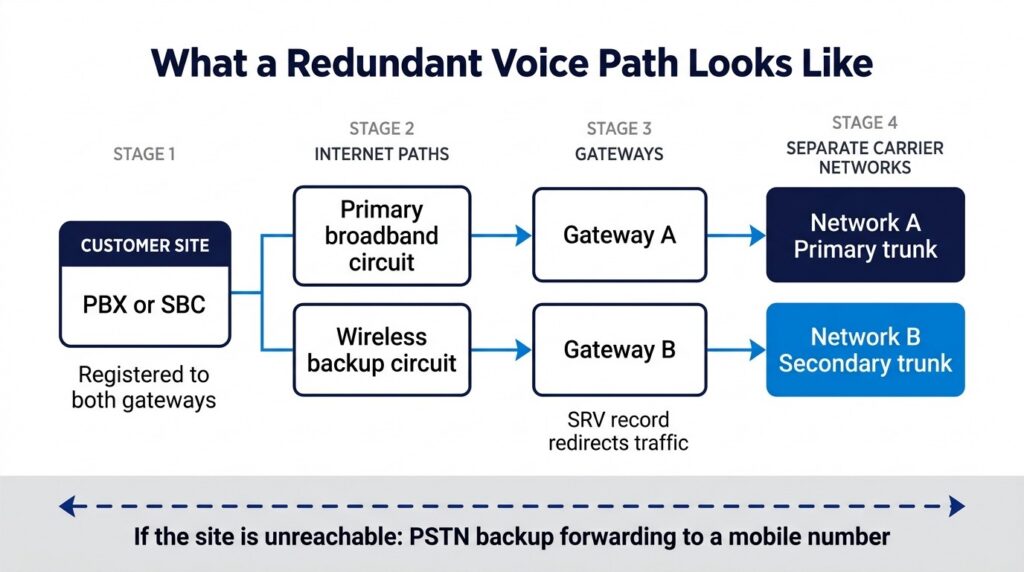
A well-designed path has diversity at every hop. The PBX registers to more than one gateway, those gateways sit on separate networks, and the site has two ways to reach the internet using different physical media. A final fallback destination lives on the public telephone network in case the site becomes unreachable.
How Do Redundant SIP Trunks Work Across Separate Networks?
The strongest available design delivers primary and secondary trunks on two physically separate carrier networks from a single source, so you configure failover in one control panel and escalate to one support team. Redundant SIP trunks from two unrelated vendors achieve separation but double your overhead and invite finger-pointing during exactly the incident where you can least afford it. Some platforms go further, routing inbound failover across separate affiliated networks under common ownership so a trunk group can fail to a genuinely different carrier network without a second contract.
How Does Automatic Call Failover Work in Practice?
Automatic call failover depends on three things: detection of the problem, a predefined alternate route, and a trigger connecting them without human involvement. Understanding the mechanics helps you set accurate expectations, which is most of the battle.
Registration, SRV Records, and Multiple Gateways
Most platforms operate several SIP gateways rather than one. An SRV record published for the platform’s domain lets traffic redirect to an alternate gateway when one degrades, requiring no reconfiguration on the customer’s equipment. The catch is that SIP trunk failover at this layer only works if the phone system is registered to all available gateways, which makes configuring alternate proxies during deployment the most valuable few minutes you’ll spend on an installation.
Inbound Rerouting and PSTN Backup
Inbound rerouting handles the case where the trunk is fine but the customer’s equipment isn’t. Secondary trunk routing sends calls elsewhere when the primary doesn’t answer, and backup forwarding to the public telephone network triggers when the platform gets no response from the customer’s server at all. Because that trigger is condition-based, it fires whether the failure happens at 2 p.m. or 2 a.m.
How Do Remote and Hybrid Users Stay Reachable During an Outage?
When users already have softphones or mobile clients, a site-level failure stops being a communications failure and becomes an inconvenience. Design for this scenario deliberately: confirm that critical users have a working client installed, that extensions ring on both the desk phone and the mobile client, and that caller ID presents correctly from the mobile path. Customers running contact centers or on-call rotations should have this tested during onboarding.
How Should You Set Voice Recovery Objectives for SIP Trunk Disaster Recovery?
Borrowing recovery objectives from data protection gives SIP trunk disaster recovery planning a structure that customers already recognize. The NIST Cybersecurity Framework treats documented and tested recovery plans, measured against defined recovery time and recovery point targets, as a core discipline rather than an optional exercise.
Defining Voice RTO by Customer Tier
Voice recovery time objective is the maximum acceptable interval between a failure and restored call handling. A three-person insurance office can absorb 15 minutes, while a medical answering service cannot absorb 30 seconds, so one number across your base overprotects some accounts and underprotects others. Set the target in writing:
- Tier 1, near-zero tolerance: dual trunks on separate networks, dual internet circuits, automatic rerouting, mobile clients pre-deployed
- Tier 2, minutes matter: secondary trunk routing plus PSTN backup forwarding and a documented escalation path
- Tier 3, hours are acceptable: backup forwarding to a mobile number with voicemail-to-email capture
Writing the tier into the service agreement converts a vague expectation into a defined commitment.
What Does a Recovery Point Mean for Voice?
Recovery point is trickier for voice because a lost call can’t be recovered the way a lost file can. The practical translation is which information survives: voicemail captured to email does, call detail records do if generated platform-side, and queue position doesn’t. Explain this concept before an incident because setting the expectation that in-progress calls drop while new calls reroute prevents a worse conversation later.
7 Elements Every Dealer’s Continuity Playbook Should Include
A repeatable VoIP business continuity playbook turns continuity from a per-deal conversation into a standard part of your delivery.
- A completed failure-layer audit. Document what protects each layer from carrier to endpoint, including where the answer is currently nothing.
- Defined trunk architecture per tier. Decide in advance which customers get separated trunks and which get single-path service with backup forwarding.
- Documented internet and power backup. Record the secondary circuit provider, the failover method, and the UPS runtime.
- Written recovery objectives. Voice RTO and recovery point expectations attached to the service agreement.
- Preconfigured fallback destinations. Forwarding numbers, mobile clients, and voicemail delivery addresses verified at onboarding.
- A quarterly test schedule. Scheduled on the calendar, with a named owner, treated as a deliverable rather than an aspiration.
- An escalation runbook. Who the customer calls, what you check first, and what you tell them while it’s happening.
How Do You Test SIP Trunk Failover Without Disrupting Customers?
Untested SIP trunk failover is a hypothesis. The objection you’ll hear is that testing risks causing the outage you’re trying to prevent, which is manageable through scheduling rather than avoidance. Run tests in a maintenance window, notify the customer, test one layer at a time, and keep a documented rollback.

A Quarterly Failover Test Checklist
- Confirm the PBX is registered to all available gateways rather than the primary alone.
- Disable the primary trunk at the edge and verify calls complete over the secondary path.
- Simulate loss of the primary internet circuit and confirm cutover to the backup connection.
- Stop responses from the customer’s server and verify backup forwarding engages.
- Place inbound and outbound test calls in the failed state, checking audio in both directions.
- Verify outbound caller ID presents correctly on every alternate path.
- Confirm voicemail is captured and delivered by email during the simulated failure.
- Restore primary service and verify traffic returns to the intended path.
- Record measured recovery time against the customer’s stated objective.
- Log results and corrective actions, then send the customer a short summary.
That final step is the one customers value most because a quarterly one-page report showing measured continuity is proof of work that justifies a recurring fee.
How Do You Validate 911 Routing During Failover?
Emergency call handling deserves its own test. Confirm a test call routes correctly during failover and that the transmitted address matches the caller’s physical location, coordinating with the appropriate authority so you aren’t dispatching resources unnecessarily. Address accuracy is the most common failure here, so review registered addresses at the same cadence as your testing.

How Do Dealers Turn Continuity Into Recurring Revenue?
Separated trunks and backup circuits both carry recurring costs you can mark up, and quarterly testing is a service with real labor behind it. The retention effect is larger than the direct margin because a customer with documented objectives and a quarterly report from you is hard for a price-focused competitor to displace. Dealers working to build predictable recurring revenue often find that continuity is a highly rewarding attached service in their catalog once productized.
Getting there depends on the platform underneath you. When you evaluate a provider platform, check whether separated trunks, multiple gateway registration, and automatic backup forwarding are standard or custom engineering requests. The same applies to wholesale SIP trunk capacity, where flexible provisioning determines whether you can scale redundant capacity without renegotiating.
Frequently Asked Questions About SIP Trunk Failover
How quickly should SIP trunk failover engage during an outage? Gateway-level redirection and secondary trunk routing typically engage within seconds, while backup forwarding to the public telephone network engages once the platform confirms the server isn’t responding. Measure the actual interval during testing and use that number in agreements rather than a vendor estimate.
Do I need two providers to get real redundancy? No. Two trunks on physically separate carrier networks from a single platform provide genuine diversity while keeping configuration, billing, and support consolidated. Two unrelated vendors add overhead and complicate escalation when speed matters most.
How often should failover be tested? Quarterly is the practical standard for most business customers. Accounts with near-zero tolerance for downtime, particularly contact centers and dispatch operations, benefit from monthly verification of the primary failover path.
Does automatic call failover protect against internet outages at the customer site? Only partially. Trunk-side failover protects against carrier and platform issues, but if the site loses internet access entirely, calls can’t reach the equipment. Covering that requires a secondary circuit, wireless backup, or forwarding to a destination independent of the site connection.
Is SIP trunk disaster recovery planning worth it for small customers? Yes, at an appropriate scope. A 10-person business doesn’t need dual carrier networks, but it does need a tested backup forwarding destination and voicemail delivered by email.
Build Continuity Into Every Deployment
SIP trunk failover isn’t a feature you enable at the end of an install. It’s a design discipline that starts with knowing which layers can fail, continues through documented recovery objectives, and stays honest through testing you actually perform. Dealers who work this way spend less time explaining outages and more time expanding accounts.
SIPTRUNK gives you the capabilities to build this properly, including trunks delivered on separate networks, multiple gateway registration, and automatic backup routing, all managed from one platform with billing and support handled for you. Get started with SIPTRUNK and start selling VoIP business continuity that your customers can count on.

Mitch leads the Sales team at BCM One, overseeing revenue growth through cloud voice services across brands like SIPTRUNK, SIP.US, and Flowroute. With a focus on partner enablement and customer success, he helps businesses identify the right communication solutions within BCM One’s extensive portfolio. Mitch brings years of experience in channel sales and cloud-based telecom to every conversation.