

What Makes the Best VoIP Reseller Program? 10 Must-Have Features
The best VoIP reseller program gives you the tooling, margins, and branding control to build recurring revenue without operating a carrier network.
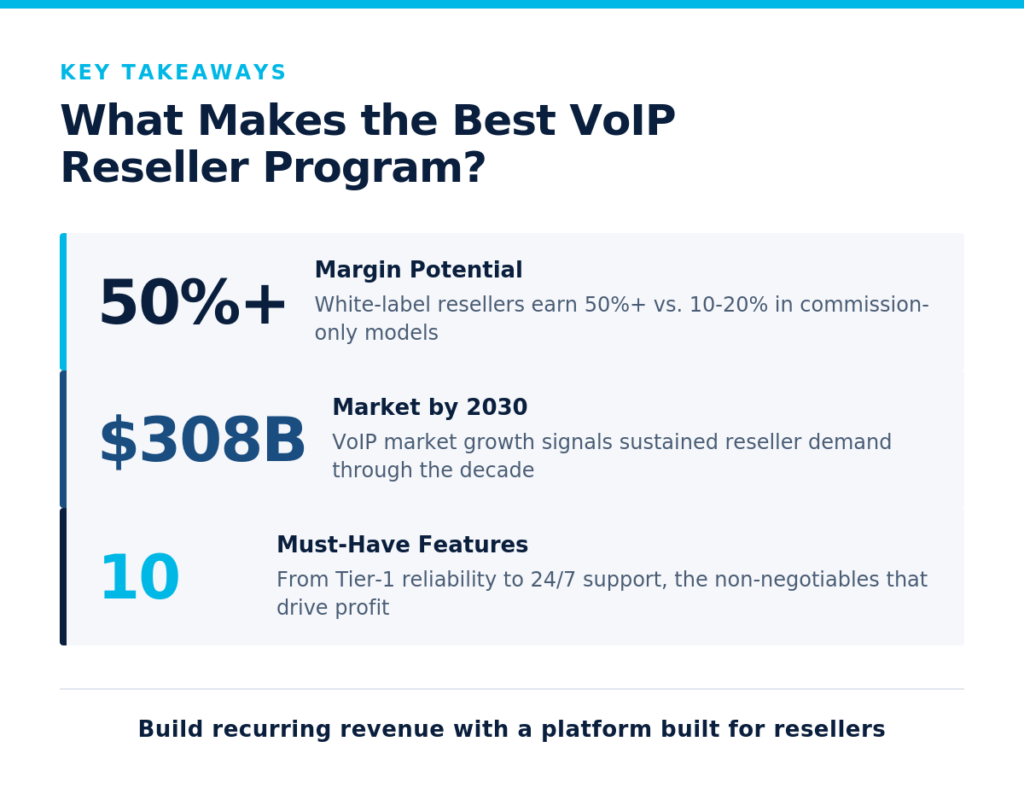
- The global VoIP services market reached $172.49 billion in 2025 and is forecast to expand to $308.41 billion by 2030, signaling sustained reseller demand through the decade.
- Reseller-focused white-label platforms typically allow partners to set their own pricing and capture meaningful margins on recurring services.
- Onboarding speed, automated provisioning, and hands-off billing are now table stakes, not differentiators.
- Generic VoIP partnerships no longer cut it. The best programs are built specifically for telecom agents, IT consultants, VARs, and MSPs.
If your provider doesn’t treat your margin, branding, and growth as the product, you are in the wrong program.
The voice market is moving fast, and your customers know it. Hosted and cloud-based phone services already account for the majority of business voice revenue, with hosted and cloud PBX accounting for 52.3% of 2024 revenue and forecast to expand at 12.8% CAGR through 2030, according to Mordor Intelligence. That shift is a pipeline of customers actively looking for a trusted advisor to modernize their communications, and that advisor can be you. The best VoIP reseller program gives you the foundation to capture that demand without owning carrier infrastructure, hiring a NOC team, or fronting capital for a softswitch.
This guide breaks down what separates a great VoIP reseller program from a mediocre one, including VoIP reseller features that drive profitability, program models worth comparing, margins you can realistically expect, and the onboarding experience that determines whether you start earning in weeks or months.
What Is a VoIP Reseller Program?
A VoIP reseller program is a partnership model where a platform provider supplies the underlying voice infrastructure, billing systems, and technical operations, while you sell, brand, and manage the customer relationship. You set pricing, own the account, and collect recurring revenue. The platform partner handles the parts that would otherwise require millions in capital and a team of telecom engineers.
Legacy PSTN networks are being decommissioned across North America, and cost savings between 25% and 65% over legacy PRI lines continue to be the strongest economic pull, especially for high-volume, multi-site users. Combine that with rising adoption of remote and hybrid work models, and the demand profile for resellers has never looked stronger.
The best VoIP reseller program meets that demand with the right balance of automation, branding control, and partner economics. The wrong program looks similar on the surface and quietly erodes your margins, brand equity, and time.
What Features Should You Expect From the Best VoIP Reseller Program?
The list below covers the 10 VoIP reseller features that consistently separate a profitable partnership from a frustrating one. Use it as a baseline checklist when evaluating any provider.
1. Tier-1 Network Reliability
Voice quality is the first thing your customers notice and the first thing they complain about. A reseller-focused platform should route traffic through Tier-1 carrier networks, with redundant failover and round-the-clock monitoring. Anything less means your brand absorbs the cost of every dropped call.
2. Complete White-Label Branding
Your customers should see your company at every touchpoint, including the control panel, invoices, support documentation, and welcome emails. A true white-label VoIP reseller arrangement keeps the platform provider invisible to your end users. That separation is what builds genuine brand equity over time, rather than positioning you as a middleman.
3. Automated Provisioning
Manual provisioning is a margin killer. The best VoIP reseller tools let you onboard a new customer in minutes through a self-service control panel, with number assignment, trunk configuration, and routing all handled automatically. Speed of activation is one of the strongest predictors of reseller profitability.
4. Hands-Off Billing and Tax Compliance
Telecom billing is not standard SaaS billing. It involves usage rating, jurisdictional taxes, regulatory fees, and compliance documentation that change frequently. A reseller-grade platform should automate all of it and remit revenue to your bank account on a predictable schedule, freeing you to focus on growth rather than reconciliation.

5. Flexible, No-Contract Terms
Long-term contracts and upfront fees create friction with both you and your customers. Programs that require neither give you the flexibility to scale up or down as your customer base evolves, and they signal a provider confident enough in its platform to earn your business month after month.
6. Broad Platform and Device Compatibility
Your customers will arrive with existing PBX systems, softphones, and SIP-compatible endpoints. The best programs work with whatever your customers already own, including IP PBX, virtual PBX, and Microsoft Teams environments. Avoid providers that restrict you to a single ecosystem or proprietary hardware.
7. Transparent Reseller Pricing
You should be able to see exactly what you pay, what you charge, and what you keep. Programs that obscure wholesale rates or layer in surprise fees make accurate quoting impossible and create friction during customer renewals. Transparency at the rate level protects your margins.
8. Comprehensive Training and Enablement Resources
Even experienced telecom professionals need ramp-up time on a new platform. Look for providers offering structured onboarding, documentation, sales collateral, and access to subject-matter experts. A partner that invests in your enablement runs a program that expects you to grow.
9. 24/7 Expert Technical Support
Voice traffic doesn’t respect business hours. When something breaks at 2 a.m., you need a responsive support team that understands SIP trunking at the protocol level, not a tier-one chat agent reading from a script. Round-the-clock expert support is a hard requirement, not a nice-to-have.
10. A Path to Scale With Add-On Services
The strongest VoIP reseller programs let you grow beyond basic SIP trunking into adjacent services, including failover trunks, hosted PBX integrations, and unified communications offerings. That flexibility turns a single trunk sale into a long-term account.
How Do White-Label VoIP Reseller Programs Compare?
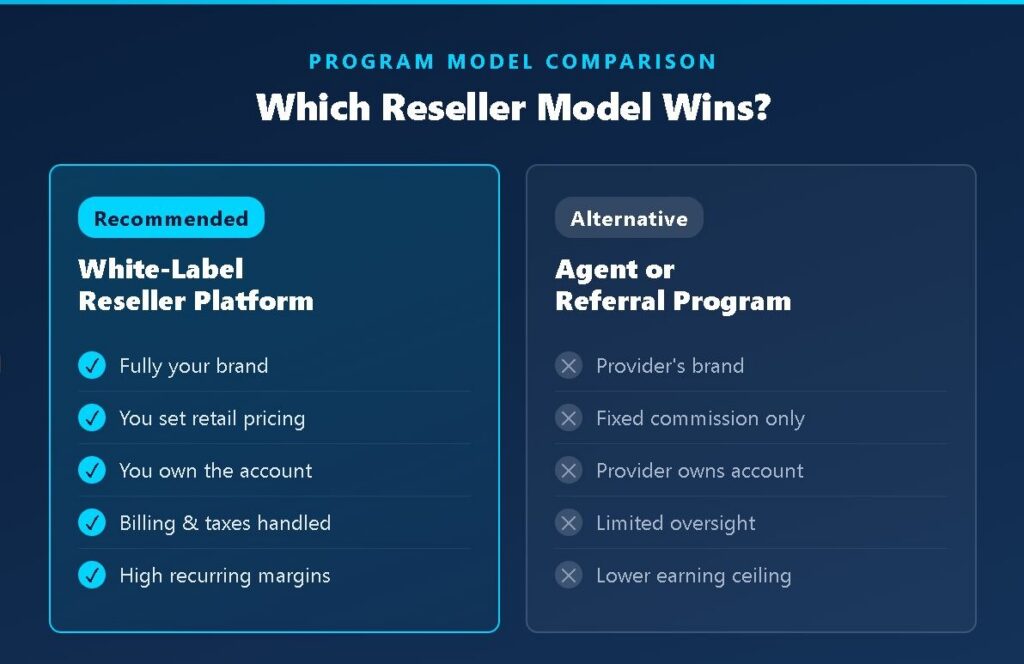
Not every white-label VoIP reseller partnership is structured the same way. Before signing a contract, it helps to understand how the three most common models compare on the factors that directly affect your business. The table below outlines the practical differences.
| Feature | White-Label Reseller Platform | Agent or Referral Program | Direct Wholesale Carrier |
| Branding | Fully your brand | Provider’s brand | Provider’s brand |
| Pricing control | You set retail pricing | Fixed commission | Negotiated wholesale only |
| Customer ownership | You own the account | Provider owns the account | You own the account |
| Billing and taxes | Handled by platform | Handled by provider | Your responsibility |
| Onboarding speed | Days to weeks | Days | Weeks to months |
| Margin potential | High and recurring | Lower, commission-based | High, but operationally heavy |
| Best for | Telecom agents, MSPs, VARs, IT consultants | Side revenue, light commitment | Established carriers with NOC capacity |
If you want to build a real telecom business with brand equity, recurring revenue, and customer ownership, a white-label reseller platform is the model that scales. Agent programs limit your upside, and direct wholesale arrangements require operational depth most resellers can’t justify.
What Kind of Margins Can You Expect as a VoIP Reseller?
Margin is where the conversation gets real. White-label resellers can achieve profit margins of 50% or higher, compared to 10–20% in traditional commission-only arrangements, which is the gap that makes the reseller model worth pursuing. Where your margin actually lands depends on the choices you make about pricing, packaging, and service bundling.
A few factors consistently influence where your margins fall:
- Pricing flexibility. Programs that let you set your own retail prices give you the most upside. Fixed-commission models cap your margin at whatever the provider decides.
- Service mix. Layering complementary services such as failover trunks, hosted features, and integrations into your offering increases average revenue per customer.
- Retention. VoIP services are sticky. A customer added in year one continues generating revenue for years, which compounds the value of every new account.
The most important point is that margin is not the same as revenue. A 70% margin on a small subscription is less valuable than a 50% margin on a multi-trunk enterprise account. The best SIP trunk provider for resellers supports both ends of that spectrum with the same platform and the same set of VoIP reseller tools.
What Does a Great Onboarding Experience Look Like for VoIP Resellers?
Onboarding is an underestimated factor in reseller success. Programs that take weeks to activate a partner leak revenue every day, and programs that drop new resellers into a portal with no support produce frustrated partners who never reach scale.
Here is what a strong onboarding experience should include:
- A structured kickoff with a dedicated account team that learns your business, your target customers, and your timeline before pushing you toward the platform.
- Self-service activation paths where you can configure your first trunk, test calls, and access billing tools without waiting for a ticket to clear.
- Clear documentation and training resources covering the platform interface, common sales scenarios, and technical configurations your customers will request.
- Defined milestones and check-ins during the first 90 days so you have a clear path from your first customer to your first significant MRR.
The best programs treat onboarding as a continuous process rather than a one-time event. Quarterly business reviews, ongoing access to product updates, and a clear escalation path for technical questions all signal a provider that is invested in your long-term success. If a provider’s onboarding consists of a login email and a PDF, expect that level of partnership to persist throughout the relationship.
Frequently Asked Questions
What is the difference between a VoIP reseller and a VoIP agent?
A VoIP reseller purchases services at wholesale rates, sets retail pricing, owns the customer relationship, and earns ongoing margin on recurring services. A VoIP agent refers customers to a provider and earns a commission on those sales while the provider owns the account. Resellers generally have higher long-term earning potential and stronger brand equity, while agents have a lighter operational footprint.
How long does it take to start earning revenue as a VoIP reseller?
Most resellers using a well-designed white-label platform can activate their first customer within a few weeks of signing on, assuming they already have a pipeline. Reaching meaningful monthly recurring revenue typically takes between three and twelve months, depending on sales activity and the size of the accounts being onboarded.
Do I need technical expertise to become a VoIP reseller?
A working knowledge of SIP, networking, and business phone systems is helpful, but you don’t need to be an engineer. A reseller-focused platform handles the technical complexity behind the scenes, and a quality program will provide training and support to fill in any knowledge gaps. The skills that matter most are sales, customer relationship management, and the ability to translate technical features into business benefits.
What VoIP reseller features should I prioritize when comparing programs?
The non-negotiables are Tier-1 network reliability, full white-label branding, automated provisioning, hands-off billing and tax compliance, and 24/7 expert technical support. After those baseline VoIP reseller features, prioritize flexibility on contracts, transparent pricing, and a clear path to add adjacent services as your customer base grows. Anything less than those fundamentals will create friction that compounds as you scale.
How to Choose a VoIP Reseller Program Built for Long-Term Growth
The best VoIP reseller program aligns with how you plan to grow. If your goal is recurring revenue, brand equity, and customer ownership, a white-label platform built specifically for resellers gives you the foundation to achieve all three. The features outlined above, from Tier-1 reliability through structured onboarding, form the practical checklist for evaluating any provider you consider.
SIPTRUNK was built from the ground up as a telecom reseller platform for agents, IT consultants, VARs, and MSPs who want to add a recurring revenue stream without operating a carrier. With no contracts, no upfront costs, automated provisioning, hands-off billing, and 24/7 expert support, our platform handles the technical complexity so you can focus on selling and growing. Get started with SIPTRUNK today and start building a VoIP reseller business designed for your success.

Mitch leads the Sales team at BCM One, overseeing revenue growth through cloud voice services across brands like SIPTRUNK, SIP.US, and Flowroute. With a focus on partner enablement and customer success, he helps businesses identify the right communication solutions within BCM One’s extensive portfolio. Mitch brings years of experience in channel sales and cloud-based telecom to every conversation.