

Best White-Label VoIP Platforms: A Reseller Guide
The best white-label VoIP platforms are the ones whose architecture matches the business you’re actually building.
- White-label VoIP spans five structurally different platform models, and evaluating all of them against a single feature checklist is the most common reason resellers choose wrong.
- MSPs should weight multi-tenant provisioning, automated telecom tax handling, and brand-invisible support above headline per-seat pricing.
- Margin erodes in operations, not in the rate card. Billing reconciliation, tax filing, and first-tier support absorb more gross profit than wholesale cost ever does.
- White-label SIP trunking remains the lowest-overhead entry point for resellers who already manage customer PBX environments.
Decide what kind of voice business you intend to run before you compare platforms because the right architecture for a 20-customer MSP is the wrong one for a virtual carrier.
Evaluating the best white-label VoIP platforms has become harder as the category has widened. The VoIP market is projected to grow from $195.39 billion in 2026 to $388.97 billion by 2034, and that expansion has pulled dozens of vendors into the reseller channel, nearly all of them claiming to support white labeling. The claim is usually accurate. It’s also close to meaningless because platforms that share the phrase frequently solve entirely different problems.
For MSPs, IT consultants, and telecom agents building a branded voice offering, the useful question isn’t which platform is best in the abstract. It’s which architecture fits the business you intend to run. A reseller adding voice to existing managed services contracts has different requirements than one building a standalone carrier operation. Understanding how reseller platforms are structured before you compare features will spare you an expensive migration two years from now.
What Do the Best White-Label VoIP Platforms Actually Deliver?
A white-label platform gives you a branded voice product to sell while a backend provider operates the switching, number management, and carrier interconnects. You set the pricing, own the customer relationship, and appear as the provider of record. What separates the strong platforms from the weak ones is how completely the upstream vendor disappears and how much operational work lands on your desk once customers start calling. That’s the real dividing line among white-label VoIP providers, regardless of how their feature lists compare.
How Does White-Label Differ From a Standard Reseller Agreement?
The distinction comes down to whose name the customer sees and who controls the economics. In a standard agent or referral arrangement, the underlying provider bills the customer directly and pays you a commission, which means your revenue is contingent on someone else’s retention. Under a true white-label model, you bill the customer, you set the margin, and the relationship belongs to you. That difference compounds over time, and it’s the reason the reseller and wholesale voice models produce such different business valuations.
Where Does White-Label SIP Trunking Fit Into the Stack?
White-label SIP trunking sits at the connectivity layer, supplying the PSTN interconnect a PBX or UCaaS application needs to place and receive calls. For resellers already managing customer phone systems, SIP is usually the most efficient starting point because you’re adding a billable service to infrastructure you already support rather than migrating customers onto an unfamiliar platform. Many resellers begin here and expand into hosted seats once recurring revenue justifies the complexity, a progression covered in this guide to white-label SIP trunking providers.
Why Do Most Platform Comparisons Mislead Resellers?
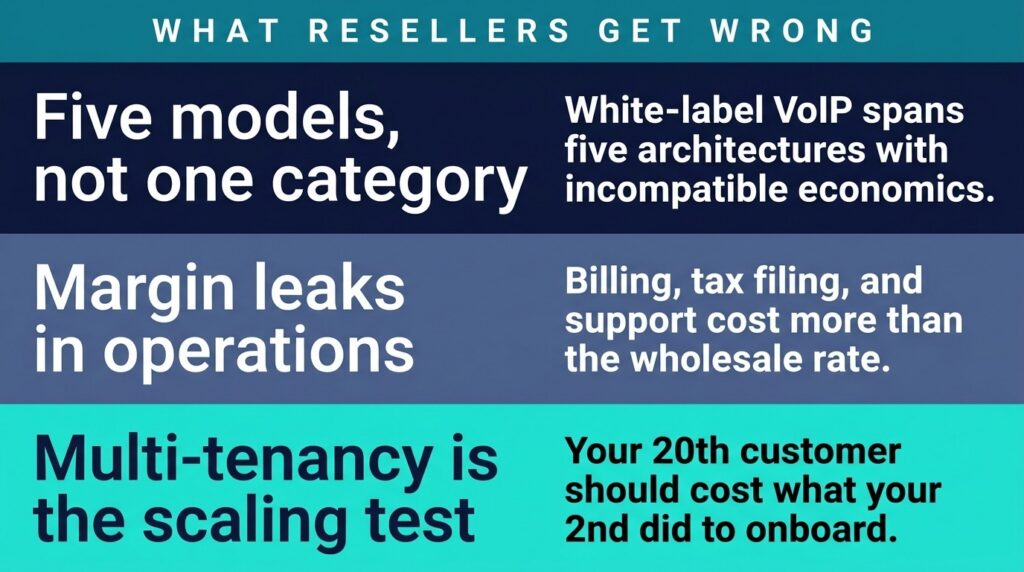
Most published comparisons rank platforms as though they belong to one category. They don’t. White-label VoIP describes at least five distinct architectures with incompatible economics, and a feature grid that spans all of them obscures the only question that matters, which is what you’re responsible for operating after the contract is signed.
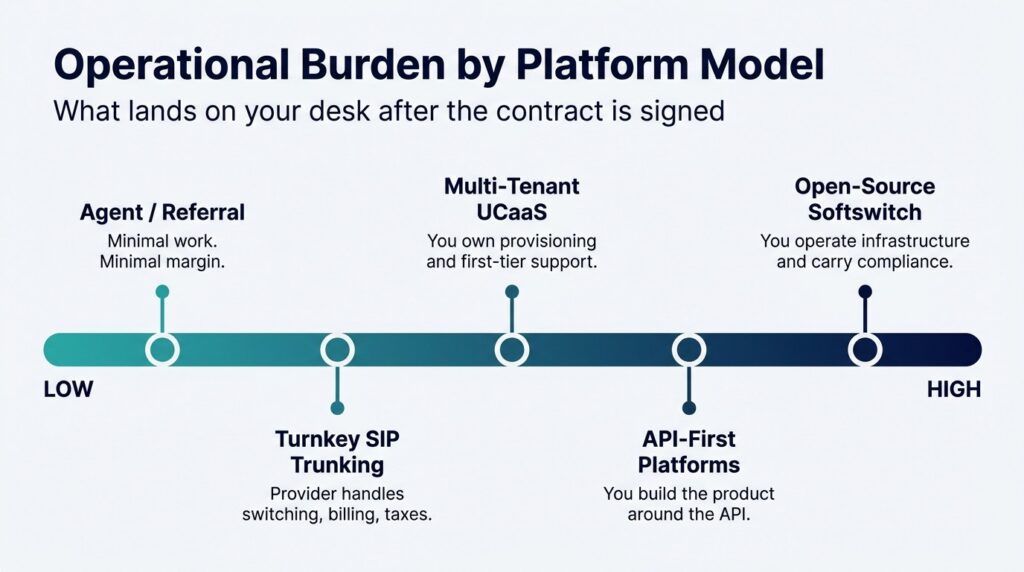
| Platform Model | What You Control | Operational Burden | Best Fit |
| Turnkey SIP trunking | Branding, pricing, customer relationship | Low. Provider handles switching, billing, taxes | MSPs and VARs supporting existing PBX environments |
| Multi-tenant UCaaS | Branding, packaging, seat tiers, portal identity | Moderate. You own provisioning and first-tier support | Resellers building a seat-based hosted voice practice |
| Open-source softswitch | Everything, including the software stack | High. You operate infrastructure and carry compliance | Technical teams with in-house telecom engineering |
| API-first platforms | Application logic and end-user experience | High. You build the product around the API | Software vendors embedding voice into their own tools |
| Agent or referral programs | Very little. The provider bills the customer | Minimal, but so is the margin and the asset value | Referral partners who don’t want a voice practice |
A platform can be excellent within its model and completely wrong for you. An open-source softswitch offers total control, which is valuable if you employ telecom engineers and worthless if you don’t. Agent programs are simple to join, yet they leave you with commission income rather than a business you could sell.
What Should MSPs Require From a White-Label Provider?
MSP VoIP solutions carry requirements that general-purpose platforms often fail to meet because MSPs manage many small accounts rather than a few large ones. The U.S. managed services market is projected to reach $106.8 billion by 2026, and the providers capturing that growth are the ones who can add a service line without adding headcount. That constraint should drive every question you ask a prospective white-label provider.
Does the Platform Support Genuine Multi-Tenant Provisioning?
Multi-tenancy means each customer account is structurally isolated while you manage all of them from one administrative console. Ask whether provisioning a new account is self-service or a support ticket because the answer determines whether your 20th customer costs the same to onboard as your second. Platforms retrofitted with a white-label skin over single-tenant software tend to fail here, and the failure surfaces exactly when you start scaling.
How Are Billing, Telecom Taxes, and Compliance Handled?
Telecom billing is materially harder than software billing, and it’s where inexperienced resellers lose the most money. Federal USF contributions, state communications excise taxes, and local 911 fees must be calculated on the right portion of revenue, and getting it wrong creates liability that surfaces years later in an audit. A capable white-label provider absorbs tax calculation, remittance, and regulatory filing on your behalf. If a platform expects you to source a separate billing and tax engine, factor that recurring cost into your margin model first.
Will Support Preserve Your Brand or Undermine It?
Your customers should never encounter the upstream provider’s name, and that principle has to extend past the login screen into escalation paths, documentation, and any correspondence a customer might see. Ask how escalations are routed, what the response commitments are, and whether support staff operate under your brand. A single support email carrying another company’s logo can unwind years of positioning work.

Which 10 Requirements Separate the Best White-Label VoIP Platforms?
Once you’ve identified the right platform model, these are the specifications worth verifying directly rather than accepting from a marketing page:
- Complete brand removal across portals, dashboards, notifications, invoices, and support correspondence.
- Self-service provisioning that activates a customer without contacting the provider.
- Automated telecom tax calculation and remittance handled by the platform, not pushed back to you.
- Transparent wholesale pricing with no volume commitments or capacity reserved in advance.
- Broad PBX and endpoint compatibility covering the systems your customers already run.
- No long-term contract or upfront platform fee, so cost scales with active subscribers.
- Carrier-grade redundancy with published uptime performance and documented failover behavior.
- Fraud monitoring and spend controls applied at the account level, with configurable alerting.
- Responsive partner support staffed by people who understand telecom, not a generic help desk.
- A clear path to expand from trunking into hosted seats without replatforming.
Several of these elements overlap with the must-have reseller program features that determine whether a partnership stays profitable past the first dozen accounts.
How Do Platform Choices Affect Reseller Margin and Recurring Revenue?
Voice is attractive to resellers because it produces predictable monthly revenue from customers who rarely churn once a phone system is working. The economics only hold, though, if the platform you choose doesn’t consume that revenue in operational overhead. This is where platform selection stops being a technical decision and becomes a financial one.
Where Does Recurring Revenue Actually Compound?
Recurring voice revenue compounds because retention in this category is unusually strong. Businesses rarely change phone providers without a compelling reason, so each account you add tends to persist and stack on the last. Cost savings drive the initial conversion, and migrations from legacy PRI lines typically deliver reductions between 25% and 65%. That compounding is what turns a service line into an asset with real enterprise value, which is the central argument of the SIP trunk reseller platform approach.
What Erodes Reseller Margin?
The wholesale rate is rarely the problem. Margin leaks through billing reconciliation, tax filing, provisioning labor, and support calls, which a better platform would have prevented. A reseller paying a slightly higher wholesale rate on a platform that automates taxes and provisioning often nets more than one chasing the lowest per-channel price and absorbing that work internally. Model the fully loaded cost per account, including your own time, before treating rate cards as comparable.
What White-Label SIP Trunking Considerations Matter Most Now?
Two factors have moved from secondary to essential over the past few years, and both belong in any current evaluation.
How Does the Platform Handle Regulatory and Fraud Controls?
Voice fraud remains a persistent risk, and unauthorized usage on a compromised account can generate substantial charges within hours. Verify that the platform enforces account-level spending limits, monitors anomalous traffic, and can suspend activity automatically before losses accumulate. Ask who absorbs fraudulent charges under the partner agreement because that answer varies and is rarely volunteered.
Is PBX Compatibility Verified or Merely Claimed?
Compatibility problems surface during deployment rather than evaluation, and they’re expensive because they arrive when a customer is already committed. Look for a published list of certified PBX platforms rather than a general assurance that the service supports standard SIP. Certification means the provider has tested the configuration and can supply working setup documentation, which shortens deployments and reduces escalations.
Frequently Asked Questions
What’s the difference between a white-label provider and a wholesale VoIP provider? A white-label provider supplies branded infrastructure plus the tooling to sell and manage it, including provisioning, billing, and support. A wholesale provider sells raw capacity or minutes and expects you to supply the platform layer yourself.
How much technical expertise do the best white-label VoIP platforms require? Turnkey platforms are built so resellers without deep telecom engineering experience can successfully provision and support accounts. Open-source and API-first options assume substantially more in-house capability.
Can I start with white-label SIP trunking and add hosted seats later? Yes, and it’s a common progression. Trunking generates recurring revenue from existing customer PBX systems while you build capacity to support a seat-based offering.
Do MSP VoIP solutions require a long-term contract? Strong partner programs don’t require contracts, upfront platform fees, or minimum volume commitments. If a provider asks for all three, treat it as a signal about how they view the partnership.
Who owns the customer relationship under a white-label agreement? You do, provided the agreement is genuinely white-label rather than an agent arrangement. Confirm in writing that the provider won’t contact or market to your customers directly.
Choosing the Platform That Fits Your Business
The best white-label VoIP platforms are matched to a business model you’ve chosen, rather than the ones ranked highest on a list that treats five different architectures as interchangeable. Decide first whether you’re adding a service line to an existing practice or building a standalone voice operation, then evaluate platforms within that model on provisioning, tax handling, support quality, and how completely they stay invisible to your customers.
For MSPs, VARs, and IT consultants looking for a straightforward entry point, SIPTRUNK offers a reseller platform with no contracts, no upfront costs, and billing and taxes handled on your behalf. Get started with SIPTRUNK to see how quickly you can add a branded voice offering to your existing services.

Mitch leads the Sales team at BCM One, overseeing revenue growth through cloud voice services across brands like SIPTRUNK, SIP.US, and Flowroute. With a focus on partner enablement and customer success, he helps businesses identify the right communication solutions within BCM One’s extensive portfolio. Mitch brings years of experience in channel sales and cloud-based telecom to every conversation.