

SIP Reseller Program vs. Wholesale Voice: What’s the Difference?
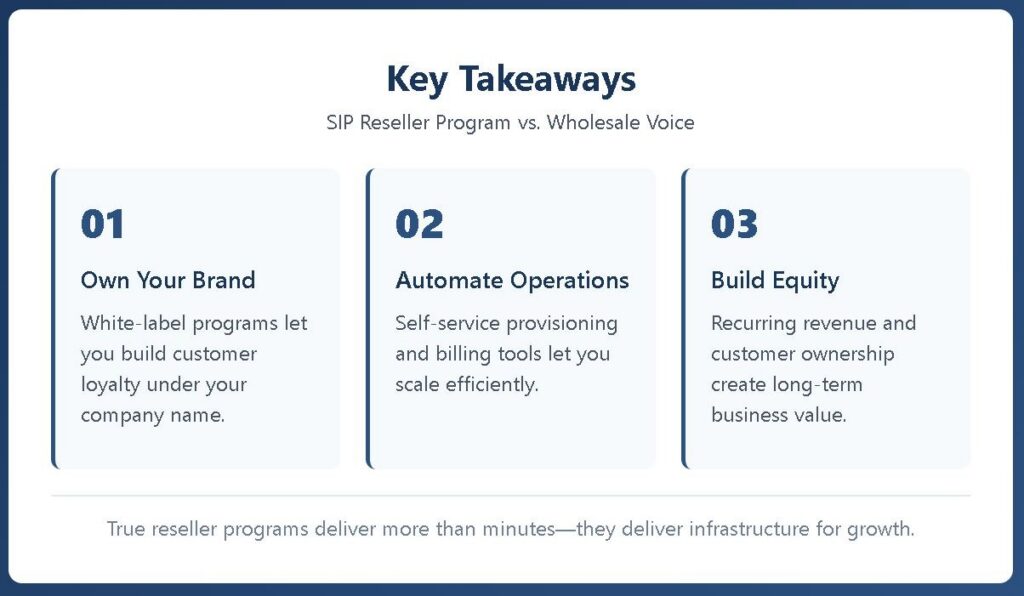
A true SIP reseller program gives you ownership of the customer relationship, your brand, and your margins, while wholesale voice simply sells you minutes in bulk.
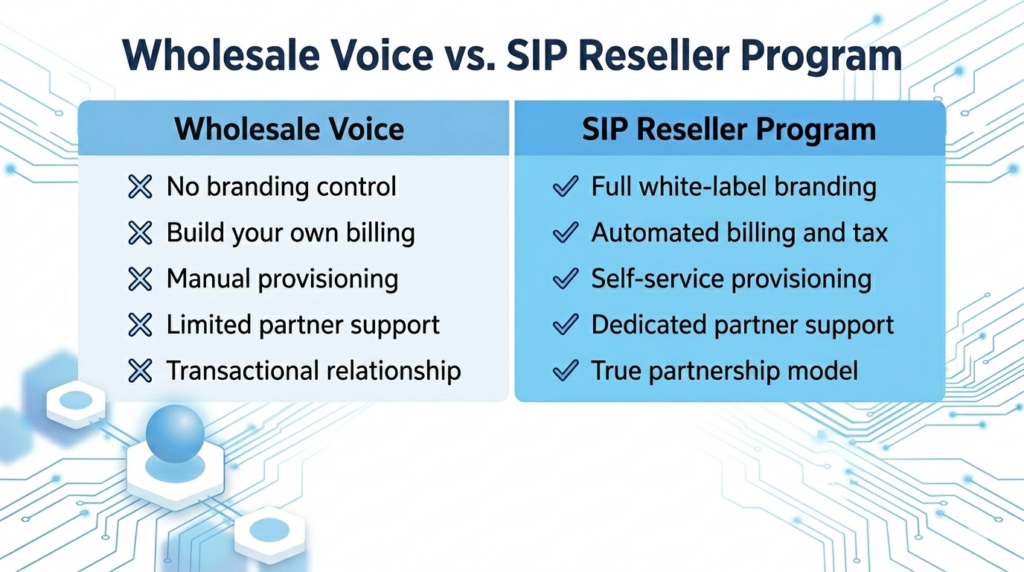
- Wholesale voice provides raw capacity without branding, billing tools, or partner support, leaving resellers to build their own infrastructure.
- A genuine SIP reseller program includes white-label capabilities, automated provisioning, and hands-off billing that let you scale efficiently.
- The difference between these models determines whether you build equity in your own business or remain invisible behind someone else’s brand.
- Choosing the right partnership model positions you to capture share in a market projected to reach $36.74 billion by 2031.
If you want recurring revenue and customer loyalty, the program structure matters as much as the product itself.
The SIP trunking market is expanding at a 12.9% CAGR, with projections reaching $36.74 billion by 2031. This growth is creating opportunities for telecom agents, IT consultants, managed service providers, and value-added resellers who want to add voice services to their portfolios. Yet the pathway into this market varies depending on the type of partnership you choose.
Many offerings marketed as “reseller programs” are actually wholesale voice arrangements dressed in different language. The distinction matters because it determines your profit margins, relationship with customers, and ability to build a sustainable business. Understanding what separates a true SIP reseller program from a basic wholesale voice offering is the first step toward making an informed decision about where to invest your time and resources.
What Is the Difference Between Wholesale Voice and a SIP Reseller Program?
The telecom industry uses the terms wholesale voice vs reseller programs loosely, which creates confusion for channel partners evaluating their options. The difference comes down to who owns the customer relationship and how much control you have over the experience you deliver.
Wholesale Voice: The Basics
Wholesale voice operates on a straightforward model. A carrier sells bulk voice capacity to resellers at discounted per-minute rates. The reseller then marks up those minutes and sells them to end customers. This model works well for call centers and high-volume users who need raw termination capacity, but it presents limitations for partners who want to build a branded service offering.
In a typical wholesale arrangement, the upstream provider handles the technical infrastructure while you handle sales. However, the customer often knows exactly where the service originates. Your branding is minimal or nonexistent. Billing systems are your responsibility to build or source separately. Support escalations frequently bypass you entirely, going straight to the carrier. The relationship feels transactional because that’s precisely what it is.
Wholesale pricing can appear attractive at first glance. Per-minute rates are low, and volume discounts improve margins at scale. Yet the hidden costs emerge quickly. You need to invest in your own billing platform, tax compliance systems, and customer management tools. Without these components, you can’t operate efficiently or maintain the service quality your customers expect.
True SIP Reseller Programs: The Full Picture
A genuine SIP reseller program takes a different approach. The provider builds infrastructure specifically designed for channel partners who want to resell SIP trunks under their own brand. White-label capabilities mean your customers see your company name, your logo, and your billing. The upstream provider stays invisible.
This model treats the reseller as a true partner rather than a customer buying commodity minutes. Automated provisioning tools let you activate new accounts in minutes rather than days. Integrated billing handles invoicing, payment collection, and tax compliance on your behalf. Dedicated support teams help you resolve issues without exposing the underlying carrier relationship to your end users.
The economics also differ. While wholesale voice focuses on per-minute arbitrage, reseller programs typically offer predictable recurring revenue. You earn commissions for every customer you bring onto the platform, and those commissions continue as long as the customer remains active. Your monthly income grows as your customer base expands.
What Features Define a True SIP Reseller Program?
Not every program that uses the word “reseller” delivers the same value. Evaluating potential partners requires understanding which features separate comprehensive platforms from basic wholesale arrangements.
A legitimate SIP reseller program includes white-label branding that puts your identity front and center. Your customers interact with your portal, receive invoices bearing your company name, and contact your support channels first. This visibility creates customer loyalty tied to your brand rather than the underlying carrier.
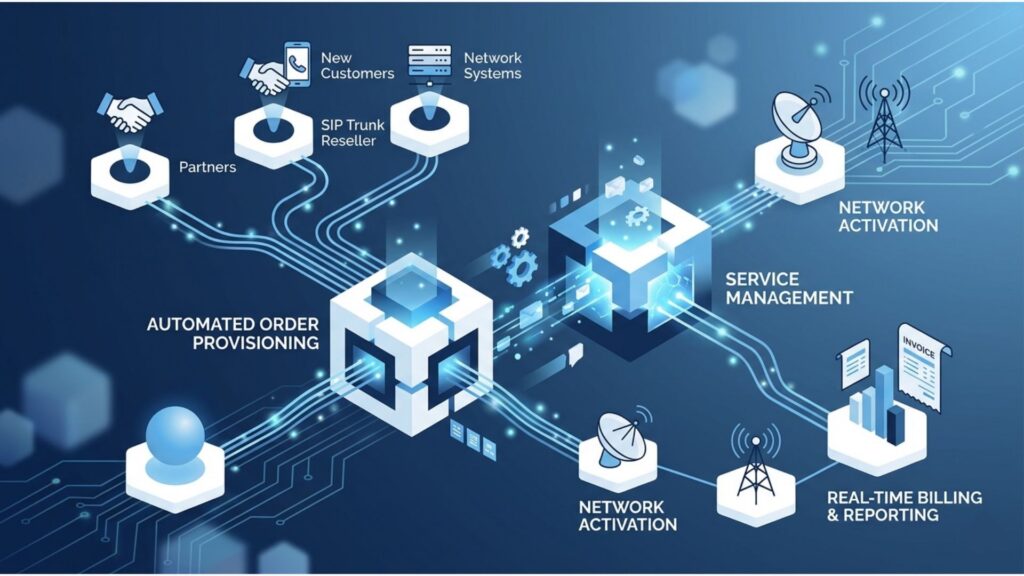
Automated provisioning is another hallmark of mature reseller platforms. The ability to activate new SIP trunks, port phone numbers, and configure features through a self-service control panel eliminates the back-and-forth that slows down sales cycles. Partners who can deliver same-day activation win business that competitors with manual processes can’t capture.
Billing and tax automation removes one of the largest operational burdens from your plate. Telecommunications taxation is notoriously complex, with rates and rules varying by jurisdiction. Platforms that handle tax calculation, collection, and remittance let you focus on sales rather than compliance paperwork.
Tier-1 network connectivity ensures the call quality your customers demand. Reseller programs built on redundant, carrier-grade infrastructure deliver reliability that protects your reputation. When your upstream provider experiences outages or quality issues, your customers blame you regardless of where the fault lies.
Contract flexibility matters for partners at different stages of growth. Programs requiring long-term commitments, minimum volumes, or significant upfront investment create barriers that prevent many resellers from getting started. The most partner-friendly platforms offer no-contract arrangements with no upfront costs, letting you scale at your own pace.
Finally, dedicated partner support distinguishes true reseller programs from wholesale arrangements. Access to knowledgeable support teams who understand the channel model helps you resolve issues quickly and maintain customer satisfaction.
Why Does Branding Control Matter for SIP Trunk Partners?
Building a telecom practice requires establishing your company as a trusted provider in your customers’ minds. Branding control from the right SIP trunk partner makes this possible.
When customers interact exclusively with your brand, they develop loyalty to your company rather than the underlying carrier. This loyalty translates into higher retention rates because switching providers means leaving a relationship they value. In contrast, customers who know exactly where their service originates have no particular attachment to the reseller in the middle of the transaction.
Branding control also protects your margins. Customers who see your competitors offering the same upstream service can easily compare prices and demand discounts. White-label SIP programs allow you to differentiate based on service quality, support responsiveness, and the overall experience you deliver.
The equity you build in your brand has long-term value beyond monthly commissions. A white-label SIP trunking business with strong customer relationships becomes an asset that can be sold or expanded into adjacent services. Wholesale arrangements where the carrier owns the customer relationship leave you with little to show for years of sales effort.
How Does Automation Impact Reseller Success?
The operational efficiency of your practice determines how many customers you can serve profitably. Automation makes scaling possible without proportional increases in administrative overhead.
Self-service provisioning is the most visible automation benefit. Partners who can configure new accounts, add features, and port numbers without opening support tickets move faster than competitors who wait for carrier fulfillment teams. Speed matters because business customers often need SIP trunking activated quickly to support moves, expansions, or system migrations.
The broader trend toward unified communications reinforces why automation matters. The unified communications market reached $136.11 billion in 2023 and is projected to grow at 17.4% CAGR through 2030. Businesses increasingly expect integrated communication solutions that work seamlessly across voice, video, and messaging. Resellers who can provision services quickly and integrate with existing systems capture more of this growing demand.
Billing automation operates behind the scenes but delivers equally important benefits. Generating invoices, processing payments, handling failed transactions, and managing collections consume time when done manually. Platforms that automate these functions let you add customers without adding administrative staff.
Tax compliance automation deserves special attention because the consequences of errors are severe. Telecom services are subject to federal, state, and local taxes that vary by location and service type. Manually calculating these taxes across multiple jurisdictions invites mistakes that lead to penalties and interest charges. Automated tax engines apply the correct rates and handle remittance, eliminating this risk.
One reseller described the impact of working with a partner-focused platform this way: “It helped us fill a needed voice solution gap which has, in turn, made our company more competitive with less risk and investment. In fact, it has been the fastest-growing offering for our company in less than one year.”
What Should You Look for in a White-Label SIP Program?
The following criteria help distinguish white-label SIP programs that will support your growth from those that will constrain it.
Network reliability should top your evaluation checklist. Ask potential partners about their carrier relationships, redundancy architecture, and uptime guarantees. Tier-1 network connectivity with geographic diversity protects against outages that damage your reputation. Request historical uptime data and references from current partners who can speak to real-world performance.
Partner support structures reveal how the provider views the channel relationship. Dedicated account managers, priority support queues, and training resources indicate genuine investment in partner success. Programs that route resellers through the same support channels as retail customers signal that the channel is an afterthought rather than a strategic priority.
Flexible pricing models accommodate partners at different stages of development. Some programs offer channelized pricing with unlimited calling for predictable budgeting. Others provide metered options with per-minute rates for customers with variable usage patterns. The best platforms offer both, letting you match pricing to customer needs. Guidance on selecting SIP trunk providers can help you evaluate these options.
Low barriers to entry enable faster market testing. Programs requiring significant upfront investment, long-term contracts, or minimum volume commitments force you to bet heavily before validating demand. No-contract arrangements with no upfront costs let you start small, learn the business, and scale as you gain confidence.
Platform usability affects your daily operations and customer experience. Request demonstrations of the partner portal, provisioning tools, and reporting dashboards. Interfaces that require extensive training or generate frequent support tickets add hidden costs that erode profitability.
Frequently Asked Questions
What is the main difference between a SIP reseller and a wholesale voice customer?
A SIP reseller operates under their own brand with tools for customer management, billing, and support. A wholesale voice customer purchases bulk minutes without branding capabilities or operational infrastructure, functioning essentially as a pass-through for carrier capacity.
Can I make more money with wholesale voice or a SIP reseller program?
Reseller programs typically generate better long-term returns because they include recurring revenue structures, automated billing, and customer ownership. Wholesale voice may offer lower per-minute costs, but the investment required to build billing and support systems often eliminates margin advantages.
Do I need technical expertise to become a SIP trunk partner?
Most modern reseller platforms handle the technical complexity, allowing partners to focus on sales and customer relationships. Basic understanding of voice over IP concepts helps with customer conversations, but you don’t need to be a telecommunications engineer to succeed.
How long does it take to start reselling SIP trunks?
With the right partner, you can begin selling within days of signing up. Platforms designed for resellers offer streamlined onboarding, training resources, and provisioning tools that accelerate time-to-revenue compared to building your own infrastructure.
Start Building Your SIP Reseller Business
The distinction between wholesale voice and a true SIP reseller program determines whether you build a sustainable business or remain dependent on commodity margins. White-label branding, automated operations, and genuine partner support create the foundation for recurring revenue that grows over time. The market opportunity is substantial, but capturing it requires choosing the right partner from the beginning.
SIPTRUNK provides a reseller platform designed specifically for telecom agents, IT consultants, VARs, and managed service providers who want to add SIP trunking to their service portfolios. With no contracts, no upfront costs, and Tier-1 network reliability, partners can start selling quickly and scale confidently. Get started with SIPTRUNK to explore how our platform can support your growth.

Mitch leads the Sales team at BCM One, overseeing revenue growth through cloud voice services across brands like SIPTRUNK, SIP.US, and Flowroute. With a focus on partner enablement and customer success, he helps businesses identify the right communication solutions within BCM One’s extensive portfolio. Mitch brings years of experience in channel sales and cloud-based telecom to every conversation.