

How Businesses Use SIP Trunking to Modernize Voice Systems
Businesses can modernize their voice infrastructure using SIP trunking without replacing existing PBX systems, achieving cost reductions while maintaining operational continuity.
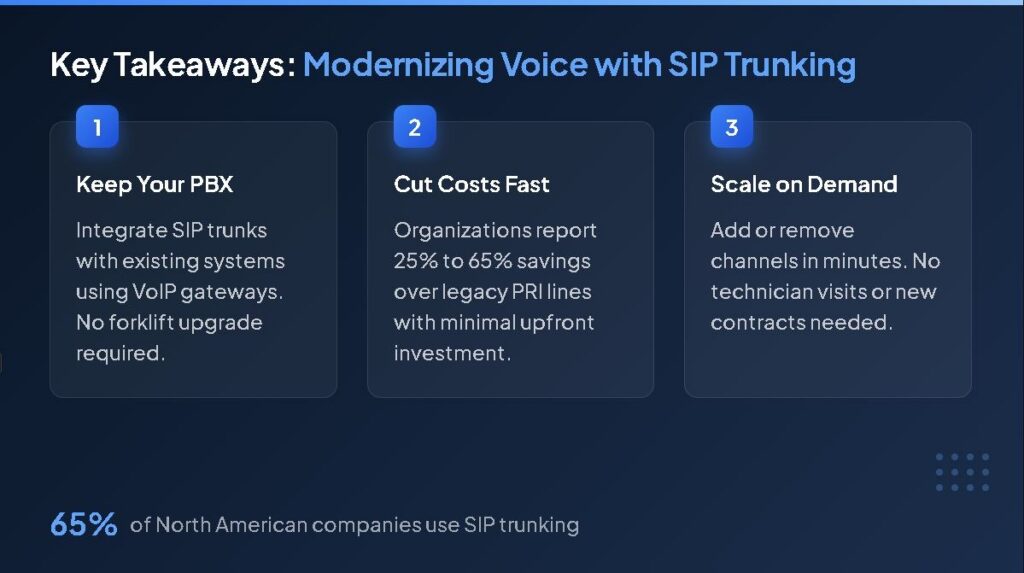
- SIP trunking integrates with legacy PBX hardware through VoIP gateways, allowing organizations to preserve their current investments while gaining modern capabilities.
- Companies migrating from traditional phone lines to SIP trunks report average cost reductions of 25% to 65%, with potential savings reaching even higher depending on call volume and legacy infrastructure costs.
- Hybrid telecom upgrades enable phased migration strategies that minimize disruption to daily operations and eliminate the need for employee retraining.
For resellers, understanding SIP trunking integration positions you to deliver measurable value to customers who want modernization without the risks of full system replacement.
The pressure on businesses to modernize voice systems continues to intensify. The SIP trunking market now stands at $85.07 billion and is projected to reach $181.58 billion by 2031, reflecting a 16.64% CAGR driven by enterprises shifting toward IP-based voice services. Approximately 65% of North American companies have already adopted SIP trunking as part of their communication strategy, positioning it as mainstream infrastructure.
Yet many organizations hesitate. They have functioning PBX systems, trained staff, and established workflows. The prospect of ripping out existing infrastructure creates anxiety about downtime, retraining costs, and implementation risks. This hesitation creates an opportunity for resellers who can articulate a better path forward: SIP trunking integration that modernizes voice capabilities without forcing a complete system overhaul.
The following sections examine how businesses accomplish this transition, the cost implications of hybrid approaches, and the practical steps involved in connecting legacy equipment to modern SIP infrastructure.
What Does It Mean to Modernize Voice Systems with SIP Trunking?
Voice system modernization through SIP trunking involves replacing traditional analog phone lines or PRI circuits with internet-based connections while retaining the PBX hardware that routes internal calls. This upgrade enhances how a business connects to the public telephone network without requiring changes to desk phones, internal extensions, or established call-handling procedures.
Why Legacy PBX Systems Still Dominate
Despite decades of technological advancement, legacy PBX systems remain widespread in organizations of all sizes. These systems work. They reliably handle call routing, voicemail, hunt groups, and auto-attendants. Staff members understand how to use them. The equipment has often been fully depreciated, meaning the ongoing cost of ownership is limited to maintenance and phone line charges.
The challenge is that these systems connect to the outside world through expensive, inflexible infrastructure. Traditional PRI lines require businesses to purchase capacity in fixed increments, typically 23 channels at a time. Organizations pay for this capacity regardless of actual usage. Long-distance and toll charges accumulate on every outbound call. Adding capacity requires scheduling technician visits and waiting for physical line installation.
The Role of SIP Trunking in Voice Modernization
SIP trunking replaces these physical connections with virtual phone lines that operate over existing internet infrastructure. Voice signals convert to digital packets that travel across IP networks, eliminating the need for dedicated circuit-switched connections. Each SIP channel handles one concurrent call, and businesses can add or remove channels on demand without hardware changes.
Modernization occurs at the point where the PBX connects to the outside world. Internal operations remain unchanged. Employees continue using familiar phones and features while the organization gains access to lower calling rates, flexible capacity scaling, and advanced capabilities like geographic redundancy and disaster recovery routing.
How Does SIP Trunking Integrate with Legacy PBX Infrastructure?
The technical bridge between legacy PBX systems and SIP trunking services involves specific hardware and configuration components. Understanding these elements helps resellers explain the integration process to customers and set accurate expectations about implementation requirements.
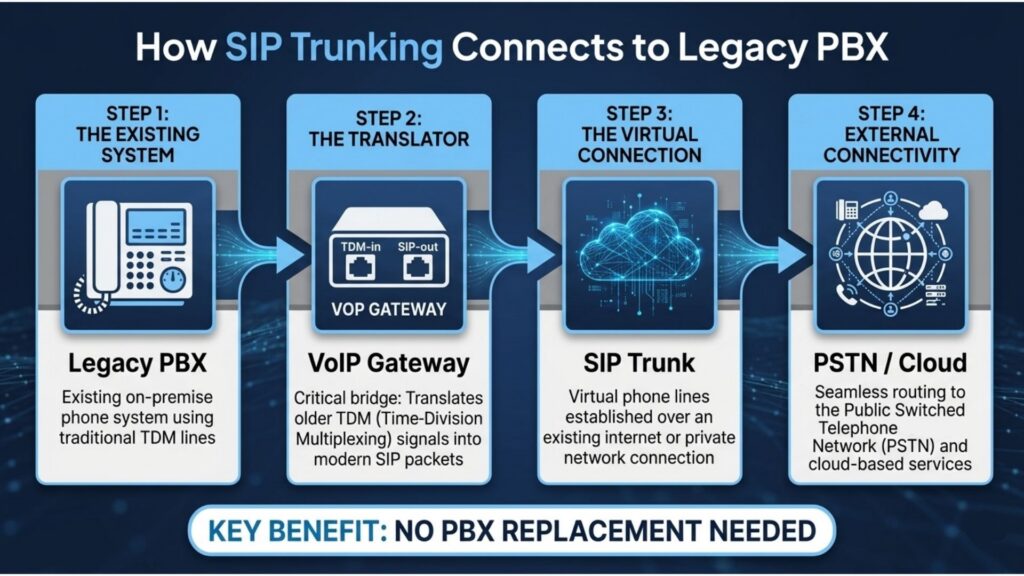
Traditional PBX systems communicate using time-division multiplexing (TDM) protocols over T1/PRI lines. SIP trunking operates on Session Initiation Protocol over IP networks. These two technologies speak different languages, requiring translation equipment at the point of connection.
VoIP gateways perform this translation function. These devices connect to the PBX using traditional interfaces (T1/PRI ports or analog FXO/FXS ports) on one side and to the internet via Ethernet on the other. The gateway converts TDM voice signals into SIP packets for outbound calls and reverses the process for inbound calls. From the PBX perspective, the gateway appears to be a standard phone line connection.
Session border controllers (SBCs) add security and interoperability functions to this connection. SBCs manage firewall traversal, encrypt voice traffic, and ensure compatibility between different SIP implementations. Hybrid SBCs combine gateway and security functions in a single device, simplifying deployments and providing a clear migration path when organizations eventually replace their legacy PBX with IP-native systems.
The integration process typically follows a straightforward sequence. The gateway or hybrid SBC connects to the existing PBX using available trunk ports. Network configuration establishes connectivity to the SIP trunking provider. Call routing rules direct traffic through the new connection while maintaining the option to fall back to existing lines during the transition period. Test calls verify audio quality and feature functionality before the organization commits to full migration.
What Are the Cost Benefits of a Hybrid Telecom Upgrade?
The financial case for SIP trunking integration rests on measurable reductions in both fixed and variable telecom expenses. Organizations replacing PRI lines with SIP trunks consistently report substantial monthly savings, while the hybrid approach minimizes the upfront investment required to achieve these results.
Comparing PRI Lines vs. SIP Trunk Costs
Traditional PRI circuits carry high fixed costs regardless of usage patterns. Each PRI delivers 23 voice channels and generally costs several hundred dollars per month, depending on location and carrier, before factoring in long-distance charges and maintenance fees. Organizations needing more concurrent call capacity must purchase additional PRIs in full, even if they only need a few extra channels. Installation fees and service contracts add to the total expense.
SIP trunking restructures these economics. Channel-based pricing allows businesses to purchase exactly the capacity they need, with provider rates varying based on volume commitments and features. Metered options offer lower base costs for organizations with lighter call volumes, charging per minute rather than per channel. International rates drop compared to traditional carrier pricing.
The SIP trunking market reflects these advantages, driven by cost savings between 25% and 65% over legacy PRI lines. Adopting SIP trunking is a straightforward financial decision for most organizations.
Calculating Return on Investment
The hybrid approach accelerates ROI by eliminating the need for PBX replacement. A VoIP gateway that connects a legacy system to SIP trunking services costs a fraction of the cost of new phone system hardware. Organizations preserve their investment in existing equipment while immediately capturing monthly savings on telecom charges.
Consider an organization currently spending $1,500 monthly on PRI circuits before long-distance charges. Replacing these with appropriately sized SIP trunk capacity can reduce the base connectivity cost, often by 40% or more. Eliminating per-minute long-distance fees pushes total savings even higher. The gateway hardware typically pays for itself within the first year of operation.
For resellers, this straightforward ROI calculation becomes a powerful sales tool. Customers can see exactly how the numbers work and understand that modernization doesn’t require abandoning functional equipment. The conversation shifts from “replace your phone system” to “reduce your phone bill while adding capabilities.”

What Are the Steps to Implement SIP Trunking Integration?
Successful SIP trunking integration follows a structured process that minimizes risk and ensures continuity throughout the transition. Resellers who understand these steps can guide customers through implementation with confidence and set appropriate expectations about timeline and complexity.
- Assess current infrastructure. Document the existing PBX model, trunk interfaces, and concurrent call requirements. Determine whether the system supports SIP connectivity directly or requires gateway equipment. Identify any analog devices like fax machines or alarm systems that need special consideration.
- Evaluate network readiness. SIP trunking requires adequate bandwidth and proper network configuration. Voice traffic needs quality of service (QoS) prioritization to ensure call clarity. Firewalls must permit SIP signaling and RTP media traffic. Organizations with unreliable internet connections may need backup connectivity options.
- Select appropriate gateway hardware. Match gateway capacity to concurrent call requirements. Hybrid SBCs offer advantages for organizations planning eventual PBX replacement. Ensure compatibility with both the existing PBX and the selected SIP trunking provider.
- Configure and test the connection. Install gateway equipment and establish connectivity to the SIP provider. Program call routing rules on the PBX to direct traffic through the new trunks. Conduct test calls covering inbound, outbound, and transfer scenarios. Verify caller ID presentation and emergency calling functionality.
- Execute phased migration. Begin by routing a portion of traffic through SIP trunks while maintaining legacy lines as backup. Monitor call quality and address any issues. Gradually shift more traffic to the new connection as confidence builds. Disconnect legacy lines only after confirming stable operation.
- Document and train. While end users typically notice no change in phone operation, IT staff need documentation covering the new infrastructure. Provide information about monitoring tools, troubleshooting procedures, and escalation contacts for technical support.
This phased approach allows organizations to validate SIP trunking benefits before fully committing. The ability to maintain legacy lines during transition provides a safety net that reduces implementation risk to near zero.
Why Do Businesses Choose Hybrid Over Full Replacement?
The decision to integrate SIP trunking with existing infrastructure rather than deploying entirely new phone systems reflects practical business considerations that extend beyond technical capability.
Budget constraints often drive the hybrid approach. Full unified communications deployments require substantial capital expenditure for new hardware, licensing, and professional services. Many organizations can’t justify this investment when their current PBX adequately handles internal calling. SIP trunking integration delivers immediate cost savings with minimal upfront spending, freeing budget for other priorities.
Operational continuity matters equally. Phone systems are mission-critical infrastructure. Extended downtime during system replacement creates real business costs through missed calls, frustrated customers, and disrupted workflows. The hybrid approach maintains existing operations throughout the transition, with failover capability to protect against implementation issues.
Employee familiarity reduces hidden costs. Retraining staff on new phone systems consumes time and creates temporary productivity losses. When desk phones and features remain unchanged, employees continue working without interruption. The modernization happens invisibly from their perspective.
A Practical Scenario
Consider a professional services firm with 50 employees operating a legacy Nortel or Avaya system. The PBX works reliably, staff know how to use the features, and the only complaint involves high monthly phone bills and inflexible capacity.
Rather than proposing a six-figure phone system replacement project, a reseller can demonstrate how SIP trunking integration solves the actual problem. Install a gateway device, configure SIP trunks, and the firm immediately begins saving money. The existing investment continues delivering value. When the organization eventually decides to upgrade its PBX, the SIP infrastructure remains in place, and the transition becomes even simpler.
This scenario plays out repeatedly across industries. Healthcare practices, legal offices, manufacturing facilities, and retail operations all benefit from the same hybrid upgrade path that modernizes connectivity without disrupting established operations.
What Features Does SIP Trunking Add to Modernized Voice Systems?
SIP trunking integration provides capabilities that legacy PSTN connections can’t match. Resellers can highlight this tangible value when discussing modernization with prospective customers.
Instant scalability eliminates capacity planning anxiety. Adding SIP channels takes minutes rather than weeks. Seasonal businesses can increase capacity during peak periods and scale back afterward. Growing organizations add lines as needed without scheduling technician visits or signing new contracts.
Geographic flexibility enables virtual presence anywhere. Organizations can obtain local phone numbers in any area code, allowing distributed teams to present a local caller ID regardless of physical location. Multi-site businesses can consolidate trunking while maintaining distinct local identities for each office.
Disaster recovery becomes achievable for organizations of any size. SIP trunking providers can automatically reroute calls to backup locations, mobile phones, or cloud-based answering services when primary sites become unavailable. This redundancy was previously available only to enterprises with significant telecom budgets.
Enhanced security protects voice communications through encryption. Modern SIP implementations support TLS for signaling and SRTP for media, preventing eavesdropping on sensitive conversations. Secure SIP trunking has become increasingly important as voice traffic moves across internet infrastructure.
Unified communications readiness positions organizations for future expansion. SIP trunking creates the foundation for integrating voice with video, messaging, and collaboration platforms. Even organizations not ready for full unified communications today can adopt these capabilities incrementally without replacing their trunking infrastructure.
Frequently Asked Questions
Can SIP trunking work with any PBX system?
Most PBX systems manufactured in the past two decades can connect to SIP trunking services, either directly or through gateway equipment. Systems with built-in SIP support require only configuration changes. Older TDM-based systems need VoIP gateways to translate between protocols. Even vintage key systems can often connect using analog telephone adapters.
How long does SIP trunking integration typically take?
Simple implementations with modern equipment can be completed in a single day. More complex environments involving legacy PBX systems, multiple locations, or extensive testing requirements may take one to two weeks. Phased migration allows organizations to begin realizing benefits immediately while completing full implementation over time.
What happens to existing phone numbers during migration?
Phone numbers transfer to the new SIP trunking provider through porting. The organization retains all existing numbers, and callers experience no change in dialing behavior. Porting typically takes two to four weeks, depending on the releasing carrier, but temporary forwarding can maintain continuity during the transition.
Does SIP trunking require dedicated internet bandwidth?
SIP trunking operates over standard internet connections, though voice traffic benefits from adequate bandwidth and QoS configuration. Each concurrent call typically consumes between 80 and 100 Kbps, depending on the audio codec used. Organizations with limited bandwidth or unreliable connections may benefit from dedicated voice circuits or SD-WAN implementations that prioritize voice traffic.
Modernize Voice Systems with the Right Partner
SIP trunking has become essential infrastructure for businesses seeking to reduce telecom costs, increase operational flexibility, and prepare for future communication capabilities. The ability to integrate SIP trunks with existing PBX systems removes the barriers that previously made voice modernization seem disruptive and expensive.
Resellers have a clear value proposition. Customers get immediate cost savings, maintained operational continuity, and a foundation for continued modernization. The conversation focuses on solving real problems rather than forcing unnecessary equipment purchases.
SIPTRUNK provides the reseller platform that makes delivering these benefits straightforward. With Tier-1 network connectivity, simple provisioning tools, and support designed for channel partners, we enable resellers to help their customers confidently modernize voice infrastructure. Get started today to explore how SIP trunking integration can become a core offering in your portfolio.

Mitch leads the Sales team at BCM One, overseeing revenue growth through cloud voice services across brands like SIPTRUNK, SIP.US, and Flowroute. With a focus on partner enablement and customer success, he helps businesses identify the right communication solutions within BCM One’s extensive portfolio. Mitch brings years of experience in channel sales and cloud-based telecom to every conversation.