

Building a Profitable VoIP Reseller Business
A VoIP reseller business turns one-time sales efforts into predictable monthly recurring revenue, often at margins traditional telecom commissions can’t match.
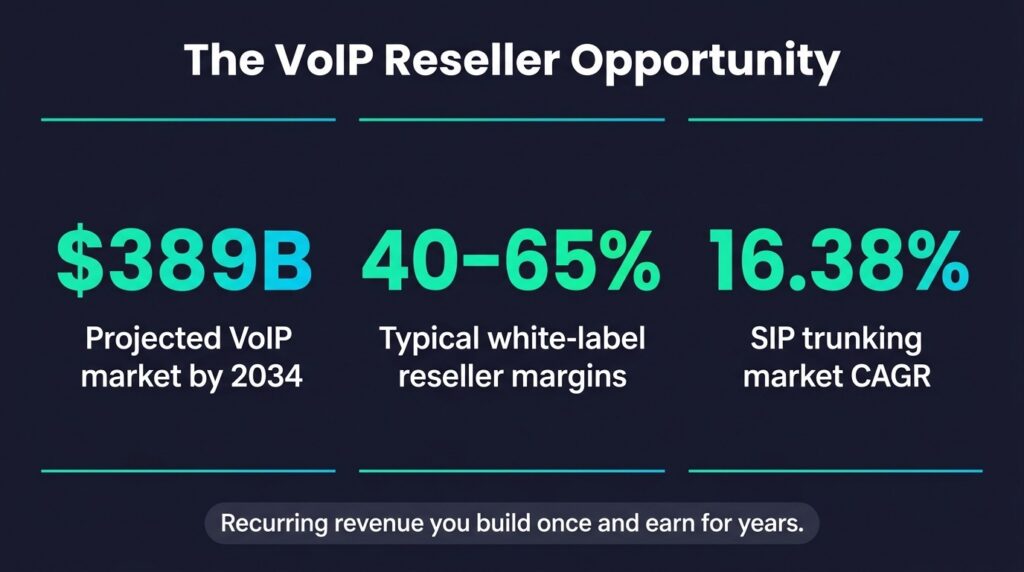
- The VoIP market is projected to grow from $176.16 billion in 2025 to $388.97 billion by 2034, signaling sustained demand for the resellers who serve it.
- White-label resellers commonly earn 40% to 65% margins, compared with roughly 20% to 25% for referral agents who only collect a commission.
- Recurring revenue compounds. Every customer you keep adds to your monthly recurring revenue and raises the lifetime value of your book of business.
- Managed service providers can bundle voice with existing IT services to lift revenue per account and reduce churn.
If you want durable, scalable income, build your VoIP business on a white-label platform that lets you own the pricing, branding, and customer relationships.
The VoIP reseller opportunity rewards companies that want recurring income without the expense of building telecom infrastructure from scratch. The VoIP market is forecast to grow from $176.16 billion in 2025 to $388.97 billion by 2034, advancing at a CAGR of 10.4%. That trajectory points to steady, long-term demand, which makes a reseller model worth building around. If you’re looking for a scalable way to expand your services, a VoIP reseller business offers a proven path to monthly recurring revenue while you keep control of the customer experience.
What separates resellers who build real businesses from those who stall is a clear grasp of the financial model. The sections below walk through how the money actually works: the recurring revenue engine, margins you can expect, and monetization strategies that let managed service providers turn voice into a durable profit center.
What Is a VoIP Reseller Business, and Why Is It Profitable Now?
A VoIP reseller business buys voice services wholesale from a platform provider and sells them to end customers under its own brand, keeping the difference as profit. You handle sales, pricing, and customer relationships, while your provider runs the infrastructure, provisioning, and backend support. This division of labor makes the model accessible. You don’t need to own a softswitch or hire a network engineering team to start earning.
The timing is favorable because businesses are retiring legacy phone systems faster than ever. Companies want flexible, cost-effective communication that supports remote and hybrid work, and they prefer to buy it from a trusted local partner rather than a faceless carrier. That preference creates room for resellers who can package, brand, and support voice service for a specific audience. Telecom agents, IT consultants, VARs, and MSPs are all well positioned to fill that role, and many start by reselling VoIP services alongside offerings they already sell.
How Does the Recurring Revenue Model Work?
The recurring revenue model works by charging customers a predictable monthly fee for service, so revenue accumulates instead of resetting with every sale. Unlike one-time hardware or project work, a voice subscription keeps paying month after month for as long as the customer stays. You sell once and earn repeatedly.
What Is Monthly Recurring Revenue in a VoIP Business?
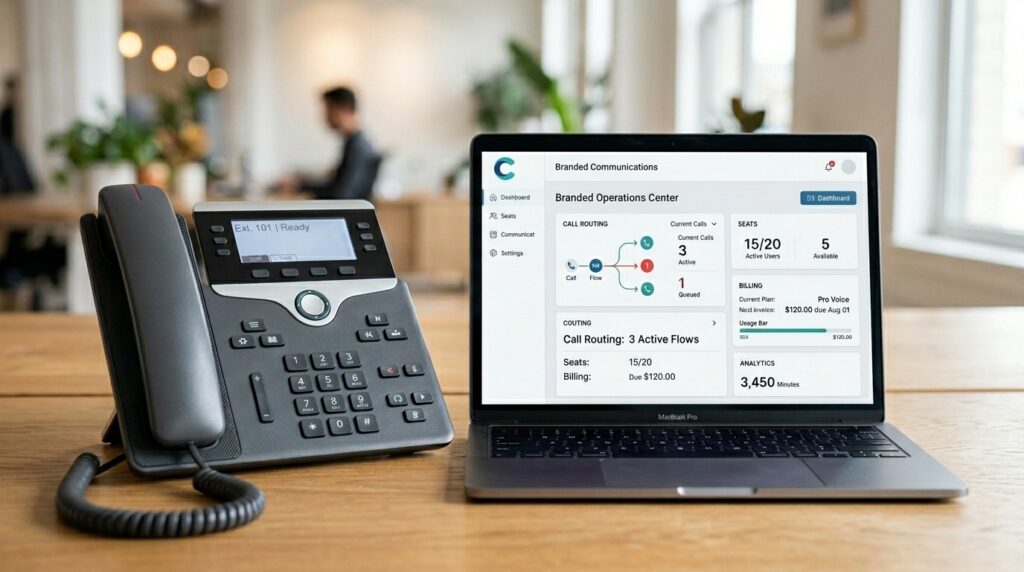
Monthly recurring revenue (MRR) is the total predictable income your customer base generates each month from seats, phone numbers, and add-on features. It’s an important metric for tracking the health of a reseller business because it shows whether your revenue base is growing, flat, or shrinking. Two related numbers matter alongside it: average revenue per user (ARPU), which measures how much each account contributes, and gross margin, which measures how much of that revenue you keep after wholesale costs.
Understanding these metrics helps you make smarter decisions about pricing and upsells. When you raise ARPU by adding services to an existing account, you grow revenue without the cost of acquiring a new customer. When you reduce churn by delivering reliable support, you protect the MRR you’ve already built. Together, these levers compound into a steadily larger business.
What Does a Simple Recurring Revenue Example Look Like?
Here’s an illustrative scenario to make the math concrete. Suppose you sign 25 small business customers in your first year, each paying $300 per month for voice service. That produces $7,500 in monthly recurring revenue, or $90,000 annualized, from accounts you only had to sell once. At a 50% gross margin, roughly $3,750 of that monthly total is profit before your own operating costs.
Now extend the picture. If you retain those customers and add 25 more accounts in year two at the same average, your MRR roughly doubles to $15,000 while your acquisition effort stays similar. Because the first year’s customers keep paying, growth stacks on top of growth. This compounding effect is the core reason resellers prize recurring revenue, and it’s why guides to reselling SIP trunks emphasize retention as much as acquisition.
What Profit Margins Can VoIP Resellers Expect?
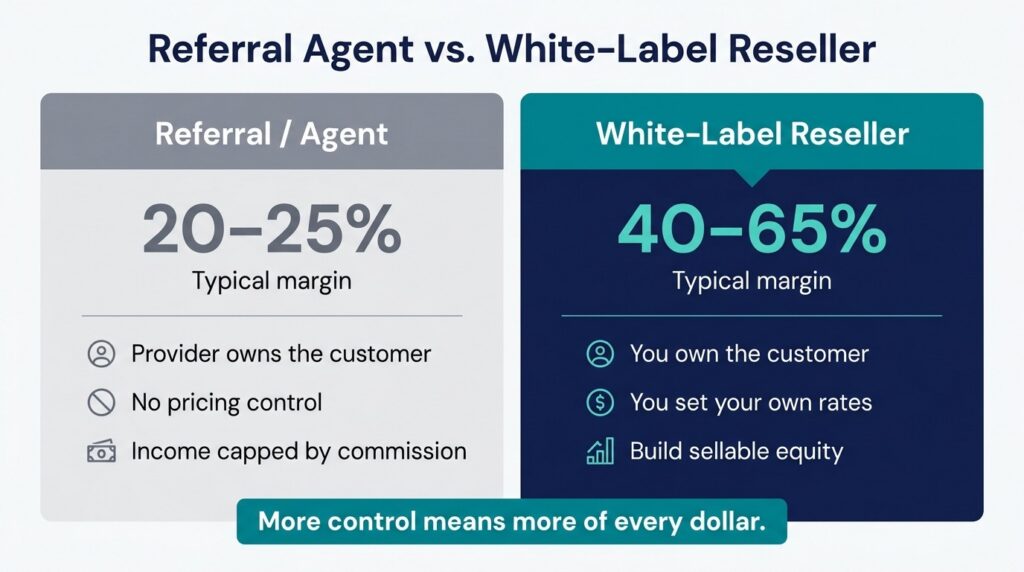
VoIP reseller margins vary with the business model you choose, but white-label resellers consistently earn more than referral agents. Industry reporting puts VoIP margins from 20% to 70%, with the spread driven largely by how much of the customer relationship you own. The more control you take over pricing, branding, and support, the more of the revenue you keep.
The table below summarizes the two most common approaches and what each one typically returns.
| Model | Typical Margin | Who Owns the Customer | Pricing Control |
| Referral / agent | 20% to 25% | The provider | None |
| White-label reseller | 40% to 65% | You | You set your own rates |
The referral model is simpler to start because you pass leads to a provider and collect a commission. The trade-off is that you don’t own the customer, you can’t set prices, and your income is capped by someone else’s commission schedule. The white-label model asks you to take on sales and basic support, and in return, you keep a far larger share of every dollar and build equity in a customer base that’s yours to grow or sell later. For most companies serious about building a business rather than a side commission, the white-label path is the stronger choice.
How Can MSPs Monetize VoIP Reselling?
Managed service providers monetize VoIP reselling by bundling voice into the IT stack they already manage, which raises revenue per client and deepens retention. An MSP that adds branded voice service becomes a single source for both IT and communications, and customers who rely on one provider for critical systems rarely switch. That stickiness is worth as much as the margin itself because retained accounts keep MRR compounding.
The most effective MSPs treat voice as a platform to cross-sell and upsell, not a standalone line item. A few proven monetization moves include:
- Bundling voice with managed IT and security so a single monthly invoice covers more of the customer’s needs and raises ARPU.
- Adding higher-value features like toll-free numbers, additional call paths, and call routing for business continuity as accounts mature.
- Tiering your packages so customers can move up to richer service levels as they grow, turning account expansion into a built-in growth channel.
Each of these tactics increases the lifetime value of a customer you’ve already won. When you combine bundling with reliable support, you create accounts that grow over time and resist churn, which is exactly the foundation on which a profitable reseller business is built.
How Do You Build a Profitable VoIP Reseller Business?
Building a profitable VoIP reseller business comes down to choosing the right partner, targeting the right customers, and pricing your service for sustainable margins. The steps below outline a practical path from launch to recurring revenue.
- Choose a reseller-focused platform. Look for automated provisioning, integrated billing, compatibility with major IP PBX systems, no long-term contracts, and no upfront hardware costs. The right platform determines how quickly and profitably you can operate.
- Define a narrow target market. Instead of selling to everyone, focus on a specific niche such as local clinics, multi-site retailers, or professional services firms. Specific positioning closes more deals than a generic pitch.
- Set a pricing strategy. Most successful resellers use markup pricing, buying wholesale and adding a margin that reflects the sales, setup, and support value they provide. Value-based and tiered pricing can further boost revenue as accounts grow.
- Build a focused marketing plan. Combine SEO for high-intent searches, targeted outreach, and educational content that positions you as the knowledgeable local choice for modern voice service.
- Invest in customer support. Responsive service reduces churn and turns satisfied customers into referrals, protecting the recurring revenue you’ve worked to build.
Follow these steps with the right platform behind you, and scaling your brand becomes achievable and sustainable rather than overwhelming. The model rewards consistency: each account you add and keep makes the next one more profitable.
Why Does SIP Trunking Strengthen a VoIP Reseller Business?
SIP trunking strengthens a VoIP reseller business by giving you a high-margin, easy-to-bundle service that connects customer phone systems to the public network over the internet. It eliminates the cost of legacy lines and hardware, and it scales cleanly as a customer grows. For resellers, that means another recurring revenue stream layered on top of the accounts you already serve.
The market behind it is expanding. The SIP trunking market is projected to grow from $73.14 billion in 2025 to $181.58 billion by 2031 at a CAGR of 16.38%, with cost savings of 25% to 65% over legacy PRI lines fueling adoption. Those savings give you a clear, honest sales message: you can lower a customer’s phone costs while upgrading their flexibility. Offering SIP trunking through a dedicated SIP trunk reseller platform lets you deepen value with existing clients and win new ones at the same time.
Frequently Asked Questions
Do you need technical expertise to start a VoIP reseller business? No extensive technical background is required. A reseller-focused platform handles provisioning, billing, and infrastructure, so you can concentrate on sales and customer relationships. Most resellers get up to speed quickly with the training and support a good partner provides.
What profit margins can a VoIP reseller realistically expect? Margins depend on your model. Referral agents typically earn 20% to 25%, while white-label resellers who own pricing and the customer relationship commonly earn 40% to 65%. The more of the customer experience you control, the higher your margin potential.
How much does it cost to start, and how fast can you launch? With the right white-label partner, there are no upfront hardware costs and no contracts to sign, so startup costs stay low. Because the platform handles the technical setup, many resellers can configure their branding and begin selling within days rather than months.
Is VoIP reselling a good fit for managed service providers? Yes. MSPs are especially well suited because they can bundle voice with the IT services they already deliver. That bundling raises revenue per client, strengthens retention, and positions the MSP as a single source for technology and communications.
Ready to Build Your VoIP Reseller Business?
A profitable VoIP reseller business is built on a simple foundation: predictable recurring revenue, healthy margins, and a partner that handles the technical heavy lifting so you can focus on selling and serving customers. When you own the pricing, the brand, and the relationship, every account you add compounds into a more valuable business over time.
SIPTRUNK makes that foundation easy to build, with automated provisioning, flexible subscription options, private labeling, and expert support designed specifically for resellers. Whether you’re expanding your current services or launching a new brand, SIPTRUNK gives you everything you need to grow with confidence. Get started today and turn your reseller vision into a recurring revenue business.

Mitch leads the Sales team at BCM One, overseeing revenue growth through cloud voice services across brands like SIPTRUNK, SIP.US, and Flowroute. With a focus on partner enablement and customer success, he helps businesses identify the right communication solutions within BCM One’s extensive portfolio. Mitch brings years of experience in channel sales and cloud-based telecom to every conversation.