

Selling SaaS: The Definitive Guide for Resellers in 2026
Selling SaaS through reseller programs offers telecom agents, IT consultants, and managed service providers a proven path to scalable, recurring revenue.
- The global SaaS market is projected to grow from $375.57 billion in 2026 to $1.48 trillion by 2034, creating substantial opportunities for channel partners who can position themselves as trusted advisors.
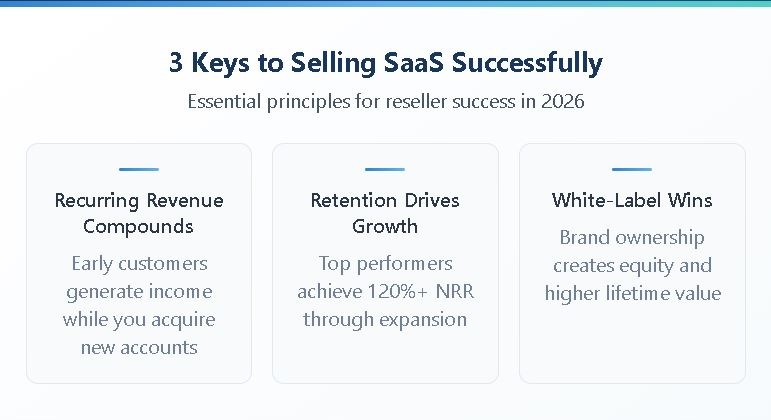
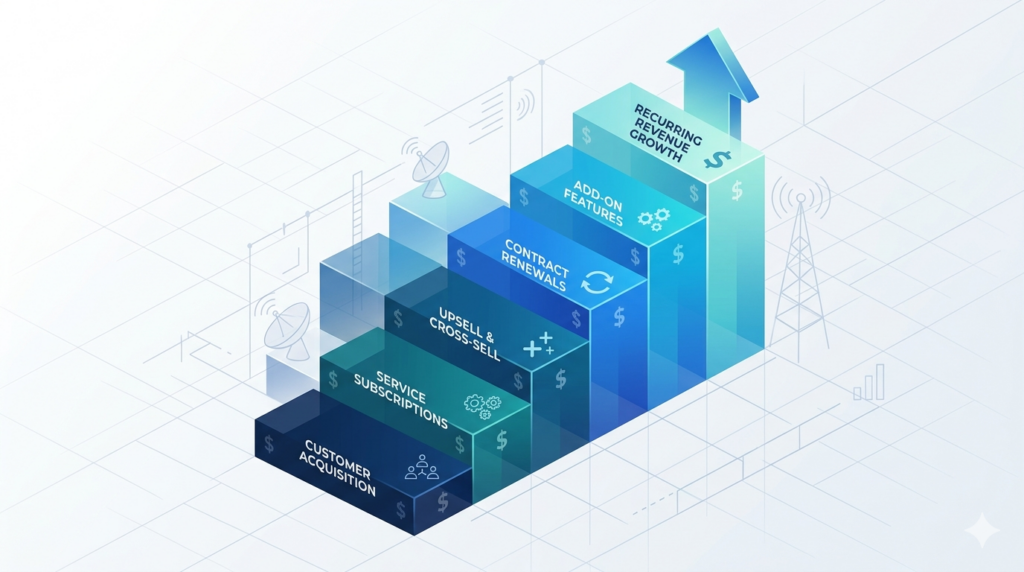
- Recurring revenue models change business economics, allowing resellers to build compounding income streams rather than chasing one-time transactions.
- White-label platforms eliminate infrastructure barriers, enabling resellers to offer branded solutions without development costs or technical complexity.
- Success in SaaS sales depends on customer retention and expansion, making consultative selling and ongoing relationship management more valuable than aggressive closing tactics.
Resellers who master subscription economics and position themselves within high-growth categories, such as communications and unified platforms, will build sustainable businesses that appreciate in value over time.
The subscription economy has redefined how businesses acquire and pay for technology. Organizations that once purchased perpetual software licenses now prefer flexible, cloud-delivered solutions that scale with their needs. This shift creates a compelling opportunity for telecom agents and IT consultants seeking diversified revenue streams beyond traditional project-based work.
Selling SaaS requires a different mindset than transactional product sales. The subscription model rewards patience, relationship building, and a genuine commitment to customer outcomes. Each customer you acquire generates monthly revenue for as long as they remain active, transforming your business from a constant hunt for new deals into a foundation of predictable, growing income.
Theglobal SaaS market reached $375.57 billion in 2026, exhibiting an 18.7% CAGR through 2034. For resellers positioned in high-demand categories, this growth translates into expanding addressable markets and increasing customer willingness to adopt cloud-based solutions.
What Makes Selling SaaS Different from Traditional Software Sales?
The distinction between SaaS sales and traditional software sales lies in the revenue timeline. Traditional models generate large upfront payments followed by periodic maintenance fees. SaaS delivers smaller monthly payments that accumulate into substantial lifetime value when customers remain engaged and satisfied.
This shift in payment timing changes everything about how successful resellers operate. The initial sale matters less than the ongoing relationship. A customer who pays $200 monthly for three years generates $7,200 in total revenue, while a customer who churns after six months produces only $1,200 from the same starting point. The math compels resellers to prioritize retention alongside acquisition.
Why Does the Subscription Model Change Everything?
Subscription economics create powerful alignment between reseller success and customer outcomes. When your revenue depends on customers continuing to find value, you naturally invest in their success rather than disappearing after the initial transaction. This alignment builds trust and generates referrals that traditional transactional relationships rarely produce.
The compounding nature of recurring revenue also transforms business valuation. A reseller generating $10,000 monthly from a stable customer base possesses a predictable asset that appreciates as new customers join. Buyers of reseller businesses pay premium multiples for recurring revenue compared to project-based income, making the long-term wealth-building potential much greater.
For resellers already managing ongoing client relationships through IT services or telecommunications support, SaaS sales integrate naturally into existing workflows. Your current customers likely need solutions you could provide through reseller partnerships, and the trust you have already established shortens sales cycles.
What Role Does Customer Success Play in SaaS Sales?
Customer success has evolved from a support function into a core revenue driver. Organizations recognize that preventing churn and identifying expansion opportunities within existing accounts often delivers better returns than equivalent investment in new customer acquisition. Resellers who embrace this principle build more defensible businesses.
The most effective SaaS resellers think of themselves as ongoing advisors rather than one-time sellers. They schedule regular check-ins, monitor usage patterns, and proactively suggest optimizations. This consultative approach deepens relationships while surfacing opportunities for additional services or upgraded tiers.
Net Revenue Retention (NRR) is the defining metric for SaaS business health. The median NRR for B2B SaaS companies is 106%, while top-performing companies exceed 120%, meaning their existing customer base generates 20% more revenue year-over-year through expansions and upsells, even before counting new customer acquisition. Resellers who understand and optimize for NRR build exceptionally valuable practices.
How Should Resellers Approach SaaS Sales in 2026?
The SaaS sales environment has matured. Buyers conduct extensive independent research before engaging vendors, arrive at conversations with sophisticated questions, and expect consultative interactions rather than generic pitches. Resellers who succeed adapt their approach to meet these elevated expectations.
Product-led growth (PLG) strategies have gained traction, with many SaaS companies offering free trials or freemium tiers that allow prospects to experience value before purchasing. Understanding how to guide prospects through self-service experiences while adding consultative value at the right moments distinguishes effective resellers from order-takers.
What Is the Product-Led Growth Model?
Product-led growth relies on the product itself to drive acquisition, conversion, and expansion. Users sign up independently, explore functionality without sales intervention, and upgrade when they recognize sufficient value. This model has transformed expectations across the industry, with buyers now anticipating hands-on experience before financial commitment.
For resellers, PLG creates both challenges and opportunities. The challenge involves adding value when prospects can theoretically access products directly. The opportunity emerges from the complexity most businesses face when evaluating, implementing, and optimizing solutions. Resellers who position themselves as implementation experts and ongoing advisors rather than mere access points capture substantial value.
Effective resellers leverage PLG by helping prospects navigate free trials, ensuring they experience core value quickly rather than abandoning products before understanding their potential. This guidance accelerates conversion while building relationships that persist through renewal cycles.
How Do Reseller Programs Create Scalable Revenue?
Reseller programs provide infrastructure that allows entrepreneurs to build scalable businesses without developing proprietary technology. The best programs combine competitive margins, comprehensive training, and operational support that handles billing, provisioning, and technical maintenance on the reseller’s behalf.
White-label programs are the premium tier of reseller opportunities. These arrangements allow partners to brand services as their own, controlling pricing, customer relationships, and service delivery. Customers interact exclusively with the reseller’s brand, creating stronger loyalty and higher lifetime value compared to referral-based models.
The scalability advantage becomes apparent as customer bases grow. Unlike consulting or project work, where revenue scales linearly with hours invested, SaaS reseller revenue compounds as customer counts increase. Once systems and processes are established, adding new customers requires marginal incremental effort while generating substantial marginal revenue.
What Are the Most Important SaaS Sales Metrics to Track?
Successful resellers treat their businesses as data-driven operations, monitoring key metrics that reveal customer health and identify optimization opportunities. Understanding these metrics enables informed decision-making about where to invest time and resources for maximum impact.
- Monthly Recurring Revenue (MRR): The total predictable revenue generated each month from active subscriptions. MRR growth rate indicates business trajectory and helps forecast future cash flow.
- Customer Acquisition Cost (CAC): The total expense required to acquire a new customer, including marketing, sales time, and onboarding costs. Efficient CAC enables profitable scaling.
- Customer Lifetime Value (CLTV): The total revenue expected from a customer throughout their relationship. CLTV should exceed CAC by a factor of three or more for sustainable unit economics.
- Churn Rate: The percentage of customers who cancel within a given period. Reducing churn often delivers better returns than an equivalent investment in acquisition.
- Net Revenue Retention (NRR): Revenue from existing customers compared to the prior period, accounting for expansions, contractions, and churn. NRR above 100% indicates organic portfolio growth.
Tracking these metrics consistently reveals patterns that inform strategic decisions. A rising churn rate might indicate onboarding problems or product-market fit issues with certain customer segments. Declining CLTV could suggest pricing misalignment or competitive pressure requiring response.
How Can Resellers Build Recurring Revenue Through SaaS Sales?
Building sustainable recurring revenue requires intentional choices about which programs to join, how to structure offerings, and where to focus sales efforts. Random opportunism rarely produces the compounding results that strategic positioning enables.
The telecommunications and unified communications sector presents compelling opportunities for selling SaaS. Businesses across every industry require reliable voice, messaging, and collaboration tools. The essential nature of these services creates strong retention dynamics, while the technical complexity involved in provisioning and management creates genuine value-add opportunities for knowledgeable resellers.
What Revenue Models Work Best for Resellers?
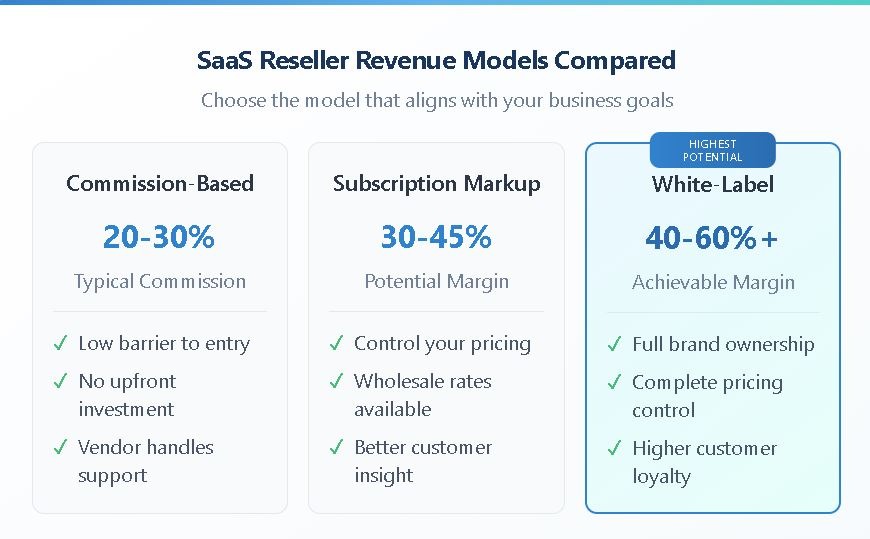
Commission-based models provide the simplest entry point, requiring minimal upfront investment while generating ongoing payments based on customer subscriptions. Standard commission rates typically range from 20–30% of customer payments, though performance tiers often reward high-volume partners with improved rates.
Subscription markup models offer superior margin potential for resellers willing to manage customer relationships more directly. Under these arrangements, resellers purchase services at wholesale rates and set their own retail pricing. The margin between wholesale and retail costs flows directly to the reseller, often exceeding what commission models provide.
One-time commissions might appear attractive initially, but recurring commissions build substantially more value over time. Consider the difference between earning $500 once versus earning $100 monthly for the customer’s entire lifetime. After just six months, the recurring model surpasses the one-time payment, and the gap widens thereafter.
Why Does White-Label Reselling Outperform Commission Models?
White-label arrangements provide the highest revenue potential because resellers control the complete customer experience. Pricing flexibility allows optimization based on market conditions and competitive positioning. Brand ownership creates equity that appreciates as customer bases grow and recognition develops.
The customer relationship advantages prove equally valuable. When customers perceive the reseller as their provider rather than a middleman, loyalty strengthens and price sensitivity decreases. Customers hesitate to switch when doing so means abandoning a known brand for an unfamiliar alternative, even if the underlying technology remains similar.
White-label programs also enable service bundling that increases per-customer revenue. A reseller offering branded telecom services alongside managed IT support creates integrated solutions that competitors can’t easily replicate. This differentiation commands premium pricing while deepening customer dependency.
What Are Common Challenges When Selling SaaS?
Every business model presents obstacles. Understanding common challenges of selling SaaS before encountering them allows proactive preparation that transforms potential failures into manageable situations.
Differentiation through specialization, exceptional service, and strategic positioning matters more than ever. Resellers competing solely on price typically attract price-sensitive customers who churn readily when alternatives appear marginally cheaper.
How Do You Overcome Long Sales Cycles?
Enterprise SaaS sales often involve extended evaluation periods with multiple stakeholders, budget approval processes, and implementation planning. Resellers serving larger organizations must maintain pipeline visibility while nurturing relationships across extended timelines.
The most effective approach involves establishing clear milestones and maintaining consistent communication without appearing desperate. Regular value-add touchpoints, such as sharing relevant industry content or providing insights from similar implementations, keep relationships warm while demonstrating ongoing expertise.
Smaller business segments typically feature shorter cycles but require higher volume to achieve revenue targets. Resellers must balance portfolio composition between quick-closing small deals and larger opportunities that justify extended cultivation efforts.
What Technical Knowledge Do Resellers Actually Need?
Technical expertise requirements vary across SaaS categories. Some programs provide comprehensive technical support that handles implementation, troubleshooting, and ongoing maintenance entirely, allowing resellers to focus purely on sales and relationship management.
Other programs expect resellers to develop technical competency, particularly when solutions involve complex integrations or customization. Understanding where a program falls on this spectrum helps resellers select opportunities matching their capabilities and growth aspirations.
The general trend favors reduced technical requirements as platforms mature. Leading providers have invested heavily in automated provisioning, self-service management portals, and comprehensive documentation that enables resellers without deep technical backgrounds to succeed. The most important knowledge often involves understanding customer business problems rather than the underlying technology mechanics.
Frequently Asked Questions
How long does it take to generate meaningful revenue as a SaaS reseller? Revenue timelines depend on existing customer relationships, sales capabilities, and chosen program characteristics. Resellers with established client bases often generate initial revenue within weeks by introducing new services to known contacts. Those building from scratch typically require several months of consistent effort before momentum develops. The recurring nature of SaaS subscriptions means early customers continue generating monthly income while you acquire additional accounts, creating compound growth over time.
Do resellers need significant capital to get started? Most white-label programs require minimal upfront investment, with primary costs involving business registration, basic marketing materials, and time investment rather than infrastructure purchases. Programs that handle billing, provisioning, and technical support eliminate the capital requirements traditionally associated with telecommunications services. Focus initial resources on customer acquisition rather than operational build-out.
What industries offer the strongest opportunities for SaaS resellers? Telecommunications and unified communications are strong opportunities due to essential service characteristics and technical complexity that create genuine advisor value. Healthcare, financial services, and professional services also demonstrate high SaaS adoption rates and willingness to pay for implementation expertise. Industry specialization often accelerates success by enabling deeper customer understanding and more relevant positioning.
How do I differentiate from other resellers offering similar services? Differentiation emerges from specialization, exceptional service, and unique value-add capabilities rather than product features alone. Vertical market expertise allows premium pricing and simplified marketing. Consultative approaches that solve business problems rather than push products build stronger relationships. Bundling complementary services creates integrated solutions that competitors can’t easily replicate.
Start Building Your SaaS Reselling Business Today
The shift toward subscription-based software delivery continues accelerating, creating expanding opportunities for resellers who position themselves strategically. Success requires understanding subscription economics, selecting appropriate programs, and committing to customer success as a core business principle.
Telecommunications services are an ideal entry point for many resellers due to essential business requirements, strong retention characteristics, and complexity that creates advisor value. Businesses need reliable voice and unified communications, and they appreciate partners who simplify technology decisions while ensuring ongoing service quality.
SIPTRUNK provides a comprehensive SIP trunking reseller platform with the tools and support that resellers need to build sustainable telecom practices. With automated provisioning, white-label branding, hands-off billing and taxes, and no-contract flexibility, you can start generating recurring revenue immediately while maintaining complete control over customer relationships. Get started today and join the partners already building valuable recurring revenue businesses.

Mitch leads the Sales team at BCM One, overseeing revenue growth through cloud voice services across brands like SIPTRUNK, SIP.US, and Flowroute. With a focus on partner enablement and customer success, he helps businesses identify the right communication solutions within BCM One’s extensive portfolio. Mitch brings years of experience in channel sales and cloud-based telecom to every conversation.