

Benefits of Starting a SaaS Reseller Business in 2025
Starting a SaaS reseller business in 2025 offers unprecedented opportunities with minimal risk.
- The global SaaS market is growing, creating massive demand for reseller services.
- Modern tech stack eliminates traditional barriers with AI-powered tools, automation, and cloud infrastructure.
- Reseller programs offer low startup costs compared to traditional software development.
- The recurring revenue model generates compounding returns from satisfied customers for years.
The combination of market growth, technological advancement, and reduced barriers makes now the ideal time to enter the SaaS reseller space.
The software industry has evolved over the past decade, but 2025 is a unique inflection point for entrepreneurs ready to start a SaaS reseller business. The convergence of market demand, technological maturity, and reduced entry barriers creates an environment where resellers can achieve substantial success without the traditional risks and investments.
The global SaaS market is projected to grow from $315.68 billion in 2025 to $1,13 trillion by 2032, exhibiting a compound annual growth rate of 20%. This explosive growth creates enormous opportunities for resellers who can position themselves as trusted advisors in this expanding ecosystem.
While traditional SaaS reselling focuses on software applications, the same business model and technological advantages extend to telecommunications services delivered through SaaS platforms. Modern telecom reseller platforms enable partners to resell SIP trunking, VoIP services, and unified communications solutions using the same low-cost, high-margin approach that makes software reselling attractive.
Why Is 2025 the Perfect Time to Start a SaaS Reseller Business?
The timing for launching a SaaS reseller business has never been more favorable. Market demand has reached massive levels, with up to 99% of businesses expected to be using at least one SaaS solution by the end of 2025. This near-universal adoption means businesses across every sector actively seek solutions, creating consistent demand for reseller services. The shift from on-premise software to cloud-based solutions is a permanent transformation rather than a temporary trend.
The subscription economy has matured, educating customers about the benefits of recurring service models. Businesses now understand and expect SaaS pricing structures, eliminating the educational burden that resellers faced in earlier years. This market maturity translates to shorter sales cycles and higher conversion rates for experienced resellers.
Technology infrastructure has evolved to support reseller success. Cloud platforms, automation tools, and API integrations enable small teams to deliver enterprise-grade solutions. What once required massive technical teams can now be accomplished by individual resellers leveraging the right platforms and partnerships.
What Are the Financial Benefits of the SaaS Reseller Business Model?
The financial advantages of the SaaS reseller business model surpass those of traditional affiliate-based commission structures. Modern reseller programs offer multiple revenue streams and scalable profit potential that other business models can’t match.
How Do Low Startup Costs Make SaaS Reselling Accessible?
Traditional software development requires substantial upfront investment. Launching a SaaS platform costs anywhere from $50,000 to $500,000, depending on complexity, team structure, and go-to-market strategy. These capital requirements exclude most entrepreneurs from software entrepreneurship.
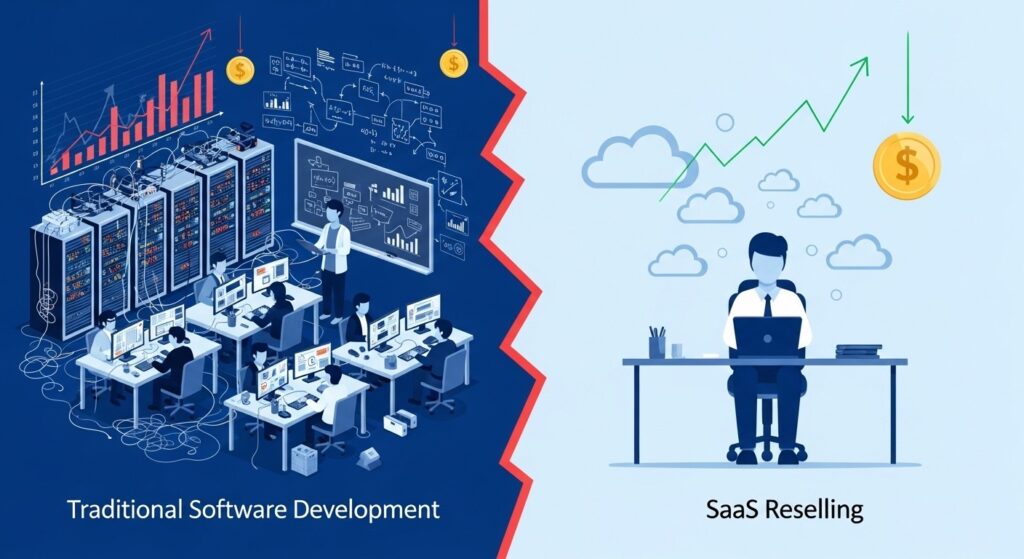
Starting a SaaS reseller business eliminates these barriers entirely. Leading white-label reseller programs require no upfront costs, no long-term contracts, and no hardware investments. Resellers can launch professionally branded services within hours rather than years. The primary investments involve business registration, website development, and initial marketing efforts.
Consultants, IT professionals, and business advisors can expand their service offerings without technical expertise or substantial capital. The risk profile shifts from potentially catastrophic financial loss to manageable business development expenses.
What Kind of Reseller Revenue Can You Expect?
SaaS reseller revenue potential varies based on market focus, customer segmentation, and program selection. However, successful resellers consistently achieve attractive margins through multiple monetization strategies.
Commission-based programs typically offer rates starting around 20% to 30%, with top-tier programs reaching up to 40% depending on sales volume and program structure. White-label programs provide even greater profit potential by allowing resellers to set their own pricing above wholesale rates. This pricing flexibility enables premium positioning and higher margins for specialized services.
Value-added reseller programs create additional revenue streams through implementation, training, and ongoing support services. Successful resellers often achieve higher total revenue through services than software sales alone. This consulting revenue complements recurring software commissions to create multiple income sources from single customer relationships.
Why Does Recurring Revenue Create Long-Term Wealth?
The recurring revenue model changes wealth creation potential compared to traditional service businesses. Unlike project-based work, where revenue stops when projects end, SaaS customers generate monthly income for years.

Industry benchmarks suggest a good customer lifetime value should be at least three times the customer acquisition cost, indicating strong profit potential for successful relationships. The compounding effect creates exponential growth potential. Each satisfied customer continues generating revenue while resellers acquire additional accounts.
This recurring nature enables predictable business planning and sustainable growth strategies.
How Does the Modern Tech Stack Benefit SaaS Resellers?
The technological foundation supporting SaaS resellers has evolved. Modern platforms provide capabilities that previously required large technical teams and substantial infrastructure investments.
What AI Tools Streamline Reseller Operations?
Artificial intelligence transforms reseller efficiency across sales, marketing, and customer success. Analysis reveals that 95% of organizations are expected to use AI-powered SaaS applications, creating both opportunity and competitive advantage for AI-savvy resellers.
Customer relationship management platforms now include predictive analytics that identify upselling opportunities, churn risks, and optimal pricing strategies. Resellers can proactively manage customer relationships and maximize revenue per account.
Marketing automation powered by machine learning optimizes campaign performance, lead scoring, and content personalization. Resellers can compete effectively against larger competitors by leveraging AI tools that previously required dedicated marketing teams and substantial budgets.

How Do Cloud Platforms Reduce Infrastructure Costs?
Cloud infrastructure eliminates traditional barriers to software distribution. Resellers can deliver enterprise-grade solutions without maintaining servers, managing updates, or providing 24/7 technical support. Platform providers handle infrastructure management, security compliance, and system maintenance.
This dynamic enables global scalability from day one. Resellers can serve customers across multiple markets without regional infrastructure investments. Geographic expansion becomes a marketing challenge rather than a technical impossibility.
Which Automation Features Accelerate Growth?
Modern reseller platforms include automation capabilities that eliminate manual processes and enable rapid scaling. Automated provisioning allows instant customer onboarding without technical intervention. Billing automation handles subscription management, invoicing, and payment processing across hundreds of accounts.
Customer communication automation includes onboarding sequences, usage notifications, and renewal reminders. These automated touchpoints maintain customer engagement while freeing resellers to focus on acquisition and relationship management.
What Types of SaaS-Powered Reseller Business Models Work Best?
Understanding the various reseller models helps entrepreneurs select approaches aligned with their strengths, resources, and market opportunities. Whether focused on software applications or telecommunications services delivered via SaaS platforms, each model offers distinct advantages and requirements.
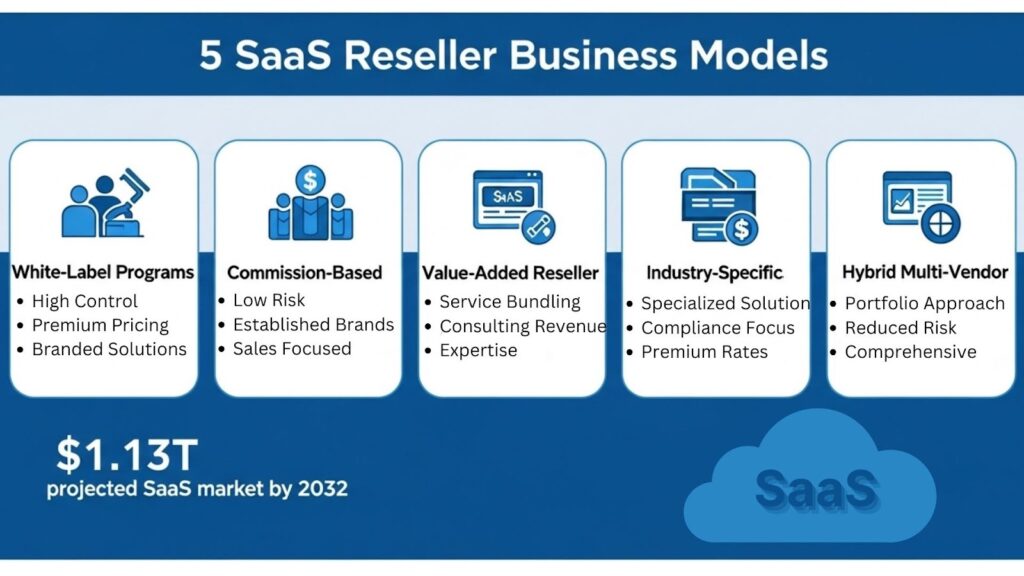
1. White-Label Reseller Programs
White-label programs provide the most comprehensive business ownership experience. Resellers receive fully branded solutions that appear as their own products. Customer relationships, pricing control, and service delivery remain under reseller management.
These programs typically require higher minimum commitments but offer maximum profit potential and business asset value. Successful white-label resellers often achieve premium pricing through specialized positioning and superior customer service.
2. Standard Commission-Based Models
Commission-based programs offer the lowest barrier to entry with minimal financial risk. Resellers promote established brands and earn commissions on successful sales. While margins may be lower, reduced responsibility for customer success and technical support appeals to sales-focused professionals.
3. Value-Added Reseller (VAR) Programs
VAR programs encourage resellers to bundle additional services around core software products. Implementation, training, customization, and ongoing support create multiple revenue streams and higher customer lifetime value.
This model suits consultants and service providers who can deliver expertise beyond software sales. The combination of software commissions and service revenue often produces the highest total margins.
4. Industry-Specific Specialty Programs
Vertical SaaS programs target specific industry segments with specialized solutions. Healthcare, finance, manufacturing, and education sectors often require compliance features and industry expertise that generalist resellers can’t provide.
Specialization enables premium pricing and reduced competition. Industry expertise becomes a competitive advantage that creates customer loyalty and referral opportunities.
5. Hybrid Multi-Vendor Approaches
Experienced resellers often represent multiple SaaS vendors to create comprehensive solution portfolios. This approach reduces dependency on single vendors while enabling complete customer solution delivery.
Multi-vendor strategies require more sophisticated business management but create competitive differentiation and higher total account values.
How Do SaaS-Powered Telecom Reseller Programs Work?
While software reselling dominates discussions about SaaS reseller opportunities, telecommunications reseller platforms represent one of the highest-margin segments in the SaaS-delivered reseller space. These platforms enable partners to resell voice, data, and unified communications services using the same low-cost, high-margin approach that makes software reselling attractive.
Unlike traditional telecom reselling that required significant infrastructure investments and technical expertise, modern SaaS-delivered telecom platforms handle all backend operations. Resellers focus on customer acquisition and relationship management while the platform provider manages network infrastructure, compliance, billing, and technical support.
What Services Can You Resell Through SaaS Telecom Platforms?
SaaS-powered telecom reseller platforms typically offer comprehensive communications solutions that businesses need to operate effectively. Core services include SIP trunking for business phone systems, which replaces traditional phone lines with internet-based calling that reduces costs by up to 60% while providing enhanced features.
Unified communications solutions combine voice, video, messaging, and collaboration tools into integrated platforms. These services address the remote work and digital transformation needs that most businesses now prioritize. Voice over IP (VoIP) services, cloud-based phone systems, and international calling solutions round out typical service portfolios.
The recurring nature of telecommunications services creates predictable monthly revenue streams. Unlike software that customers might cancel or downgrade, businesses depend on communications services for daily operations, resulting in low churn rates and stable long-term relationships.
Why Do Telecom Reseller Margins Exceed Software Commissions?
Telecommunications reseller platforms often provide superior profit potential compared to software affiliate programs. While software reseller commissions typically range from 20-40%, telecom resellers using white-label platforms can achieve margins of 40-60% or higher by setting their own pricing above wholesale rates.
The value-added service opportunities in telecom reselling create additional revenue streams. Implementation consulting, number portability services, system integration, and ongoing optimization generate service revenue that complements recurring communications charges. Many successful telecom resellers earn more from services than the underlying communications products.
Customer lifetime values in telecommunications typically exceed those of most software categories. Business communications are mission-critical services that customers rarely change, creating relationships that often last for years. The combination of high margins, low churn, and value-added service opportunities makes telecom reselling particularly attractive for experienced business-to-business sales professionals.
What Should You Look for in a SaaS Telecom Reseller Platform?
Evaluating SaaS-delivered telecom reseller platforms requires focusing on different criteria than software reseller programs. Network quality and reliability form the foundation of successful telecommunications reselling. Look for platforms offering Tier-1 network infrastructure with proven uptime records and redundant routing capabilities.
Automated provisioning and management tools eliminate technical barriers that traditionally limited telecom reselling to technical experts. The best platforms enable instant service activation, real-time usage monitoring, and self-service customer portals that reduce ongoing support requirements.
White-label branding capabilities allow resellers to present services under their own brand identity. Complete customization including logos, color schemes, invoicing, and customer communications helps build brand loyalty and competitive differentiation. The ability to set your own pricing above wholesale rates provides maximum profit potential and market positioning flexibility.
Comprehensive support structures become particularly important in telecommunications reselling. Look for platforms providing 24/7 technical support, escalation procedures, and dedicated account management. Since communications services are mission-critical for business customers, reliable vendor support directly impacts customer satisfaction and retention.
How Do You Choose the Right SaaS Products to Resell?
Product selection determines reseller success more than any other factor. The ideal products combine market demand, competitive differentiation, and strong vendor partnership opportunities.
What Market Demand Indicators Should You Track?
Market research identifies products with growing demand and sustainable competitive advantages. Companies now use an average of 106 SaaS applications each, indicating continued expansion opportunities across multiple solution categories.
Growth indicators include increasing search volume for solution categories, venture capital investment in specific sectors, and regulatory changes driving software adoption. Communication solutions, AI tools, and compliance software are currently high-growth categories.
Customer pain points drive sustainable demand. Solutions addressing remote work, cybersecurity, data analytics, and process automation align with universal business priorities. Products solving urgent problems command premium pricing and customer loyalty.
How Do You Evaluate Vendor Support and Training?
Vendor partnership quality determines reseller success as much as product quality. The best vendors provide comprehensive training, marketing support, and ongoing partnership development.
Training programs should include product knowledge, sales methodologies, and customer success strategies. Ongoing education ensures resellers stay current with product updates and market developments.
Marketing support includes lead generation programs, co-branded materials, and digital marketing resources. Vendors invested in partner success provide tools and support that accelerate customer acquisition.
Which Commission Structures Maximize Profitability?
Commission structures vary across vendors and programs. Understanding the mathematics of different approaches helps optimize revenue potential.
Flat percentage commissions provide predictable income but may limit profit potential as accounts grow. Tiered commissions reward volume growth but require substantial scale to achieve maximum rates.
Lifetime commissions create long-term wealth but often feature lower initial rates. Upfront bonuses provide immediate income but may reduce ongoing revenue streams.
What Competitive Advantages Do SaaS Resellers Have in 2025?
Learning how to resell SaaS is about building a scalable, high-margin business model that thrives on adaptability and customer insight. As cloud adoption accelerates and businesses seek specialized partners to guide their digital transformation, SaaS resellers occupy a powerful position between software vendors and end users.
How Does Scalability Without Overhead Create Opportunity?
Traditional software companies require proportional scaling of technical teams, infrastructure, and support staff as customer bases grow. Resellers leverage vendor infrastructure to serve hundreds or thousands of customers without comparable overhead increases.
This scalability advantage enables rapid geographic expansion, market segment diversification, and competitive pricing strategies. Resellers can enter new markets quickly, while competitors require substantial investment and planning.
Why Do Businesses Prefer Local Reseller Relationships?
Despite software standardization, businesses value local relationships for consultation, support, and guidance. Resellers provide personalized service and market expertise that national vendors can’t deliver cost-effectively.
Local market knowledge enables customized solutions and industry-specific positioning. Resellers understand regional business practices, regulatory requirements, and competitive landscapes better than distant vendors.
What Value-Added Services Differentiate Successful Resellers?
Beyond software sales, successful resellers provide consulting, implementation, and ongoing optimization. These services create customer dependency and reduce churn while generating additional revenue streams.
Training and change management help customers maximize software value and adoption. Implementation consulting ensures successful deployments and customer satisfaction. Ongoing optimization maintains relationships and identifies expansion opportunities.
Frequently Asked Questions
How much does it cost to start a SaaS reseller business? Most white-label SaaS reseller programs require minimal upfront investment for business registration, website development, and initial marketing efforts. Unlike traditional software development, reselling eliminates infrastructure and development expenses entirely.
What technical skills do I need to resell SaaS products? Technical expertise is not required for most reseller programs. Modern platforms handle infrastructure, provisioning, and technical support while resellers focus on sales, marketing, and customer relationships. A basic understanding of business software concepts helps with customer consultations.
How long does it take to see reseller revenue? With automated provisioning and instant setup, resellers can begin generating revenue within days of program enrollment. However, building substantial recurring revenue requires consistent customer acquisition efforts over time.
Can I run a SaaS reseller business part-time? Yes, many successful resellers begin part-time while maintaining other income sources. The recurring revenue model means early customers continue generating monthly income while you gradually scale operations. Automation tools enable efficient management of growing customer portfolios.
How to Resell SaaS and Achieve Success
The combination of market opportunity, technological enablement, and proven business models makes 2025 an exceptional year to enter the SaaS reseller space. However, success requires strategic planning, careful vendor selection, and disciplined execution.
Whether you’re an established consultant looking to diversify revenue streams or an entrepreneur seeking entry into the software industry, technology solutions like SIP trunking and unified communications are among the highest demand segments in the current market. SIPTRUNK’s white-label reseller platform provides exactly the kind of comprehensive solution that enables rapid market entry and scalable growth. Get started now to build your SaaS reseller business on recurring revenue with complete brand control.

Mitch leads the Sales team at BCM One, overseeing revenue growth through cloud voice services across brands like SIPTRUNK, SIP.US, and Flowroute. With a focus on partner enablement and customer success, he helps businesses identify the right communication solutions within BCM One’s extensive portfolio. Mitch brings years of experience in channel sales and cloud-based telecom to every conversation.