

How to Resell VoIP Services: A Guide to Recurring Revenue
Reselling VoIP services converts one-time technology projects into predictable monthly income, and the carrier copper shutdown is creating the largest migration window the channel has seen in decades.
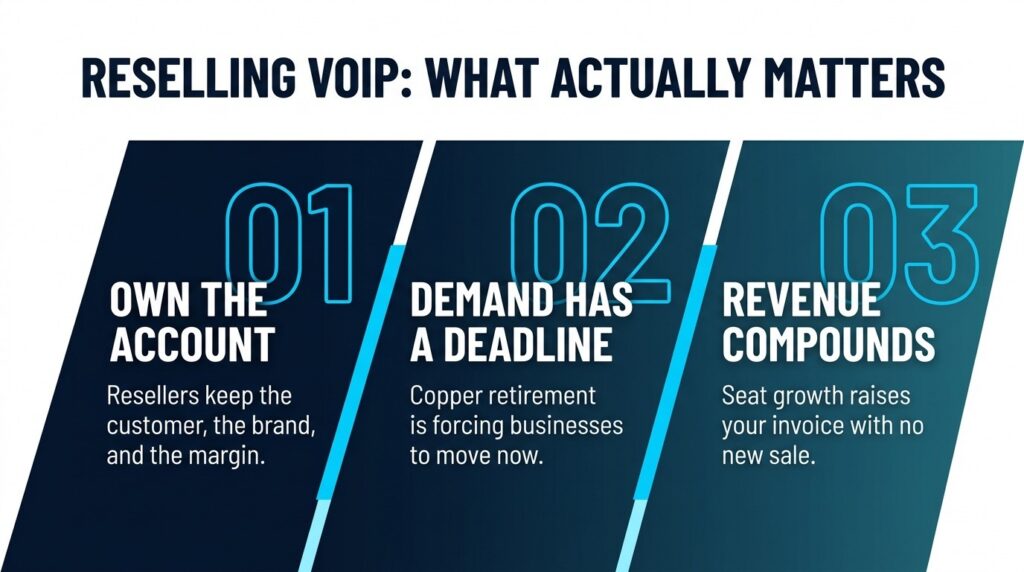
- Demand is being forced, not persuaded. Carriers are decommissioning legacy copper facilities, so businesses must move to IP voice on a deadline rather than on their own timeline.
- Owning the customer relationship is where the margin lives. White-label models let you set retail pricing, keep your brand on the invoice, and retain the account.
- Voice revenue compounds without new sales cycles. Seat-based billing grows automatically as your customers hire.
- The operational barrier is lower than most assume. The right platform absorbs the network, billing, taxation, and provisioning workload that historically kept IT firms out of telecom.
If you already manage networks, security, or phone systems for business clients, voice is the shortest path you have to durable recurring revenue.
Businesses across the country are being pushed off analog phone lines faster than they expected. Carriers have stopped accepting new copper orders in many markets and begun retiring facilities outright, accelerated by the FCC’s technology transition rules that streamlined how quickly legacy networks can be decommissioned. Every affected business needs a replacement, and most would rather buy it from a partner they already trust than shop for an unfamiliar carrier. That’s the opening. If you want to resell VoIP services profitably, understanding how the SIP trunk reseller platform model works is the place to start.
What Does It Mean to Resell VoIP Services?
To resell VoIP services means to purchase voice connectivity and platform capacity at wholesale rates, then package, price, and sell that service to your own customers under your own terms. You handle the customer relationship, pricing, and accounts. Your provider handles the network, interconnects, and underlying infrastructure.
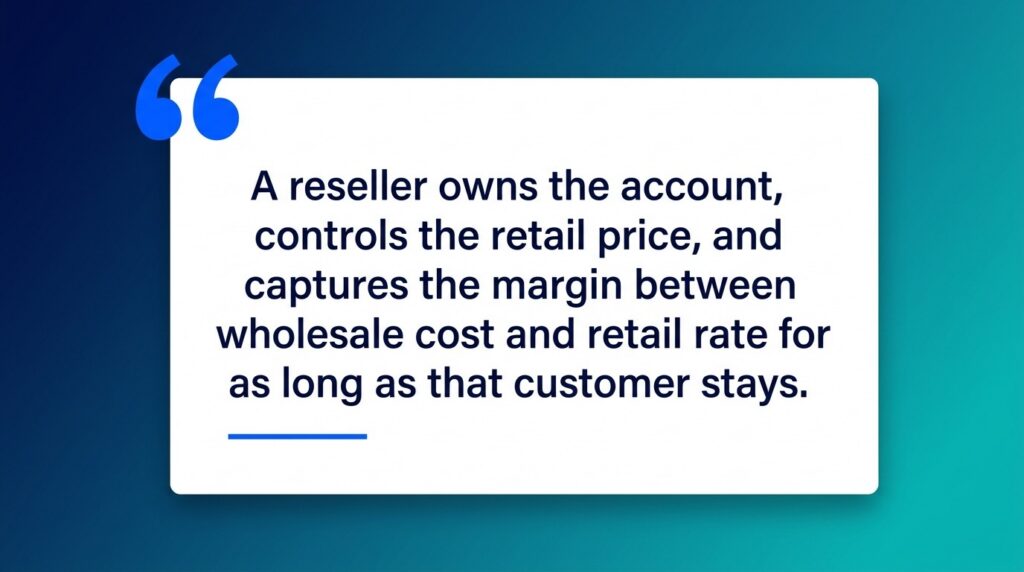
This distinction separates reselling from referral work. A referral partner introduces a prospect and collects a commission on someone else’s contract. A reseller owns the account, controls the retail price, and captures the margin between wholesale cost and retail rate for as long as that customer stays. The second model builds enterprise value. The first builds a finder’s fee.
Most resellers deliver voice through SIP trunking, which connects a customer’s existing phone system to the public telephone network over their internet connection. Because SIP trunking works with equipment many customers already own, you can often modernize their voice service without replacing hardware.
Why Is Demand for VoIP Services Accelerating Right Now?
Two forces are converging. One is regulatory and immediate, and the other is a longer market shift that’s been building for a decade.
The Copper Retirement Deadline
The FCC has sharply reduced the procedural barriers carriers face when retiring copper, and carriers have responded with discontinuation notices across large portions of their footprints. Businesses in affected wire centers get a limited window to transition before service ends.
Forced migration is the most favorable sales condition that exists. You aren’t convincing a prospect to modernize eventually. You’re solving a problem with a deadline, and buyers under deadline pressure decide quickly and rarely shop on price alone.
What the Market Data Shows
The growth trend supports the urgency. According to SIP trunking market research, the market stood at roughly $73 billion in 2025 and is forecast to approach $182 billion by 2031, growing at a compound annual rate near 16%. That same research identifies cost savings of 25% to 65% over legacy PRI circuits as the strongest economic driver behind adoption.
Broader VoIP market forecasts point in the same direction, projecting growth from about $176 billion in 2025 to roughly $389 billion by 2034. Demand of that scale is structural, not cyclical.
Which Reseller Model Should You Choose?
Partner programs don’t all work the same way, and the model you select determines how much control you retain over pricing, branding, and the customer relationship. Understanding the difference between reseller models before you sign anything will save you from rebuilding your business later.
| Model | Who owns the customer | Pricing control | Typical fit |
| White-label reseller | You | You set retail rates | MSPs, VARs, IT consultants building a service line |
| Wholesale voice | You, with heavier lift | You set retail rates | Providers with in-house switching and billing |
| Agent or referral | The provider | None, commission-based | Firms wanting revenue without service ownership |
Most IT and telecom firms land on the white-label approach. It delivers branding control and margin ownership without requiring you to operate carrier infrastructure. If branded delivery is your priority, a closer look at white-label VoIP provider options clarifies what varies between programs.
How Do You Begin to Resell VoIP Services?
The path from decision to first customer is shorter than most people expect, particularly if you already serve business clients.
Define Your Target Customer First
Resist the temptation to sell to everyone with a phone. Pick a segment you already understand, whether that’s medical practices, professional services firms, or manufacturers running older PBX equipment. A narrow focus gives you repeatable pricing, standard configurations, and referral momentum.
Select Your Platform Partner
Your provider determines your margin ceiling, support burden, and credibility with customers. Evaluate network quality, PBX compatibility, provisioning speed, and whether billing and telecom taxation are handled for you. A detailed walkthrough of how to become a VoIP reseller covers this evaluation in depth.
Build Your Pricing Model
Decide whether you’ll price per seat, per trunk, per concurrent call path, or as a bundled managed service. Bundling voice into an existing agreement tends to produce the healthiest margins because the customer evaluates the package rather than a line item. Review published SIP trunk pricing structures to see where your wholesale cost lands.
Handle Registration and Compliance
Complete the required federal registrations before you invoice your first customer. Retroactive compliance costs far more than doing it correctly at the outset. Build the filing timeline into your launch plan rather than treating it as an afterthought.
Launch With Existing Relationships
Your first customers should come from accounts you already serve. They trust you, you know their infrastructure, and you can reference the copper retirement notices they’ve likely received. Those early wins become reference stories that shorten every conversation after.
Why Is VoIP a Natural Expansion for MSPs and IT Consultants?
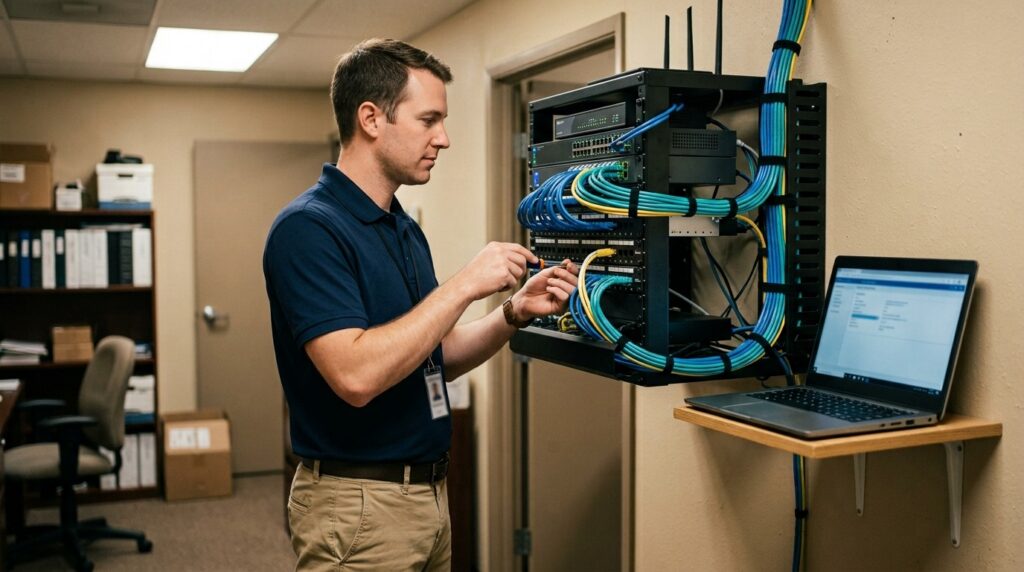
Managed service providers are arguably better positioned to resell VoIP services than traditional telecom agents, and the reason is proximity. You already hold the customer’s network diagram, firewall rules, bandwidth utilization, and support history. Voice quality depends almost entirely on those same variables.
The skill overlap is substantial. Network monitoring translates directly into call quality management, and security expertise applies to protecting voice systems from toll fraud. Your help desk already fields user questions, so extending that to phones is an incremental change rather than a new capability.
There’s a defensive argument too. If you don’t provide voice, another vendor will, and they’ll sit inside your customer’s environment with a legitimate reason to discuss network performance and infrastructure. Adding voice closes that door and increases the number of services a client would have to unwind to leave you. Firms exploring this move often start with SIP trunk reseller program fundamentals before committing to a service line.
What Does Recurring Revenue Actually Look Like?
Abstract talk about recurring revenue rarely convinces anyone. The mechanics do. Here’s how voice revenue behaves for a reseller building a book of business.
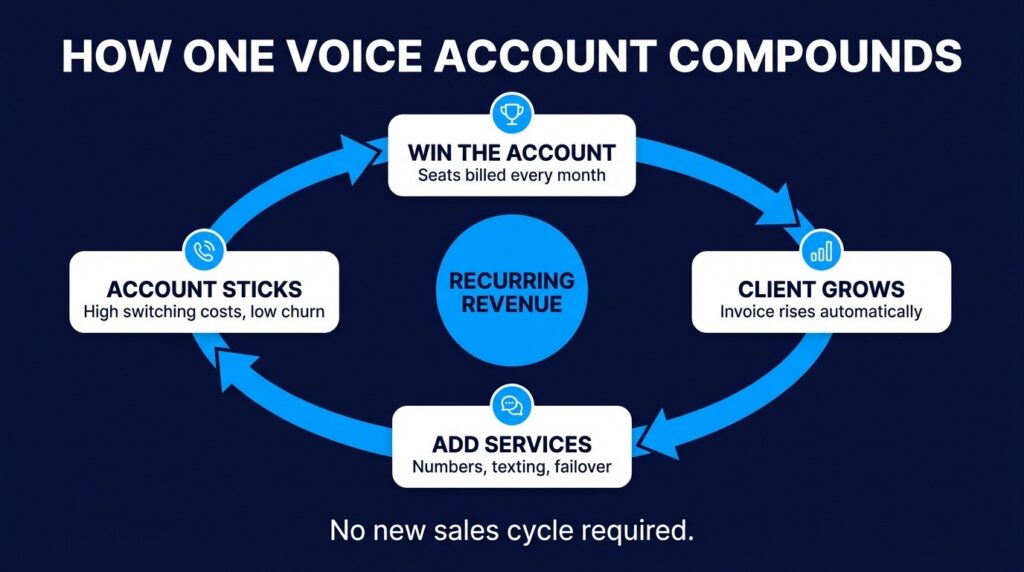
- A single account produces predictable monthly income. A 20-seat customer billed at a modest per-seat rate generates several hundred dollars monthly, and your margin is the spread between that rate and your wholesale cost.
- Ten similar accounts change your business model. The same configuration repeated across 10 customers produces annual recurring revenue that covers fixed overhead. Voice stops being a side offering and becomes a funded department.
- Seat growth compounds without a new sales cycle. When a 20-seat client hires 10 people, your invoice grows automatically. No proposal, no negotiation, no procurement cycle.
- Add-on services layer onto the same account. Additional numbers, business texting, fax replacement, call recording, and failover trunking attach to customers who already trust your delivery.
- Voice revenue is unusually durable. Phone service is embedded in daily operations, and switching costs are high enough that churn on well-supported accounts tends to run low.
- Recurring revenue raises what your company is worth. Buyers value contracted monthly revenue at a substantial multiple of project income.
What Compliance Requirements Apply to VoIP Resellers?
Most resellers offering interconnected voice must register with the FCC using Form 499-A and contribute to the Universal Service Fund. You’ll also carry Enhanced 911 obligations, which require accurate location information so emergency responders can reach your customers. Customer Proprietary Network Information rules govern how you protect calling records from unauthorized disclosure.
State obligations vary considerably, with some requiring separate registration, additional tax collection, or surcharge remittance beyond federal rules. Confirm requirements in every territory where you sell, and consider engaging a telecommunications attorney during setup. Responsibility rests with you even when a platform partner assists with filings.
How Do You Evaluate a VoIP Reseller Platform?
Marketing claims are easy to produce, so evaluate partners against criteria you can verify. Network quality and redundancy come first because voice failures damage your reputation rather than your provider’s.
Look closely at whether billing, telecom taxation, and regulatory remittance are handled on your behalf. Tax calculation is genuinely difficult, and a provider that absorbs it removes the burden that stops most IT firms from entering voice. Contract terms matter too, since long-term commitments or upfront hardware purchases transfer risk onto you before you’ve proven the model.
Finally, examine what happens after the sale. Provisioning speed, portal usability, porting support, and escalation quality determine whether your voice practice scales or stalls. A structured review of the features every reseller program needs offers a useful framework.
What Challenges Should New VoIP Resellers Expect?
Number porting is the most common friction point, since transfers can take days or weeks depending on the losing carrier. Setting realistic expectations up front prevents most complaints.
Call quality issues almost always trace back to the customer’s network rather than the carrier, so assess bandwidth and configure quality of service before cutover. Pricing pressure is real but manageable, and resellers who win compete on responsiveness and on supporting voice alongside the rest of the customer’s technology stack.
Frequently Asked Questions
How much can I earn reselling VoIP services? Earnings depend on customer count, seats per account, your retail pricing, and your wholesale cost. Because revenue is recurring, income accumulates rather than resets, and a modest book of accounts can produce meaningful annual recurring revenue within a year or two.
Do I need telecom experience to resell VoIP services? No. Platform providers handle network operations, interconnects, and infrastructure. What you need is the ability to assess a network, configure a PBX connection, and support end users, which most IT firms already do.
What licenses do VoIP resellers need? Most interconnected VoIP resellers must register with the FCC via Form 499-A and comply with Universal Service Fund, E911, and CPNI requirements. State-level obligations vary, so verify requirements in each territory where you operate.
Can MSPs resell VoIP alongside managed IT services? Yes, and the combination works well. Voice bundles naturally into managed services agreements, draws on infrastructure knowledge you already have, and increases account stickiness.
How long does it take to launch a VoIP reseller practice? Platform onboarding and provisioning can often be completed in days. Realistically, expect several weeks to finish compliance registration, finalize pricing, and prepare your first customer, with revenue beginning once accounts are ported and live.
Start Building Recurring Revenue From Voice
The copper shutdown has created a migration wave that will run for years, and affected businesses want a trusted partner rather than a new carrier relationship. If you already serve those companies, you hold the advantage that matters most. What you need is a platform that handles the network, billing, taxation, and support so you can focus on selling.
SIPTRUNK provides exactly that infrastructure, with no contracts, no upfront costs, and a control panel built for resellers rather than carriers. Explore the reseller platform built for partners to see how the program is structured. To add voice to your service portfolio, get started with SIPTRUNK and begin building your recurring revenue stream.

Mitch leads the Sales team at BCM One, overseeing revenue growth through cloud voice services across brands like SIPTRUNK, SIP.US, and Flowroute. With a focus on partner enablement and customer success, he helps businesses identify the right communication solutions within BCM One’s extensive portfolio. Mitch brings years of experience in channel sales and cloud-based telecom to every conversation.