

How to Become a VoIP Reseller
Becoming a VoIP reseller lets you add a high-margin, recurring revenue stream without building or maintaining any phone infrastructure yourself.
- The market keeps expanding, giving resellers, MSPs, and IT consultants a growing pool of business customers ready to upgrade from legacy phone systems.
- White-label and SIP trunk reseller programs let you sell branded voice service while a platform provider handles provisioning, billing, and support.
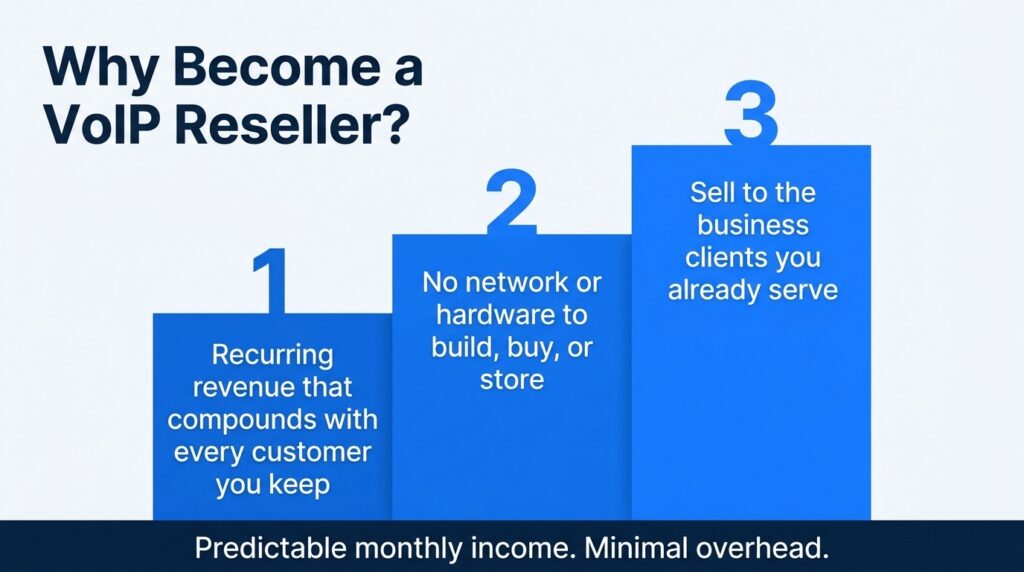
- Recurring revenue compounds with every customer you keep, turning one-time sales into predictable monthly income.
- Targeting a specific vertical or your existing client base beats chasing a broad, undefined market.
If you already serve business clients, voice is one of the easiest services to add and one of the hardest for customers to leave.
Voice over Internet Protocol (VoIP) has become the default way businesses handle calls, replacing aging copper lines with flexible, internet-based service. That shift has created a steady opportunity for entrepreneurs and technology providers who want to become a VoIP reseller and earn income from a service that companies already need. The global VoIP market is projected to grow from $176.16 billion in 2025 to nearly $389 billion by 2034, according to Fortune Business Insights, and much of that demand flows through partners rather than the carriers themselves.
You don’t have to build your own network or write a single line of switching code to participate. By reselling voice service built on reliable SIP trunking infrastructure, you can focus on sales and customer relationships while a platform provider carries the technical foundation. This guide walks through how the model works, why it fits MSPs and IT providers so well, and how to turn it into a durable VoIP reseller business.
How Do You Become a VoIP Reseller?
To become a VoIP reseller, you partner with a platform provider that supplies the underlying voice infrastructure, then sell that service to business customers under your own terms. The provider operates the network, manages provisioning, and handles billing and taxes. You own the customer relationship, set your pricing, and collect the revenue. Because you’re selling a subscription rather than a one-time product, every account you sign adds to a recurring revenue base that grows month over month.
There are two broad paths to choose from, and the difference matters for both your margins and your brand.
| Reseller model | How it works | Best for |
| Agent / referral | You refer customers to a provider and earn a commission. The provider owns billing and the customer relationship. | Anyone who wants the simplest entry with minimal setup |
| White-label / private label | You sell branded service as your own, control pricing, and own the customer relationship while the provider runs the backend. | Anyone building a lasting VoIP reseller business with higher margin control |
Both models work, but the white-label route gives you the most control over pricing and the customer experience, which is why it tends to produce stronger long-term margins. If your goal is to build equity in your own brand, a SIP trunk reseller program built around private labeling is usually the better fit.
Do You Need Technical Skills to Become a VoIP Reseller?
No deep telecom background is required to become a VoIP reseller. The best SIP trunk reseller platforms handle the complex parts, including network management, provisioning, and tier-1 support, so you can start with a working knowledge of how VoIP benefits a business. A basic grasp of networking and phone systems helps during customer conversations, but the platform carries the technical load while you focus on selling and supporting accounts.
Why Is Reselling VoIP a Strong Opportunity for MSPs and IT Providers?
For managed service providers and IT consultants, voice is one of the most natural services to add because it deepens relationships you already have. Your clients already trust you with their networks and security. Extending that trust to their phone system keeps you central to their operations and adds another line of monthly income. Voice seats also tend to stay in place for years once they’re deployed, which makes them some of the stickiest recurring revenue an MSP can carry.

The move away from legacy systems is steady, and businesses increasingly prefer a single local partner who can manage IT and communications together. An MSP that already handles a client’s firewall, endpoints, and helpdesk is better positioned to win the phone system than an outside carrier with no existing relationship. That advantage is why so many IT providers now treat voice as a core part of their stack.
How Does Voice Strengthen Client Retention?
When a client’s phone system, network, and support all run through one provider, switching away becomes genuinely disruptive, which raises switching costs and protects your accounts. Bundled communication services also give you regular, low-friction reasons to stay in contact, opening the door to upsells like additional locations, business texting, or call analytics over time.
How Do You Build Recurring Revenue as a VoIP Reseller?
Recurring revenue comes from signing customers onto subscription plans and keeping them long enough that monthly billing compounds. A single mid-sized customer might represent a modest amount on its own, but a few dozen accounts on predictable monthly plans build a base that grows without constant new selling.
Here are proven ways to grow recurring revenue as a VoIP reseller business:
- Start with your existing customers. The clients who already trust you are the easiest to convert, since they know your service and don’t need to be sold on your reliability.
- Pick a vertical and specialize. Focusing on healthcare, legal, real estate, or another communication-heavy industry lets you speak directly to specific pain points and win referrals within that niche.
- Bundle voice with services you already sell. Packaging phone service alongside IT, internet, or security makes the offer stickier and harder to unbundle.
- Offer flexible pricing tiers. Plans that fit small offices and larger operations alike widen your addressable market without extra overhead.
- Layer in value-added features. Business texting, call recording, and analytics justify higher plan tiers and increase your average revenue per account.
- Prioritize retention and engagement. Keeping customers is cheaper than replacing them, and engaged accounts are the ones most likely to expand. The definitive guide to reselling SIP trunks covers these growth mechanics in more depth.
The objective is straightforward: add accounts faster than you lose them, then expand each account over time.
What Pricing Models Work Best?
Pricing is where many new resellers leave money on the table. The strongest approach usually combines a predictable base subscription with room to capture more revenue from heavier users. Most successful resellers lean on a small set of models:
- Subscription tiers, with entry, professional, and advanced plans mapped to business size and feature needs.
- Usage-based options, such as per-minute or bundled-minute pricing for customers with variable call volume.
- Hybrid plans, which pair a flat monthly fee with overage rates so you get predictable income plus upside from high-volume accounts.
White-label programs typically give you more control over these structures than commission-only arrangements, which is part of what makes building a profitable VoIP reseller business realistic for newcomers.
What Should You Look for in a SIP Trunk Reseller Platform?
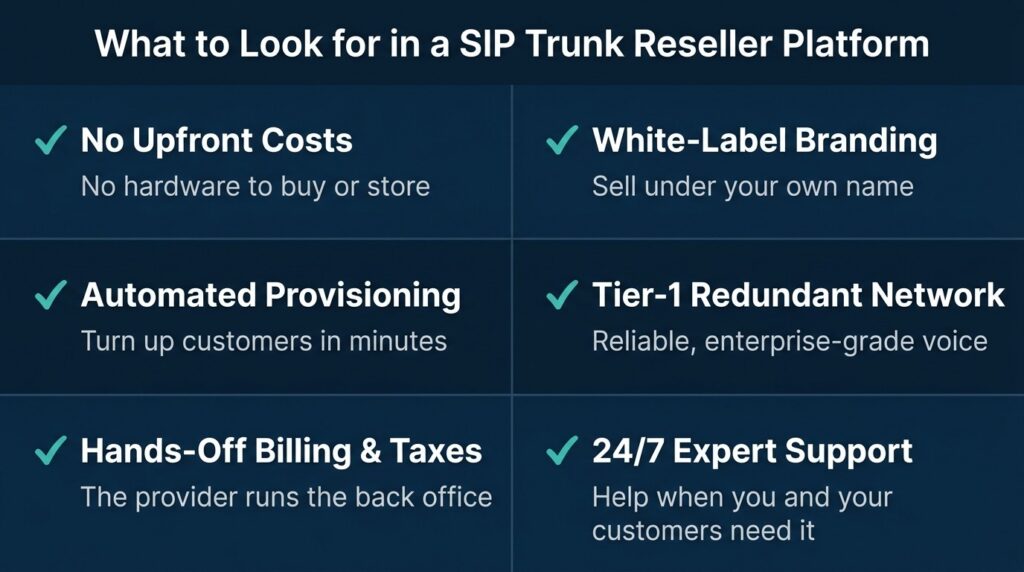
The platform you choose shapes your margins, your workload, and how customers perceive your brand, so evaluate it carefully. The strongest SIP trunk reseller platforms remove the operational burden while giving you room to build your own brand on top. Look for a provider that asks for no upfront investment, no long-term contract, and no hardware to buy and store, along with automated provisioning, hands-off billing and tax handling, a tier-1 redundant network, white-label branding, flexible subscription options, 24/7 support, and compatibility with major IP PBX systems.
SIP trunking is the foundation beneath any VoIP service you sell. It connects internet-based phone systems to the public telephone network and carries voice, video, business texting, and call analytics over a single connection. The SIP trunking market is projected to grow from roughly $85 billion in 2026 to $181.58 billion by 2031, and businesses moving off legacy PRI lines often realize cost savings of 25–65%, which hands you a clear value story to bring to every prospect. If you’re new to the technology, a quick refresher on SIP trunking basics is worth the time.
Which Reseller Tools Make the Biggest Difference?
Beyond the core network, the tools a provider gives you determine how fast you can launch and scale. A simple control panel with automated provisioning lets you turn up new customers in minutes instead of days. Branded customer portals, ready-made marketing and sales materials, and automated billing free you from administrative drag so your time goes toward selling. The more a platform handles for you, the faster your VoIP reseller business reaches a point where revenue outpaces effort.
How Do You Find and Keep the Right Customers?
Successful resellers generate more sales by targeting a specific audience than by casting a wide net. Focus on decision-makers in organizations that depend on communication and value cost-effective, reliable service. Industries such as healthcare, legal services, real estate, and customer-support operations are strong fits because phone systems sit at the center of how they work every day. Segmenting by business size and industry lets you tailor your message instead of pitching everyone the same way.
Retention matters as much as acquisition in a recurring revenue model, so plan for the long relationship from the first conversation.
How Do You Keep Customers for the Long Term?
Winning a customer is only half of the equation. Consistent support resolves issues quickly and protects the trust that keeps accounts in place. Beyond service, regular engagement through check-ins and proactive recommendations turns a vendor relationship into a partnership, and those touchpoints surface natural opportunities to expand an account. That is how a steady customer base compounds into meaningful recurring revenue.
Frequently Asked Questions
Do you need technical experience to become a VoIP reseller? No extensive technical background is required. Quality SIP trunking platforms manage infrastructure, provisioning, and support, so you can focus on sales and customer relationships. A basic understanding of VoIP concepts helps during customer consultations, but the platform handles the heavy lifting.
How much can you earn as a VoIP reseller business? Earnings depend on your pricing strategy, the number of accounts you carry, and how long you retain them. Because the model is subscription-based, income is recurring and grows as your customer base expands. White-label programs give you control over pricing, which generally allows for higher margins than commission-only arrangements.
What’s the difference between VoIP and SIP trunking? VoIP is the service your customers use to make and receive calls over the internet. SIP trunking is the connectivity layer that links those phone systems to the public telephone network. As a reseller, you sell VoIP services built on a provider’s SIP trunking foundation.
Do you need certifications to resell VoIP? Professional certifications aren’t typically required, though a credential like the Certified VoIP Analyst can strengthen your credibility with prospects. Regulatory compliance is a separate question that depends on your model. If you act purely as a referral agent, the underlying provider is generally the provider of record and carries obligations such as FCC Form 499 registration, Universal Service Fund contributions, E911, and annual CPNI certification. If you resell under your own brand, some of those requirements can apply directly to you, so confirm in writing which responsibilities your platform partner covers and consult a telecom attorney about your specific situation.
Start Building Your VoIP Reseller Business
Reselling VoIP is one of the most accessible ways to add predictable, recurring revenue without taking on the cost and complexity of running a network. Choose the right platform partner, target a focused audience, build flexible pricing, and treat retention as seriously as acquisition. Do those things well, and a handful of accounts can grow into a durable communications practice.
SIPTRUNK gives resellers a reliable SIP trunk reseller platform with automated provisioning, hands-off billing, white-label branding, and flexible plans that scale with your business. With a tier-1 redundant network and expert support behind you, you can deliver enterprise-grade voice without the infrastructure headaches. Get started today with a free SIPTRUNK reseller account and begin building recurring revenue.

Mitch leads the Sales team at BCM One, overseeing revenue growth through cloud voice services across brands like SIPTRUNK, SIP.US, and Flowroute. With a focus on partner enablement and customer success, he helps businesses identify the right communication solutions within BCM One’s extensive portfolio. Mitch brings years of experience in channel sales and cloud-based telecom to every conversation.