
How to Become a Profitable SIP Trunk Reseller (Revenue & Growth Guide)
The SIP trunking market is projected to reach $181.58 billion by 2031, and resellers who establish themselves now stand to capture healthy recurring revenue.
- White-label SIP trunk reseller programs let you sell under your own brand with no infrastructure investment.
- White-label arrangements enable higher margins than commission-only referral programs because you control pricing and customer relationships.
- Automated provisioning, billing, and support tools eliminate most technical barriers, making this opportunity accessible to telecom agents, IT consultants, MSPs, and VARs alike.
If you have existing business relationships and want to add a predictable monthly revenue stream, SIP trunk reselling deserves serious consideration.
Businesses across every industry are abandoning legacy phone systems. The SIP trunking market is growing at over 16% annually, driven by remote work adoption, cost pressures, and the need for flexible, scalable infrastructure. For channel partners, this transition is one of the most accessible recurring revenue opportunities in telecommunications.
Becoming a SIP trunk reseller doesn’t require building a network operations center or hiring a team of telephony engineers. Modern reseller platforms handle the infrastructure, compliance, billing, and technical support. Your role centers on identifying customer needs, building relationships, and delivering solutions that solve real business problems.
This guide covers everything you need to evaluate this opportunity, from realistic revenue expectations to the tools that separate struggling resellers from thriving ones.
What Is a SIP Trunk Reseller?
A SIP trunk reseller partners with an established provider to offer voice communication services under their own brand or through a referral arrangement. The provider supplies the underlying infrastructure, including connections to Tier-1 carrier networks, while the reseller focuses on customer acquisition and relationship management.
SIP trunking itself replaces traditional phone lines with virtual connections that transmit voice, video, and messaging over the internet. Each trunk supports multiple simultaneous calls, and capacity scales instantly without hardware installations or truck rolls. For businesses, this means lower costs and greater flexibility. For resellers, it means recurring monthly revenue from every customer account.
The reseller model works because it effectively aligns incentives. Providers gain distribution reach without building direct sales teams in every market. Resellers gain access to enterprise-grade technology without capital investment. Customers receive personalized service from a local partner who understands their specific needs.
Why Is SIP Trunk Reselling a Smart Business Move?
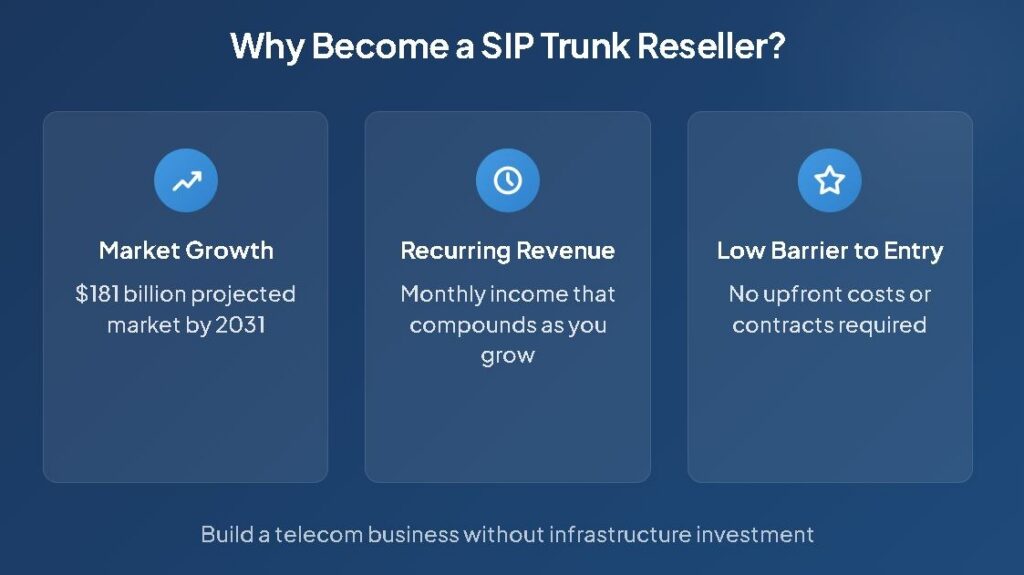
Many businesses choose to resell SIP trunks due to three attractive factors: sustained demand growth, favorable economics, and accessible entry.
Explosive Market Growth
The SIP trunking market stands at $85.07 billion in 2026 and is projected to reach over $181 billion by 2031. Several forces sustain this momentum. Mandatory PSTN shutdowns are pushing businesses off legacy systems, whether they planned to migrate or not. Cloud adoption continues to accelerate, with businesses prioritizing internet-based solutions over legacy infrastructure. Remote and hybrid work models have become permanent fixtures, requiring communication systems that function seamlessly across locations.
Recurring Revenue Potential
Unlike hardware sales or project-based consulting, SIP trunking generates predictable monthly income. Each customer you acquire continues paying month after month, often for years. Customers often remain on communication services for years, meaning a single new customer can deliver ongoing monthly revenue long after the initial sales effort.
Rather than constantly hunting for the next project, you build a growing base of monthly income that compounds as you add accounts. The stability enables better planning, easier financing, and a more valuable business if you ever choose to sell.
Low Barrier to Entry
Starting a traditional telecommunications company requires millions in infrastructure investment, regulatory licensing, and technical staff. White-label SIP trunk reseller programs eliminate these barriers. You can begin offering services with no upfront capital, no contracts locking you into commitments, and no technical expertise requirements.
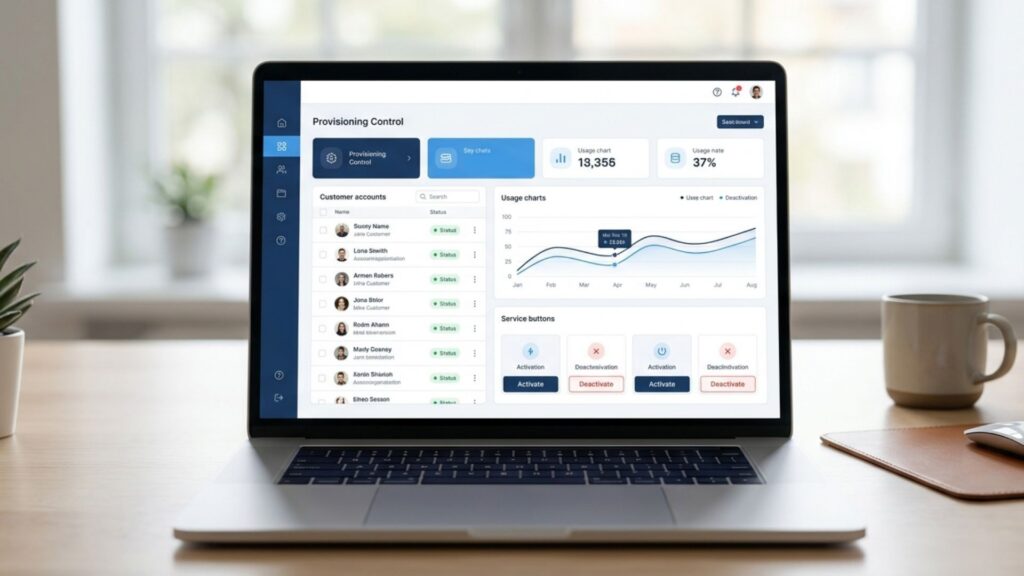
The platform provider handles provisioning, billing, tax compliance, technical support, and network maintenance. Your focus remains on customer relationships and sales. This division of responsibilities lets you leverage professional-grade infrastructure while concentrating on activities that directly generate revenue.
How Much Can You Earn as a SIP Reseller?
When you resell SIP trunks, understanding the financial opportunity requires examining both revenue potential and the factors that influence profitability.
Margin Potential for Resellers
SIP resellers can achieve healthy profit margins depending on their pricing strategy, customer mix, and the value-added services they provide. White-label programs generally enable higher margins than commission-only referral arrangements because you control pricing and own the customer relationship directly.
White-label offerings can generate roughly twice the gross margin of branded alternatives. In the SIP trunking context, this comparison translates to meaningful income differences between resellers who simply refer customers versus those who build their own branded service offerings.
Revenue Projections
Successful resellers typically earn between $5 and $15 in monthly recurring revenue per customer channel. A channel represents one concurrent call capacity, and most business customers need multiple channels based on their call volume.
Consider a practical example: 50 business customers averaging 8 channels each yields 400 total channels. At $10 monthly recurring revenue per channel, that produces $4,000 monthly, or $48,000 annually, from a relatively modest customer base. As you expand to 100 or 200 customers, the math becomes increasingly compelling.
Pricing Strategies That Protect Margins
How you structure pricing impacts your profitability. Two primary approaches dominate the market.
The markup model applies a percentage increase to wholesale rates. This straightforward approach works well for price-sensitive customers and competitive situations. However, it can leave money on the table when customers would pay more for convenience or bundled services.
Value-based pricing packages SIP trunking with additional services, premium features, or enhanced support at rates reflecting the total value delivered rather than underlying costs. Resellers who bundle implementation assistance, training, ongoing optimization, or complementary services often achieve substantially higher effective margins.
What Tools Do SIP Trunk Resellers Need?
The platform you choose determines your operational efficiency, customer experience, and your ability to scale profitably. Several capabilities separate adequate platforms from exceptional ones.
Automated Provisioning
Manual provisioning creates bottlenecks that frustrate customers and consume your time. Leading platforms enable instant activation of new trunks and phone numbers, allowing you to onboard customers in minutes rather than days. This speed becomes a competitive advantage when prospects compare you against slower alternatives.
Look for platforms that support a broad range of IP-PBX systems and SIP-compliant devices. Compatibility limitations can disqualify you from opportunities before you even begin the sales conversation.
White-Label Control Panels
Your customers should see your brand throughout their experience, from login screens to billing statements and support documentation. Comprehensive white-labeling transforms you from a middleman into a genuine communications provider in your customers’ perception.
The best white-label programs include customizable portals where customers manage their services, branded documentation, and the ability to set your own pricing without exposing wholesale rates. Some providers offer co-branded support options where their technical team answers calls using your company name.
Billing and Tax Automation
Telecommunications billing involves complexity that catches many new resellers off guard. Usage tracking, tax calculations across multiple jurisdictions, invoice generation, and payment processing all require attention. Platforms that automate these functions reduce administrative overhead and errors that damage customer relationships.
Tax compliance alone justifies selecting a provider with robust automation. Telecom taxes vary by location and service type, and mistakes create liability. Let the platform handle this complexity while you focus on growing accounts.
Customer Management Features
Visibility into customer usage patterns, call quality metrics, and account health helps you proactively address issues before they become complaints. Platforms offering analytics dashboards and automated alerts enable better service delivery with less manual monitoring.
Some advanced platforms include margin optimization tools that analyze customer profitability and suggest pricing adjustments. These insights help you maximize revenue while remaining competitive.
White-Label vs. Agent Programs: Which Is Right for You?
Two primary business models dominate SIP trunk reselling, each with distinct advantages and trade-offs.
White-Label Programs
- You own the customer relationship and brand experience
- Higher profit margins through direct pricing control
- Greater long-term business value and exit potential
- More responsibility for customer service and technical questions
- Best suited for established technology companies or those building a communications practice
Agent/Referral Programs
- Simpler entry with minimal overhead
- Provider handles billing, support, and service delivery
- Lower margins through commission-based compensation
- Less control over customer experience and pricing
- Best suited for consultants, brokers, or those testing the opportunity
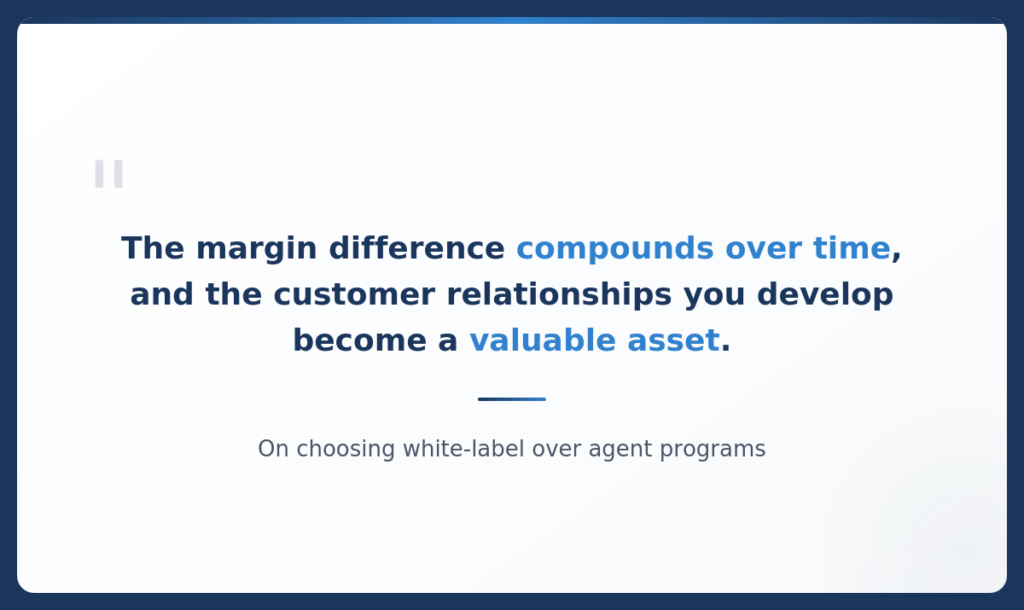
Most resellers building substantial businesses choose white-label arrangements despite the additional responsibility. The margin difference compounds over time, and the customer relationships you develop become a valuable asset. Agent programs work well for testing market demand or supplementing other service offerings without major commitment.
Your existing capabilities should guide this decision. If you already operate a technology services business with support staff and customer management infrastructure, white-label SIP trunking is a natural extension. If you primarily provide advisory services without operational capacity, agent programs let you participate without building new capabilities.
How Do You Get Started as a Reseller?
The path from decision to first customer involves several practical steps.
Select a Provider Partner
Your provider shapes your business trajectory for years. Evaluate potential partners based on network reliability, pricing transparency, support responsiveness, and platform capabilities. Tier-1 network connections minimize call-quality issues that damage customer relationships. Transparent pricing structures let you quickly build accurate customer proposals without lengthy approval processes.
Request trial accounts to test provisioning workflows, control panel functionality, and support response times. The experience you have during evaluation typically reflects what your customers will experience after signing up.
Establish Your Market Focus
Attempting to serve every business in every industry dilutes your effectiveness. Successful resellers often concentrate on specific verticals or geographic areas where they can develop deep expertise and referral networks.
Healthcare organizations require HIPAA-compliant communications with reliable uptime. Professional services firms value call recording, CRM integration, and mobile accessibility. Manufacturing and logistics companies benefit from scalability and cost savings. Each vertical has distinct priorities that inform your sales approach and service packaging.
Develop Your Sales Process
SIP trunking sales typically involve demonstrating cost savings against current telecom spending. Gather information about prospects’ existing phone bills, call volumes, and pain points. Position your solution in terms of specific financial benefits and operational improvements relevant to their situation.
Customer testimonials and case studies from similar businesses strengthen your credibility. Collect success stories as you build your customer base, documenting concrete outcomes like cost reductions, implementation speed, or reliability improvements.
Build Operational Readiness
Before actively selling, ensure you can deliver on promises. Configure your branded portal, establish support procedures, and document your implementation process. Smooth onboarding experiences generate referrals and reduce churn. Rough implementations create support burdens and reputation damage.
Consider fast-track or accelerated onboarding programs if your provider offers them. These programs provide structured training, dedicated support during initial sales, and sometimes financial incentives for reaching early milestones.
What Makes SIP Trunking Valuable to Your Customers?
Understanding customer benefits enables more effective sales conversations and positions you as a consultative partner rather than a commodity vendor.
Substantial Cost Reduction
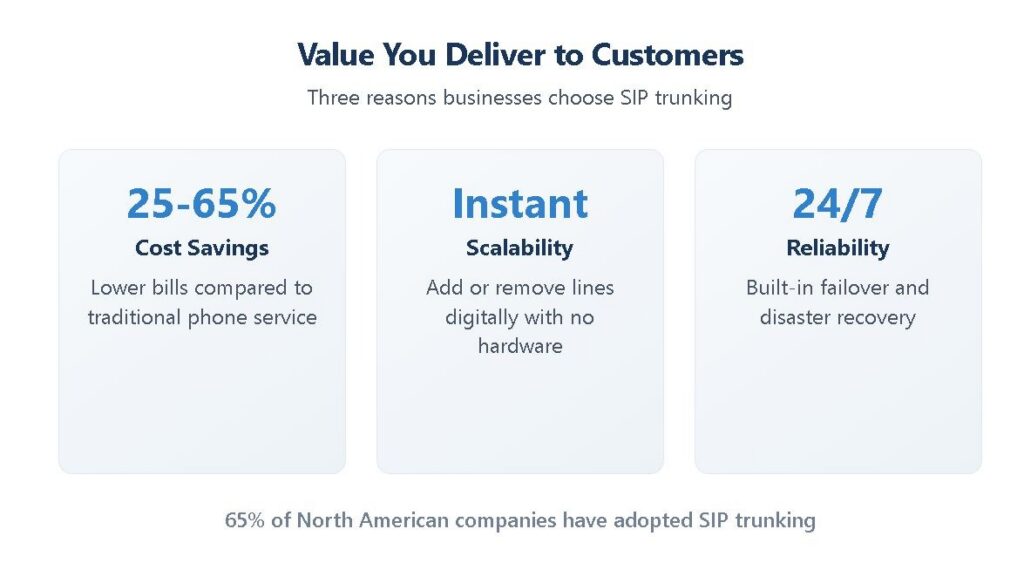
Businesses switching to SIP trunking regularly save 25% to 65% on communication costs compared to traditional phone services. Approximately 65% of North American companies have already adopted SIP trunking as part of their communication strategy, largely driven by these economics.
The savings come from eliminating long-distance charges, reduced infrastructure maintenance, pay-for-what-you-use scaling, and consolidated vendor relationships. For businesses with high call volumes or multiple locations, the financial case often becomes overwhelming.
Instant Scalability
Traditional phone systems require physical installations to add capacity. SIP trunking scales digitally. Your customers can add lines during busy seasons and reduce them during slow periods, matching communication costs to actual business needs.
This flexibility proves valuable for growing businesses, seasonal operations, and organizations with fluctuating call volumes. The ability to respond immediately to changing requirements without hardware projects or lengthy provisioning cycles is a genuine competitive advantage.
Business Continuity and Reliability
SIP trunking enables disaster recovery capabilities impossible with traditional phone lines. Calls can automatically route to alternate locations, mobile devices, or backup systems when primary connections fail.
Geographic flexibility also supports distributed workforces. Employees working from home, satellite offices, or client sites access the same phone system as headquarters. For organizations embracing hybrid work models, this capability is essential.
Frequently Asked Questions
Do I need technical expertise to become a SIP trunk reseller?
Technical knowledge helps but is not required for success. Platform providers handle infrastructure management, network operations, and most technical support. Many successful resellers come from sales, consulting, or general business backgrounds rather than telecommunications engineering. Your platform partner should offer training resources that cover necessary technical concepts without requiring deep expertise.
How long does it typically take to become profitable?
Timelines vary based on your existing customer relationships, sales execution, and local market conditions. The recurring revenue model means early customers continue generating monthly income while you acquire additional accounts. Resellers with established networks in technology services often achieve profitability within six to twelve months. Those building from scratch may require a longer runway.
What ongoing support should I expect from a SIP trunk reseller program?
Quality providers offer multiple support tiers: technical assistance for implementation questions, sales support including proposals and competitive positioning, and operational guidance on best practices. Evaluate support responsiveness during your trial period. Providers who are difficult to reach before you sign up rarely improve afterward.
Can I offer SIP trunking alongside other services?
Absolutely. Many successful resellers bundle SIP trunking with complementary offerings like managed IT services, cloud solutions, cybersecurity, or business consulting. These bundles increase average revenue per customer, strengthen relationships through multiple touchpoints, and create switching costs that improve retention.
Start Building Your SIP Trunk Reseller Business
The telecommunications industry is undergoing a generational shift, and the resellers establishing themselves now will benefit from that transition for years to come. Market projections, technology trends, and customer demand all point toward sustained growth in SIP trunking adoption.
Success requires selecting the right platform partner, one that provides reliable infrastructure, transparent pricing, and comprehensive support without burdening you with contracts or upfront commitments. SIPTRUNK offers exactly this combination: a reseller-focused platform built specifically for channel partners who want to build recurring revenue businesses without infrastructure headaches. Get started with SIPTRUNK and discover how straightforward building a profitable SIP practice can be.

Mitch leads the Sales team at BCM One, overseeing revenue growth through cloud voice services across brands like SIPTRUNK, SIP.US, and Flowroute. With a focus on partner enablement and customer success, he helps businesses identify the right communication solutions within BCM One’s extensive portfolio. Mitch brings years of experience in channel sales and cloud-based telecom to every conversation.