
SIP vs PRI: Differences, Costs, and When to Switch
Every remaining PRI on your book is a replacement opportunity, and the SIP vs PRI conversation goes to the partner who brings the customer’s own numbers.
- PRI sells capacity in fixed circuits, while SIP sells it one channel at a time, which is where most of the customer’s savings come from.
- Most existing phone systems keep working on SIP through native support or a gateway, so the conversation rarely requires a new PBX.
- A PRI circuit is a single point of failure, while a well-designed SIP deployment reroutes calls to other networks, sites, or devices automatically.
- PRI still belongs at sites without reliable broadband, under unexpired contracts, or with unvalidated life-safety lines, and each of those exceptions is temporary.
Audit every PRI you touch now, and schedule each conversation around the renewal date rather than the carrier’s retirement notice.
Most customers still on PRI will make the SIP vs PRI decision within the next few contract cycles, and many will make it only because a carrier letter forced the issue. Interconnected VoIP already carries roughly 82% of business wireline voice connections, and the FCC’s March 2026 modernization order removed the filing steps that once slowed copper retirement. For partners building a voice practice on a SIP trunk reseller platform, every remaining PRI is a qualified opportunity for the partner who walks the customer through the trade-offs honestly.
SIP vs PRI: How Should You Explain the Difference to a Customer?
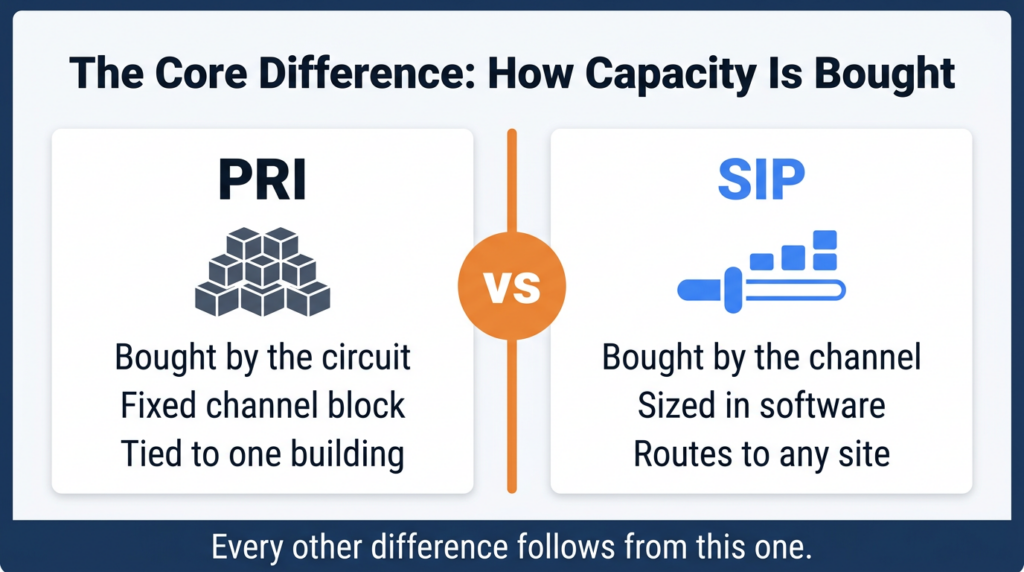
Explain it as a difference in how capacity is bought and where calls can go. A PRI is a dedicated digital circuit that delivers a fixed block of call paths to one building, while a SIP trunk delivers call paths over an IP network, sized in software and routable to any site. Every SIP vs PRI difference the customer cares about, from cost to growth to outage behavior, follows from capacity being physical in one case and virtual in the other.
What Is PRI, and What Is the Customer Actually Paying For?
PRI is an ISDN service that delivers a fixed block of voice channels plus a signaling channel over a T1 circuit, and the customer pays for every channel whether they use it or not. A PRI invoice typically bundles the circuit or local loop, the PRI port, DID number blocks, and usage charges, often under a multi-year term. The most common misunderstanding is numbers versus channels: a business can route dozens of numbers across one PRI and still be limited to the circuit’s channel count for simultaneous calls.
What Is SIP Trunking in Reseller Terms?
In reseller terms, a SIP trunk is a set of virtual call paths you provision to a customer’s phone system over IP, billed per channel or by usage and changed in a portal rather than through a carrier order. Two pricing models dominate: unlimited-minute plans priced per concurrent channel, and metered plans with unlimited channels and per-minute rates. Matching the model to the customer’s calling pattern is where a dealer adds value that a standard carrier quote does not.
How Do SIP Trunking vs PRI Compare Side by Side?
PRI wins on dedicated bandwidth and native support for legacy lines, while SIP wins on cost, scalability, failover, multi-site reach, and dealer revenue. The table below covers the SIP trunking vs PRI factors customers ask about and the two that matter to your business, so use it as a one-page reference in discovery.
| Factor | PRI | SIP trunking |
|---|---|---|
| Connection | Dedicated, circuit-switched digital line | Virtual trunk over an IP network |
| Capacity | Fixed channel block per T1 circuit | Individual channels, set in software |
| Adding capacity | New circuit order and provisioning lead time | Portal change, with temporary bursts on many plans |
| Who makes changes | Carrier, through a service order | Dealer, through a provisioning portal |
| Cost model | Per circuit, often under multi-year terms | Per channel or by usage |
| On-site hardware | Circuit termination, PRI card, PBX | IP-PBX or gateway, often a session border controller |
| Call quality driver | Dedicated bandwidth | Bandwidth, QoS marking, and network design |
| Failover | Second circuit or manual forwarding | Automatic rerouting to other trunks, sites, or devices |
| Number routing | Portable, but inbound routing is tied to the circuit | Portable, and inbound routing can move between sites |
| Multi-site and remote staff | One circuit per location | Centralized trunks serving many locations |
| Legacy devices | Native support for fax, alarm, and elevator lines | Requires validation before cutover |
| Dealer revenue | Mostly one-time installation | Recurring monthly revenue per channel |
How Do SIP vs PRI Costs Compare?
SIP usually costs less because the customer pays for measured demand instead of full circuits, and the dedicated loop disappears. Industry research ranks cost efficiency versus legacy PRI as the leading driver of SIP trunking adoption, with the largest gains at high-volume and multi-site accounts. How much a specific customer saves depends mostly on how much PRI capacity sits idle.
What Hidden Costs Does PRI Carry?
The biggest hidden cost is stranded capacity. A customer whose busiest hour uses a fraction of the circuit still pays for all of it, and one that outgrows a circuit by a few channels pays for a second full circuit. Multi-year terms, early termination fees, and a carrier dispatch for every change add to the total.
How Do You Build the Savings Case From the Customer’s Bill?
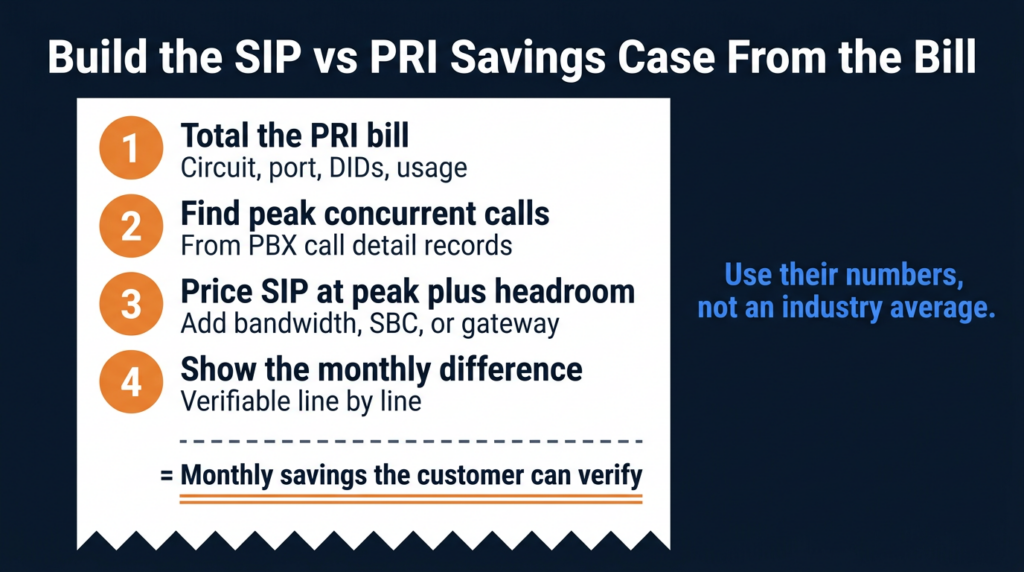
Build it from the customer’s own invoices and call records rather than an industry average. Total the circuit, port, DID, and usage charges from recent PRI bills, then pull call detail records from the PBX to find peak concurrent calls. Price SIP at that peak plus headroom, add any bandwidth, session border controller, or gateway costs, and present the difference as a monthly figure the customer can verify line by line.
What Does the Cost Shift Mean for Dealers?
A PRI replacement turns a one-time installation into monthly recurring revenue, and every channel added later grows it without a new sale. The pricing model changes your business as much as the customer’s bill. With white-label SIP trunking, the invoice carries your brand, so the customer credits the savings to you, which is the economic case behind a SIP trunk reseller program.
How Does Scalability Differ Between SIP Trunks vs PRI?
SIP scales one channel at a time, while PRI scales one circuit at a time. Adding PRI capacity means a carrier order, provisioning lead time, and often another PBX card. On a SIP trunk reseller platform, adding channels or DIDs is a portal change the dealer makes directly, and many plans allow temporary bursts above the contracted count.
A tax preparation firm whose call load surges from February through April can size SIP to actual demand and adjust monthly. On PRI, the same firm either overbuys for the peak or drops calls during it.
What Hardware and Infrastructure Does Each Require?
PRI requires a delivered circuit, termination equipment, and a PBX with a T1 interface card, while SIP requires an IP-capable PBX or a gateway, a business-grade connection, and usually a session border controller. PRI keeps that hardware on site and partly under carrier control, while SIP moves most of it into software, which shifts your job from managing circuits to engineering the network.
The session border controller handles topology hiding, SIP normalization, and TLS and SRTP encryption. On hardware, the SIP vs PRI comparison favors SIP: less on-site equipment is among the SIP trunking benefits customers notice first, provided voice traffic is marked as Expedited Forwarding and prioritized end to end.
Which Is More Reliable, and How Does Failover Work?
A well-designed SIP deployment is more reliable in practice because it reroutes calls on its own, while a PRI delivers consistent quality but has no automatic failover. Neither technology is immune to carrier failure, and the real difference is what happens next.
Publicly reported outages involving telecommunications providers rose above their 2020 to 2025 average in 2025, and a PRI has no answer except a second circuit or manual forwarding after the phones go quiet. A SIP deployment built with secondary trunk routing, a second network path, and PSTN backup forwarding moves calls without anyone touching the system, as detailed in SIP Trunk Failover: A Dealer’s Continuity Playbook.
Call quality on SIP trunks vs PRI is the objection resellers hear most, and it is a network question rather than a protocol one. Size bandwidth to peak concurrent calls, apply QoS on every hop between the PBX and the edge, and test under business-hour load before cutover. PRI keeps one real advantage: consistent quality without network planning.
How Does Each Technology Support Business Continuity?
SIP supports continuity by letting each number fail over to another site or device, while PRI ties every number to one building that goes silent when the circuit does. That is why continuity is where the PRI vs SIP gap is widest. In a 2025 survey of data center operators, 57% said their most recent major outage cost more than $100,000. When a flood, fire, or fiber cut takes a PRI site offline, inbound calls fail until the circuit returns.
On SIP, each DID can carry its own failover destination, such as another office, a mobile number, or voicemail to email, triggered automatically. For healthcare and legal customers, that per-number control often settles the decision.
Can Customers Keep Their Phone Numbers on SIP?
Yes. Customers port their existing numbers to the SIP trunk, so main lines, DIDs, and toll-free numbers stay the same, and inbound routing then belongs to the trunk rather than a circuit. Porting is also the step most likely to delay a project, and E911 location records move from the circuit to a per-address database, so both belong at the front of the plan.
Will SIP Work With the Customer’s Existing PBX?
In most cases, yes. Modern IP-PBX platforms register to SIP trunks natively, and older TDM systems connect through a gateway that presents the familiar PRI handoff, so handsets, extensions, and call flows stay in place. Keeping the existing system is the mainstream path: on-premises deployments held roughly three-quarters of SIP trunking market share in 2025. Before quoting, confirm the system appears on a certified PBX platform list and still receives security updates, since an unsupported PBX turns a trunk conversion into a phone system sale.
When Does PRI Still Make Sense?
PRI still makes sense at sites without reliable broadband, under contracts with heavy penalties remaining, where life-safety lines have not been validated on IP, and at locations closing soon. Each one is a question of timing rather than long-term strategy, so keep PRI in place, for now, when any of these apply:
- The site lacks reliable broadband. An existing circuit may sound better until fiber or a dedicated connection arrives.
- The contract has significant penalties remaining. Early termination fees can erase first-year savings, so time the move for renewal.
- Life-safety or legacy lines have not been validated on IP. Alarm panels, elevator phones, and certain fax workflows need testing first.
- The location is closing soon. A new trunk for a site with months of life left rarely pays off.
Recommending PRI in these cases builds credibility. Outside them, staying on PRI means paying more while the carrier sets the end date.
When Is SIP the Better Choice?
SIP is the better choice for nearly every business with reliable internet, and the case strengthens with every added location. The SIP trunking benefits that decide most deals are lower monthly cost, capacity that tracks actual demand, per-number failover, and one set of trunks serving every site and remote employee.
Consider a multi-office dental group with a PRI at each location. In most SIP vs PRI evaluations like this one, centralized trunks replace a circuit at every office, idle channels disappear, and a flooded office forwards to its nearest sister location instead of going silent.
What Are the Signs a Customer Is Ready to Move Away From PRI?
A customer is ready when two or more of these signals appear, and the most urgent are a carrier notice, a renewal within the next year, and idle channels on the bill. When they show up on an account, schedule the SIP vs PRI conversation:
- The carrier sent a price increase or discontinuation notice. Carrier discontinuance applications are now granted automatically on the 31st day, so the first warning is often a letter.
- The PRI contract renews within the next year. Renewal avoids early termination fees.
- Peak call volume uses a fraction of the channels. Idle channels are paid for every month.
- The customer is adding a location or remote staff. PRI means a new circuit, while SIP extends existing trunks.
- The phone system is due for replacement. A new PBX decision is the natural point to move the trunks.
- A recent outage exposed a single point of failure. Leadership that lived through silent phones is ready to discuss failover.
- The building is getting a fiber upgrade. New bandwidth often provides room to carry voice.
What Does Moving From PRI to SIP Involve?
A move from PRI to SIP follows four stages: assess the environment, bring up the SIP trunk alongside the existing circuit, port the numbers, and cut over once calling and emergency services are verified. Porting paperwork, E911 records, legacy device discovery, and rollback planning decide whether the cutover is profitable or turns into unpaid support. Before you quote your next conversion, read PRI to SIP Migration Without Replacing Your PBX, which covers each stage in the order dealers run them.
Frequently Asked Questions
Customers and partners raise these questions most often during a comparison. Each answer is short enough to reuse in a proposal, and none requires a new phone system.
How Many SIP Channels Does a Customer Need to Replace a PRI?
Size to measured peak concurrent calls, not to the PRI’s full channel count. Pull several months of call detail records, find the busiest hour, and add headroom for growth and seasonal spikes. Most customers need fewer channels than they currently pay for, and that gap is often the headline of the proposal.
Is SIP as Secure as PRI?
SIP can be as secure as PRI when it is deployed correctly, and in one area it is stronger. PRI’s security comes from isolation, while SIP relies on session border controllers, encryption, and fraud monitoring. IP calling also supports STIR/SHAKEN caller ID authentication end to end, and the FCC has acknowledged that non-IP networks leave a gap in that framework.
Can a Business Run PRI and SIP at the Same Time?
Yes, and many do during a transition. A hybrid setup keeps the PRI for a set period while SIP carries new capacity or outbound calls, then shifts the remaining traffic once the customer is confident. It is also a practical way to bridge a contract that has not yet expired.
Turn the SIP vs PRI Conversation Into Recurring Revenue
Every PRI on a customer’s bill is a conversation waiting to happen, and the partner who explains the trade-offs honestly, including when to wait, earns the replacement. Lead with the customer’s real channel usage, continuity risk, and renewal date, and deliver the conversion on a SIP trunk reseller platform that handles provisioning, porting, and billing under your brand. SIPTRUNK gives channel partners that platform, with Tier-1 networks, no contracts or upfront costs, hands-off billing and taxes, and 24/7 expert support. Get started with SIPTRUNK and turn every PRI replacement into a monthly recurring revenue stream.

Mitch leads the Sales team at BCM One, overseeing revenue growth through cloud voice services across brands like SIPTRUNK, SIP.US, and Flowroute. With a focus on partner enablement and customer success, he helps businesses identify the right communication solutions within BCM One’s extensive portfolio. Mitch brings years of experience in channel sales and cloud-based telecom to every conversation.