

SIP Trunk Pricing Explained: Costs by User Type
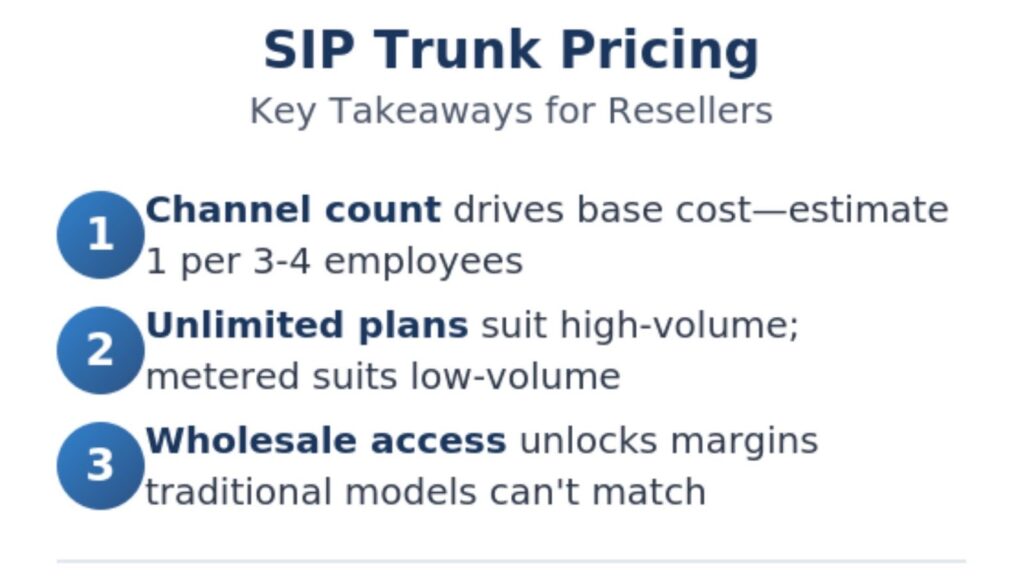
Understanding SIP trunk pricing structures is essential for positioning your services competitively. Wholesale access through reseller platforms can reduce per-channel costs compared to retail rates, creating significant margin opportunities.
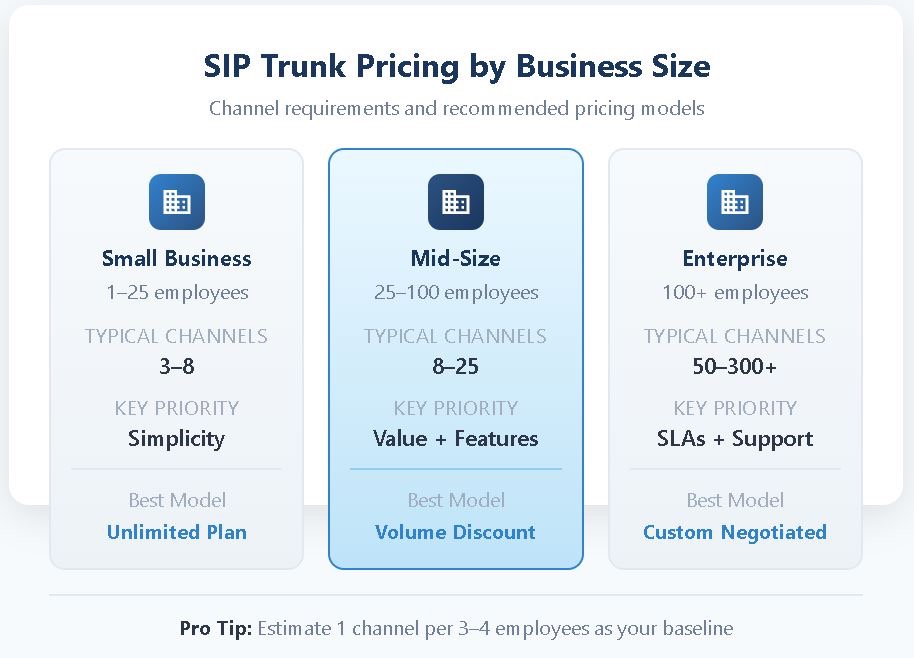
- Small businesses (1–25 employees) typically need 3–8 channels and benefit most from unlimited plans with predictable billing.
- Mid-size organizations (25–100 employees) require 8–25 channels and often qualify for volume discounts.
- Enterprise operations (100+ employees) can negotiate custom pricing with per-channel costs dropping below $10 at scale.
- Resellers accessing wholesale pricing can achieve 50–75% margins compared to 15–25% in traditional agent models.
Evaluate your clients’ concurrent call requirements, call volume patterns, and growth trajectory before recommending a pricing model.
For resellers building a telecommunications practice, few conversations matter more than the pricing discussion. Your clients want to understand what they are paying for and why. And they want assurance that the solution you recommend delivers genuine value. Mastering SIP trunking fundamentals positions you as the trusted advisor who can translate complex pricing structures into straightforward business decisions.
The challenge is that SIP trunk pricing varies across providers, user types, and service configurations. A small law firm with five employees has vastly different requirements than a regional healthcare network managing hundreds of concurrent calls. With the SIP trunking market projected to reach $157.91 billion by 2030, understanding how to match the right pricing model to each client’s situation determines whether you close the deal and whether that client remains satisfied long after implementation.
This guide breaks down how SIP trunk pricing works across different business sizes, compares the most common pricing models, and highlights the hidden costs that can erode value if overlooked.
What Factors Determine SIP Trunk Pricing?
Before diving into specific numbers, it helps to understand the variables that shape what your clients will pay. SIP trunk pricing is rarely a single line item. Instead, it reflects a combination of infrastructure requirements, usage patterns, and service features that together define the total cost of ownership.
How Do Channel Requirements Affect Cost?
Channels are the core unit of SIP trunk pricing. Each channel supports one concurrent call, whether inbound or outbound. A business that regularly handles ten simultaneous conversations needs ten channels. Underestimating channel requirements leads to busy signals and frustrated customers. Overestimating means paying for unused capacity.
The standard rule of thumb suggests one channel for every three to four employees, though this varies by industry. A call center or sales organization may need a one-to-one ratio, while a professional services firm with employees who spend most of their day in meetings might need only one channel per eight to ten staff members. Reviewing your client’s current phone system data reveals peak concurrent call volumes and provides a reliable baseline for channel planning.
Which Pricing Model Fits Different Client Profiles?
Providers typically offer three primary pricing structures: metered plans that charge per minute, unmetered plans with unlimited calling for a flat monthly fee, and block pricing that bundles minutes at discounted rates. Each model serves different use cases, and recommending the wrong one can cost your client money or leave them exposed to unexpected charges.
Metered pricing works well for businesses with low or unpredictable call volumes. Organizations making fewer than 1,000 minutes of calls monthly often find per-minute billing more economical than paying for unlimited capacity they will not use. However, metered plans create budgeting uncertainty, and costs can spike during busy periods.
Unmetered plans deliver predictable monthly expenses regardless of call volume. For businesses with consistent, moderate-to-high calling activity, the unlimited model simplifies financial planning and eliminates the anxiety of watching minutes accumulate.
What Additional Factors Influence Total SIP Trunk Cost?
Beyond channels and calling plans, several ancillary costs affect the final invoice. Direct Inward Dial (DID) numbers typically add $1 to $5 monthly each, depending on provider and number type. Toll-free numbers carry their own per-minute charges even on unlimited plans.
Setup fees, while increasingly rare as providers compete for market share, still appear in some arrangements. Regulatory fees, E911 compliance charges, and taxes add further line items. Understanding how to evaluate comprehensive SIP costs helps you present accurate projections that build client confidence.
How Do SIP Trunk Pricing Models Compare?
Selecting the appropriate pricing model requires matching your client’s operational reality to the structure that delivers the best value. The following comparison illustrates how each model performs across key criteria.

| Pricing Model | Monthly Cost Range | Best For | Key Advantage | Primary Risk |
| Metered (Pay-Per-Minute) | Varies by provider and destination | Low-volume users, seasonal businesses | Pay only for actual usage | Unpredictable costs during busy periods |
| Unmetered (Unlimited) | $15–$25/channel | Medium to high-volume callers | Predictable monthly billing | Overpaying if call volume drops |
| Block Pricing | Discounted bundles (e.g., 2,500 min) | Medium-volume users wanting cost control | Balance of savings and predictability | Unused minutes may expire |
| Wholesale/ Reseller | Significantly below retail rates | Resellers, MSPs, high-volume buyers | Highest margin potential | Requires volume commitments |
For resellers specifically, wholesale pricing unlocks margin opportunities that traditional agent commission models can’t match. Reducing costs creates room to price competitively while maintaining healthy profit margins.
What Does SIP Pricing Look Like by User Type?
Different organizations have distinct communication requirements, and those differences translate directly into pricing. Approximately 65% of North American companies have adopted SIP trunking as part of their communication strategy, with adoption accelerating among small and mid-size businesses moving to cloud-based systems. Segmenting your prospects by size and usage pattern helps you develop accurate quotes and set appropriate expectations.

How Should Small Businesses Approach SIP Trunk Cost?
Small businesses with one to twenty-five employees are the most price-sensitive segment. These organizations typically need three to eight channels and prioritize simplicity over advanced features. Monthly SIP trunk costs for this segment generally fall between $50 and $200, depending on the pricing model and provider selected.
Unlimited plans often make the most sense here because they eliminate billing surprises and allow business owners to focus on operations rather than monitoring call minutes. The straightforward value proposition of flat-rate pricing resonates with decision-makers who lack dedicated IT staff and want a solution that works without constant oversight. Small businesses also appreciate SIP trunk providers who bundle essential features like caller ID, voicemail, and basic call routing without additional charges.
What Pricing Structures Work for Mid-Size Organizations?
Mid-size organizations with 25 to 100 employees occupy a sweet spot for SIP trunk resellers. These businesses have enough call volume to benefit from cost savings over legacy systems while remaining manageable to support.
Channel requirements typically range from eight to twenty-five, with monthly costs between $200 and $750. At this scale, volume discounts may become available depending on the provider and commitment level. Resellers should inquire about tiered pricing when quoting larger deployments, as per-channel costs can decrease with higher channel counts or term agreements.
Mid-size organizations also tend to require more sophisticated features, including auto-attendants, call queues, and integration with CRM systems. Understanding how to position your reseller services to address these needs strengthens your competitive position.
What Should Enterprise and High-Volume Operations Expect?
Enterprise operations with more than 100 employees are the highest value opportunities but also demand the most complex pricing discussions. These organizations may deploy fifty to several hundred channels across multiple locations, with monthly costs ranging from $1,200 to well over $10,000.
Custom pricing becomes the norm at enterprise scale. Per-channel costs can drop below $10 for organizations committing to high channel counts and term agreements. Enterprises also require robust service level agreements guaranteeing uptime, call quality, and support response times. Redundancy features, automatic failover capabilities, and dedicated account management add value that justifies premium pricing. The total cost of ownership conversation shifts from monthly fees to a comprehensive communication investment.
How Do Resellers and Channel Partners Benefit from Wholesale Pricing?
For resellers, the pricing equation looks fundamentally different. Rather than paying retail rates, partners accessing wholesale SIP trunk pricing through established platforms can purchase services at costs that create substantial margin opportunities. Wholesale termination pricing varies widely by destination, volume, and route quality, but it’s common for high-volume destinations to be priced in fractions of a cent per minute, while premium, quality-controlled routing carries higher per-minute costs due to stricter performance requirements and carrier selection.
The financial advantage becomes clear through simple arithmetic. A reseller purchasing channels at $12 and selling them at $25 earns $13 in gross profit per account, representing a 108% markup on cost (or roughly a 52% gross margin on the sale). The wholesale approach delivers stronger revenue control and long-term profitability compared to traditional agent sales. By reviewing wholesale SIP trunking strategies, resellers can further optimize pricing, positioning, and margin structure as they scale.
| User Segment | Typical Channels | Monthly Cost Range | Recommended Model |
| Small Business (1–25 employees) | 3–8 | $50–$200 | Unlimited |
| Mid-Size (25–100 employees) | 8–25 | $200–$750 | Unlimited with volume discount |
| Enterprise (100+ employees) | 50–300+ | $1,500–$10,000+ | Custom/negotiated |
| Reseller (wholesale access) | Variable | Fractions of a cent/minute | Wholesale platform |
What Hidden Costs Should You Watch For?
Transparent pricing builds trust, and part of your value as a reseller lies in helping clients avoid unexpected charges. The most common hidden costs in SIP trunking include:
- Setup and activation fees: While many providers have eliminated these charges, some still have fees for initial configuration.
- Number porting: Moving existing phone numbers to a new provider may incur one-time fees that vary by provider and quantity.
- Regulatory recovery fees: Compliance with federal and state telecommunications regulations generates pass-through charges.
- International calling surcharges: Calls outside the U.S. and Canada carry per-minute rates that vary by destination.
- Premium feature add-ons: Call recording, advanced analytics, and enhanced security may require additional monthly fees.
- Overage charges: Metered plans impose per-minute costs that can accumulate rapidly during unexpected call spikes.
Presenting a complete cost picture rather than focusing solely on per-channel pricing demonstrates your commitment to your clients’ long-term success. For detailed pricing transparency, direct clients to review comprehensive SIP trunk pricing structures before finalizing their decision.
How Does Carrier Integration Affect SIP Trunk Cost?
The quality of the underlying network infrastructure directly impacts both price and performance. Tier-1 carrier networks offer superior call quality, lower latency, and higher reliability but typically command premium pricing. Budget providers may achieve lower costs by routing calls through multiple carriers or limiting support options.
Businesses conducting a SIP trunk cost comparison should consider the relationship between price and quality of service. Lower priced options might sacrifice reliability, resulting in dropped calls, poor audio quality, or system outages that damage customer relationships. Premium providers invest in redundant infrastructure, multiple carrier connections, and automatic failover capabilities. These investments justify higher pricing through enterprise-grade reliability and strong uptime commitments.

For resellers, partnering with SIP trunking providers who maintain Tier-1 network relationships protects your reputation. When your clients experience clear calls and consistent uptime, they credit your recommendation. When they experience quality problems, they remember who sold them the service.
Frequently Asked Questions About SIP Trunk Pricing
What is the average SIP trunk cost per channel? Most providers charge between $15 and $30 per channel monthly for unlimited domestic calling plans. Wholesale pricing through reseller platforms can reduce this amount. Metered alternatives charge $0.005 to $0.03 per minute plus a nominal monthly base fee.
How many SIP channels does a typical business need? The standard guideline suggests one channel for every three to four employees. A business with 40 employees would typically need 10 to 13 channels. However, call-intensive operations like contact centers may require a one-to-one ratio, while businesses with employees who primarily communicate via email might need fewer.
Are setup fees still common with SIP trunking providers? Setup fees have become increasingly rare as providers compete for market share. Many established platforms have eliminated activation charges entirely.
Partner with a Platform Built for Reseller Success
Understanding SIP trunk pricing positions you to serve clients across every business segment. From small businesses seeking predictable monthly costs to enterprises negotiating custom agreements, your expertise in matching pricing models to operational requirements creates lasting value.
SIPTRUNK provides the reseller-focused platform, wholesale pricing access, and technical support that enable you to build a profitable telecommunications practice without infrastructure investment or complex billing management.mGet started today and discover how transparent pricing and reliable Tier-1 network connectivity can strengthen your client relationships and grow your recurring revenue.

Mitch leads the Sales team at BCM One, overseeing revenue growth through cloud voice services across brands like SIPTRUNK, SIP.US, and Flowroute. With a focus on partner enablement and customer success, he helps businesses identify the right communication solutions within BCM One’s extensive portfolio. Mitch brings years of experience in channel sales and cloud-based telecom to every conversation.