

How to Sell SIP Trunking Services: A Step-by-Step Guide
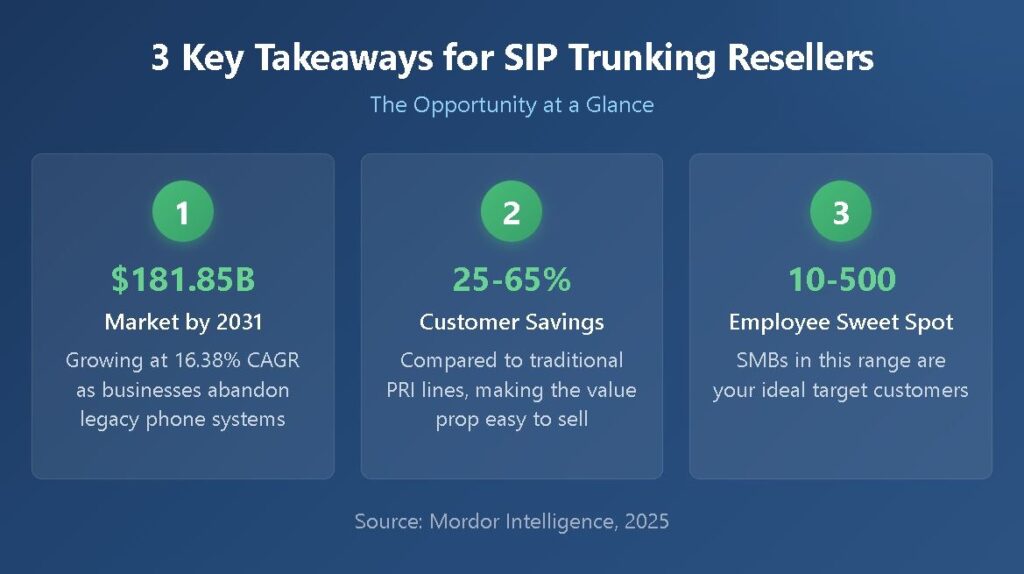
SIP trunking is one of the fastest growing opportunities in telecommunications, with the market projected to reach $181.85 billion by 2031.
- The right wholesale partner eliminates infrastructure investment while handling billing, taxes, and technical support.
- SMBs with 10 to 500 employees, who are currently overpaying for legacy phone lines, represent your ideal customer base.
- Recurring revenue streams through unlimited calling plans, metered options, and value-added services create predictable income.
- Focus on a niche vertical first, master the fundamentals, then scale with a platform built for resellers.
Start with the right foundation, and selling SIP trunking becomes a repeatable process that grows your business month over month.
Businesses everywhere are abandoning traditional phone lines in favor of internet-based voice solutions, creating an opportunity for resellers who understand how to position themselves.
The SIP trunking market stands at $73.14 billion in 2025 and is advancing at a 16.38% compound annual growth rate. This acceleration reflects enterprises moving toward Internet Protocol voice services, mandatory PSTN decommissioning timelines, and growing demand for unified communications platforms. For resellers, these converging forces translate into steady demand from businesses actively seeking modern communication solutions.
Businesses switching from legacy PRI lines typically realize cost savings between 25% and 65%, depending on their call volume and current infrastructure. When you combine these savings with improved scalability and disaster recovery capabilities, you have a value proposition that resonates with decision-makers across virtually every industry. This SIP trunking guide explains how to capture B2B VoIP sales that have become such a lucrative specialization for telecom agents, IT consultants, and managed service providers.
What Do You Need Before You Start Selling SIP Trunking?
Entering the SIP trunking reseller market requires less capital than most people assume, but it does demand preparation in several key areas. Understanding these prerequisites will help you build a sustainable business rather than scrambling to fill gaps after you have already signed your first customer.
What Technical Knowledge Is Required?
You don’t need to be a telecommunications engineer to succeed in this space, but you should understand the fundamentals. SIP, or Session Initiation Protocol, is the signaling mechanism that initiates, maintains, and terminates voice calls transmitted over the internet. A SIP trunk forms the virtual connection between your customer’s phone system and the public telephone network.
At a minimum, you should be able to explain how SIP trunks integrate with common IP-PBX systems like 3CX, FreePBX, and Microsoft Teams. You should also understand the concept of channels, which represent simultaneous call capacity, and how they differ from traditional phone lines. Resellers invest time in learning about codecs, call quality factors, and basic troubleshooting. The right wholesale partner will handle complex technical issues, allowing you to focus on relationships and sales.
What Business Infrastructure Should Be in Place?
Your business infrastructure needs are straightforward but important. You will need a reliable internet connection, a professional website that establishes credibility, and a system for managing customer relationships. Many resellers start with basic CRM software and expand their tools as they grow.
A clear marketing strategy is essential. Before you approach your first prospect, you should have defined your target market, developed your messaging, and created educational content that positions you as a knowledgeable advisor. Building a successful SIP trunks reseller business depends on establishing yourself as a trusted resource rather than simply another vendor.
How Do You Choose the Right Wholesale Partner?
Your wholesale partner may be the single most important decision you make. The right partner delivers the infrastructure, support systems, and tools that enable you to confidently serve customers without building a technical team from scratch.

Look for partners offering white-label capabilities that allow you to brand services under your own company name. Evaluate their provisioning platform for ease of use, since you will interact with it daily. Confirm they handle customer billing, tax compliance, and technical support at a level that protects your reputation. The best partners also provide training resources, sales enablement tools, and dedicated account management to help you succeed.
Step 1. How Do You Identify Your Ideal SIP Trunking Customers?
The first step in this SIP trunking guide is to follow successful resellers who avoid the trap of marketing to everyone. Instead, they focus their energy on prospects most likely to benefit from SIP trunking and most likely to convert into long-term customers.
Small and medium-sized businesses with 10 to 500 employees represent the sweet spot for most resellers. These organizations often pay significant premiums for outdated phone systems while lacking modern features like mobile integration, analytics, or unified communications. They feel the pain of outdated systems but often lack the internal expertise to evaluate alternatives.
Certain industries present strong opportunities. Healthcare organizations need HIPAA-compliant communication solutions that support telemedicine and multi-location coordination. Financial services firms require secure, recorded calls for regulatory compliance. Retail and hospitality businesses benefit from scalable solutions that handle seasonal volume fluctuations. The broader VoIP market is projected to grow from $144.77 billion in 2024 to $326.27 billion by 2032, driven by adoption in these key sectors.
When qualifying prospects, ask questions that reveal their current communication challenges. How many phone lines do they have? What do they spend monthly on telecommunications? Are they planning to expand or open new locations? Do remote employees struggle to connect with the main office? The answers will help you determine fit and tailor your approach.

Step 2. What Revenue Models Work Best for SIP Trunk Resellers?
The second step is developing your pricing strategy. Building sustainable income requires understanding the various ways you can structure your offerings. Successful resellers create multiple revenue streams that serve different customer needs while maximizing their own profitability.
Proven Pricing Strategies
Unlimited Monthly Plans provide customers with predictable billing while generating consistent recurring revenue for your business. Customers pay a fixed monthly fee per channel for unlimited domestic calling. This model appeals to high-volume callers who want cost certainty.
Metered Usage Models work well for customers with fluctuating call volumes. You offer pay-per-minute pricing that scales with actual usage. While the base revenue may be lower, per-minute margins can be substantial.
Bundled Packages combine SIP trunking with additional services like business texting, toll-free numbers, or international calling. Bundling increases your average revenue per customer while making your offering stickier.
Premium Feature Add-ons allow you to sell advanced capabilities like call analytics, CRM integrations, auto-attendants, and unified messaging as separate monthly subscriptions. These features differentiate your offering from commodity providers.
White-Label Platform Services position you to offer complete hosted PBX solutions under your brand. This approach captures higher monthly recurring revenue per customer but requires more support capability. Understanding wholesale SIP trunking structures will help you determine which models align with your business goals.

Step 3. How Do You Pitch SIP Trunking to Business Decision-Makers?
Effective B2B VoIP sales focus on business outcomes rather than technical specifications. Decision-makers care about solving problems, reducing costs, and gaining competitive advantages. Your job is to translate SIP trunking features into benefits that matter to their specific situation.
Lead every conversation by understanding the prospect’s current challenges. Ask about their communication pain points, growth plans, and budget constraints before presenting solutions. This consultative approach positions you as an advisor rather than a salesperson pushing products.
When presenting cost savings, be specific and credible. If a prospect currently pays $75 per line for 20 PRI channels, calculate their exact monthly spend and show them a realistic comparison. Avoid vague promises of “up to 50% savings” without substantiation. Decision-makers respond to concrete numbers backed by transparent assumptions.
Address objections proactively. Security concerns arise frequently, so be prepared to explain encryption, fraud protection, and compliance capabilities. Quality concerns can be mitigated by discussing Tier-1 network infrastructure and Quality of Service guarantees. Migration worries are eased by outlining the implementation process and emphasizing that number portability allows businesses to keep their existing phone numbers.

Step 4. What Marketing Strategies Drive SIP Trunking Sales?
Generating consistent leads requires a marketing approach that builds awareness and establishes your expertise over time. The most effective strategies combine digital presence with relationship building.
Educational content marketing establishes you as a knowledgeable resource. Create blog posts, guides, and videos that help prospects understand their options without immediately pushing for a sale. Topics like “How to Evaluate Your Business Phone System” or “Understanding SIP Trunking vs. Traditional Phone Lines” attract prospects early in their research process. This approach aligns with how buyers actually make decisions, since many business decision-makers read multiple pieces of content before contacting a vendor.
Search engine optimization ensures prospects find your content when they search for solutions. Target keywords related to business phone systems, VoIP migration, and telecommunications cost reduction in your geographic area or industry niche. Paid advertising can accelerate results while your organic rankings develop.
Customer referrals often produce high-quality leads. After successfully implementing solutions, ask satisfied customers if they know other businesses facing similar challenges. A simple referral program that rewards introductions can generate steady deal flow with minimal marketing spend.
Step 5. How Do You Scale Your SIP Business Over Time?
Growth requires systematizing your sales and delivery processes while continuously expanding your capabilities. The resellers who build significant businesses treat scaling as an intentional strategy rather than something that happens by accident.
Start by documenting your sales process from initial contact through implementation and ongoing support. Identify the steps that consistently lead to closed deals and train yourself, or eventual team members, to repeat them reliably. Standardization enables you to handle more customers without proportionally increasing your workload.
Expand your service offerings as you gain experience. Once you master basic SIP trunking sales, consider adding unified communications packages, contact center solutions, or specialized vertical offerings. Each addition increases your value to existing customers while opening doors to new prospects. Review white-label VoIP platforms periodically to ensure your partner relationship supports your growth ambitions.
Invest in systems that reduce administrative burden. Automated provisioning, integrated billing, and customer self-service portals free your time for revenue-generating activities. The right wholesale partner provides these tools as part of their platform, allowing you to scale without building expensive infrastructure.
Frequently Asked Questions
What Is the Difference Between SIP Trunking and VoIP?
VoIP refers broadly to voice communication transmitted over the internet. SIP trunking is a specific method of connecting a business phone system to the public telephone network using VoIP technology. Think of VoIP as the category and SIP trunking as a particular implementation that businesses use to replace traditional phone lines.
How Much Can Businesses Save by Switching to SIP Trunking?
Most businesses realize savings between 25% and 65% compared to traditional PRI or analog lines. The exact amount depends on current spending, call volume, and the specific SIP trunking plan selected. High-volume international callers often see the most dramatic reductions.
Do I Need Technical Expertise to Sell SIP Trunking Services?
You need foundational knowledge but not deep technical expertise. Understanding how SIP integrates with common phone systems and being able to explain the benefits in business terms is sufficient. The right wholesale partner handles complex technical support, allowing you to focus on sales and customer relationships.
How Long Does It Take to Start Generating Revenue?
Many resellers close their first deal within 30 to 60 days of launching. The timeline depends on your existing network, marketing efforts, and sales experience. Focusing on a specific niche or leveraging existing customer relationships can accelerate initial traction.
Start Building Your SIP Trunking Business Today
Selling SIP trunking services offers a clear path to recurring revenue in a growing market. The fundamentals are straightforward: understand your customers’ needs, partner with a reliable platform, and consistently deliver value that justifies their trust. Whether you are an IT consultant looking to expand your offerings or a telecom agent seeking new revenue streams, the opportunity is substantial for those willing to invest the effort.
SIPTRUNK provides the comprehensive platform and support system that resellers need to succeed in this venture. With white-label capabilities, automated provisioning, and dedicated partner support, you can focus on building customer relationships while the platform handles the technical complexity. Get started with SIPTRUNK today and begin building your recurring revenue stream.

Mitch leads the Sales team at BCM One, overseeing revenue growth through cloud voice services across brands like SIPTRUNK, SIP.US, and Flowroute. With a focus on partner enablement and customer success, he helps businesses identify the right communication solutions within BCM One’s extensive portfolio. Mitch brings years of experience in channel sales and cloud-based telecom to every conversation.