

Steps to Build a VoIP Reseller Business from Scratch: Legal, Technical, & Sales
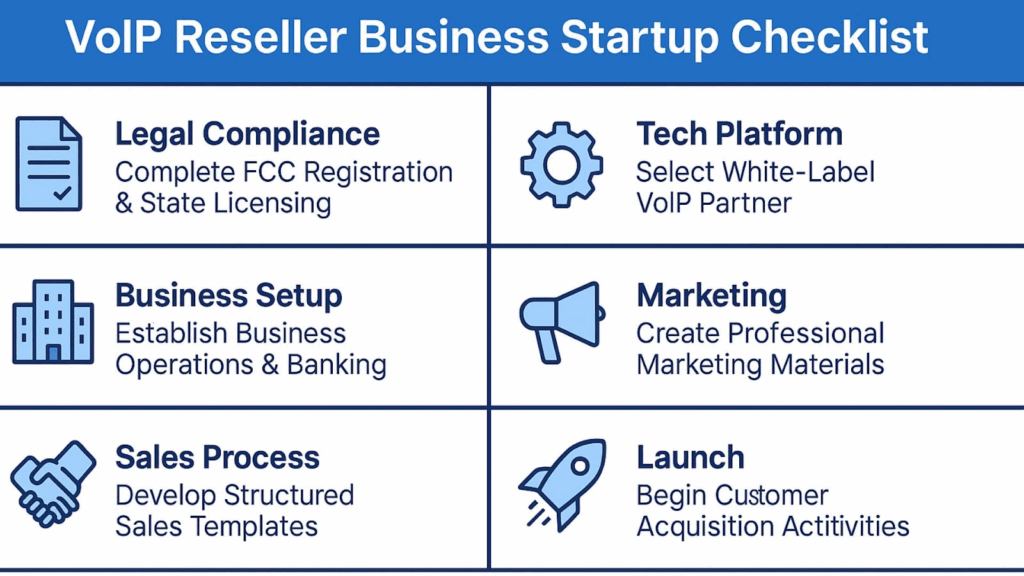
Starting a profitable VoIP reseller business requires thoughtful planning and regulatory compliance in today’s market.
- Legal compliance is mandatory: FCC registration, USF contributions, and state licensing requirements must be met before launching.
- Modern tech stack drives success: Automated provisioning, integrated billing, and white-label capabilities separate successful resellers from competitors.
- Structured sales approach accelerates growth: Proven templates for business planning, customer acquisition, and objection handling streamline operations.
- Partner selection determines profitability: Choose providers offering comprehensive support, competitive margins, and contract-free arrangements.
The VoIP reseller market presents exceptional opportunities for businesses ready to navigate compliance requirements and implement proven growth strategies.
The telecom industry continues its rapid shift toward internet-based solutions, creating opportunities for entrepreneurs to start a VoIP reseller business. The global VoIP services market reached $144.77 billion in 2024 and is expected to grow to $326.27 billion by 2032, representing a compound annual growth rate of 10.8%.
This growth stems from businesses abandoning legacy phone systems in favor of flexible, cost-effective VoIP solutions that support remote work environments and digital transformation initiatives. Resellers gain the chance to build sustainable recurring revenue streams while helping organizations modernize their communications.
However, the process for starting a VoIP reseller business has evolved. New regulatory requirements, advanced technology expectations, and sophisticated buyer demands mean success requires more than simply partnering with a provider and marketing services. Successful VoIP resellers must navigate compliance obligations, implement modern tech stacks, and execute structured sales procedures that differentiate their offerings.
Whether you’re expanding an existing technology business or launching a new venture, understanding these requirements before you start a VoIP reseller business ensures you build on solid foundations rather than encountering costly obstacles after launch.
What Are the Legal Requirements for Starting a VoIP Reseller Business?
Before exploring technical and sales considerations, prospective resellers must understand that federal regulations now classify VoIP resellers as telecommunications service providers subject to direct government obligations. This classification brings significant compliance requirements that can’t be delegated to wholesale partners.

Federal Compliance Requirements
Every VoIP reseller must register with the Federal Communications Commission using Form 499-A, regardless of business size or revenue thresholds. This registration identifies your company as a telecom service provider and establishes contribution obligations for Universal Service Fund programs supporting rural telecommunications, low-income access, and emergency services.
Registration requires providing detailed business information, including ownership structure, service offerings, and projected revenues. Once registered, resellers receive an FCC Registration Number that must be referenced in all regulatory filings and can be provided to wholesale partners to avoid duplicate taxation on services.
Universal Service Fund contributions currently stand at 15.6% of combined interstate and international revenues, with rates adjusted quarterly based on program funding requirements. Recent enforcement actions demonstrate that delayed registration results in escalating penalties, with cumulative fines reaching $18,000 over five years for businesses that fail to register promptly.
Robocall Mitigation Compliance
All VoIP service providers, including resellers, must register in the FCC’s Robocall Mitigation Database and file Robocall Mitigation Plans demonstrating effective policies to prevent illegal robocall traffic. Failing to meet these requirements for VoIP resellers risks having your traffic blocked by downstream carriers, potentially disrupting operations and damaging customer relationships.
The mitigation plan must detail specific technical and operational measures used to identify and block suspicious traffic patterns. While wholesale partners typically handle technical implementation, resellers remain responsible for filing accurate plans and maintaining compliance documentation.
State and Local Obligations
State licensing requirements vary by jurisdiction and service type. Some states require telecommunications reseller licenses, while others mandate sales tax registration for services sold to end customers. Local jurisdictions may impose additional business licensing requirements for VoIP resellers depending on service delivery methods.
Emergency services compliance is another critical obligation. Understanding VoIP reseller taxes and ensuring services provide Enhanced 911 capabilities that automatically transmit caller location information to emergency dispatchers remains mandatory for all VoIP services capable of making calls to the Public Switched Telephone Network.
What Tech Stack Do Modern VoIP Resellers Need?
VoIP resellers must implement technology infrastructure that supports efficient operations while delivering exceptional customer experiences. Clients expect automated provisioning, transparent billing, and reliable support systems that demonstrate professionalism and technical competence.

Core Platform Requirements
Your primary technology foundation should include automated SIP trunk provisioning that enables instant service activation without manual intervention. This capability allows resellers to onboard customers quickly while reducing operational overhead associated with manual configuration.
White-label portal capabilities ensure customers associate services with your brand rather than your wholesale provider. Look for platforms offering complete customization options, including branded login pages, custom domain hosting, and personalized email communications that reinforce your brand identity throughout the customer journey.
Real-time analytics and reporting tools provide visibility into customer usage patterns, helping you optimize service plans and identify expansion opportunities. Modern platforms should offer detailed call data records, quality metrics, and usage trends that enable proactive account management and technical troubleshooting.
Integrated Business Management Systems
Effective VoIP reseller businesses require CRM systems specifically designed for telecom services. Your CRM should track customer communication preferences, service history, and billing information while providing automated workflow capabilities for common support requests.
Automated billing systems eliminate manual invoice generation while providing customers with transparent usage reporting and flexible payment options. Your billing platform should support multiple rate structures, including unlimited plans, metered services, and hybrid arrangements that accommodate diverse customer preferences.
Tax management automation ensures compliance with complex requirements across multiple jurisdictions. Modern billing systems include built-in tax engines that calculate appropriate fees based on service type, customer location, and applicable regulations, reducing compliance risks and administrative burden.
How Do You Create a VoIP Reseller Business Plan?
When you start a VoIP reseller business without a plan, it’s like building a house without blueprints. A solid business plan gives you direction, helps you spot opportunities, and keeps your growth sustainable. Focus on understanding your market, defining how you’ll stand out, and mapping out your revenue goals and operations so you can hit the ground running with confidence.
Market Analysis and Target Selection
Begin by identifying your target customer segments based on communication needs, technology sophistication, and decision-making processes. Small to medium-sized businesses typically offer the most attractive opportunities for new resellers, as they need communication solutions but lack internal resources to manage complex vendor relationships.
Industry specialization often provides competitive advantages by enabling a deeper understanding of specific communication requirements. Healthcare practices require HIPAA-compliant communication solutions, while law firms prioritize Direct Inward Dialing capabilities for client accessibility. Manufacturing companies may need integration with existing business applications and robust business continuity features.
Geographic focus helps concentrate marketing efforts and build local market presence. Regional targeting enables personalized customer service while reducing travel costs for on-site support and sales activities. Consider factors like local competition density, business growth rates, and existing technology adoption levels when selecting target markets.
Revenue Modeling and Financial Planning
Develop realistic revenue projections based on customer acquisition timelines, average contract values, and market conditions. Success timelines vary based on competitive positioning, target market characteristics, and operational efficiency.
Customer lifetime value calculations should factor in monthly recurring revenue, average customer tenure, and expansion revenue from additional services or capacity increases. Research customer requirements for VoIP resellers and local market conditions to establish realistic projections for your specific business model.
Consider multiple revenue scenarios based on different growth assumptions, market conditions, and competitive factors. Conservative projections help ensure adequate working capital, while optimistic scenarios guide expansion planning and investment decisions. Build in quarterly reviews to adjust projections based on actual performance data.
Partner Selection Strategy
Successful VoIP reseller start-up businesses depend heavily on wholesale partner selection. When learning how to become a VoIP reseller, prioritize partners offering competitive wholesale pricing, reliable technical infrastructure, and comprehensive support that enable your business growth.
Financial considerations should include commission opportunities, payment terms, and fee structures that impact cash flow and profitability. Look for partners offering 50–100% profit margins depending on services and partnership models, monthly billing cycles, and transparent pricing structures that reward business growth.
Technical capabilities must include redundant network infrastructure, quality monitoring systems, and rapid provisioning that ensure reliable service delivery. Evaluate partners based on their ability to provide Service Level Agreements covering uptime, call quality, and support response times that protect your customer relationships. Your chosen platform should align with your business plan for VoIP resellers to ensure smooth operations.
What Sales Plan Templates Drive VoIP Reseller Success?
Implementing structured sales processes improves conversion rates and reduces sales cycle length for VoIP reseller businesses. Successful resellers use proven templates for customer acquisition, needs assessment, and objection handling that consistently guide prospects through buying decisions.
Customer Acquisition and Lead Generation
Develop systematic approaches for identifying and engaging qualified prospects based on pain points and technology readiness. Create outreach templates addressing specific business challenges like remote work support, cost reduction needs, or system reliability concerns that resonate with target audiences.
Email sequence templates should nurture prospects through educational content that demonstrates expertise while building trust and credibility. Include case studies showing cost savings achieved by similar businesses, technical guides explaining VoIP benefits, and comparison charts highlighting advantages over traditional phone systems.
Educational content marketing establishes thought leadership while nurturing prospects through information that builds trust and demonstrates expertise. When you resell VoIP services, create blog posts, white papers, and case studies addressing common challenges and success stories.
Consultative Selling Framework
A successful consultative sales approach starts with asking the right questions. Build a discovery process that helps you uncover what really matters to each customer, such as their communication challenges, growth goals, and current technology setup. Use flexible question templates to guide your conversations, making it easier to understand technical constraints and budget expectations before you recommend a solution.
When it’s time to evaluate their setup, site survey templates help you stay consistent. Cover essentials like internet reliability, hardware compatibility, and on-site infrastructure so your solution fits perfectly. Checklists for network performance, devices, and integration needs keep everything organized and ensure nothing gets overlooked.
Finally, use proposal templates that clearly connect your recommendations to the customer’s goals. Outline how your solution solves their specific pain points, the steps for implementation, and what kind of ROI they can expect. Keep it focused, results-driven, and easy for them to see why your plan delivers more value than the alternatives.
Objection Handling and Closing Strategies
Common objections in VoIP sales include concerns about call quality, implementation complexity, and ongoing reliability. Develop response templates addressing these concerns with factual information, customer testimonials, and risk mitigation strategies that build confidence in your solutions.
Price objections require demonstrating the total cost of ownership advantages rather than simply comparing monthly fees. Create cost comparison templates showing savings from reduced long-distance charges, eliminated hardware maintenance, and improved productivity through advanced features.
Technical complexity concerns can be addressed through simplified explanations, demonstration videos, and implementation support guarantees. Develop educational materials that explain VoIP technology in business terms while emphasizing your role in managing technical details and ensuring smooth transitions.
What Are SIP Trunks? The Foundation of Your Reseller Business
Session Initiation Protocol (SIP) serves as the signaling mechanism that initiates, maintains, and terminates communication sessions transmitted over internet connections. SIP trunks function as virtual pathways that carry digital communications between business phone systems and the broader telephone network, replacing traditional copper wire connections with internet-based connectivity.
This technology transformation enables businesses to reduce communication costs while gaining access to advanced features like call recording, analytics, and mobile integration. Understanding how SIP trunking works is essential when you start a VoIP reseller business because you’re providing the infrastructure that enables modern communication rather than the communication services themselves.
Modern businesses need solutions that support remote workers, integrate with digital collaboration tools, and provide scalability without hardware investments. SIP trunk resellers bridge this technology gap by providing internet-based connectivity that transforms existing phone systems into modern communication platforms while maintaining a connection to traditional telephone networks.
Which Essential Features Should You Evaluate When Choosing Your SIP Trunk Partner?
Selecting the right partner is vital for VoIP reseller start-ups, as your wholesale provider’s capabilities directly impact service quality, customer satisfaction, and business profitability. Focus on providers offering comprehensive platforms designed for reseller success.
Platform Capabilities and Infrastructure
Seek partners offering transparent pricing structures with multiple billing options that accommodate diverse customer preferences. Unlimited channel plans provide predictable monthly costs for businesses with consistent calling patterns, while metered options serve organizations with variable usage requirements.
Avoid partners requiring significant upfront investments, long-term contracts, or minimum revenue commitments that limit business flexibility. The most successful VoIP reseller partnerships operate on month-to-month arrangements that allow service adjustments based on market conditions and customer needs.
Network reliability depends on redundant Tier-1 connections that ensure consistent call quality and minimal service disruptions. Your wholesale partner should maintain geographically distributed infrastructure with automatic failover capabilities that protect customer communications during network issues.
Support and Training Resources
Comprehensive onboarding programs should include technical training, sales enablement resources, and marketing materials that accelerate your ability to effectively sell and support VoIP services. Quality partners provide certification programs that demonstrate your expertise to potential customers.
Ongoing support becomes critical when customer issues require escalation beyond your capabilities. Evaluate partners based on response time commitments, escalation procedures, and expertise levels of their support teams to ensure customer satisfaction.
Marketing resources should include co-brandable materials, case studies, and educational content that support your sales efforts. The best wholesale partners provide website templates, proposal tools, and competitive analysis resources that enhance your market positioning.
How to Build and Scale Your VoIP Reseller Start-Up Business
Successful customer acquisition requires targeting specific market segments with tailored messaging that addresses their unique challenges and business objectives. Rather than pursuing broad market approaches, focus on industries or business types where you can develop expertise and competitive advantages.

Customer Relationship Excellence
Long-term success in VoIP reselling depends on maintaining strong customer relationships through proactive support, regular communication, and strategic guidance that helps customers maximize their investments. Exceptional customer service becomes your primary competitive differentiation.
Regular check-ins provide opportunities to identify expansion needs, address potential issues before they become problems, and demonstrate ongoing value that justifies service fees. Implement review processes that ensure consistent customer contact and relationship maintenance.
Feedback collection enables continuous service improvement while demonstrating customer focus that builds loyalty and generates referrals. Use surveys, review requests, and informal conversations to gather insights about service quality, feature needs, and competitive positioning that inform business development strategies.
Sustainable Growth Strategies
Service expansion opportunities might include offering complementary services like network security, collaboration tools, or IT consulting that increase customer lifetime value while strengthening business relationships. Evaluate expansion options based on customer needs, market opportunities, and your organizational capabilities.
Expertise development in specific industries, technical specializations, or geographic markets enables premium pricing while reducing competitive pressure from generalist providers. Consider pursuing additional certifications, developing specialized service packages, or building partnerships that enhance your capabilities and market positioning.
Continuous learning about telecom technology, market trends, and customer needs ensures your business remains relevant as the industry evolves. Attend industry conferences, participate in training programs, and maintain relationships with wholesale partners who provide market insights and product development information.
Frequently Asked Questions
What licenses do I need to start a VoIP reseller business? You must register with the FCC using Form 499-A and comply with Universal Service Fund contribution requirements. State licensing varies by jurisdiction, so research specific requirements in your operating territories. Some states require telecommunications reseller licenses, while others mandate sales tax registration for services.
How much capital do I need to start a VoIP reseller business? Capital requirements depend on your business model, target market, and growth plans. Choose wholesale partners requiring no upfront payments to minimize initial investment requirements. Consider costs for business setup, initial marketing, and working capital needs.
What technical knowledge do I need to resell VoIP services? A basic understanding of VoIP technology, IP networking, and business phone systems helps with customer consultations and technical discussions. However, the best wholesale partners provide comprehensive training and handle complex technical support, allowing you to focus on sales and customer relationship management.
How long does it take to become profitable as a VoIP reseller? Profitability timelines vary based on market conditions, customer acquisition costs, competitive positioning, and operational efficiency. Focus on building sustainable customer relationships rather than targeting specific timeframes.
What ongoing compliance requirements apply to VoIP resellers? Annual FCC Form 499-A filings, quarterly USF contribution payments, annual CPNI certifications, and Robocall Mitigation Plan updates are the primary ongoing federal requirements. State and local obligations vary by jurisdiction and may include periodic license renewals or tax filings.
Discover the Ease of Starting Your SIP Trunk Reseller Business
The telecom industry is full of opportunity for entrepreneurs who are ready to take action. With the right strategy, a reliable partner, and a solid plan for attracting and keeping customers, you can build a business that grows month after month.
Launching a successful VoIP reseller business takes some groundwork: understanding compliance requirements, choosing modern tools, and creating sales processes that turn leads into loyal customers. But the payoff is worth it: steady recurring revenue, expanding demand, and the satisfaction of helping businesses communicate better every day.
SIPTRUNK provides the comprehensive platform and support resources you need to build a successful VoIP reseller business. Our white-label solution includes automated provisioning, transparent billing, regulatory compliance support, and dedicated partner assistance that lets you focus on customer acquisition and relationship building. Get started today with a free reseller account and begin building your VoIP business on proven foundations.

Mitch leads the Sales team at BCM One, overseeing revenue growth through cloud voice services across brands like SIPTRUNK, SIP.US, and Flowroute. With a focus on partner enablement and customer success, he helps businesses identify the right communication solutions within BCM One’s extensive portfolio. Mitch brings years of experience in channel sales and cloud-based telecom to every conversation.