

How to Find the Best VoIP Wholesale Providers
The VoIP wholesale market presents a compelling opportunity for IT resellers seeking recurring revenue streams, but choosing the right provider determines long-term success.
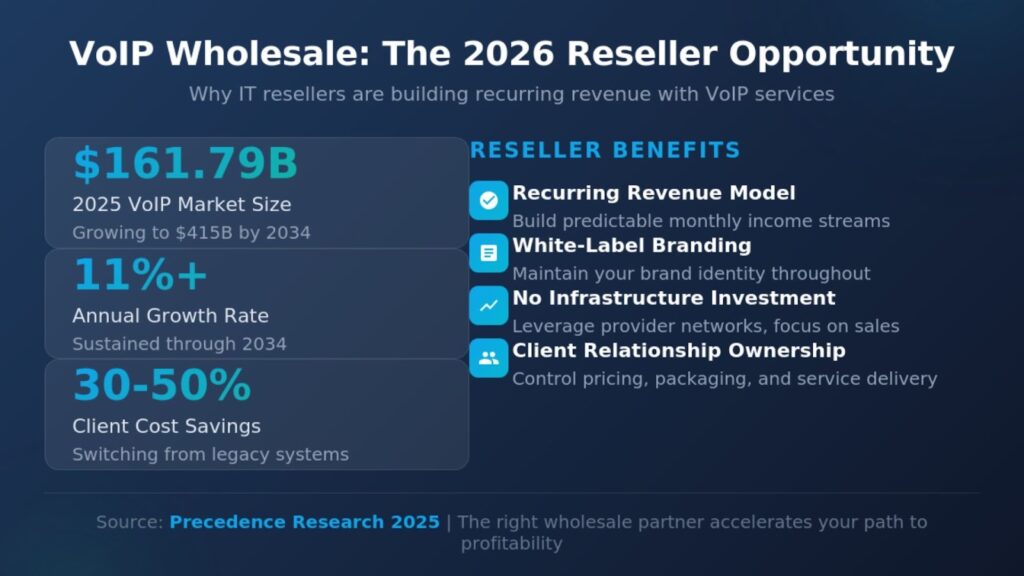
- Market momentum is strong: The VoIP market reached $161.79 billion in 2025 and continues growing at over 11% annually, creating sustained demand for reseller services.
- Provider quality varies: Tier-1 network access, integration capabilities, and white-label support differ between wholesale providers.
- Integration capabilities now drive competitive advantage: Modern resellers need providers offering API access, CRM connectivity, and unified communications support.
- Evaluation criteria have evolved: Beyond pricing, successful resellers prioritize scalability, security compliance, and partnership support structures.
Resellers who systematically evaluate providers against these criteria position themselves to capture market share while building sustainable, profitable businesses.
The Voice over Internet Protocol industry has matured into a foundational element of business communications. The VoIP market reached $161.79 billion in 2025 and is projected to grow to $415.20 billion by 2034. This trajectory reflects a shift in how organizations approach telecommunications, moving decisively away from legacy systems toward flexible, internet-based solutions.
For technology sales leaders, VARs, IT consultants, and managed service providers, this growth translates into tangible opportunity. The ability to offer enterprise-grade VoIP services under your own brand creates recurring revenue while strengthening client relationships. However, realizing this potential requires partnering with the right VoIP wholesale provider. The wrong choice leads to service interruptions, margin compression, and damaged client trust. The right choice builds the foundation for a scalable telecommunications practice.
This guide provides a comprehensive framework for evaluating and selecting the best VoIP wholesale providers. You will learn how to assess network quality, compare pricing structures, evaluate integration capabilities, and identify partnership programs that support your business growth.
How Does VoIP Wholesale Reselling Work?
Understanding the wholesale VoIP model helps resellers position themselves in the market. The wholesale approach differs from retail telecommunications, offering advantages that benefit both resellers and their end customers.
Understanding the Wholesale VoIP Model
VoIP technology converts voice signals into digital data packets transmitted over Internet Protocol networks. This software-based approach eliminates the physical infrastructure requirements of traditional telephone service, reducing costs while expanding functionality. Wholesale VoIP providers purchase bulk capacity from Tier-1 carriers and make these services available to resellers at volume-discounted rates.
The reseller serves as the connection point between SIP wholesale providers and end-user businesses. This position allows resellers to package services according to their market’s specific needs, set competitive pricing, and maintain direct client relationships. The wholesale provider handles the complex technical infrastructure, including call routing, network maintenance, and regulatory compliance. Resellers focus on sales, customer service, and relationship management.
This division of responsibilities creates efficiency for all parties. Businesses gain access to modern communications technology through trusted local providers. Resellers build recurring revenue without infrastructure investment. Wholesale providers achieve scale through their reseller networks.
Why Resellers Choose White-Label Solutions
White-label VoIP wholesale arrangements allow resellers to offer services under their own brand identity. Clients interact with your company name, your support team, and your billing systems. This approach strengthens brand equity and prevents clients from bypassing your services to work directly with upstream providers.
The best wholesale partners provide complete white-label support, including branded customer portals, customizable invoices, and marketing materials. They handle back-end complexity while ensuring your brand remains front and center throughout the client experience. This arrangement works particularly well for IT consultants and managed service providers who want to expand their offerings without diluting their established market presence.
White-label programs also provide flexibility in service packaging. Resellers can bundle voice services with their existing offerings, create tiered pricing structures, and develop specialized packages for vertical markets.
What Should You Look for in the Best VoIP Wholesale Providers?
Selecting a VoIP wholesale provider requires evaluating multiple factors that impact service quality, profitability, and operational efficiency. The following criteria help distinguish providers who will support your long-term success from those who may create ongoing challenges.

How Important Is Tier-1 Network Infrastructure?
Network quality directly determines client satisfaction and your reputation in the market. Tier-1 providers own and operate their network infrastructure with direct connections to the public switched telephone network. This ownership typically delivers superior call quality, faster issue resolution, and more consistent performance compared to providers who resell capacity from other carriers.
When evaluating network infrastructure, ask specifically about redundancy and failover capabilities. Professional-grade providers operate multiple geographically distributed points of presence with automatic failover. This architecture ensures service continuity even during localized outages or maintenance windows. Look for uptime guarantees of 99.999% backed by service level agreements that include compensation provisions.
Call quality metrics provide objective measures for comparison. Mean Opinion Score ratings above 4.0 indicate excellent voice quality suitable for professional business communications. Ask SIP wholesale providers about their average latency, jitter performance, and packet loss rates. These technical specifications translate directly into the client experience your customers will have.
What Integration and API Capabilities Should Providers Offer?
Organizations expect their phone systems to connect with customer relationship management platforms, helpdesk software, and collaboration tools. The best VoIP wholesale providers recognize this reality and offer robust integration capabilities.
API access enables custom integrations that differentiate your services from competitors. Look for providers offering well-documented APIs for provisioning, call control, and data access. These capabilities allow you to automate routine tasks, build custom reporting dashboards, and create seamless experiences for your clients. Providers with limited API functionality will constrain your ability to serve sophisticated customers.
Unified communications support has become important as businesses consolidate their communications tools. Evaluate whether providers can support video conferencing, team messaging, and presence features alongside traditional voice services. The ability to offer comprehensive UCaaS solutions positions you as a strategic communications partner rather than a commodity voice provider.
Why Does Pricing Transparency Matter?
Pricing complexity creates problems for resellers trying to develop competitive offerings and maintain healthy margins. The best VoIP wholesale providers offer clear, straightforward pricing without hidden fees or complicated tier structures. Transparency allows you to confidently quote prices to prospects and accurately forecast your revenue.
Evaluate the pricing models available from each provider. Unlimited minutes plans work well for high-volume clients who need predictable monthly costs. Per-minute pricing benefits seasonal businesses or organizations with variable call patterns. Hybrid models combining channel fees with minute bundles offer flexibility for diverse client bases. Your provider should offer options that match your target market’s preferences.
Hidden costs erode profitability and damage client relationships. Ask specifically about setup fees, porting charges, regulatory surcharges, and minimum commitments. The most reseller-friendly providers automatically handle telecommunications taxes, removing administrative burden while ensuring compliance across jurisdictions. Request a complete rate card and review it carefully before committing to any partnership.
What White-Label and Partnership Support Should You Expect?
Partnership programs vary between VoIP wholesale providers. Some offer minimal support beyond basic service delivery. Others invest heavily in reseller success through training, marketing resources, and dedicated account management.
Comprehensive white-label support should include branded customer portals, customizable documentation, and the ability to maintain consistent branding throughout the client experience. Evaluate how thoroughly you can customize the end-user interface and whether your brand identity will be preserved in all client interactions.
Training and enablement resources accelerate your time to revenue. Look for providers offering sales training, technical certification programs, and competitive positioning guidance. Some providers also offer co-marketing opportunities, including trade show participation, webinar partnerships, and lead-sharing arrangements. These resources prove valuable for resellers entering the VoIP market for the first time.
How Should You Structure a Provider Comparison Matrix?
Systematic comparison helps identify providers who best match your requirements. The following evaluation framework addresses the criteria that matter most for reseller success.
When you compare VoIP carriers for wholesale partnerships, organize your evaluation around six core categories.
- Network quality encompasses uptime guarantees, geographic coverage, and call quality metrics.
- Pricing flexibility includes available models, transparency, and margin potential.
- Integration capabilities cover API access, CRM connectivity, and UCaaS support.
- White-label depth addresses branding customization, portal access, and documentation.
- Partnership support includes training resources, account management, and growth assistance.
- Security and compliance address encryption standards, fraud protection, and regulatory requirements.
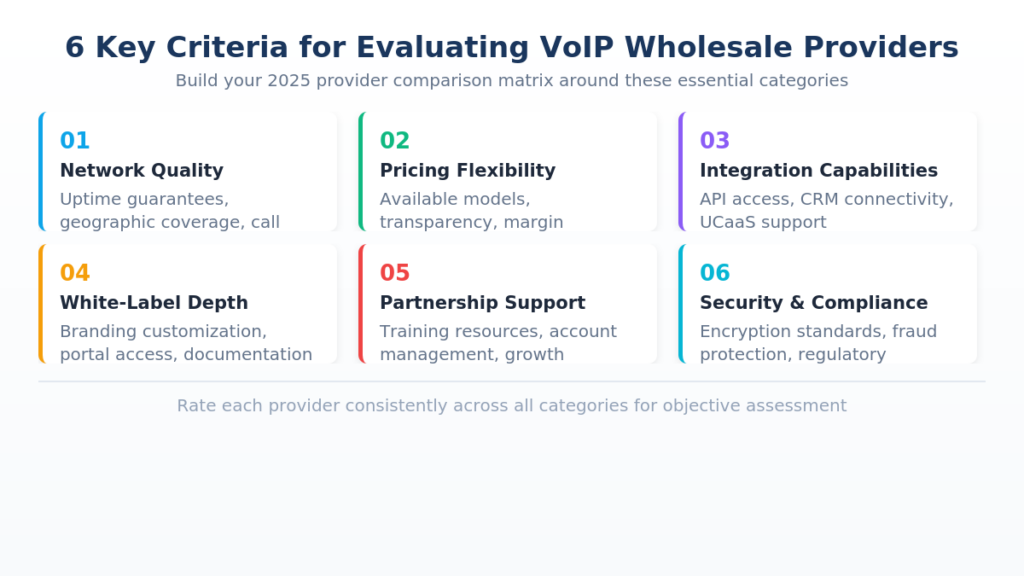
Rate each provider across these categories using consistent criteria. Gather information through provider consultations, reference checks with existing resellers, and hands-on evaluation of management portals. Document your findings in a comparison matrix that allows objective assessment rather than relying on sales presentations alone.
Consider weighting categories according to your specific priorities. Resellers serving enterprise clients may prioritize security compliance and integration capabilities. Those targeting small businesses might emphasize pricing simplicity and ease of provisioning. Your evaluation framework should reflect the needs of your target market.
Why Should IT Resellers Consider VoIP Wholesale?
The business case for VoIP reselling has strengthened as market adoption accelerates and technology capabilities expand. Understanding these dynamics helps resellers communicate value to prospects while building confidence in their strategic direction.

What Cost Advantages Can You Offer Clients?
VoIP technology reduces telecom costs for businesses of all sizes. Organizations switching from traditional phone service typically realize savings of 30% to 50% on their monthly communications expenses. These savings come from eliminated line charges, reduced long-distance fees, and consolidated infrastructure costs.
As a reseller, you capture margin while still delivering savings to clients. This value proposition opens doors with cost-conscious prospects and strengthens relationships with existing clients. The ability to demonstrate concrete ROI differentiates your services from competitors who struggle to quantify their value.
Modern VoIP solutions also reduce hidden costs that businesses often overlook. Simplified moves, adds, and changes eliminate service call charges. Consolidated billing reduces administrative overhead. Remote work support eliminates the need for separate home office phone lines. Help clients understand these comprehensive savings to strengthen your value proposition.
How Does VoIP Support Business Continuity and Flexibility?
Reliability concerns that once hindered VoIP adoption have been thoroughly addressed by modern providers. Call forwarding to mobile devices ensures business continuity even during internet outages. Geographic number portability allows businesses to maintain their identity regardless of physical location. Cloud-based infrastructure provides resilience that traditional phone systems cannot match.
Scalability is another compelling advantage for growing businesses. Adding capacity requires no hardware installation or lengthy provisioning processes. Businesses can add or remove lines as needs change, paying only for the capacity they actually use. This flexibility proves valuable for seasonal businesses, project-based organizations, and rapidly growing companies.
The shift toward hybrid and remote work has accelerated VoIP adoption across industries. Employees working from home offices need the same professional communications capabilities as those in corporate facilities. VoIP for IT resellers delivers consistent functionality regardless of location, supporting the distributed workforce models that have become standard in many organizations.
What Integration Features Matter Most When Comparing VoIP Carriers?
Integration capabilities are a key differentiator among VoIP wholesale providers. Businesses expect their communications systems to work seamlessly with other business applications, creating pressure on resellers to deliver connected solutions.

Customer relationship management integration allows call data to automatically flow into client records. Sales teams see caller information before answering. Service representatives access complete interaction histories. Managers analyze call patterns alongside sales data. These capabilities transform voice communications from an isolated utility into an integrated business intelligence resource.
Analytics and reporting features help clients optimize their communications investments. Real-time dashboards show call volumes, wait times, and agent performance. Historical reports identify trends and support capacity planning. Call recording and quality monitoring enable training and compliance documentation. Providers offering comprehensive analytics capabilities help you deliver measurable value to clients.
Artificial intelligence features are becoming common in VoIP for IT resellers. Automated call routing uses machine learning to connect callers with appropriate resources. Sentiment analysis helps managers identify calls requiring attention. Transcription services create searchable records of voice conversations. Fraud detection algorithms protect against unauthorized usage. Evaluate which AI capabilities providers offer and how they might benefit your target clients.
How Can You Effectively Compare VoIP Carriers for Wholesale Partnerships?
Structured evaluation processes help identify the best VoIP wholesale providers for your situation. The following approach ensures thorough assessment while managing the time investment required.
Begin by defining your requirements clearly. Document your target market characteristics, required features, integration needs, and growth projections. This foundation ensures you evaluate providers against relevant criteria rather than generic checklists. Share these requirements with potential providers to assess their ability to meet your specific needs.
Request detailed information from multiple providers. Ask for complete rate cards, service level agreements, and partnership program documentation. Request references from resellers with similar business models and target markets. Evaluate management portals and provisioning tools through hands-on demonstrations rather than relying on marketing materials alone.
Conduct pilot implementations before committing to exclusive partnerships. Test provisioning workflows, call quality, and support responsiveness with real scenarios. Evaluate how providers handle problems and escalations. This practical experience reveals operational realities that sales presentations may not capture.
Assess the financial stability and market position of potential partners. VoIP wholesale requires long-term commitment, and provider instability creates significant business risk. Evaluate company history, customer retention rates, and investment in platform development. Partners who demonstrate sustained growth and continued innovation provide more reliable foundations for your business.
Frequently Asked Questions About VoIP Wholesale Providers
What distinguishes Tier-1 from Tier-2 VoIP providers? Tier-1 providers own their network infrastructure and maintain direct connections to the public switched telephone network. This ownership typically results in better call quality, faster issue resolution, and more reliable service. Tier-2 providers resell capacity from Tier-1 networks, which can introduce additional latency and create dependencies on upstream provider performance. For resellers, Tier-1 partnerships generally provide more consistent client experiences.
How do I determine appropriate margin levels for VoIP reselling? Margin expectations vary based on service complexity, support requirements, and competitive positioning. Basic voice services support healthy margins that increase when bundled with value-added services, including integration, analytics, and managed support. Evaluate your cost structure, including sales, support, and administrative overhead, when determining pricing. The most profitable resellers focus on value delivery rather than competing solely on price.
What security certifications should VoIP wholesale providers maintain? Professional providers should demonstrate SOC 2 Type II compliance, which validates security controls and operational practices. STIR/SHAKEN authentication support helps combat caller ID spoofing and fraud. TLS and SRTP encryption protect voice traffic from interception. For clients in regulated industries, ensure providers can support HIPAA compliance, PCI requirements, or other applicable standards.
How quickly should new services be provisioned? Modern SIP wholesale provider platforms should offer near-instantaneous provisioning for standard configurations. Automated systems allow you to activate new accounts, provision numbers, and configure services within minutes rather than days. Complex custom configurations may require additional time, but basic service activation should be streamlined and efficient.
Partner with the Right VoIP Wholesale Provider
The VoIP wholesale market offers a substantial opportunity for resellers prepared to invest in the right partnerships. Success requires systematic evaluation of providers against criteria that matter for your specific business model and target market. Network quality, integration capabilities, pricing transparency, and partnership support all contribute to long-term success.
SIPTRUNK provides the comprehensive platform that resellers need to succeed in today’s VoIP market. With Tier-1 network infrastructure, robust white-label capabilities, and dedicated partnership support, SIPTRUNK helps resellers build profitable telecommunications practices. Get started today and discover how the right wholesale partnership transforms your business.

Mitch leads the Sales team at BCM One, overseeing revenue growth through cloud voice services across brands like SIPTRUNK, SIP.US, and Flowroute. With a focus on partner enablement and customer success, he helps businesses identify the right communication solutions within BCM One’s extensive portfolio. Mitch brings years of experience in channel sales and cloud-based telecom to every conversation.