

How Wholesale SIP Termination Works: A Technical Overview for Resellers
Wholesale SIP termination routes voice calls from IP networks to traditional phone systems through carrier-grade infrastructure.
- Enables cost-effective outbound calling with savings over traditional methods.
- Provides multiple termination routes (premium, standard, CLI) for different quality/cost requirements.
- Requires proper codec support, Session Border Controllers, and carrier interconnections.
For resellers, understanding technical flow and route selection is critical for customer success.
Understanding how wholesale SIP termination works is fundamental for resellers looking to capitalize on the rapidly expanding VoIP market, which reached $161.79 billion in 2025 and is projected to grow at an 11.04% CAGR through 2034. As businesses migrate from traditional telephony to internet-based communications, resellers need comprehensive knowledge of the technical infrastructure that enables these cost-effective voice solutions.
So, how does wholesale SIP termination work? It’s the backbone of modern business communications, allowing resellers to offer sophisticated VoIP carrier services without substantial infrastructure investments. This process transforms how voice calls traverse networks, laying the groundwork for scalable, profitable reseller businesses in telecommunications.
What Is Wholesale SIP Termination?
Wholesale SIP termination is the process by which voice calls initiated on a VoIP network are routed to their final destination on the Public Switched Telephone Network (PSTN) or another SIP-enabled system. Unlike SIP origination, which handles incoming calls from traditional networks to VoIP systems, termination focuses exclusively on outbound call delivery from internet-based systems to traditional telephone infrastructure.
Wholesale SIP termination is the bridge between modern IP-based communication systems and legacy telephone networks. A wholesale SIP termination provider purchases voice termination services in bulk from telecom carriers, then resells these services to businesses, resellers, and service providers at wholesale rates. This bulk purchasing model enables significant cost savings compared to traditional telecom providers.
The fundamental difference between wholesale and retail SIP termination lies in scale and target market. Wholesale providers cater to resellers, carriers, and high-volume users who require competitive per-minute rates and robust infrastructure. These providers maintain extensive carrier relationships across multiple geographic regions, ensuring optimal call routing and quality across diverse destinations.
How Does Wholesale SIP Termination Work?
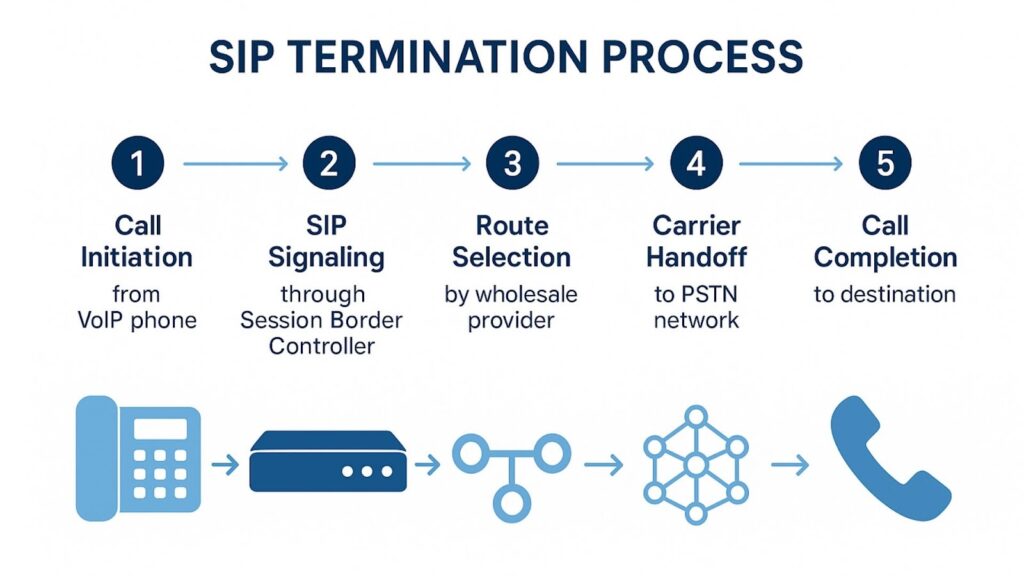
Understanding how wholesale SIP termination works requires examining each step of the call routing process, from initial call setup through final delivery to the destination party.
Call Initiation and SIP Signaling
The wholesale SIP termination process begins when a user initiates an outbound call from their VoIP-enabled device or PBX system. The calling device generates a SIP INVITE message containing essential call information, including the destination number, caller identification, and preferred media parameters. This SIP signaling establishes the foundation for the entire termination process.
SIP signaling operates as a control layer, managing call setup, modification, and teardown procedures. The protocol uses text-based messages similar to HTTP, making it relatively straightforward to troubleshoot and monitor. Each SIP message contains headers that provide routing information, authentication credentials, and media specifications that guide the call through the termination process.
Session Border Controller Processing
Session Border Controllers (SBCs) act as intelligent intermediaries between calling parties and carrier networks. These specialized devices function as back-to-back user agents (B2BUAs), terminating incoming SIP sessions and re-originating them as new sessions toward the destination.
SBCs provide essential security functions by hiding network topology, preventing unauthorized access, and implementing fraud protection measures. They also handle protocol normalization, ensuring that SIP implementations from different vendors can communicate effectively despite subtle protocol variations. Additionally, SBCs manage media transcoding when calling and receiving parties use incompatible audio codecs.
Route Selection and Carrier Handoff
Once the SBC processes the call, the wholesale SIP termination provider’s routing engine determines the optimal path for call delivery. This decision involves analyzing multiple factors, including destination number, call quality requirements, cost considerations, and real-time carrier availability. Advanced routing systems maintain detailed databases of carrier capabilities and performance metrics.
Route selection typically involves least cost routing (LCR) algorithms that balance cost efficiency with quality requirements. Premium routes offer superior quality metrics but command higher per-minute rates, while standard routes provide cost-effective termination for less critical communications. Intelligent routing systems continuously monitor carrier performance and automatically adjust routing decisions based on real-time quality metrics.
PSTN Integration and Call Completion
The final stage involves delivering the call from the IP network to the traditional telephone infrastructure. This transition requires sophisticated gateway equipment that converts SIP signaling into protocols compatible with PSTN switches, such as ISUP (ISDN User Part) or traditional circuit-switched signaling.
Media gateways handle the conversion of packetized voice data into traditional circuit-switched voice streams. These devices manage timing synchronization, echo cancellation, and signal level adjustments to ensure seamless call quality across network boundaries. The conversion must maintain strict quality standards to prevent audio degradation or call failures.
What Types of SIP Termination Routes Are Available to Resellers?
Understanding different SIP termination routes enables resellers to offer appropriate solutions for diverse customer requirements and budget constraints.
Premium CLI Routes vs. Standard Routes
Premium CLI (Calling Line Identification) routes guarantee accurate caller ID delivery and maintain higher answer seizure ratios (ASR) compared to standard routes. These routes utilize direct carrier relationships and premium network infrastructure, resulting in superior call quality and more reliable caller ID presentation.
Standard routes provide cost-effective termination for high-volume applications where absolute quality isn’t critical. These routes may utilize multiple carrier hops or aggregated traffic paths, potentially resulting in slightly degraded caller ID accuracy or increased post-dial delay. However, standard routes offer cost savings for applications like autodialing, notifications, or other automated calling systems.
Direct Carrier Routes vs. Aggregated Routes
Direct carrier routes establish termination paths through single, tier-one telecommunications carriers, providing optimal quality and minimal latency. These routes offer the most reliable performance but may have limited geographic coverage or higher minimum volume requirements. Direct routes are ideal for mission-critical communications or high-quality business applications.
Aggregated routes combine traffic from multiple smaller carriers or utilize intermediate aggregators to reach final destinations. While these routes may introduce additional network hops, they often provide broader geographic coverage and more competitive pricing for certain destinations. Advanced wholesale providers maintain sophisticated routing tables that automatically select optimal routes based on real-time performance data.
Geographic and Quality-Based Route Selection
Geographic routing considerations become critical for international termination or specialized domestic requirements. Local in-country routes typically provide superior quality and regulatory compliance compared to international gateway routes. Understanding termination regulations, number portability requirements, and local carrier relationships enables resellers to offer compliant, high-quality solutions.
Quality-based route selection involves matching customer requirements with appropriate infrastructure levels. Enterprise customers typically require premium routes with guaranteed quality metrics, while cost-conscious applications may benefit from standard routing with acceptable quality trade-offs.
What Are the Key Technical Infrastructure Components?
Successful wholesale SIP termination depends on a robust technical infrastructure that ensures reliable, high-quality call delivery.
Session Border Controllers (SBCs)
Enterprise-grade SBCs provide the foundation for secure, reliable SIP termination. These devices implement comprehensive security measures, including denial-of-service protection, authentication enforcement, and encryption capabilities. SBCs also manage call admission control (CAC) policies that prevent network overload during peak usage periods.
Modern SBCs support advanced features like STIR/SHAKEN call authentication, which helps combat robocalling and caller ID spoofing. They also provide detailed call detail records (CDRs) and real-time monitoring capabilities that enable proactive network management and troubleshooting.
Codec Support and Media Gateways
Comprehensive codec support ensures compatibility across diverse customer equipment and carrier networks. Wholesale SIP termination providers must support standard codecs like G.711 (PCMU/PCMA), G.729, and G.722, as well as newer formats like Opus for high-definition voice applications. Media gateways provide real-time transcoding capabilities when calling and receiving parties use incompatible codecs.
Advanced media processing capabilities include echo cancellation, noise reduction, and dynamic jitter buffering. These features ensure optimal voice quality across varying network conditions and help maintain consistent user experiences regardless of underlying network infrastructure.
Network Operations Centers (NOCs)
Carrier-grade NOCs provide 24/7 monitoring and management of wholesale SIP termination infrastructure. These facilities maintain real-time visibility into network performance, carrier relationships, and call quality metrics. NOC staff can quickly identify and resolve issues that might impact call delivery or quality.
Modern NOCs utilize automated monitoring systems that track key performance indicators (KPIs) and trigger alerts when metrics exceed acceptable thresholds. This proactive approach minimizes service disruptions and ensures consistent delivery for reseller customers.
Which Quality Metrics Should Every Reseller Understand?
Understanding key quality metrics enables resellers to effectively evaluate wholesale SIP termination providers and set appropriate customer expectations.
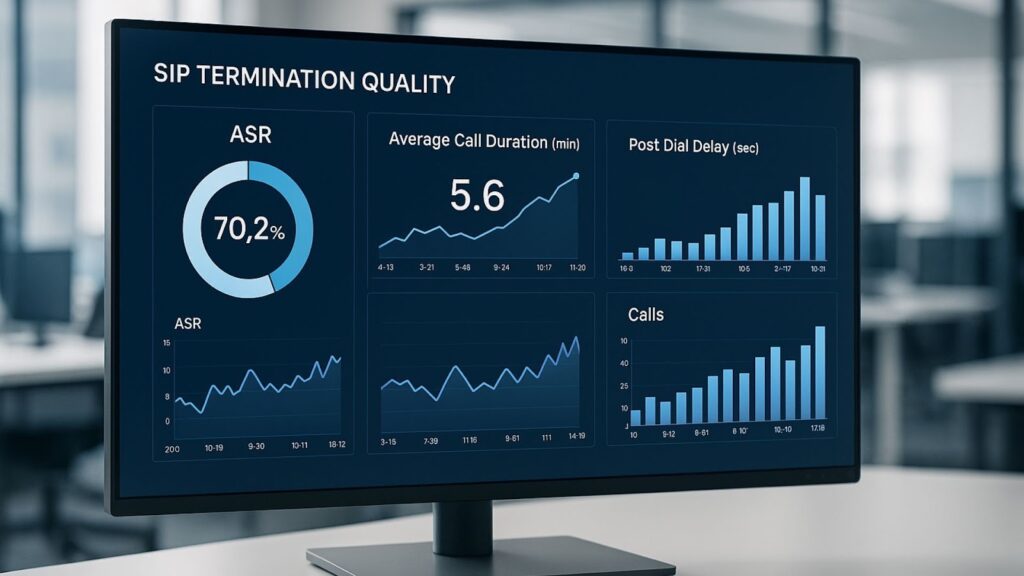
Answer Seizure Ratio (ASR) measures the percentage of calls that are successfully connected and answered. Premium routes typically achieve higher ASR rates than standard routes, with industry leaders delivering consistently superior connection rates. Higher ASR translates to better customer satisfaction and reduced operational complications from failed calls.
Average Call Duration (ACD) indicates the typical length of completed calls on specific routes. Longer ACD generally suggests higher quality routes with better audio quality and fewer mid-call disconnections. Route-specific ACD data helps resellers understand the reliability characteristics of different termination options.
Post Dial Delay (PDD) measures the time between completing number dialing and hearing the ringback tone or connection. Premium routes typically deliver lower PDD than standard routes, creating better user experiences. Excessive PDD creates poor user experiences and may indicate routing inefficiencies.
Jitter and Latency Measurements quantify network performance characteristics that directly impact voice quality. Jitter measures variation in packet arrival times, while latency indicates one-way transmission delay. Industry standards recommend minimizing both metrics to ensure optimal voice quality for business communications.
CLI Delivery Rates indicate the percentage of calls where the caller identification information accurately reaches the destination party. Premium routes achieve substantially higher CLI delivery rates than standard routes, depending on carrier relationships and routing paths.
What Are the Benefits of Wholesale SIP Termination for Resellers?
Wholesale SIP termination offers compelling advantages that enable resellers to offer VoIP carrier services and build profitable, scalable telecom businesses.
Cost Structure and Margin Opportunities
Wholesale SIP trunking services often deliver impressive cost reductions compared to legacy carrier rates, giving resellers the ability to build healthy margins while offering customers better value. Volume-based pricing tiers provide additional cost advantages as customer bases grow, enabling improved profitability over time. Flexible pricing models allow resellers to offer competitive rates while maintaining healthy margins.
The elimination of infrastructure investments reduces barriers to entry and ongoing operational expenses. Resellers can focus on sales and customer service rather than maintaining complex technical infrastructure, improving overall business efficiency and profitability.
Scalability Without Infrastructure Investment
Cloud-based wholesale platforms enable instant capacity scaling without hardware purchases or lengthy deployment cycles. Resellers can provision new customers within minutes and adjust capacity based on real-time demand fluctuations. This scalability eliminates the traditional constraints associated with circuit-based telecommunications services.
Modern wholesale platforms provide self-service portals that automate routine provisioning and management tasks. These tools reduce operational overhead and enable resellers to manage larger customer bases with minimal staff increases.
Global Reach and Local Presence
Wholesale SIP termination providers maintain carrier relationships across numerous countries and regions, enabling resellers to offer international calling services without establishing direct carrier partnerships. Local presence capabilities allow businesses to obtain phone numbers in markets where they don’t maintain physical operations.
Advanced routing capabilities ensure optimal call quality and competitive pricing for international destinations. Intelligent routing systems automatically select the best available paths based on real-time performance data and cost considerations.
How to Choose the Right Wholesale SIP Termination Provider
Selecting an appropriate wholesale provider requires careful evaluation of multiple technical and business factors.
Evaluating Network Redundancy and Reliability
Robust network redundancy ensures consistent service availability during equipment failures or carrier outages. Leading providers maintain multiple carrier relationships for each destination and implement automatic failover mechanisms that route traffic around network problems. Geographic diversity of network infrastructure reduces the impact of regional outages or disasters.
Service level agreements (SLAs) should specify minimum uptime guarantees and performance standards. Comprehensive SLAs include provisions for service credits when performance falls below agreed thresholds, providing financial protection for service disruptions.
Assessing Carrier Relationships and Route Quality
The quality and scope of carrier relationships directly impact termination quality and geographic coverage. Established providers maintain direct relationships with tier-one carriers in major markets, ensuring optimal routing and quality. Newer or smaller providers may rely on aggregated routes that introduce additional network hops and potential quality degradation.
Route quality assessments should include analysis of ASR, ACD, PDD, and CLI delivery metrics for specific destinations. Historical performance data provides insights into consistency and reliability over time, helping predict future service quality.
Technical Support and Troubleshooting Capabilities
Comprehensive technical support ensures rapid resolution of issues that might impact customer satisfaction. Leading providers offer 24/7 support with experienced technical staff capable of diagnosing complex routing and quality issues. Proactive monitoring and alerting capabilities help identify problems before they impact customers.
Self-service portals should provide real-time access to call detail records, quality metrics, and account management functions. These tools enable resellers to troubleshoot common issues independently and provide responsive customer service.
Implementation Considerations for Resellers
Successfully implementing wholesale SIP termination requires attention to technical compatibility and operational requirements.
Customer PBX Compatibility Requirements
Wholesale SIP termination works with all major IP PBX platforms, including Asterisk, FreePBX, 3CX, and commercial systems from Cisco, Avaya, and other vendors. However, specific configuration requirements vary between platforms, and resellers must understand these differences to provide effective customer support.
Authentication methods, codec preferences, and SIP header formatting may require customization for optimal compatibility. Experienced wholesale providers offer configuration guides and technical support to simplify integration processes and reduce deployment time.
Number Porting and Provisioning Processes
Efficient number porting procedures enable customers to retain existing phone numbers when transitioning to SIP termination services. Leading providers offer streamlined porting processes with minimal downtime and comprehensive project management support. Automated provisioning systems reduce deployment time and eliminate manual configuration errors.
Regulatory compliance requirements vary by jurisdiction and may impact porting timelines and procedures. Providers should maintain current knowledge of local regulations and handle all necessary documentation and carrier coordination.
Billing Integration and Rate Management
Flexible billing integration accommodates diverse reseller business models and customer requirements. Modern platforms support real-time rating, detailed CDR exports, and automated invoice generation. API integrations enable seamless data exchange with existing business systems and customer portals.
Rate management tools should support complex pricing structures, including time-of-day routing, destination-specific rates, and volume-based pricing tiers. Automated rate updates ensure pricing accuracy and reduce administrative overhead for resellers.
Frequently Asked Questions
What’s the difference between SIP termination and SIP trunking? SIP termination specifically refers to completing outbound calls from VoIP systems to traditional phone networks. SIP trunking encompasses the entire connection between your phone system and service provider, including both inbound and outbound calling capabilities, plus additional features like messaging and video.
How do termination routes affect call quality? Premium routes utilize direct carrier relationships and superior infrastructure, delivering higher answer seizure ratios, lower post-dial delays, and better caller ID accuracy. Standard routes may introduce additional network hops, potentially resulting in slightly reduced quality but lower costs for high-volume applications.
What technical requirements do customers need for SIP termination? Customers need a SIP-enabled PBX or VoIP system, sufficient internet bandwidth to support concurrent calls, and proper Quality of Service (QoS) configuration on their network equipment. Most modern IP PBX systems support SIP termination with minimal configuration adjustments.
How quickly can SIP termination services be provisioned? Leading wholesale providers can provision SIP termination services within minutes through automated platforms. Number porting may require additional time depending on regulatory requirements and losing carrier procedures, but basic service activation is typically immediate once account setup is complete.
How Can Wholesale SIP Termination Work for Your Reseller Business?
Understanding how wholesale SIP termination works provides resellers with the foundation necessary to build successful, profitable telecommunications businesses. The technical infrastructure underlying modern voice communications continues evolving, with innovations in AI-driven routing, enhanced security protocols, and improved quality metrics creating new opportunities for competitive differentiation.
Successful resellers combine technical knowledge with strong provider relationships and customer-focused service delivery. By mastering the fundamentals of SIP termination routes, quality metrics, and implementation considerations, resellers can confidently offer sophisticated VoIP carrier services that meet diverse customer requirements while maintaining healthy profit margins.
SIPTRUNK provides a comprehensive wholesale SIP termination platform that enables resellers to capitalize on these market opportunities without substantial infrastructure investments. With carrier-grade reliability, competitive pricing, and comprehensive support, we help resellers build thriving telecom practices. Get started today to deliver exceptional value to customers while generating predictable recurring revenue.

Mitch leads the Sales team at BCM One, overseeing revenue growth through cloud voice services across brands like SIPTRUNK, SIP.US, and Flowroute. With a focus on partner enablement and customer success, he helps businesses identify the right communication solutions within BCM One’s extensive portfolio. Mitch brings years of experience in channel sales and cloud-based telecom to every conversation.