

How Do You Choose Wholesale SIP Trunk Providers in 2026?
The right wholesale SIP trunk provider determines whether your reseller business scales profitably or stalls under operational drag.
- The SIP trunking market is on track to grow from $73.14 billion in 2025 to over $181 billion by 2031, creating a sustained reseller opportunity.
- Strong SLA benchmarks (99.99%+ uptime, MOS ≥4.0, jitter under 30ms) separate carrier-grade providers from budget alternatives that compromise call quality.
- Pricing models vary, and choosing the right structure directly impacts your margins and your clients’ total cost of ownership.
- Enterprise verticals like contact centers, healthcare, and financial services demand compliance-ready infrastructure that not every wholesale provider can deliver.
Evaluate prospective partners against measurable criteria rather than marketing claims, because the wrong choice will quietly erode your margins for years.
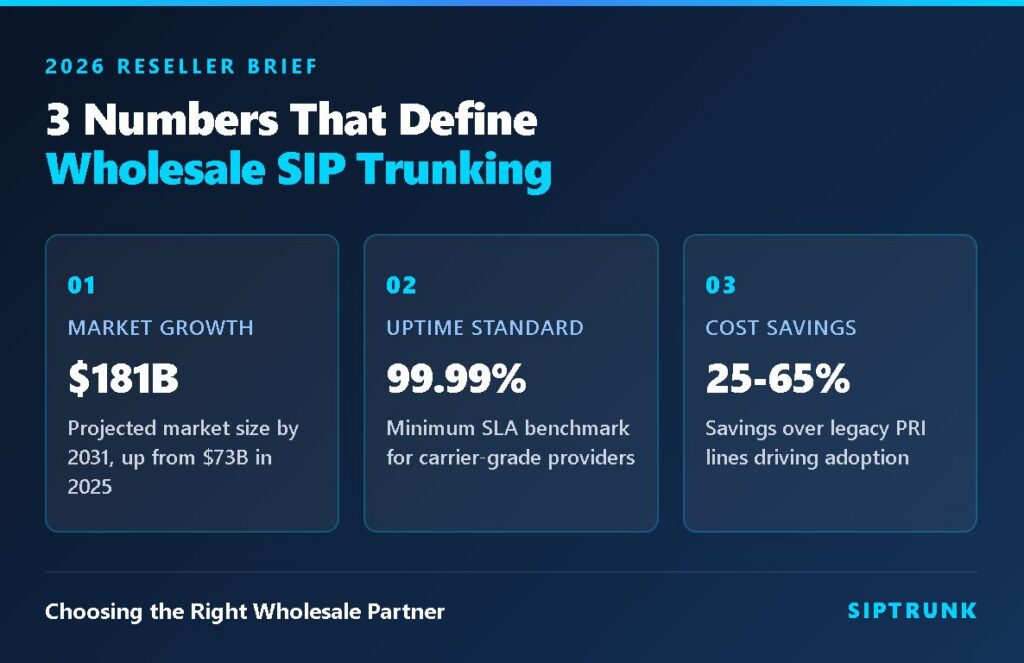
The shift away from legacy telephony is happening at scale, and resellers who align with the right infrastructure partner are positioned to capture a disproportionate share of the migration. Mordor Intelligence’s SIP trunking market analysis shows the market climbing from $73.14 billion in 2025 toward $181.58 billion by 2031 at a 16.38% CAGR, with cost savings of 25% to 65% over legacy PRI lines driving adoption across every enterprise segment.
That growth means little to your business, however, without a reliable wholesale partner standing behind your service. The provider you choose shapes your service quality, operational overhead, compliance posture, and profit margins. This guide walks through what wholesale SIP trunk providers deliver, SLA benchmarks that matter, pricing models you should understand before signing anything, and enterprise use cases where the right partnership pays off most.
What Are Wholesale SIP Trunk Providers?
Wholesale SIP trunk providers supply the infrastructure layer that resellers, MSPs, and IT consultants use to deliver voice services under their own brand. Rather than selling SIP trunking directly to end users, these providers operate the underlying network, billing systems, and provisioning tools that enable a channel partner to launch a voice practice without building telecom infrastructure from scratch.
Wholesale SIP trunking is not the same as wholesale VoIP service or retail SIP trunking. A SIP wholesale service gives you platform access, white-label capabilities, and carrier-grade routing at rates that allow you to set your own retail pricing and capture meaningful margin. For a reseller buying channels at platform pricing and selling them at standard market rates, the difference between gross margin and a viable business often comes down to which wholesale partner you choose.
The best wholesale VoIP providers absorb the cost of running a Tier-1 network, maintaining redundant data centers, handling telecom taxes, and supporting 24/7 NOC operations. You inherit those capabilities. Your clients see a polished, reliable voice service. The infrastructure investment stays with the provider.
What Should a Wholesale SIP Provider SLA Include?
The service level agreement is the most underexamined document in reseller partnerships. A weak SLA exposes you to outages, dropped calls, and compliance gaps that damage your customer relationships. A strong SLA defines measurable performance commitments, remediation procedures, and accountability that protect your business.
Before signing with any wholesale partner, confirm specific thresholds across uptime, voice quality, call completion, and support responsiveness.
What Uptime and Redundancy Should You Expect?
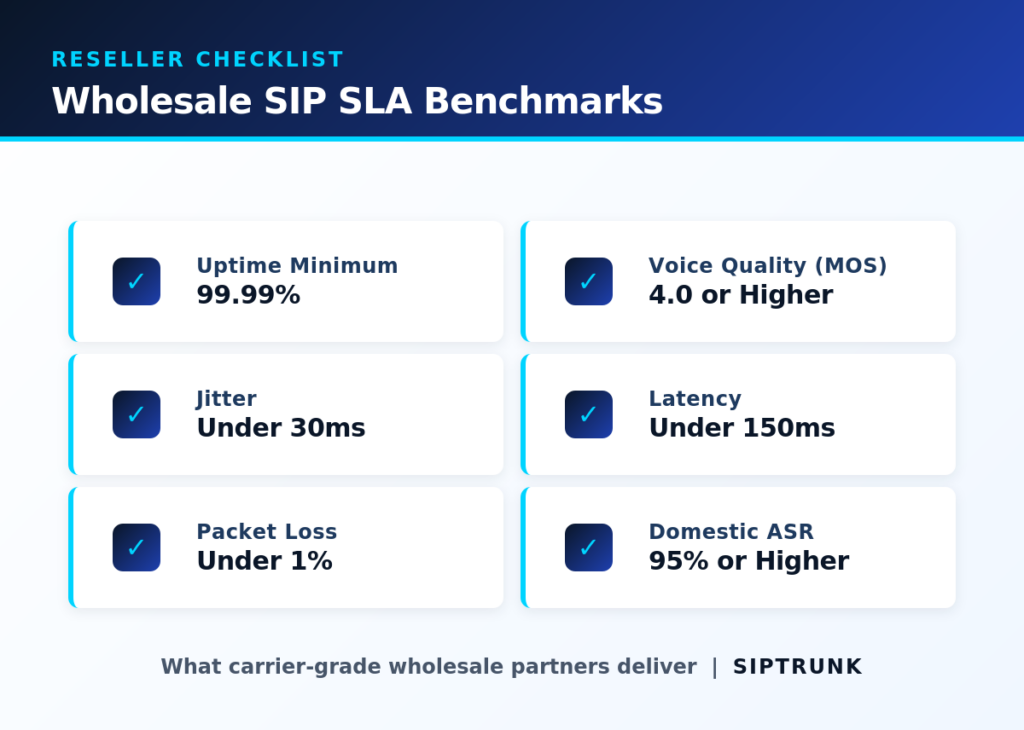
Industry-standard wholesale SIP agreements specify 99.99% uptime, which translates to roughly 52.6 minutes of allowable downtime per year. Providers that commit only to 99.9% are giving themselves nearly nine hours of annual downtime, an unacceptable threshold for any reseller serving mission-critical businesses. The strongest providers exceed the standard, offering 99.995% or 99.999% commitments backed by geographically distributed data centers and automatic failover routing.
Redundancy claims should be verifiable. Ask prospective providers about their data center locations, upstream carrier relationships, and how planned maintenance is treated under the SLA. A provider that excludes planned maintenance and “customer-caused outages” from uptime calculations can technically meet 99.99% while still creating service gaps your clients will notice.
Which Voice Quality Performance Thresholds Matter?
Uptime alone does not guarantee good calls. Voice quality depends on a set of measurable performance metrics that your wholesale partner should commit to maintaining:
- Mean Opinion Score (MOS): target 4.0 or higher for consistent HD voice quality
- Latency: under 150 milliseconds for natural conversational flow
- Jitter: below 30 milliseconds to prevent audio distortion
- Packet loss: under 1% to maintain call clarity
Providers that rely heavily on least-cost routing (LCR) often miss these thresholds, particularly under load. Carrier-grade wholesale SIP trunking providers maintain direct interconnects with Tier-1 networks and document their quality of service metrics in regular reports you can request before signing.
What Call Completion Standards Should the Provider Guarantee?
Answer Seizure Ratio (ASR) measures the percentage of attempted calls that successfully connect. Professional wholesale SIP agreements include ASR thresholds typically exceeding 95% for domestic traffic. Post-dial delay, which measures the time between dialing and ringing, should be specified as well, generally under three seconds for domestic calls.
Call completion failures cost your business directly. Every dropped call frustrates an end customer and creates a support ticket, both of which erode the margins that make reselling worthwhile.
How Responsive Is the Provider’s Support?
A 24/7 support commitment matters more than headline pricing when something breaks at 2 a.m. The SLA should specify response times, escalation paths, and what counts as a P1 incident versus a routine ticket. Vague language about “best-effort support” or unspecified queues should be a red flag. Confirm that escalation reaches a live engineer, not just a ticketing system.
Here is a quick checklist of requirements in any wholesale SIP SLA:
- 99.99% uptime minimum, with measurement methodology defined
- MOS ≥4.0, jitter <30ms, latency <150ms, packet loss <1%
- ASR thresholds of 95%+ for domestic traffic
- Documented redundancy across multiple geographic regions
- 24/7 NOC support with defined response times and escalation paths
- Service credits tied to measurable SLA breaches
- Termination rights after repeated material failures within a defined window
How Do Wholesale SIP Trunk Pricing Models Work?
Wholesale SIP trunk pricing is rarely one-size-fits-all. Providers structure contracts to fit different traffic patterns, risk tolerances, and reseller business models. Understanding the four dominant pricing structures helps you select the right fit for your client base and protects your margins from the predictable mistakes resellers make when they sign the wrong contract.
What Is Flat-Rate or Per-Channel Pricing?
Flat-rate plans charge a fixed monthly price per channel, typically including unlimited or fair-use domestic calling. For resellers, the predictability simplifies budgeting and quoting. According to industry pricing data, per-channel costs typically range from $15 to $25 monthly at retail, with some unmetered plans reaching $30. Wholesale access through reseller platforms can greatly reduce that, creating room for healthy margins.
Flat-rate works best for clients with steady, predictable call volumes. It struggles when traffic patterns are highly seasonal or when concurrent call peaks exceed the average load.
How Does Metered or Usage-Based Pricing Work?
Metered pricing charges per minute or per call, with a small base fee. The model rewards light callers and penalizes heavy ones. For resellers serving small consultancies, professional service firms, or low-volume operations, metered plans often produce lower total cost than flat-rate alternatives.
The risk lies in unpredictable spikes. A client running an unexpected outbound campaign can generate a bill that triggers a difficult conversation about overage charges.
When Does Pay-As-You-Go Pricing Make Sense?
Pay-as-you-go eliminates fixed monthly commitments entirely. Clients pay only for what they use, with no channel reservations or minimum commitments. For seasonal businesses, pilot deployments, or clients testing SIP trunking before full migration, the flexibility is valuable.
For resellers, pay-as-you-go is harder to forecast and harder to build recurring revenue against. It works as a complement to other models rather than a default.
What Is Hybrid or Committed-Minute Wholesale Pricing?
Hybrid models combine a fixed base (a set number of channels or minutes) with overage rates for usage beyond the commitment. Wholesale SIP trunk providers offering volume-tiered pricing typically use this structure. Minimum monthly commitments unlock progressively lower per-minute rates as volume grows.
Hybrid is the dominant model for resellers building a real book of business because it balances predictable revenue with elastic capacity. As your customer base scales, your unit costs decline, which directly improves your margin profile.
A reseller purchasing channels at platform pricing and selling them at retail market rates generates a meaningfully higher gross margin than commission-based agent models, which typically return only 15% to 25% of retail. The wholesale structure gives you control over your pricing, customer relationships, and long-term revenue trajectory.
Which Enterprise Use Cases Benefit Most From Wholesale SIP Trunking?
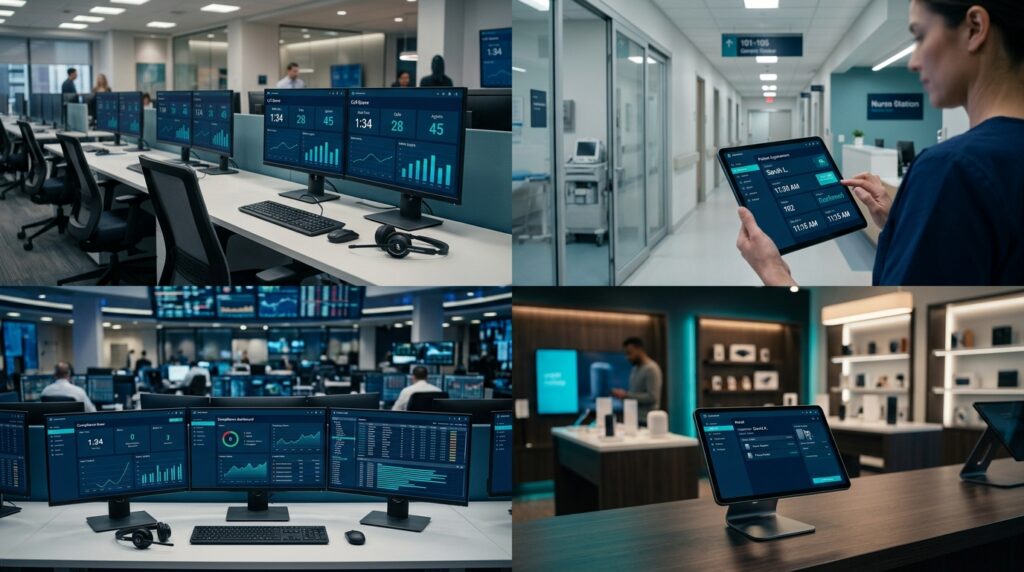
Wholesale SIP trunking is not equally valuable to every business. Certain enterprise verticals derive outsized benefit, and resellers who understand those use cases close deals faster because they speak the prospect’s language.
How Do Contact Centers Use Wholesale SIP Trunking?
Contact centers and BPO operations are some of the highest-value SIP trunking deployments. They require high concurrent call capacity, real-time failover, fraud controls, and integrations with workforce management and CRM platforms. SIP trunking allows them to scale channels with demand rather than provisioning for peak load year-round. Resellers serving this segment should emphasize bursting capacity, ASR guarantees, and detailed call analytics.
Why Do Financial Services Firms Prioritize SIP Compliance?
Financial services and other compliance-heavy industries require SLA-backed contracts with documented controls. Encryption (TLS 1.3 for signaling, SRTP for media), STIR/SHAKEN compliance for caller ID authentication, and audit trails are all baseline requirements. The FCC’s STIR/SHAKEN framework establishes industry standards that wholesale providers must meet to remain a viable partner for this vertical. Reselling into financial services means selecting a wholesale partner who treats compliance as table stakes rather than an upgrade.
How Does SIP Trunking Support HIPAA-Aligned Healthcare Communications?
Healthcare is among the fastest-growing SIP trunking adopters. Hospitals, clinics, and telehealth providers need encrypted voice traffic, appointment hotline scalability, and integration with electronic health record systems. HIPAA alignment requires that your SIP wholesale service can document encryption practices and access controls. Resellers winning in healthcare lead with security and compliance, then with cost savings.
What Makes SIP Trunking Ideal for Retail and Seasonal Businesses?
Multi-location retail, hospitality, and seasonal businesses face dramatic call volume swings. SIP trunking lets them add channels during peak periods and scale back during quiet months without the cost of permanent capacity. The elasticity is genuinely difficult to deliver with legacy infrastructure, which makes it one of the easier wins for a reseller’s sales pitch.
How Are AI Voice Agents Changing Wholesale SIP Trunking Demand?
The fastest-emerging use case is AI voice agents and embedded calling. Voice AI platforms require reliable, low-latency PSTN access, and they generate higher concurrency than human-staffed operations because agents scale independently of headcount. Resellers positioning themselves around AI integrations should confirm their wholesale partner supports the API access, concurrency, and reliability that AI workloads demand.
How Do Wholesale SIP Providers Compare on Key Capabilities?
Rather than comparing brands, the more useful exercise is mapping the capabilities you need against what each candidate actually delivers. The table below outlines what reseller-focused wholesale platforms should provide versus what generic providers typically offer.
| Capability | Reseller-Focused Wholesale Platform | Generic SIP Provider |
| White-label branding | Full portal and billing customization | Limited or unavailable |
| Hands-off billing and telecom tax | Fully managed | Reseller’s responsibility |
| Tier-1 network access | Standard | Variable, often LCR-based |
| Contract terms | No long-term commitment | Multi-year contracts common |
| Onboarding speed | Minutes to hours | Days to weeks |
| Margin structure | Volume-based, transparent | Commission-based or opaque |
| Reseller dashboard | Built for channel partners | Built for direct end users |
| 24/7 NOC support | Included | Tiered or add-on |
Generic SIP providers can sell you channels, but they weren’t built with channel partners in mind. The result is operational friction that eats into your margins. Reseller-focused platforms remove that friction because the business model is designed around your success. When your wholesale partner makes more money as you grow, every part of the platform is engineered to help you scale.
How Should Resellers Sell Wholesale SIP Trunks to Enterprise Clients?
Selling SIP trunking to enterprise prospects requires more than a feature list. Buyers want to understand how SIP trunking solves a specific operational problem they are facing.
Lead with quantified cost savings. Use real comparisons between current PRI or analog spend and SIP trunk pricing to show concrete numbers, not generic percentages. Reinforce reliability by emphasizing the difference between consumer VoIP and carrier-grade SIP trunking backed by Tier-1 networks. Address concerns about call quality directly, citing the specific SLA thresholds your wholesale partner commits to.
Uncover pain points first. Ask about current telecom contracts, recent outages, scaling frustrations, or compliance requirements. Then map your solution to the specific gaps you identified rather than pitching a generic feature set. For seasonal businesses, emphasize elasticity. For multi-location operations, emphasize centralized management. For compliance-heavy verticals, lead with security and audit readiness.
Most importantly, position yourself as a long-term partner rather than a transactional vendor. The clients who stay with you for years are the ones who see you as the person who solved a problem, not just the person who sold them a service.
Frequently Asked Questions About Wholesale SIP Trunk Providers
What is the difference between wholesale SIP trunk providers and retail SIP providers?
Wholesale SIP trunk providers supply infrastructure and platform access to resellers, who then sell branded services to end customers. Retail providers sell directly to businesses. The wholesale model creates margin opportunities for channel partners and enables white-label service delivery, while retail providers compete directly with their own resellers.
What SLA uptime should I require from a SIP wholesale service?
Require 99.99% minimum, which equates to roughly 52 minutes of allowable annual downtime. The strongest wholesale VoIP providers commit to 99.995% or 99.999% with documented redundancy, geographically distributed data centers, and automatic failover. Lower commitments are a meaningful operational risk for any reseller serving business-critical clients.
How do wholesale SIP trunking pricing models affect reseller margins?
The pricing model you choose directly shapes your margin structure. Flat-rate per-channel pricing offers predictable margins on steady-volume accounts. Hybrid committed-minute models reward growth with declining unit costs. Pay-as-you-go works for variable usage but is harder to forecast. The right model depends on your client mix and growth strategy.
Can wholesale SIP trunk providers support enterprise compliance requirements?
The strongest wholesale providers support STIR/SHAKEN, TLS 1.3 encryption, SRTP for media, and the documentation needed for HIPAA, SOC 2, and PCI-DSS alignment. Compliance support varies between providers, so confirm specific certifications and audit support before pursuing regulated verticals like healthcare or financial services.
Build Long-Term Reseller Success With the Right Wholesale Partner
The wholesale SIP trunk provider you choose shapes every part of your reseller business, from operational overhead to margin structure to the quality of service your clients experience. Evaluating providers against measurable SLA thresholds, transparent pricing models, and proven enterprise capabilities helps you avoid the costly surprises that derail less prepared resellers.
At SIPTRUNK, we built our platform specifically for resellers, with hands-off billing and tax handling, Tier-1 network reliability, white-label branding, no long-term contracts, and the kind of margin structure that supports long-term growth rather than short-term commissions. Get started with SIPTRUNK today to see how the right wholesale partnership can accelerate your reseller business.

Mitch leads the Sales team at BCM One, overseeing revenue growth through cloud voice services across brands like SIPTRUNK, SIP.US, and Flowroute. With a focus on partner enablement and customer success, he helps businesses identify the right communication solutions within BCM One’s extensive portfolio. Mitch brings years of experience in channel sales and cloud-based telecom to every conversation.