

What Is Wholesale SIP Trunking? A Guide for Providers
Wholesale SIP trunking enables telecom agents, MSPs, and IT consultants to resell voice services under their own brand without building carrier infrastructure.
- The SIP trunking market is projected to grow to $181.58 billion by 2031, creating opportunities for resellers.
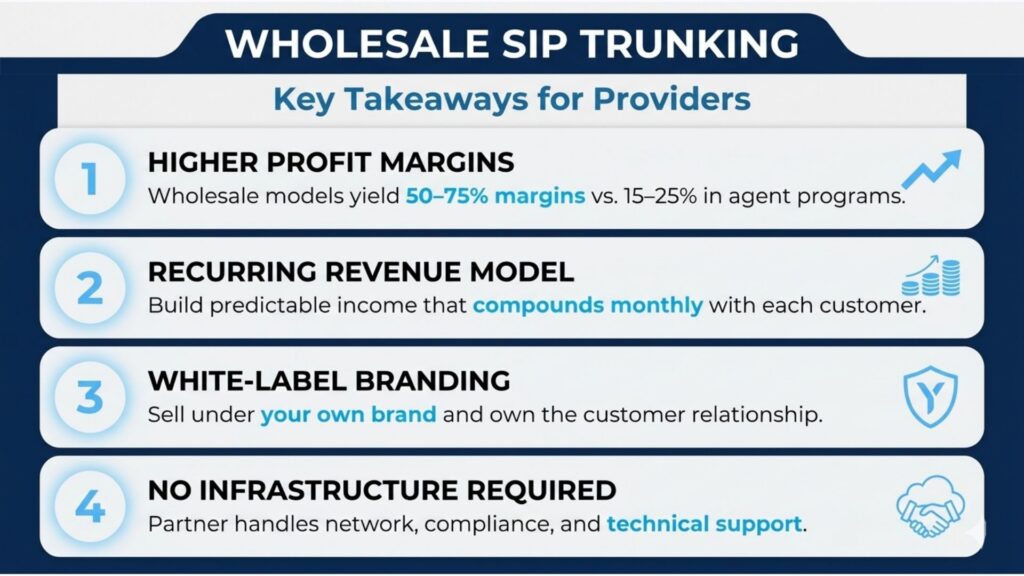
- Wholesale models offer margins of 50–75% compared to 15–25% in traditional agent commission structures.
- Providers benefit from instant provisioning, automated billing, and Tier-1 network access without infrastructure investment.
If you’re evaluating ways to add recurring revenue through telecommunications, wholesale SIP trunking deserves serious consideration.
Businesses are abandoning costly PRI lines and copper-based infrastructure in favor of internet-based voice solutions that offer flexibility, reliability, and cost savings. For telecom professionals watching this transition, a clear opportunity has emerged: reselling SIP trunk services to businesses that need modern communication infrastructure but lack the expertise to manage it themselves.
Wholesale SIP trunking sits at the center of this opportunity. Providers purchase voice capacity at bulk rates and resell those services to end customers, often under their own brand. The SIP trunking market reached $73.14 billion in 2025 and is forecast to grow at a 16.38% compound annual rate through 2031. Enterprises are shifting toward IP voice services, multiple countries are decommissioning PSTN, and unified communications platforms are bundling with SIP trunks.
This guide explains what wholesale SIP trunking is, how it works, who stands to benefit most, and the practical steps to begin reselling. Whether you’re an established managed service provider exploring adjacent revenue streams or a telecom agent evaluating wholesale partnerships, understanding this model is essential for capitalizing on the market transformation underway.
What Is Wholesale SIP Trunking?
Wholesale SIP trunking is a business arrangement where a provider purchases SIP trunk capacity in bulk from a carrier or platform and then resells those services to business customers. The reseller sets their own pricing, manages customer relationships, and often operates under their own brand, while the wholesale partner handles the underlying network infrastructure, compliance, and technical support.
This model differs from retail SIP services, where end customers purchase directly from the carrier. In retail arrangements, the carrier owns the customer relationship and controls pricing. SIP trunk wholesale arrangements give the reseller control over margins, branding, and customer experience.
How Wholesale SIP Differs from Retail Services
Retail models typically offer commission-based compensation, where an agent earns a percentage of the monthly recurring revenue they bring in. While this approach requires minimal risk, it also limits earning potential and provides no ownership of the customer relationship.
Wholesale models offer higher profit margins because resellers purchase services at wholesale rates and sell at retail prices they determine. This spread can yield margins of 50–75% on voice services, compared to the 15–25% commissions typical in agent programs. The tradeoff is that resellers assume responsibility for customer acquisition, support coordination, and business operations. For those willing to build a telecom practice rather than simply refer business, wholesale is a more lucrative path.
How Does Wholesale SIP Trunking Work?
SIP trunking replaces traditional phone lines by transmitting voice calls over an internet connection using the Session Initiation Protocol. Rather than maintaining physical circuits between a business and the telephone network, SIP trunks create virtual connections that can scale instantly based on demand.
The wholesale relationship involves three parties: the carrier or platform provider who owns the network infrastructure, the reseller who purchases capacity and manages customer relationships, and the end customer who uses the service for their business communications. The carrier handles network operations, regulatory compliance, and technical infrastructure. The reseller focuses on sales, customer onboarding, and ongoing account management. This division of responsibilities allows each party to concentrate on their strengths.
How Do SIP Channels Relate to Capacity?
SIP trunks operate through channels, where each channel represents the capacity for one concurrent call. A business that needs the ability to have 10 simultaneous phone conversations would require 10 channels. Unlike legacy PRI lines that sold capacity in fixed blocks of 23 channels, SIP trunking allows businesses to purchase exactly the capacity they need and adjust that number as requirements change.
This flexibility creates value for both resellers and their customers. Resellers can offer right-sized solutions that match actual usage patterns, while businesses avoid paying for unused capacity. Seasonal businesses can scale channels up during peak periods and reduce them during slower months. The ability to adjust capacity without hardware changes or lengthy provisioning cycles is one of the most compelling advantages of SIP technology.
For resellers, understanding bandwidth requirements is an important consultative skill. Voice quality depends on adequate internet capacity and proper network configuration. A G.711 codec requires approximately 87 kilobits per second per call, while G.729 compression reduces that to around 31 kilobits per second. Helping customers understand these requirements positions resellers as technical advisors rather than commodity salespeople.
Who Should Consider Wholesale Models?
The wholesale model works best for professionals and organizations already engaged with business technology customers. The common thread among successful resellers is existing relationships with businesses that have communication needs and the consultative credibility to recommend infrastructure changes.
Managed service providers are a natural fit for wholesale SIP trunking. MSPs already manage network infrastructure, security, and business applications for their clients. Adding voice services creates a more comprehensive offering while generating additional recurring revenue from existing relationships. The technical overlap between network management and SIP deployment means MSPs can often handle implementation without dramatic capability expansion.
Telecom agents and dealers bring different strengths to the wholesale model. They understand sales, have established relationships with business decision-makers, and often possess the skills necessary to close communication deals. For agents currently earning commissions on retail referrals, transitioning to wholesale arrangements can substantially increase per-customer revenue while building equity in a customer base they own.
Value-added resellers and IT consultants round out the primary audience for wholesale programs. VARs selling phone systems, contact center solutions, or unified communications platforms can add SIP trunking as a recurring revenue layer beneath the systems they deploy. IT consultants advising on digital transformation initiatives can include SIP trunking as part of broader modernization recommendations.
The SIP reseller opportunity extends beyond these professionals, but success patterns tend to cluster among those who already have trust-based relationships with business technology buyers. Starting from scratch with no existing customer relationships is possible but requires more time and capital investment.
What Are the Benefits of Wholesale VoIP Trunking?
The economic case for wholesale VoIP trunking rests on several reinforcing advantages that benefit both resellers and their end customers. Understanding these benefits helps frame the value proposition for prospective partners and clients.
Cost reduction is the most immediate and quantifiable advantage. Businesses migrating from legacy PRI lines to SIP trunks typically realize savings between 25% and 65% on their voice communication expenses. These savings come from eliminating physical circuit costs, reducing long-distance charges through IP routing, and right-sizing capacity to actual usage. For resellers, the ability to demonstrate concrete cost savings simplifies the sales conversation and provides clear return-on-investment calculations for prospective customers.
Scalability changes how businesses think about communication capacity. Traditional phone systems required purchasing additional circuits and waiting weeks for installation when capacity needs grew. SIP trunking eliminates these constraints. Additional channels can be provisioned in minutes, allowing businesses to respond to growth opportunities or seasonal demands without infrastructure delays. This elasticity proves valuable for growing companies, seasonal businesses, and organizations with variable call volumes.
Why Resellers Choose Wholesale Over Retail
The recurring revenue model changes the economics of telecom sales. Each customer added to a wholesale reseller’s portfolio generates predictable monthly income that compounds over time. Unlike project-based IT work, where revenue resets after each engagement, SIP trunking creates an annuity stream that grows with the customer base.
White-label capabilities allow resellers to build brand equity rather than simply promoting a carrier’s name. Customers associate the service quality and relationship with the reseller’s brand, creating loyalty that survives competitive pressure. This brand ownership also creates business value that can be monetized through customer base sales or company acquisition.
The combination of higher margins, recurring revenue, and brand ownership explains why wholesale SIP trunking has attracted interest from telecom professionals seeking to build sustainable businesses rather than transaction-based sales practices.
How Are Wholesale SIP Trunk Pricing Models Structured?
Selecting the right pricing model impacts both profitability and competitive positioning. Wholesale providers typically offer several structures, and understanding the tradeoffs helps resellers match pricing to customer needs. For those offering VoIP carrier services, the right model determines customer satisfaction and margin preservation.
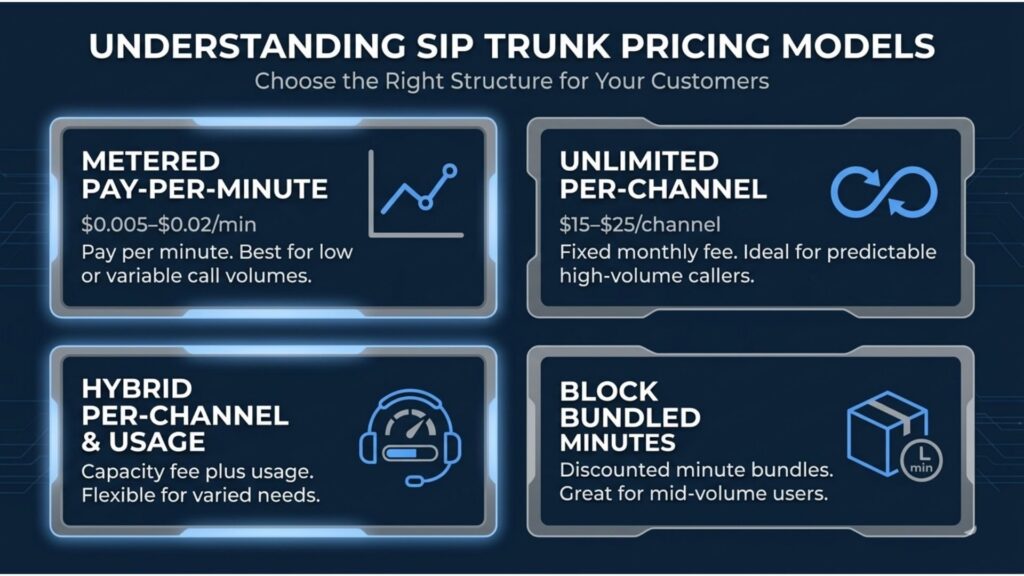
- Metered pricing charges based on actual usage, typically at rates between $0.005 and $0.02 per minute for domestic calls. This model works well for customers with low or unpredictable call volumes, offering the lowest possible cost when usage is minimal. The downside is that costs can spike during high-volume periods, creating billing unpredictability that some customers find uncomfortable.
- Unmetered or unlimited pricing charges a fixed monthly fee per channel regardless of usage. Rates typically range from $15 to $25 per channel for unlimited domestic calling. This model suits customers with predictable, moderate-to-high call volumes who prefer budget certainty. The fixed cost per channel simplifies billing discussions and allows customers to accurately forecast communication expenses.
- Per-channel pricing without unlimited calling provides flexibility for customers who need the capacity for concurrent calls but have variable minute usage. Resellers can combine per-channel access fees with per-minute rates to create hybrid structures that match specific customer profiles.
- Block pricing offers predetermined minute bundles at discounted rates. A provider might offer 5,000 minutes for a fixed monthly fee, with overage charges for usage beyond the block. This approach works for customers whose usage falls between metered and unlimited thresholds.
The optimal approach for most resellers is to offer multiple pricing options to match different customer profiles. High-volume contact centers benefit from unlimited pricing, while small professional services firms might prefer metered arrangements. The flexibility to tailor pricing to customer needs becomes a competitive differentiator and demonstrates consultative expertise.
When evaluating wholesale partnerships, assess the margin flexibility available in each pricing model. The spread between wholesale cost and achievable retail pricing determines profitability. Also consider whether the provider handles tax calculation and billing complexity, as telecommunications taxation varies by jurisdiction and can create more administrative burden.
What Should Providers Look for in a Wholesale Partner?
Your partner determines long-term success in the wholesale SIP trunking business. The wrong partnership creates customer service problems, erodes margins, and damages the brand reputation that resellers are trying to build.
Network quality forms the foundation of service delivery. Look for providers that operate on Tier-1 carrier networks with redundant infrastructure. Ask about uptime guarantees, geographic distribution of network resources, and automatic failover capabilities. A provider claiming 99.99% uptime should be able to explain how that reliability is achieved through redundant switching, diverse carrier relationships, and proactive monitoring.
Compliance infrastructure has become increasingly important as regulations tighten. STIR/SHAKEN caller ID authentication is now mandatory, and providers must obtain and use their own certificates rather than relying on downstream carriers. Understanding how a potential partner handles regulatory compliance protects resellers from liability and ensures customers can place calls without attestation issues that might cause delivery problems.
White-label capabilities vary among wholesale providers. Some offer complete brand replacement where customers never see the underlying carrier’s name. Others provide partial white-labeling with co-branded elements. Evaluate how important brand control is for your business model and confirm that prospective partners can deliver the level of customization you require.
Provisioning and management tools determine operational efficiency. Self-service portals that allow instant DID provisioning, trunk configuration, and customer management reduce the time required to onboard new customers and handle routine requests. Manual provisioning processes that require support tickets and waiting periods create bottlenecks that limit growth and frustrate customers.
Billing and tax handling are among the most underappreciated aspects of wholesale partnerships. Telecom taxation is complex, with rates and rules varying by state, municipality, and service type. Partners that handle tax calculation, collection, and remittance greatly reduce administrative burden and compliance risk. Similarly, automated billing systems that generate customer invoices and process payments streamline operations and improve cash flow predictability.
When evaluating potential partners, review how established providers handle wholesale relationships to understand what capabilities and terms are standard in the market.
How Can Providers Start Reselling SIP Trunking?
Beginning a wholesale SIP trunking practice involves several steps that build upon each other. While the barrier to entry is relatively low compared to becoming a facilities-based carrier, success requires thoughtful preparation and execution.
- Evaluate your existing customer base and relationships. Identify businesses you already serve that have voice communication needs. Consider their current phone systems, call volumes, and pain points with existing services. This assessment helps estimate initial revenue potential and identifies prospects for early adoption.
- Research and select a wholesale partner. Use the criteria discussed earlier to evaluate potential providers. Request partner program documentation, pricing schedules, and references from existing resellers. Most reputable providers offer discovery calls or demonstrations that allow you to assess their platform and support before committing.
- Understand the technical requirements. While wholesale partners handle network infrastructure, resellers need sufficient technical knowledge to have credible conversations with customers and coordinate implementations. Familiarize yourself with SIP fundamentals, common PBX platforms, and basic network requirements for voice quality.
- Develop your service packaging and pricing. Based on wholesale costs and competitive analysis, create service packages that balance margin requirements with market competitiveness. Consider offering multiple tiers to address different customer segments and use cases.
- Build basic operational infrastructure. Establish processes for customer onboarding, support escalation, and billing management. Many of these functions can leverage tools provided by wholesale partners, but resellers need clear workflows for handling customer interactions.
- Begin with existing relationships. The fastest path to initial revenue involves converting existing customers or close relationships. These early customers provide learning opportunities and case studies that support broader market development.
Timeline expectations should be realistic. Most resellers can complete partner onboarding within a few weeks. First customer acquisition typically follows within one to three months. Building meaningful monthly recurring revenue generally requires six to twelve months of consistent sales activity. The compounding nature of recurring revenue means that patience during the initial building phase pays dividends as the customer base grows.

Frequently Asked Questions
What is the difference between a SIP provider and a SIP reseller?
A SIP provider owns or operates network infrastructure and holds the carrier relationships necessary to connect calls to the public telephone network. A SIP reseller purchases capacity from a provider and sells services to end customers without owning infrastructure. Providers require significant capital investment and regulatory compliance. Resellers can enter the market with minimal upfront investment by partnering with established providers.
How much can wholesale SIP trunking resellers realistically earn?
Earnings vary based on customer base size, average revenue per customer, and margin structure. Resellers typically earn $5 to $15 monthly per customer channel. A reseller with 100 customers averaging 10 channels each could generate $5,000 to $15,000 in monthly recurring revenue. Top performers with larger customer bases generate six-figure annual revenue from their SIP practices.
Do I need technical telecommunications expertise to resell SIP trunks?
Deep technical expertise is helpful but not mandatory for success. Many resellers come from sales or business backgrounds and develop sufficient technical knowledge through partner training and experience. Partners that provide strong technical support can handle complex implementations while resellers focus on customer relationships and sales.
What features should wholesale SIP services include for business customers?
Essential features include local and toll-free DID numbers, e911 emergency services, caller ID management, call detail records, and compatibility with major PBX platforms. Additional value-added features like call recording, fax-over-IP, and SMS capabilities differentiate premium offerings and support higher pricing.
Build Recurring Revenue with Wholesale SIP Trunking
The market conditions for wholesale SIP trunking have never been more favorable. Businesses continue abandoning legacy phone systems in favor of flexible, cost-effective IP-based communications. Regulatory mandates accelerating PSTN decommissioning are pushing even reluctant organizations toward SIP adoption. The combination of market growth and accessible entry points creates a genuine opportunity for resellers who execute thoughtfully.
SIPTRUNK provides the platform, Tier-1 network infrastructure, and reseller-focused tools that enable telecom professionals to build profitable SIP practices. With instant provisioning, automated billing and tax handling, and white-label capabilities, our platform is designed for resellers who want to focus on customers rather than infrastructure management. Get started today to explore how wholesale SIP trunking can add recurring revenue to your business.

Mitch leads the Sales team at BCM One, overseeing revenue growth through cloud voice services across brands like SIPTRUNK, SIP.US, and Flowroute. With a focus on partner enablement and customer success, he helps businesses identify the right communication solutions within BCM One’s extensive portfolio. Mitch brings years of experience in channel sales and cloud-based telecom to every conversation.