

Global SIP Trunking Best Practices for International Calls, DIDs & Latency
Global SIP trunking represents a $157+ billion market opportunity by 2030 for resellers targeting international business communications.
- International SIP trunks handle 58.5% of the global VoIP market, creating massive reseller opportunities.
- Businesses slash up to 90% off international calling costs when you help them ditch traditional carriers.
- Premium global SIP services let you command higher margins and keep clients longer.
- Smart latency optimization and DID management separate pro resellers from the competition.
It’s time to position yourself as the go-to expert for global SIP trunking solutions that deliver real ROI for international clients.
The global telecom industry is creating unprecedented opportunities for savvy resellers. International SIP trunks now handle 58.5% of the entire VoIP services market, representing a massive revenue opportunity that many resellers are overlooking. Your prospects are already struggling with expensive international communications, often paying dramatically more than necessary when potential savings of up to 90% are achievable through carrier transitions.
This cost differential creates compelling value propositions that resonate immediately with decision-makers. The global SIP trunking market is projected to reach $157.91 billion by 2030, with businesses experiencing substantial cost reductions and operational improvements driving adoption. Smart resellers who master these global SIP trunking best practices are building sustainable advantages while their competitors struggle with basic domestic implementations.
What Are Your International Prospects Really Looking For?
Understanding your international clients’ specific pain points enables you to position global SIP trunking services as essential infrastructure rather than optional technology upgrades. These businesses face unique challenges that create substantial opportunities for knowledgeable resellers.
Cost Predictability
Traditional international calling creates unpredictable expenses that spike during busy periods or emergency situations. Finance teams struggle to budget for communication costs when per-minute charges vary between carriers and destinations. Demonstrate how transparent, user-based pricing models eliminate these budgeting challenges while delivering consistent cost savings.
Compliance Complexity
International businesses must navigate varying telecommunications regulations, data privacy requirements, and emergency services obligations across multiple jurisdictions. Rather than viewing compliance as a barrier, position yourself as the expert who simplifies these requirements through proper platform selection and configuration guidance.
Call Quality with International Communications
Businesses operating across time zones can’t afford communication failures during critical hours. They need resellers who understand latency in VoIP, geographic routing strategies, and failover planning. Your expertise in these technical areas differentiates professional resellers from basic service providers.
Scalability Planning
These clients need resellers who understand how communication requirements evolve during expansion phases. They want partners who can instantly provision additional capacity, efficiently configure new geographic numbers, and integrate with existing business systems without disrupting operations.
Integration Requirements
International prospects typically operate complex technology stacks that must seamlessly integrate with new communication platforms. Your ability to address integration challenges, provide technical consultation, and ensure smooth transitions often matters more than pricing differences.
How Do You Position International SIP Trunks Against Traditional Competitors?
Effective competitive positioning requires understanding the specific advantages that international SIP trunks offer over alternative solutions. Your messaging should focus on measurable business outcomes rather than technical features that prospects struggle to evaluate.
Traditional international carriers are your primary competitive target because they offer increasingly weak value propositions for modern businesses. These carriers typically charge premium rates for basic connectivity while providing limited flexibility for growing operations. Businesses switching to international SIP trunks consistently report savings higher than 50% on international calling costs, creating compelling ROI arguments that justify immediate transitions.
Hosted VoIP providers present different competitive challenges because they emphasize simplicity over control. Your positioning should highlight the limitations of one-size-fits-all solutions for businesses with complex international requirements. Demonstrate how wholesale SIP platforms provide the customization, integration capabilities, and advanced features that hosted solutions can’t deliver.
Cost comparisons should extend beyond simple rate differences to include the total cost of ownership. Position transparent pricing models as advantages that enable accurate budgeting and predictable growth costs. When prospects can reliably forecast their communication expenses, you’ve solved a genuine business problem that resonates with financial decision-makers.
8 Premium Global SIP Services That Let You Charge What You’re Worth
Carefully positioning your services enables you to capture higher margins while delivering exceptional value for international prospects. These premium services differentiate expert resellers from commodity providers and justify increased pricing.
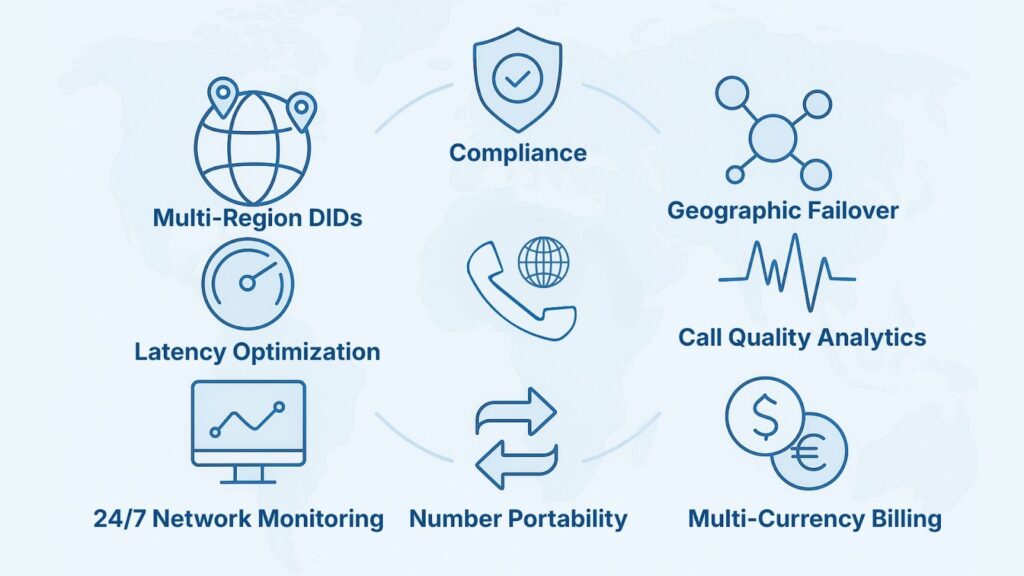
1. Smart Multi-Region DID Provisioning and Management
Advanced DID management goes beyond basic number provisioning to include geographic optimization, routing intelligence, and compliance automation. Businesses value centralized control over distributed number inventories, especially when expansion plans require rapid deployment across new markets. Your expertise in configuring strategies around local vs global DIDs can impact client operations and justify premium service fees.
2. Latency-Optimized Routing That Delivers Results
Geographic routing requires a deep understanding of network infrastructure, carrier relationships, and traffic management. Businesses experiencing call quality issues with current providers will pay premium rates for guaranteed latency improvements. Your ability to deliver measurable performance enhancements in latency in VoIP creates strong competitive differentiation and client loyalty.
3. 24/7 International Network Monitoring
Proactive monitoring services appeal to businesses that can’t afford communication disruptions during international business hours. This service combines automated alerting with expert analysis to identify and resolve issues before they impact operations. The peace of mind that comes with professional monitoring justifies monthly fees for international operations.
4. Cross-Border Compliance Consultation
Regulatory expertise is invaluable as businesses expand into new international markets. Your knowledge of telecommunications regulations, emergency services requirements, and data privacy obligations helps clients avoid costly compliance mistakes. This consultative approach positions you as a strategic partner rather than a basic service provider.
5. Multi-Currency Billing and Reporting
Financial management increases in complexity for businesses operating across multiple currencies. Advanced billing platforms that handle currency conversion, regional tax calculations, and consolidated reporting reduce administrative overhead. International businesses value these sophisticated billing capabilities and will pay premium rates to access them.
6. Geographic Failover Implementation
Disaster recovery planning requires understanding redundancy strategies, automatic failover triggers, and geographic distribution principles. Businesses with mission-critical international operations need failover systems that activate seamlessly during outages. Your expertise in designing and implementing these systems commands premium pricing.
7. International Number Portability Services
Number portability is vital when businesses transition from traditional carriers or consolidate multiple international providers. The complexity of managing porting processes across different regulatory environments creates opportunities for specialized service offerings. Successful number portability projects often lead to expanded client relationships and referral opportunities.
8. Global Call Quality Analytics and Optimization
Performance analytics provide ongoing value that justifies recurring service fees. International businesses benefit from detailed reporting on call quality metrics, usage patterns, and optimization opportunities. Your ability to interpret analytics data and recommend improvements creates continuous engagement opportunities and additional revenue streams.
What Technical Questions Will Your International Prospects Ask?
Preparing for technical discussions enables you to demonstrate expertise while building confidence in your capabilities. International prospects typically ask more sophisticated questions than domestic clients because their requirements are more complex and the stakes are higher.

Latency expectations often dominate initial technical conversations. International clients understand that geographic distance affects call quality, but they need specific assurance about acceptable performance levels. Be prepared to discuss target latency thresholds (typically under 150ms for acceptable international calls), explain how geographic routing optimization works, and provide examples of performance improvements you’ve achieved for similar clients.
DID availability questions reveal client expansion plans and help you position appropriate service levels. Prospects want to understand number availability in target markets, porting requirements for existing numbers, regulatory restrictions that might affect their plans, and timeline expectations for new market entry. Your knowledge of international number regulations and carrier relationships directly impacts your credibility during these discussions.
Bandwidth requirements help prospects understand infrastructure implications and budget for necessary upgrades. International clients need clarity about concurrent call calculations, codec selection impacts on bandwidth usage, Quality of Service configuration requirements, and network redundancy recommendations. Your ability to provide specific guidance on these technical topics demonstrates professional competence.
Integration capabilities often determine whether prospects can justify switching from current providers. Be prepared to discuss compatibility with existing PBX systems, requirements for gateway devices or software updates, API availability for custom integrations, and migration timelines that minimize business disruption. For complex operations, technical integration expertise often matters more than pricing differences.
Disaster recovery planning reveals how seriously prospects take business continuity. International businesses operating across time zones need a detailed understanding of failover capabilities, backup routing options, geographic redundancy strategies, and recovery time objectives. Your expertise in designing robust disaster recovery solutions positions you as a strategic partner rather than a basic vendor.
What’s Your Implementation Strategy for Global SIP Trunk Clients?
Successful international implementations minimize risk while delivering measurable improvements. Your methodology often determines client satisfaction and how likely they are to generate future referrals.
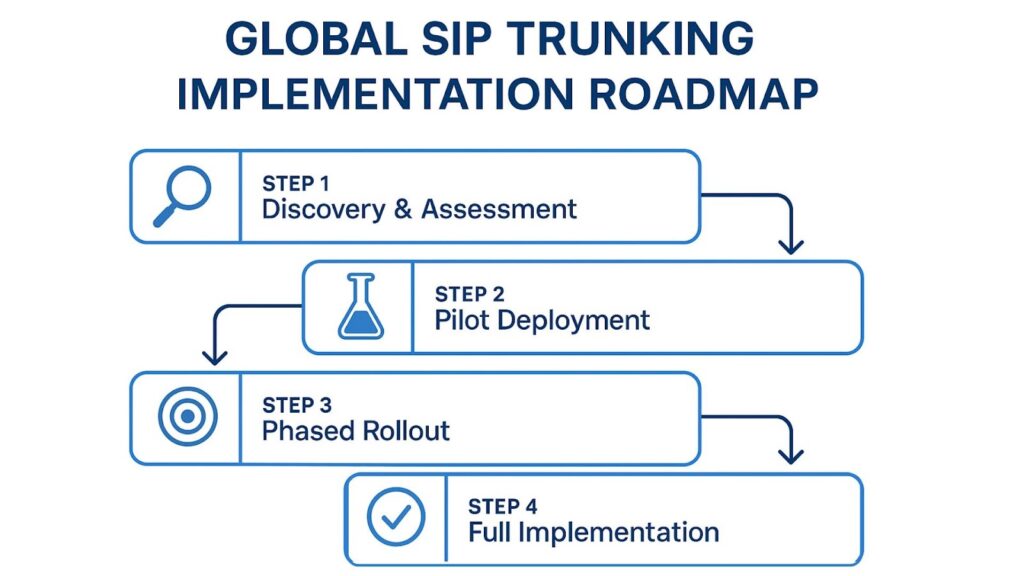
Discovery and needs assessment phases should focus on international communication patterns, current cost structures, and expansion plans. Document current international calling volumes, identify geographic coverage requirements, understand integration constraints, and establish success metrics that guide implementation decisions. This upfront investment prevents surprises later and ensures alignment on project objectives.
Phased rollout helps international clients manage risk while gaining confidence in new systems. Recommend pilot deployments in specific geographic regions before full-scale implementation. Clients can validate performance improvements and adjust configurations based on real-world results. Successful pilot projects often expand naturally into comprehensive implementations.
Change management support is essential for international rollouts because you’re often coordinating with distributed teams across multiple time zones. Provide clear communication plans, training schedules that accommodate different regions, and support coverage that matches client business hours globally. Your ability to manage complex rollouts smoothly often determines whether clients become long-term advocates.
How Do You Price International SIP Services Competitively?
Effective pricing should strike the right balance between staying competitive and maintaining healthy margins, while also reflecting the added value that comes from seasoned technical expertise. International SIP services naturally command higher rates due to the greater complexity, regulatory considerations, and specialized skills required to deliver reliable performance across global networks.

Value-based pricing focuses on client cost savings rather than provider costs. When businesses save substantial money on international calling costs, you can justify premium pricing for your services by demonstrating the ROI your expertise delivers. Calculate client savings based on their current international calling volumes and position your services as investments that pay for themselves through cost reductions.
Service tiers allow you to capture different client segments while maximizing revenue. Basic international connectivity appeals to price-sensitive prospects, while premium service tiers with enhanced features and dedicated support attract clients who prioritize quality over cost. This tiered approach allows you to compete on price when necessary while capturing higher margins from clients who value premium service.
Contracts should reflect the different risk profiles of international clients. Month-to-month options appeal to businesses testing international expansion, while annual contracts with volume discounts attract established international operations looking for cost predictability. Consider offering hybrid approaches that provide flexibility during initial deployment phases with longer term commitments for ongoing services.
What Level of Support Do Your Global Clients Actually Need?
International support requirements exceed domestic client needs because of geographic distribution and time zone differences. Your support capabilities often determine client satisfaction levels and long-term retention rates.
24/7 availability is essential when serving clients across multiple time zones. Consider partnering with support providers that offer global coverage, implementing automated support systems that handle common issues, or establishing follow-the-sun support models. The goal is to ensure clients can reach knowledgeable support during their business hours, regardless of location.
Multi-language capabilities help you serve diverse client bases while building stronger relationships in specific geographic markets. This capability is important when troubleshooting technical issues that require precise communication. Even basic language support can differentiate you from competitors who only operate in English.
Regulatory expertise enables you to provide consultation beyond basic technical support. International clients often need guidance about compliance requirements, emergency services obligations, and data privacy regulations. Your knowledge in these areas positions you as a strategic advisor, creating opportunities for ongoing consulting relationships.
How Do You Build Long-Term Revenue from Global SIP Clients?
International client relationships often generate higher lifetime values than domestic accounts because of increased service complexity and natural expansion opportunities. Strategic account management maximizes these revenue opportunities while strengthening client partnerships.
Expansion planning should occur regularly rather than only during contract renewal periods. International businesses frequently adjust their geographic footprints, modify their communication requirements, and implement new technologies that create service opportunities. Schedule quarterly business reviews that explore expansion plans, assess current system performance, and identify optimization opportunities that generate additional revenue.
Referral generation is valuable in international markets because word-of-mouth recommendations carry significant weight for complex service decisions. Satisfied international clients often know other businesses facing similar challenges and are willing to provide referrals when their own implementations succeed. Develop referral systems and provide incentives that encourage satisfied clients to recommend your services.
Service portfolio expansion enables you to capture larger portions of client technology spending over time. International businesses often need related services like unified communications, collaboration tools, network connectivity, and security solutions. Position yourself to provide these complementary services either directly or through partnerships that generate additional revenue streams.
Partnering with complementary service providers creates opportunities for mutual referral generation and joint service delivery. International businesses often work with multiple technology providers for different aspects of their operations. Building relationships with these providers can generate referral opportunities while enabling you to offer more comprehensive solutions to existing clients.
Frequently Asked Questions About Global SIP Trunking Best Practices
Q: What’s acceptable latency in VoIP for international calls? A: For international calls, target latency should remain under 150 milliseconds for acceptable voice quality. However, premium international services should aim for a latency under 120ms to ensure exceptional call quality in international performance. Geographic routing optimization and carrier-grade infrastructure help achieve these performance standards consistently.
Q: How many concurrent channels do international clients typically need? A: Most international businesses require one SIP channel per 3-4 employees for normal operations. However, businesses with high international call volumes or customer service operations may need one channel per 2 employees. Peak usage analysis helps determine optimal channel allocation for cost-effective service delivery.
Q: Can businesses port existing international numbers to SIP trunks? A: Yes, international number portability is available in most countries, though regulatory requirements vary by jurisdiction. The porting process requires proper documentation and carrier coordination, with timelines varying based on the specific country and carrier involved. Experienced resellers can manage this process to ensure smooth transitions.
Q: What’s the difference between local vs global DIDs for international businesses? A: Local DIDs provide phone numbers with area codes specific to geographic regions, while global DIDs offer universal accessibility without geographic restrictions. Local DIDs help businesses establish regional presence and reduce calling costs for local customers, while global DIDs simplify number management for distributed operations.
Q: How do resellers handle compliance requirements across different countries? A: Successful resellers partner with platforms that provide built-in compliance management for multiple jurisdictions. This includes automated tax calculations, emergency services compliance, and data privacy adherence. Expert resellers also develop knowledge of key regulatory differences to provide consultation beyond basic technical implementation.
Expand Your Reseller Business with Global SIP Trunking
Mastering these global SIP trunking best practices positions resellers as trusted advisors rather than basic service providers. The global SIP trunking market offers a significant opportunity for resellers who understand how to effectively position their services and deliver exceptional client experiences.
SIPTRUNK’s comprehensive reseller platform provides the infrastructure and support needed to capitalize on this growing market while building sustainable, profitable international practices. Get started today to learn how our carrier-grade platform can help you deliver exceptional international communication solutions that generate substantial recurring revenue.

Mitch leads the Sales team at BCM One, overseeing revenue growth through cloud voice services across brands like SIPTRUNK, SIP.US, and Flowroute. With a focus on partner enablement and customer success, he helps businesses identify the right communication solutions within BCM One’s extensive portfolio. Mitch brings years of experience in channel sales and cloud-based telecom to every conversation.