

Wholesale SIP vs VoIP Termination: Which is Right for Your Business?
Wholesale SIP and VoIP termination serve different reseller business models and client needs. SIP trunking offers higher recurring revenue, while VoIP termination provides simpler deployment for quick client wins.
- Wholesale SIP excels for clients with existing PBX systems seeking gradual cloud migration.
- VoIP termination works best for clients wanting a complete communication overhaul.
- A hybrid approach maximizes reseller revenue opportunities across a diverse client base.
- Technical requirements and client readiness determine the best service recommendation.
Most successful resellers offer both services based on client infrastructure and growth plans.
Telecommunications resellers are faced with plenty of opportunities as businesses abandon traditional phone systems for internet-based alternatives. With the global VoIP market reaching $161.79 billion in 2025 and projected to hit $415.20 billion by 2034, resellers must choose where their focus should lie: wholesale SIP vs VoIP termination services?
Understanding the difference between SIP and VoIP technologies is imperative for resellers wanting to capitalize on the growing industry. Modern communication technologies offer distinct advantages, revenue models, and implementation requirements that directly impact your business success and client satisfaction. For resellers seeking to build sustainable revenue streams, white-label platforms provide the foundation to effectively offer both service models.
What’s the Real Difference Between Wholesale SIP and VoIP Termination?
Wholesale SIP vs VoIP termination presents two distinct approaches to internet-based business communications, each serving different client needs and reseller business models. The distinction lies in infrastructure requirements, implementation complexity, and revenue potential.
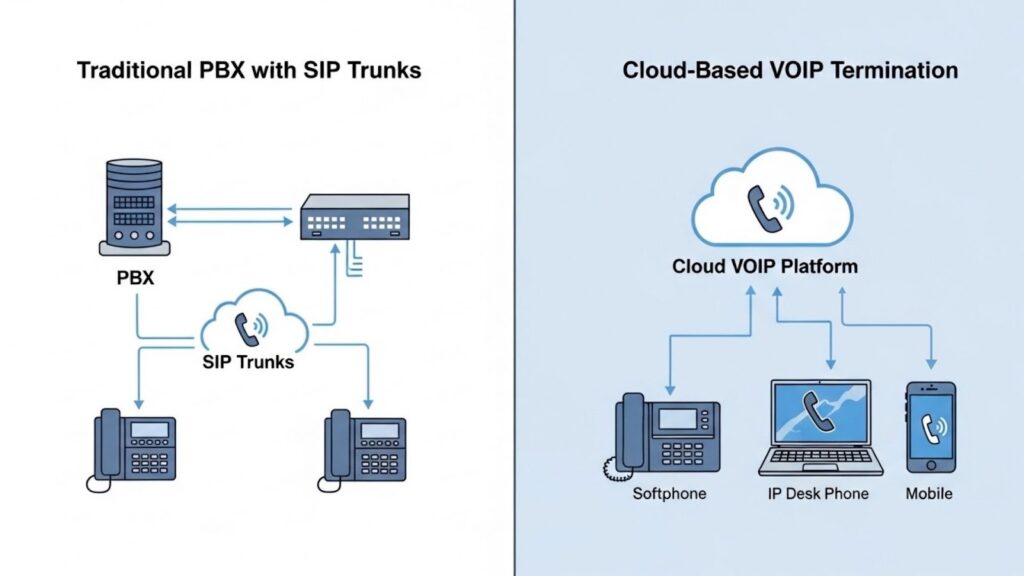
Wholesale SIP trunking connects existing PBX systems to internet-based calling networks through Session Initiation Protocol technology. This approach enables businesses to maintain their current phone infrastructure while accessing modern features like direct inward dialing, video conferencing, and unified communications. SIP trunks essentially replace traditional phone lines with virtual connections that route calls over internet protocols.
VoIP termination explained involves routing voice calls from originating carriers to destination networks using internet protocols, providing complete end-to-end calling solutions. Unlike SIP trunking, VoIP termination typically replaces entire phone systems rather than integrating with existing infrastructure. This model offers businesses comprehensive communication platforms that include voice, video, messaging, and collaboration tools.
How Do Wholesale SIP Providers Compare to VoIP Termination Providers?
The technical architecture differs between these approaches. Wholesale SIP providers focus on trunk-level connectivity, enabling businesses to add internet calling capabilities to existing PBX systems without replacing core infrastructure. VoIP termination providers deliver complete communication ecosystems that handle everything from call initiation to termination, often including advanced features like auto-attendants, call analytics, and CRM integration.
For resellers, this distinction creates different market opportunities and client requirements. SIP trunking appeals to businesses with substantial investments in current phone systems, while VoIP termination attracts organizations seeking complete communication modernization. Understanding when to recommend each approach maximizes client satisfaction and recurring revenue potential.
How Do Revenue Models Compare for Resellers?
The revenue implications of wholesale SIP vs VoIP termination create distinctly different business opportunities for resellers. These models impact everything from initial sales cycles to long-term profitability and client retention rates.
Wholesale SIP providers typically offer higher recurring revenue percentages due to lower infrastructure overhead and simplified deployment requirements. The SIP trunking market is projected to grow at 17.49% annually, creating long-term revenue opportunities for resellers. Many white-label partners offer ongoing commissions on active accounts, creating predictable monthly revenue streams.
VoIP termination services frequently involve more complex implementation but enable higher per-client revenue through comprehensive service packages. These solutions typically bundle multiple communication services, creating opportunities for upselling advanced features like analytics, security packages, and unified communications tools. However, implementation complexity can extend sales cycles and require more technical support resources.

Profitability of Wholesale SIP vs VoIP Reseller Services
The difference in SIP and VoIP models present in client acquisition costs also impacts profitability. SIP trunking sales often require less technical education since clients maintain familiar phone system interfaces. VoIP termination sales may involve longer education periods but result in higher client switching costs and improved retention rates.
Market data reveals compelling growth trajectories for both approaches. Businesses implementing VoIP solutions achieve 40% savings on local calls and 90% savings on international calls, creating strong value propositions that facilitate sales. Successful resellers often maintain portfolios including both service types to maximize market coverage and revenue diversification.
Which Service Model Fits Different Client Types?
Determining the best approach between wholesale SIP vs VoIP termination requires evaluating client characteristics, technical requirements, and business objectives. Different organizational profiles align naturally with specific service models.
| Client Profile | Best Fit | Key Indicators | Revenue Potential |
| Enterprise with Legacy PBX | Wholesale SIP | Existing infrastructure investment, IT staff, gradual migration preference | High recurring, lower implementation |
| Growing SMB | VoIP Termination | Limited IT resources, scalability needs, modern feature requirements | Moderate recurring, higher setup |
| Multi-Location Business | Hybrid Approach | Varied technical capabilities, standardization needs, cost optimization focus | Highest total revenue opportunity |
| Startup/New Business | VoIP Termination | No existing infrastructure, remote workforce, rapid scaling requirements | Fast deployment, predictable growth |
Established enterprises with significant PBX investments typically prefer wholesale SIP solutions that preserve existing infrastructure while adding internet-based capabilities. These organizations often have dedicated IT staff capable of managing hybrid environments and appreciate the gradual migration path SIP trunking provides. The recurring revenue potential remains high while implementation complexity stays manageable.
Small and medium businesses without substantial infrastructure investments usually benefit more from complete VoIP termination solutions. These organizations gain immediate access to enterprise-grade features, such as mobile integration, advanced call routing, and unified communications, which would be prohibitively expensive through traditional phone systems. The comprehensive nature of VoIP termination eliminates the need for multiple vendor relationships.
Multi-location businesses present unique opportunities for hybrid approaches combining both wholesale SIP and VoIP termination. Corporate headquarters might maintain PBX systems enhanced with SIP trunking, while satellite offices deploy complete VoIP solutions. This strategy optimizes costs while ensuring consistent communication capabilities across all locations.
What Are the Pros and Cons of Each Approach?
Understanding the advantages and limitations of wholesale SIP vs VoIP termination enables informed recommendations that align with client objectives and reseller capabilities.
Wholesale SIP Advantages:
- Lower implementation costs and faster deployment timelines
- Preserves existing infrastructure investments and user familiarity
- Excellent call quality through tier-1 network connectivity
- Flexible scaling without hardware replacement requirements
- Disaster recovery capabilities through automatic failover
Wholesale SIP Limitations:
- Requires existing PBX systems or significant infrastructure investment
- Limited unified communications features compared to complete platforms
- Potential compatibility issues with legacy equipment
- Bandwidth requirements may necessitate internet upgrades
VoIP Termination Advantages:
- Complete communication platform with unified features
- No dependency on existing infrastructure or equipment
- Advanced analytics and reporting capabilities
- Mobile integration and remote work support
- Predictable monthly costs with transparent pricing
VoIP Termination Limitations:
- Higher implementation complexity and longer deployment cycles
- Complete system replacement may face internal resistance
- Greater dependency on internet connectivity and bandwidth quality
- Potential learning curve for users transitioning from traditional systems
The choice between these approaches often depends on client risk tolerance and change management capabilities. Organizations comfortable with technological evolution typically embrace VoIP termination, while those preferring incremental changes gravitate toward wholesale SIP solutions.
Businesses implementing VoIP solutions can achieve up to 50% savings on communication costs, validating both approaches for different organizational contexts. Successful resellers position themselves as consultative partners who recommend solutions based on comprehensive client assessments rather than pushing single approaches.
How Do You Evaluate Client Readiness?
When you understand your clients deeply, you’re better equipped to suggest the right service and ensure smooth implementation. The following assessment helps resellers determine whether wholesale SIP vs VoIP termination better serves specific client needs.
Infrastructure Assessment Criteria:
- Current PBX system age, capacity, and remaining depreciation timeline
- Internet bandwidth capabilities and redundancy options
- IT staff technical expertise and availability for ongoing management
- Existing vendor relationships and contract obligations
Business Requirements Analysis:
- Communication feature priorities and advanced capability needs
- Budget constraints and capital vs operational expense preferences
- Timeline requirements and change management capabilities
- Compliance obligations and security requirements
Technical Readiness Evaluation:
- Network security posture and firewall configuration capabilities
- Quality of Service implementation for voice traffic prioritization
- Backup internet connectivity and disaster recovery planning
- Integration requirements with existing business applications

Organizations with modern PBX systems, adequate IT resources, and a preference for gradual transitions typically align well with wholesale SIP solutions. These environments enable successful implementations with minimal disruption while providing immediate cost benefits and feature enhancements.
Businesses lacking dedicated IT staff, operating aging phone systems, or prioritizing unified communications features usually benefit more from VoIP termination approaches. These implementations provide comprehensive solutions that eliminate multiple vendor relationships while delivering enterprise-grade capabilities.
The evaluation process should also consider future business plans and growth trajectories. Companies planning rapid expansion, adding remote workers, or implementing unified communications may benefit from VoIP termination even if their current infrastructure could support SIP trunking.
What Technical Factors Should Resellers Consider?
Technical considerations impact both implementation success and ongoing client satisfaction. Understanding these factors enables better service recommendations and proactive problem resolution.
Bandwidth and Quality Requirements
Wholesale SIP implementations typically require careful bandwidth planning since they integrate with existing PBX infrastructure that may have varying codec support capabilities. The difference between SIP and VoIP bandwidth needs depends heavily on the client’s current equipment and network configuration. Resellers must assess not only the raw bandwidth requirements but also Quality of Service configurations that prioritize voice traffic over other network activities. Legacy PBX systems may limit codec flexibility, potentially requiring higher bandwidth allocations to maintain call quality standards.
VoIP termination explained from a bandwidth perspective involves more predictable requirements since the entire communication stack is designed for internet-based delivery. Modern VoIP platforms typically offer adaptive codec selection that automatically optimizes bandwidth usage based on available network conditions.
These systems can dynamically adjust between high-quality uncompressed audio and bandwidth-efficient compressed codecs, providing consistent call quality even during network congestion. f VoIP termination platforms often include built-in network monitoring and optimization tools that simplify bandwidth management for clients.
Security and Compliance Considerations
Wholesale SIP providers must address security challenges that arise from integrating internet-based calling with existing PBX infrastructure. This hybrid approach creates potential vulnerabilities at connection points between traditional phone systems and internet protocols.
Resellers must ensure proper firewall configuration, implement Session Border Controllers for additional security layers, and establish monitoring systems that detect unusual calling patterns or potential fraud attempts. The distributed nature of wholesale SIP implementations often requires coordinated security policies across multiple network components.
VoIP termination platforms typically offer more comprehensive security packages since they control the entire communication environment from end to end. These solutions include advanced features like encrypted calling, automated threat detection, and centralized security management that simplify compliance reporting.
VoIP termination can provide more consistent security policies across all communication channels, including voice, video, and messaging. However, the cloud-based nature of these platforms requires careful evaluation of data residency requirements and compliance with industry-specific regulations.
Integration and Compatibility
Wholesale SIP solutions face complex integration challenges since they must work seamlessly with diverse PBX systems, each with unique firmware versions, feature sets, and configuration requirements. Success requires thorough compatibility testing and may necessitate PBX firmware updates or additional hardware components like analog telephone adapters.
Resellers must understand the technical specifications of client PBX systems and ensure that wholesale SIP providers offer adequate support for specific equipment manufacturers and models. Integration often involves configuring trunk groups, dial plans, and failover procedures that maintain business continuity during the transition.
VoIP termination explained through an integration lens involves replacing existing phone systems entirely, which eliminates compatibility concerns but creates different challenges. These platforms excel at integrating with modern business applications, offering pre-built connectors for popular CRM systems, help desk platforms, and unified communications tools.
Clients gain access to advanced features like click-to-dial functionality, automated call logging, and screen-pop capabilities that enhance productivity. However, the complete system replacement requires careful data migration planning and user training to ensure smooth adoption across the organization.
Scalability and Performance
Wholesale SIP providers enable scalability through channel-based expansion that leverages existing PBX infrastructure investments. Clients can add calling capacity by purchasing additional SIP channels without replacing core phone system components, making growth both cost-effective and operationally efficient.
The scalability model works particularly well for businesses with predictable growth patterns or seasonal fluctuations in calling volume. Performance optimization focuses on network-level improvements like bandwidth allocation and Quality of Service configurations that ensure consistent call quality as usage scales.
VoIP termination platforms offer dynamic scalability through cloud-based resource allocation that can instantly adapt to changing demands. These systems automatically provision additional capacity during peak usage periods and scale back during quieter times, optimizing costs while maintaining performance standards.
VoIP termination can support rapid business growth, remote workforce expansion, and new feature deployment without requiring hardware upgrades or complex configuration changes. Performance optimization occurs at the platform level, with providers managing network infrastructure, server capacity, and feature availability to ensure consistent service delivery across all client locations.
How Can Resellers Maximize Success With Both Models?
The most profitable resellers don’t limit themselves to single service offerings. Instead, they develop portfolios that position them as communication consultants capable of addressing diverse client needs. Building expertise in both wholesale SIP vs VoIP termination creates competitive differentiation while maximizing revenue opportunities across different market segments.
Forward-thinking resellers recognize that different clients require different approaches, and the ability to recommend solutions based on actual needs rather than limited inventory builds trust and long-term relationships. This consultative approach transforms resellers from vendors into strategic partners, commanding higher margins and improving client retention rates.
5 Essential Strategies for Portfolio Diversification
- Develop Technical Expertise in Both Approaches: Understanding the intricacies of wholesale SIP vs VoIP termination enables consultative selling and builds client confidence. Invest in technical training and certification programs offered by leading providers.
- Create Market-Specific Positioning: Target wholesale SIP services toward established businesses with existing infrastructure while positioning VoIP termination for growth-focused organizations and startups. This approach maximizes market coverage without confusing messaging.
- Build Strategic Provider Partnerships: Partner with wholesale SIP providers offering transparent pricing and reliable support alongside VoIP termination providers with comprehensive feature sets. Multiple partnerships provide flexibility in meeting diverse client needs.
- Implement Systematic Client Assessment Processes; Develop standardized evaluation frameworks that assess technical readiness, business requirements, and budget constraints. This approach ensures appropriate service recommendations and improves client satisfaction rates.
- Focus on Ongoing Client Success: Success in either model depends on ongoing client relationships and satisfaction. Provide proactive monitoring, regular performance reviews, and upgrade recommendations to maximize lifetime client value.
Client Education and Support Strategies: Successful resellers invest heavily in client education, recognizing that informed clients make better decisions and experience higher satisfaction rates. Develop educational content explaining the benefits and implementation requirements of each approach.
Performance Monitoring and Optimization: Both wholesale SIP and VoIP termination require ongoing performance monitoring to maintain client satisfaction. Implement proactive monitoring systems that identify potential issues before they impact business operations.
The most successful resellers often discover that offering both technologies creates competitive advantages and revenue diversification. Clients appreciate working with providers capable of recommending optimal solutions rather than selling single approaches regardless of fit.
FAQ
What’s the main difference between wholesale SIP and VoIP termination? Wholesale SIP connects existing PBX systems to internet-based calling networks, while VoIP termination provides complete end-to-end communication solutions that replace traditional phone systems entirely.
Which approach offers better recurring revenue for resellers? Both models offer strong recurring revenue potential, but wholesale SIP typically provides faster implementation and higher margin percentages, while VoIP termination creates opportunities for higher per-client revenue through comprehensive service packages.
How do I determine which service model fits my client’s needs? Evaluate their existing infrastructure, IT capabilities, budget preferences, and feature requirements. Clients with modern PBX systems often prefer wholesale SIP, while those seeking complete communication modernization typically benefit from VoIP termination.
Can I offer both wholesale SIP and VoIP termination services? Yes, many successful resellers offer both approaches to maximize market coverage and revenue opportunities. This strategy enables appropriate recommendations based on specific client needs rather than limited service offerings.
Building Your Communication Services Portfolio
The choice between wholesale SIP vs VoIP termination shouldn’t be an either-or decision for forward-thinking resellers. Both approaches serve distinct market segments and offer unique revenue opportunities.
SIPTRUNK’s white-label reseller platform enables you to offer both wholesale SIP and VoIP termination services under your own brand. With transparent pricing, reliable infrastructure, and dedicated reseller support, you can build a thriving communications business that serves diverse client needs while generating predictable recurring revenue. Get started today and discover how the right platform partnership transforms your communications services portfolio.

Mitch leads the Sales team at BCM One, overseeing revenue growth through cloud voice services across brands like SIPTRUNK, SIP.US, and Flowroute. With a focus on partner enablement and customer success, he helps businesses identify the right communication solutions within BCM One’s extensive portfolio. Mitch brings years of experience in channel sales and cloud-based telecom to every conversation.