

VoIP Reseller vs VoIP Affiliate: What’s the Difference?
VoIP reseller and affiliate programs offer distinct paths to telecommunications revenue, with resellers maintaining full business control and higher profit potential while affiliates enjoy simpler, commission-based earnings.
- Reseller programs provide white-label branding, pricing control, and substantial profit margins through wholesale pricing models.
- Affiliate programs offer commission-based earnings with minimal technical responsibilities and a lower barrier to entry.
- Technical control differs between options. Resellers manage customer relationships and platform operations; affiliates focus solely on referrals.
Choose reseller programs for long-term business building and brand development, and opt for affiliate programs for supplemental revenue streams.
The telecommunications industry presents multiple pathways for generating revenue, with VoIP reseller vs VoIP affiliate programs offering two of the most accessible entry points. As the global VoIP market reaches $161.79 billion in 2025 and continues expanding toward $415.20 billion by 2034, understanding these distinct business models is key for anyone looking to capitalize on this growth.
Both VoIP reseller programs and affiliate VoIP programs offer opportunities to earn revenue from the booming telecom sector, but they operate under fundamentally different structures. The main difference lies in the level of business control, technical responsibility, and revenue potential each model provides.
Why VoIP Reseller vs VoIP Affiliate Choice Shapes Your Business Future
The decision between VoIP reseller vs VoIP affiliate programs defines your business identity and long-term strategic direction. This choice determines whether you’re building a scalable business asset or creating a supplemental income stream, each requiring vastly different planning approaches and resource allocation strategies.
Understanding these distinctions early prevents costly pivots later. Entrepreneurs who start with affiliate programs expecting reseller-level profits often become frustrated with commission limitations, while those who jump into reseller programs without adequate preparation may struggle with customer service responsibilities and business development requirements. The industry rewards those who align their capabilities with the right business model from the outset.
Your choice also impacts market positioning and competitive strategy. Reseller programs position you as a telecom provider competing on service quality, relationships, and value-added offerings. Affiliate programs position you as a marketing specialist competing on reach, conversion rates, and promotional effectiveness. These differences require distinct skill sets, marketing approaches, and success metrics.
The scalability trajectories differ dramatically between models. VoIP reseller programs create compounding growth opportunities where each customer success builds toward larger business value, while affiliate programs typically scale linearly with marketing efforts. This difference affects everything from staffing decisions to technology investments and exit strategy planning.
What Are VoIP Reseller Programs?
VoIP reseller programs enable businesses to sell telecommunications services under their own brand through white-label partnerships with established providers. Resellers purchase services at wholesale rates and sell them to customers at retail prices, maintaining complete control over branding, pricing, and customer relationships.

How VoIP Reseller Programs Work
Platform providers supply the underlying technology, including SIP trunking infrastructure, call routing systems, and customer management portals. Resellers gain access to these enterprise-grade systems while maintaining their brand identity throughout the customer experience. This arrangement eliminates the need for significant technical expertise while providing professional-grade services.
The business model supports various approaches, from simple voice services to comprehensive unified communications packages. Resellers can customize service offerings, bundle additional features, and create pricing structures that align with their market positioning and profit objectives.
Revenue and Technical Structure
VoIP reseller programs generate revenue through wholesale-to-retail price differences, enabling substantial profit margins. The recurring revenue nature means profits compound over time as each customer acquisition contributes to ongoing monthly revenue streams. Benchmark studies indicate that telecom resellers can achieve a baseline profit margin of around 40% with room for growth based on the business’s strategy.
Modern reseller platforms minimize technical requirements through comprehensive support and automation. Platform providers handle provisioning, network management, billing automation, and customer support escalation, while resellers focus on customer onboarding, basic troubleshooting, and service configuration.
What Are VoIP Affiliate Programs?
Affiliate VoIP programs operate as commission-based referral systems where participants earn income by directing prospects to VoIP service providers. Unlike reseller arrangements, affiliates don’t own customer relationships or control pricing. They simply facilitate introductions between prospects and providers.

How Affiliate Programs Operate
VoIP affiliate programs provide marketing materials, tracking systems, and promotional tools that enable effective service promotion. Affiliates receive unique tracking links that ensure proper commission attribution when prospects convert to customers.
The operational structure is straightforward: affiliates identify prospects, share promotional materials or referral links, and earn commissions when those prospects purchase services. The provider handles all customer service, billing, and technical support responsibilities.
Commission Structure and Requirements
VoIP affiliate programs typically offer commission rates consistent with industry standards. Affiliate commissions generally range from 5% to 25%, with telecommunications services often falling within this range depending on program structure.
SIP trunk affiliate programs require minimal technical knowledge, focusing instead on marketing effectiveness and referral generation. Affiliates need basic digital marketing skills, including link sharing, content creation, and performance tracking, rather than telecom expertise.
Key Differences: Business Models Compared
| Aspect | VoIP Reseller Programs | VoIP Affiliate Programs |
| Investment Level | Moderate (business setup, marketing) | Minimal (promotional materials) |
| Revenue Model | Wholesale-to-retail markup | Commission-based earnings |
| Brand Control | Complete white-label capability | No branding control |
| Customer Ownership | Full customer relationships | Limited to no customer interaction |
| Technical Responsibility | Platform management, basic support | No technical duties |
| Profit Potential | Substantial recurring margins | Limited to commission rates |
| Business Scalability | Unlimited growth potential | Constrained by referral capacity |
Investment and Revenue Comparison
VoIP reseller programs require moderate initial investment in business establishment and marketing but eliminate traditional barriers like equipment purchases or facility requirements. This accessibility enables entrepreneurs to enter the market with manageable startup costs.
The revenue structure is the most significant difference between VoIP reseller vs VoIP affiliate approaches. Reseller programs offer unlimited earning potential through wholesale pricing margins and customer accumulation, while affiliate programs provide commission-based income with inherent limitations.
Affiliate programs require minimal financial investment and can generate immediate commission income but lack the compounding effect of customer ownership that drives long-term wealth building in reseller businesses.
Which Program Offers Better Payouts?
VoIP reseller programs offer superior long-term revenue potential through wholesale-to-retail price differences and recurring customer revenue. Each customer acquisition builds ongoing revenue streams that continue generating profits throughout the customer relationship, enabling geometric revenue growth.

Affiliate programs scale linearly with promotional activities and referral generation. While successful affiliates can generate significant income through effective marketing, affiliate earnings remain dependent on continuous promotional activities rather than building cumulative business value.
Advanced resellers enhance profitability through service bundling, premium feature offerings, and specialized industry solutions that enable differentiation and premium pricing while providing genuine customer value.
Top 5 Factors for Choosing Between Models
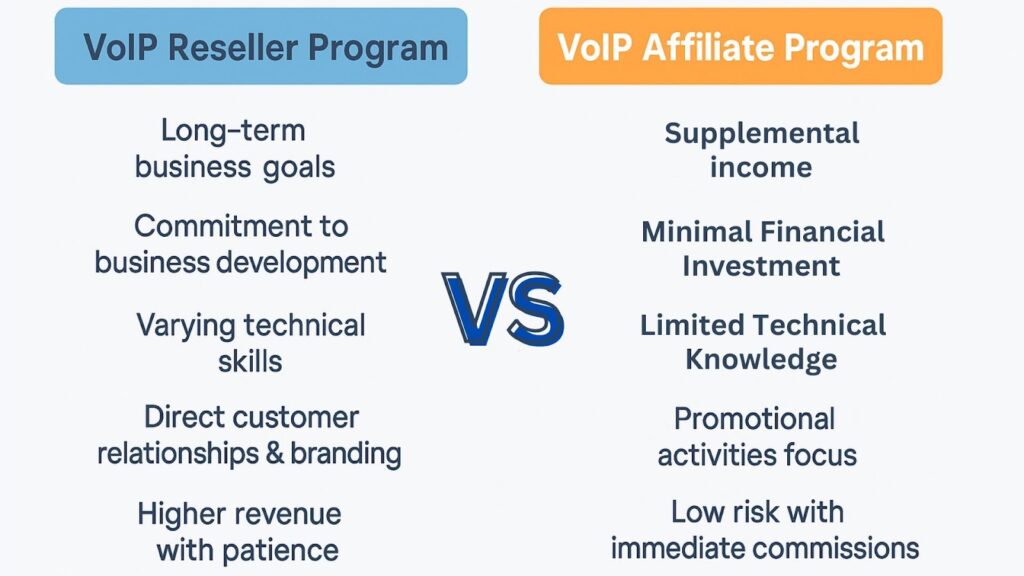
1. Business Goals and Growth Objectives: Long-term business building favors reseller programs through customer ownership and brand development. Affiliate programs suit those seeking supplemental income without significant investment.
2. Available Resources and Investment Capacity: Reseller programs require commitment to customer service and business development. Affiliate programs require minimal financial investment but demand time for effective promotional activities.
3. Technical Expertise and Team Capabilities: Modern VoIP reseller programs accommodate varying technical skill levels through comprehensive training, but resellers must handle customer inquiries. Affiliate programs require minimal technical knowledge.
4. Market Focus and Customer Relationship Priorities: Building direct customer relationships suits reseller models through brand control and service customization. Affiliate programs work well for those preferring promotional activities without customer support responsibilities.
5. Risk Tolerance and Revenue Timeline: VoIP reseller programs offer higher long-term revenue potential but require patience for business development. Affiliate programs can generate immediate commission income with lower risk but limited scalability.
Which Model Is Right for Your Business?
Determining the best choice between VoIP reseller and affiliate programs depends on individual circumstances, business objectives, and resource availability. Each model serves different entrepreneurial goals and risk tolerance levels. Considerations should include your long-term vision, available capital, technical comfort level, and desired level of customer involvement. While both approaches capitalize on the growing telecommunications market, the path you choose will impact your business development strategy, revenue potential, and operational requirements.
When to Choose VoIP Reseller Programs
VoIP reseller programs align well with entrepreneurs seeking to build substantial telecom businesses with long-term value. This model suits those willing to invest time and resources in customer development, brand building, and business growth.
Existing businesses can leverage reseller programs to expand service offerings and create new revenue streams. The reseller approach works particularly well in markets where relationships and service quality drive customer decisions.
When to Choose VoIP Affiliate Programs
Affiliate VoIP programs suit individuals and businesses seeking supplemental income without operational complexity. This model works well for those with existing audiences, marketing expertise, or complementary business relationships who can effectively generate referrals.
Marketing professionals, content creators, and business consultants often succeed with affiliate approaches by leveraging their expertise and audience relationships. The low barrier to entry enables testing market interest before potentially transitioning to reseller models.
FAQ
What’s the difference between VoIP reseller program commission and profit margins?
VoIP reseller programs generate profits through wholesale-to-retail price differences, enabling substantial margins that resellers control. Affiliate programs offer fixed commission rates with no control over the underlying profit structure.
Do SIP trunk affiliate programs require technical expertise?
No, SIP trunk affiliate programs require minimal technical knowledge. Success depends more on marketing effectiveness, audience development, and referral generation than on telecom expertise. Most programs provide ready-made promotional materials and tracking systems that eliminate technical complexity.
Can I participate in both affiliate and reseller programs simultaneously?
While technically possible, most providers prefer partners to focus on one model to avoid conflicts of interest. Some entrepreneurs start with affiliate programs to develop market knowledge before transitioning to reseller models. Check specific program terms to understand any restrictions on dual participation.
How quickly can I start earning revenue with each model?
Affiliate programs can generate immediate commission income once referrals convert to customers. VoIP reseller programs typically require more time for business development, customer acquisition, and revenue building, but they offer higher long-term earning potential through recurring revenue streams and customer ownership.
Simplify Your Decision with the Right Partner
The choice between VoIP reseller vs VoIP affiliate programs ultimately depends on your business goals, available resources, and long-term objectives. Reseller programs offer superior revenue potential, brand control, and business-building opportunities for those willing to invest in customer relationships and development. Affiliate programs provide accessible entry points with minimal risk for those seeking supplemental income or market exploration.
Both models benefit from the continued expansion of the VoIP market, with small and medium-sized enterprises expected to grow at the fastest rate and SIP trunking services representing 46% of market revenue. Success in either approach requires understanding your target market, delivering genuine value, and maintaining professional standards that build trust and credibility.
Whether you choose the brand-building approach of reselling or the promotional strategy of affiliate marketing, the telecom industry offers substantial opportunities for generating revenue and building successful ventures. SIPTRUNK provides comprehensive SIP trunking reseller programs that enable VoIP services, offering the platform infrastructure, training, and support needed to succeed. Get started with the model that aligns with your business objectives and join the growing community of successful telecommunications entrepreneurs.

Mitch leads the Sales team at BCM One, overseeing revenue growth through cloud voice services across brands like SIPTRUNK, SIP.US, and Flowroute. With a focus on partner enablement and customer success, he helps businesses identify the right communication solutions within BCM One’s extensive portfolio. Mitch brings years of experience in channel sales and cloud-based telecom to every conversation.