

How to Start a SIP Trunk Business in 2026
Starting a SIP trunk business is now a distribution and economics exercise rather than an infrastructure one, which is why telecom agents, IT consultants, and MSPs are entering faster than traditional carriers.
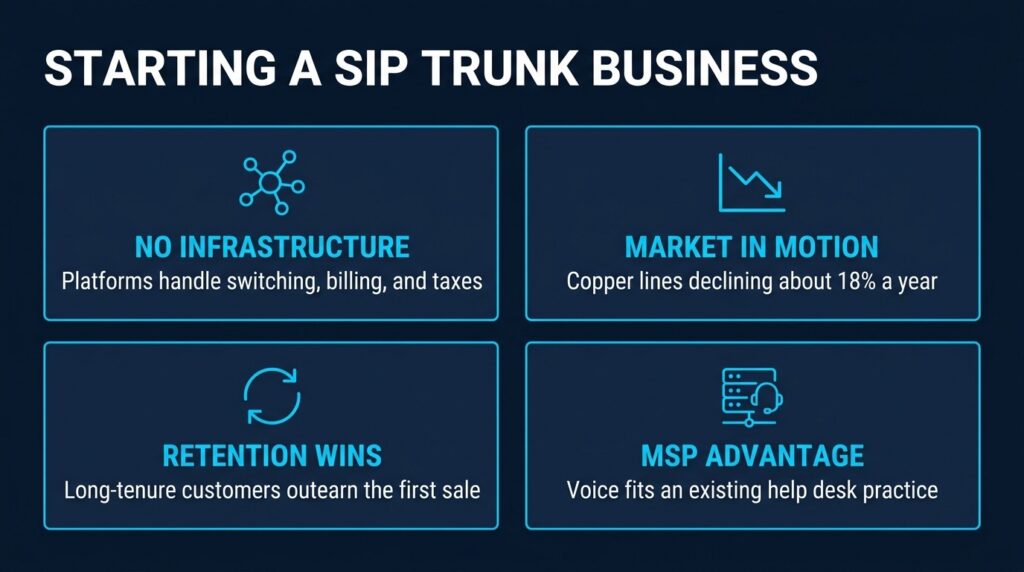
- The demand signal is unambiguous. Legacy switched access lines are disappearing while IP voice subscriptions hold steady, creating a standing migration pipeline.
- The barrier to entry has collapsed. Reseller platforms handle switching, provisioning, billing, and telecom taxes, removing the capital costs that made voice carrier-only.
- Profitability depends on retention. Customers who stay three to five years generate returns that dwarf the first invoice, so churn management outweighs volume.
- MSPs hold a structural advantage. If you already run a help desk and manage customer networks, the operational overlap with voice support is substantial.
If you serve business customers today, layer SIP trunking onto the relationships you already own rather than building a customer base from scratch.
If you’re evaluating whether to start a SIP trunk business, the economics have shifted in your favor. Current SIP trunking market forecasts put the category at roughly $85 billion in 2026, growing toward $181 billion by 2031 as enterprises retire legacy circuits. What makes that accessible to smaller operators is the arrival of platforms that sell carrier-grade voice without a softswitch, and a proven SIP trunking platform removes most of the obstacles that once kept new entrants out.
Why Is Now the Right Time to Start a SIP Trunk Business?
Now is a strong entry point because customer migration is underway, and most businesses haven’t finished it. You aren’t creating demand from nothing. You’re intercepting a transition carriers set in motion that many smaller businesses keep deferring.
What’s Driving Demand for SIP Trunking Services?
The driver is the retirement of copper infrastructure. The FCC’s most recent voice telephone services report counted roughly 15 million switched access lines still in service as of mid-2025, against 63 million interconnected VoIP subscriptions. Switched lines are declining at a compound annual rate near 18%, pushing a large pool of businesses toward IP voice on a timeline they don’t control.
Why Does the Reseller Model Lower the Barrier to Entry?
Building a voice business once meant buying a softswitch, negotiating carrier interconnects, and setting up billing that calculated telecom taxes correctly. Reseller platforms have unbundled that stack, so you sell under your own brand while the platform runs the infrastructure. Startup costs shift from capital expenditure to sales effort, letting you validate demand across a few accounts before committing further.
What Steps Should You Take to Start a SIP Trunk Business?
Sequence matters more than new entrants expect. The common failure pattern is selecting a platform first, then hunting for customers who fit it. Reversing that order works better because your target market determines which capabilities matter. The definitive guide to reselling SIP trunks covers the mechanics, and the roadmap below outlines five phases.

Phase One: Define Your Target Market First
Identify a specific customer profile rather than a broad category. Businesses with 10 to 50 employees running aging premise-based phone systems are the most accessible entry point, since their migration is simple and their decision cycle is short. Vertical specialization compounds that advantage because the requirements you already understand become a differentiator.
Phase Two: Evaluate SIP Trunk Reseller Programs Against Real Criteria
Once you know who you’re selling to, assess each SIP trunk reseller program against measurable standards rather than marketing claims. Examine contract terms, minimum commitments, provisioning speed, PBX compatibility, and whether the provider handles telecom taxes. Ask about support escalation because resolving a call quality issue on a Monday morning is what determines renewal.
Phase Three: Build Pricing You Can Defend
Your pricing should reflect the value of the outcome, not the cost of the underlying channels. Review transparent SIP trunk pricing models to establish your cost floor, then package voice alongside services your customers already buy. Selling unbundled channels invites direct price comparison, a competition you don’t want to enter.
Phase Four: Prepare Operations Before You Sell
Set up provisioning workflows, support ticketing, usage monitoring, and documentation before your first order arrives. New resellers underestimate this step and end up improvising while a live customer waits. Building these systems early costs a week and saves your first several accounts.
Phase Five: Launch Inside Your Existing Customer Base
Your first sales should come from customers who already trust you. Identify accounts still running legacy phone systems and open with a cost review rather than a product pitch. This tactic shortens the sales cycle and produces references before you spend on outbound acquisition.
How Do You Build a Profitability Framework for Your VoIP Business?
Profitability in a VoIP business is the spread between wholesale cost and retail price, multiplied by how long each customer stays. New resellers typically obsess over the first half and neglect the second. Guidance on becoming a profitable SIP trunk reseller starts with knowing which levers you control.
Where Does Margin Actually Come From?
Margin comes from three places: the gap between wholesale and retail rates, the services you bundle around the trunk, and the efficiency of your support model. The first is the most visible and most vulnerable, since raw connectivity is easy to price-shop. Resellers who package voice with configuration and integration convert a commodity line item into a relationship that holds its pricing.
Which Numbers Should You Track?
A customer who stays four years generates many multiples of the initial installation revenue, so lifetime value matters more than first-sale price. Track monthly recurring revenue, gross margin per account, churn rate, and support hours per customer. That last figure is your early warning system, since rising support load signals a mismatched customer or an implementation problem that will eventually produce a cancellation.
How Does Recurring Revenue Compound Over Time?
Recurring revenue compounds because each retained customer becomes a base that new sales build on, rather than a number you reproduce monthly. That’s the structural difference between a project business and a subscription business.
Consider the arithmetic. Add four customers per month at an average of $400 in monthly recurring revenue, retain 95% annually, and you reach roughly $19,000 in monthly recurring revenue by the end of year one and roughly $37,000 by the end of year two. An identical sales effort produces nearly twice the result in the second year. These figures are illustrative rather than a performance claim, but the curve holds whatever inputs you substitute.
Several factors accelerate that compounding:
- Expansion within accounts. Customers add channels, locations, and numbers as they grow, raising account value at no acquisition cost.
- Bundled adjacent services. Failover, number management, and integration work attach naturally to an existing trunk.
- Referral flow. Customers who had a clean migration readily recommend whoever handled it.
What Should MSPs Know Before Adding SIP Trunking?
MSPs are well positioned to add voice because the required competencies overlap with what they already deliver. VoIP market growth projections point toward nearly $389 billion by 2034, and much of that spend will flow through providers already managing their customers’ networks.

Why Does Voice Fit an Existing MSP Service Stack?
Your network monitoring translates directly to voice quality management, since jitter and packet loss are network problems before they’re voice problems. Your security practice applies to protecting trunks against toll fraud, an expensive risk many resellers handle poorly. Your help desk already fields end-user issues, so covering phones is incremental rather than new.
How Should MSPs Package and Price Voice?
Fold voice into your existing per-user or per-site pricing rather than quoting it separately, which makes your proposition harder to unbundle and stops procurement shopping the phone bill in isolation. Avoid treating voice as a passive commission stream, since referral arrangements hand the relationship to a third party for a fraction of the return. Protect implementation quality above all because a bad cutover damages the trust you spent years building.
7 Ways to Scale a SIP Trunk Business Past Your First Customers
Once you’ve validated the model, growth is a question of removing constraints. These seven moves address the bottlenecks that stall resellers between their tenth and hundredth customer.
- Standardize implementation. Document a repeatable cutover procedure so quality doesn’t depend on who handles the account.
- Specialize in one or two verticals. Industry depth shortens sales cycles and lets you reuse the same configuration.
- Productize your packages. Replace custom quotes with two or three defined tiers, since bespoke pricing eats selling time and margin.
- Build a referral engine. Formalize how you ask for introductions rather than waiting for them.
- Automate provisioning and billing. Manual setup scales with headcount, while automation lets a small team support a large book.
- Add adjacent recurring services. Failover trunks, porting, and integration work raise account value without new customers.
- Monitor churn signals. Rising tickets, falling usage, and late payments precede cancellation. Resellers who scale a VoIP reseller business treat retention as a distinct function.
Which Business Model Fits Your Company?
Four models are available to anyone entering this market, differing mainly in how much control and margin you retain versus how much operational responsibility you accept.
| Model | Control of customer | Margin position | Operational burden | Best suited to |
| Agent / referral | Provider owns it | Lowest, commission-based | Minimal | Incidental income, no service commitment |
| Reseller | You own it | Well above commission | Moderate, provider runs infrastructure | Agents, VARs, IT consultants building a service line |
| White-label | You own account and brand | Highest without infrastructure | Moderate to significant | MSPs consolidating under one brand |
| Build your own | Full control | Highest in theory | Very high, needs capital and staff | Established carriers |
Agent and referral programs suit companies wanting exposure to voice revenue without a service responsibility, though your income then depends on a customer relationship you no longer control. Building your own infrastructure delivers complete control, but the capital and regulatory requirements make it impractical for anyone not already operating as a carrier. For most agents, VARs, IT consultants, and MSPs, a SIP trunk reseller program or white-label arrangement occupies the practical middle ground, keeping the customer relationship and the margin with you while the platform absorbs what requires carrier-scale investment.
Frequently Asked Questions About Starting a SIP Trunk Business
How much does it cost to start a SIP trunk business? Under a reseller model, startup costs are primarily time and marketing rather than capital. There’s typically no infrastructure to buy and no hardware inventory to carry. Your real expenses are learning the platform, building sales materials, and acquiring your first accounts.
How long does it take to become profitable? That depends on how quickly you acquire accounts and how well you retain them. Because the model carries minimal fixed costs, many resellers reach positive contribution on their first few customers. Meaningful recurring revenue generally takes 12 to 24 months of consistent selling.
What separates a SIP trunk reseller from a wholesale voice buyer? A reseller program supplies a complete platform including provisioning, billing, taxes, and support, with your brand on the customer relationship. Wholesale voice sells bulk minutes and leaves the operational stack to you.
Can you run a SIP trunk business alongside an existing company? Yes, and that’s the most common path. Agents, IT consultants, and MSPs typically add voice to an existing portfolio rather than launching a standalone VoIP business, since current relationships provide immediate distribution.
Ready to Start a SIP Trunk Business?
The opportunity in front of resellers today is clear. Customers are being pushed off legacy infrastructure on a timeline set by carriers, the cost argument is easy to make, and recurring revenue from voice compounds in a way project work never will. Success depends less on timing than on choosing a platform that removes operational friction instead of adding to it.
SIPTRUNK was built for resellers who want to sell voice without operating a network, with no contracts, no upfront costs, automated provisioning, and hands-off billing and taxes. To add a recurring revenue stream to a business you’ve already built, get started as a reseller and begin building your book of voice customers.

Mitch leads the Sales team at BCM One, overseeing revenue growth through cloud voice services across brands like SIPTRUNK, SIP.US, and Flowroute. With a focus on partner enablement and customer success, he helps businesses identify the right communication solutions within BCM One’s extensive portfolio. Mitch brings years of experience in channel sales and cloud-based telecom to every conversation.