

SIP vs PSTN: What Businesses Need to Know in 2026
SIP trunking delivers high cost savings over legacy phone systems while providing the scalability and features enterprises need for modern communications.
- PSTN shutdown deadlines are accelerating worldwide, with the UK’s network closing by January 2027 and several European countries already fully transitioned to IP-based voice.
- The SIP trunking market is projected to grow from $85.07 billion in 2026 to over $181 billion by 2031, reflecting rapid enterprise adoption across industries.
- Migration from PSTN to SIP typically takes three to six months for most organizations, making early planning essential for business continuity.
For telecom resellers, the window to capture migration revenue is narrowing as businesses accelerate their shift away from copper-based infrastructure.
The telecommunications industry is experiencing one of its most significant transitions in decades. As carriers worldwide announce PSTN decommissioning schedules, businesses face a critical decision about their voice communications infrastructure. The SIP trunking market is projected to grow at a compound annual growth rate of 16.38%. Enterprises are discovering that the shift from legacy phone systems delivers measurable operational and financial benefits.
Understanding the comparison of SIP vs PSTN is no longer optional for organizations planning their communications strategy. Whether driven by cost reduction goals, compliance requirements, or the simple reality that traditional phone lines are being retired, the migration to IP-based voice has become a business imperative.
What Is the Difference Between SIP vs PSTN?
The fundamental difference between these two technologies comes down to how voice signals travel from one phone to another.
PSTN, or Public Switched Telephone Network, is the traditional circuit-switched telephone infrastructure that has connected callers since the late 1800s. This network relies on physical copper wires running underground, with dedicated connections established between two endpoints for each call. When you place a call on a landline, the PSTN creates a direct circuit that remains open for the duration of your conversation.
SIP, which stands for Session Initiation Protocol, takes an entirely different approach. Rather than requiring dedicated physical connections, SIP converts voice signals into digital data packets that travel over the internet. This technology enables Voice over Internet Protocol (VoIP) communications, allowing businesses to make and receive calls using their existing broadband connection instead of separate phone lines.
The practical implications of PSTN vs VoIP differences are substantial. PSTN operates on a one-user-per-line basis, meaning each employee who needs a phone line requires a separate physical connection. SIP trunking, by contrast, allows multiple simultaneous calls over a single internet connection, with capacity limited only by available bandwidth.
SIP Trunking vs PSTN Comparison at a Glance
| Factor | PSTN (Legacy) | SIP Trunking |
| Infrastructure | Copper wires, physical circuits | Internet-based, virtual channels |
| Cost Structure | Fixed line rentals, higher per-minute rates | Lower monthly costs, flexible pricing models |
| Scalability | Requires new physical lines, weeks to provision | Add or remove channels instantly |
| Features | Basic voice, limited add-ons | Voice, video, messaging, unified communications |
| Geographic Flexibility | Tied to physical location | Work from anywhere with internet access |
| Maintenance | Carrier-dependent, truck rolls required | Software-based, remote management |
| Disaster Recovery | Limited failover options | Automatic rerouting, geographic redundancy |
| Future Viability | Being retired worldwide | Industry standard moving forward |
Why Are Businesses Switching from PSTN to SIP?
The migration to SIP trunking vs PSTN is accelerating for several reasons. Regulatory mandates, economic pressures, and workforce changes are all driving businesses to reevaluate their communications infrastructure.
The Global PSTN Shutdown Timeline
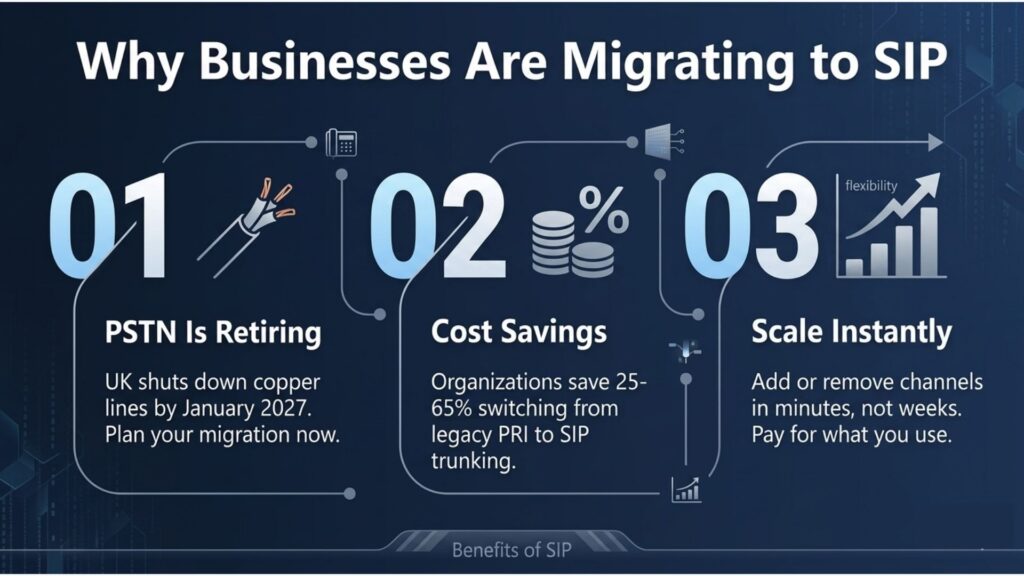
Telecom carriers around the world are actively retiring their copper-based networks. The maintenance costs for aging PSTN infrastructure have become unsustainable, and carriers are redirecting investment toward fiber and IP-based services.
In the United Kingdom, January 31, 2027 is the final PSTN switch-off date. This deadline was extended from the original December 2025 target to address concerns about vulnerable customers and telecare device compatibility. However, business customers are urged to complete their migrations well before this deadline to avoid last-minute complications. Wholesale Line Rental stopped being sold nationwide in September 2023, meaning businesses can no longer order new PSTN services or modify existing ones.
Several European countries have already completed their transitions. Germany, the Netherlands, and Estonia have fully retired their PSTN networks and now operate entirely on IP-based voice infrastructure. Other European carriers are targeting full switch-offs by 2030.
In the United States, the approach has been more market-driven than regulatory. The FCC reduced the required notice period for carriers discontinuing traditional phone lines from 180 days to 90 days, signaling regulatory support for the transition. Major carriers, including Verizon and AT&T, have issued discontinuation notices for POTS (Plain Old Telephone Service) in various regions, encouraging customers to migrate to digital alternatives.

Cost Savings That Impact the Bottom Line
The financial case for SIP trunking continues to strengthen as businesses analyze their telecom spending. Organizations migrating from legacy systems to SIP trunking typically achieve cost savings between 25% and 65% compared to traditional PRI lines, with the strongest savings seen among high-volume, multi-site users.
These savings come from multiple sources. Traditional phone systems require fixed line rentals regardless of usage, while SIP trunking allows businesses to pay only for the capacity they need. Long-distance and international call rates drop because voice traffic rides on existing internet bandwidth rather than dedicated carrier circuits. The elimination of separate voice and data networks simplifies infrastructure and reduces ongoing maintenance costs.
The pricing structures also differ. Traditional PSTN services typically carry higher monthly line rentals plus per-minute charges for long-distance calls. SIP trunk pricing offers more flexibility, with options ranging from unlimited domestic calling plans to metered pay-per-minute arrangements that suit businesses with varying call volumes. For organizations with predictable high-volume calling patterns, the savings can be substantial.
How Do SIP and PSTN Compare on Key Business Factors?
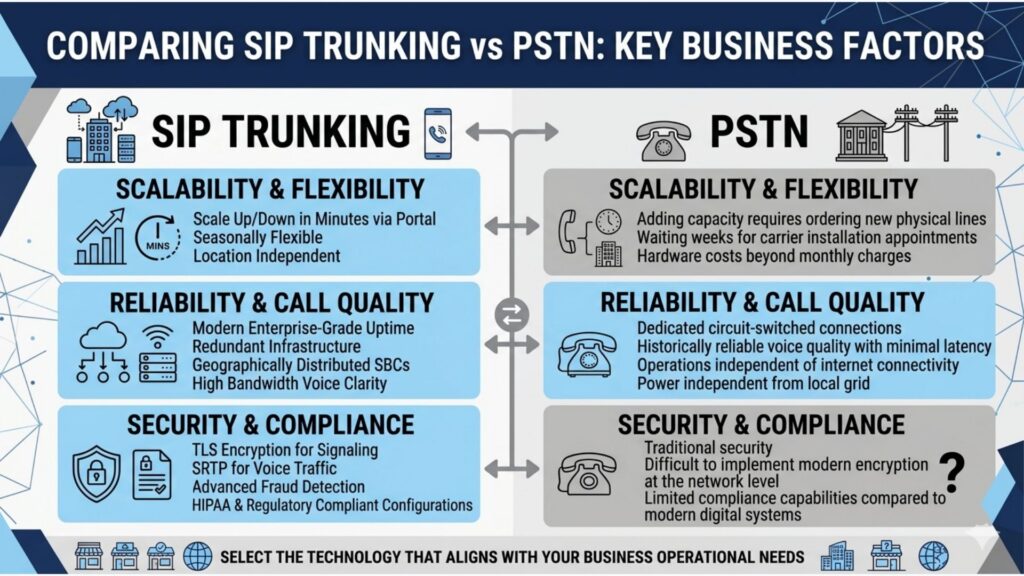
Beyond basic cost considerations, several operational factors influence the SIP vs PSTN decision. Each technology brings distinct advantages and limitations that affect daily operations.
Scalability and Flexibility
Legacy phone systems present scalability challenges. Adding capacity requires ordering new physical lines, waiting for carrier installation appointments, and potentially upgrading PBX hardware to handle additional connections. This process typically takes weeks and involves hardware costs beyond the monthly line charges. Reducing capacity is equally cumbersome, often requiring contract negotiations and minimum commitment periods.
With SIP trunking, adding channels can happen in minutes through a provider portal or a simple phone call, with new capacity available immediately. Seasonal businesses can scale up for peak periods and scale back during slower months without penalty. This flexibility extends to location independence as well. Because SIP operates over the internet, employees can maintain their business phone numbers and full functionality regardless of physical location.
Reliability and Call Quality
PSTN built its reputation on reliability. The dedicated circuit-switched connections provided consistent voice quality with minimal latency, and the network operated independently of internet connectivity. These characteristics made PSTN the trusted choice for mission-critical voice communications for over a century.
Modern SIP implementations have largely closed this reliability gap. Enterprise-grade providers now deliver high uptime through redundant infrastructure, automatic failover between carriers, and geographically distributed session border controllers. Call quality depends on internet connection quality, but businesses with adequate bandwidth experience voice clarity that matches or exceeds traditional phone systems.
One consideration that requires attention is that digital voice services require local power to function. Traditional PSTN lines could power a basic handset from the telephone exchange, maintaining functionality during power outages. SIP-based systems rely on routers and other equipment that need electricity. Businesses with continuity requirements should plan for battery backup, uninterruptible power supplies, or mobile failover solutions.
Security and Compliance
Security capabilities are an area where SIP trunking offers advantages over legacy systems. Modern SIP implementations support TLS encryption for signaling and SRTP for voice traffic, protecting calls from eavesdropping. Session border controllers provide firewall functionality, fraud detection, and access control that were never possible with PSTN infrastructure.
For regulated industries, these capabilities matter. Financial services firms subject to MiFID II or Dodd-Frank requirements can implement call recording with secure storage and retention policies. Healthcare organizations can deploy HIPAA-compliant configurations with proper encryption and access controls. The flexibility to implement these security measures at the network level provides compliance advantages that legacy systems can’t match.
How Can Resellers Help Enterprises When Migrating from PSTN to SIP?
Planning a successful migration requires attention to several factors that extend beyond basic phone service replacement. Organizations that approach this transition systematically avoid the disruptions that can affect unprepared businesses.
Assess Your Current Infrastructure
The first step in any migration involves a comprehensive inventory. Identify every phone line currently in service, including main business lines, fax machines, elevator phones, alarm systems, point-of-sale terminals, and any other devices that connect through the telephone network. Many organizations discover legacy connections they had forgotten about during this audit process.
Evaluate your clients’ existing PBX equipment. If they operate an IP-capable PBX, connecting SIP trunks may require only configuration changes. Older analog PBX systems may need replacement or the addition of gateway devices to translate between protocols. The condition and capabilities of current equipment influence the complexity and cost of migration.
Assessing internet bandwidth is equally important. Help your clients calculate their concurrent call requirements and verify that their connection can support the necessary capacity with headroom for data traffic. A general guideline suggests that one SIP channel can support approximately three employees, but actual requirements depend on call patterns and peak usage periods.
Plan for Business Continuity
The migration from PSTN to SIP is a once-in-a-generation infrastructure change. Rushing the transition or delaying until the last minute both create unnecessary risk. Remind your clients to allow adequate time for enterprise migrations, including testing and methodical rollout. Some organizations complete transitions in a few months, while complex multi-site deployments may require six months or longer.
Consider a phased implementation that begins with a pilot group or single location. This approach allows your clients to identify configuration issues, train staff on any new procedures, and refine processes before rolling out to the entire organization. Running parallel systems during the transition period provides fallback capability if unexpected problems arise.
Disaster recovery planning should address scenarios including internet outages, power failures, and provider disruptions. Modern SIP deployments support automatic failover to backup carriers, call routing to mobile devices, and geographic redundancy that can maintain service even during significant infrastructure failures. Defining these contingency measures before migration ensures business continuity throughout the transition.
Address Legacy System Dependencies
Beyond standard telephone handsets, many devices rely on PSTN connectivity that may not immediately work with SIP-based services. Security alarm systems, fire panels, elevator emergency phones, medical monitoring equipment, and some payment processing terminals were designed for analog phone lines and may require adaptation or replacement.
Organizations should contact their vendors early in their planning process to understand compatibility requirements and available solutions. Some devices can connect through analog telephone adapters that bridge the gap between legacy equipment and SIP infrastructure. Others may need firmware updates, hardware replacement, or cellular-based alternatives. Building these requirements into migration timelines prevents service gaps for critical safety and operational systems.
What Are the Advantages of SIP Trunking Over Legacy Phone Systems?
The benefits of migrating to SIP extend beyond addressing PSTN retirement deadlines. Organizations that have completed their transitions report improvements across multiple operational dimensions.
Dramatic cost reduction remains the most frequently cited benefit. Eliminating dedicated phone line rentals, reducing long-distance charges, and consolidating voice and data infrastructure onto a single network delivers immediate savings compared to previous PSTN spending.
Instant scalability transforms how organizations handle growth and change. Adding phone capacity for a new hire, expanding to a new location, or scaling up for a seasonal campaign happens in minutes rather than weeks, without hardware purchases or installation appointments.
Geographic flexibility supports modern workforce models. Employees working remotely maintain full access to business phone features, keeping the same numbers and capabilities they would have in the office. This flexibility proved essential during recent shifts toward distributed work arrangements.
Unified communications integration connects voice services with video conferencing, team messaging, and collaboration platforms. Rather than operating separate systems for different communication modes, SIP enables integration that streamlines workflows and improves productivity.
Enhanced security features, including encryption, fraud detection, and access controls, protect business communications in ways that were never possible with analog phone lines. These capabilities are particularly valuable for organizations handling sensitive information or operating in regulated industries.
Advanced analytics and AI capabilities available through modern SIP platforms provide insights into communication patterns, call quality metrics, and customer interaction data. Automated transcription, sentiment analysis, and intelligent call routing represent features that legacy systems simply cannot support.
Built-in disaster recovery through automatic failover, geographic redundancy, and flexible call routing ensures business continuity even during outages that would disable traditional phone systems.
Frequently Asked Questions
Is SIP trunking reliable for enterprise use?
Enterprise-grade SIP providers deliver reliability that meets or exceeds traditional phone systems. Leading providers maintain high uptime through redundant infrastructure, multiple carrier connections, and automatic failover capabilities. The key to reliability lies in selecting a provider with demonstrated enterprise credentials and implementing appropriate redundancy measures within your own infrastructure.
How much can businesses save by switching from PSTN to SIP?
Cost savings vary based on current spending, call volumes, and calling patterns, but industry research indicates most organizations achieve reductions between 25% and 65% compared to their previous PSTN costs. Businesses with significant long-distance or international calling typically see the largest savings, while those with high concurrent call requirements benefit from the more flexible pricing structures of SIP.
What happens if internet connectivity fails?
Modern SIP deployments include failover options to maintain service during internet outages. Common approaches include automatic rerouting to mobile devices, failover to backup internet connections, and geographic redundancy that keeps calls flowing through alternate paths. Organizations with strict continuity requirements should discuss failover architecture with their SIP provider during the planning process.
How long does a PSTN to SIP migration take?
Migration timelines depend on organizational complexity, but most organizations should plan for three to six months from initial planning through full deployment. Larger organizations with multiple locations, complex PBX environments, or numerous legacy device dependencies may require longer timelines. Starting early avoids the rush as PSTN shutdown deadlines approach.
Capture the Migration Opportunity with SIPTRUNK
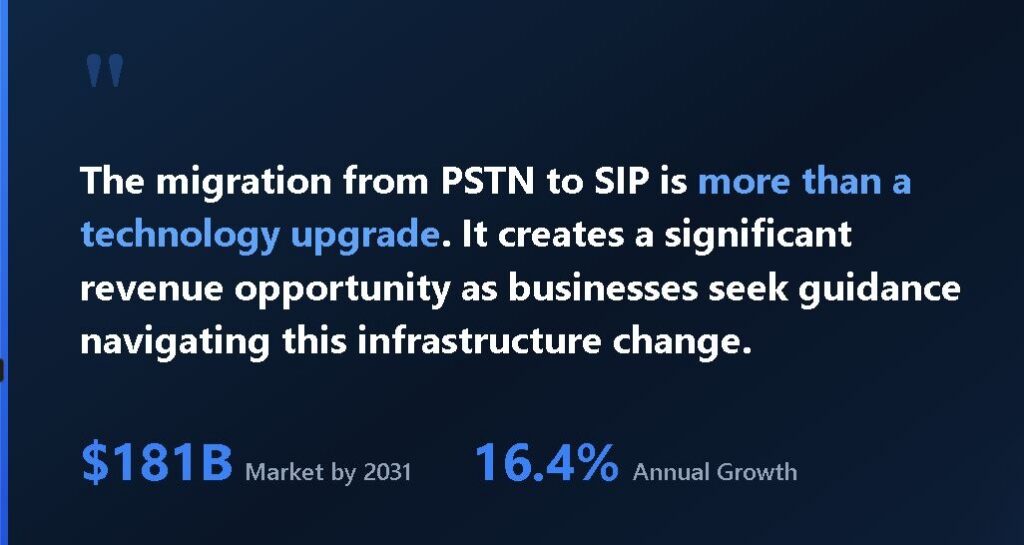
The transition from PSTN to SIP is more than a technology upgrade. For telecom resellers and channel partners, it creates a revenue opportunity as businesses seek guidance in navigating this infrastructure change. With the SIP trunking market projected to exceed $181 billion by 2031, partners who position themselves as migration experts will capture substantial recurring revenue as legacy systems retire.
SIPTRUNK provides the reseller platform that makes building a SIP trunking practice straightforward and profitable. From white-label provisioning tools to comprehensive training resources, we equip partners with everything needed to help their customers transition smoothly from legacy phone systems to modern IP-based communications. Get started with SIPTRUNK today.

Mitch leads the Sales team at BCM One, overseeing revenue growth through cloud voice services across brands like SIPTRUNK, SIP.US, and Flowroute. With a focus on partner enablement and customer success, he helps businesses identify the right communication solutions within BCM One’s extensive portfolio. Mitch brings years of experience in channel sales and cloud-based telecom to every conversation.