

AI + SIP Trunking: What Resellers Need to Know in 2026
AI and SIP trunking are converging to transform how resellers operate, creating measurable advantages in efficiency, security, and customer satisfaction.
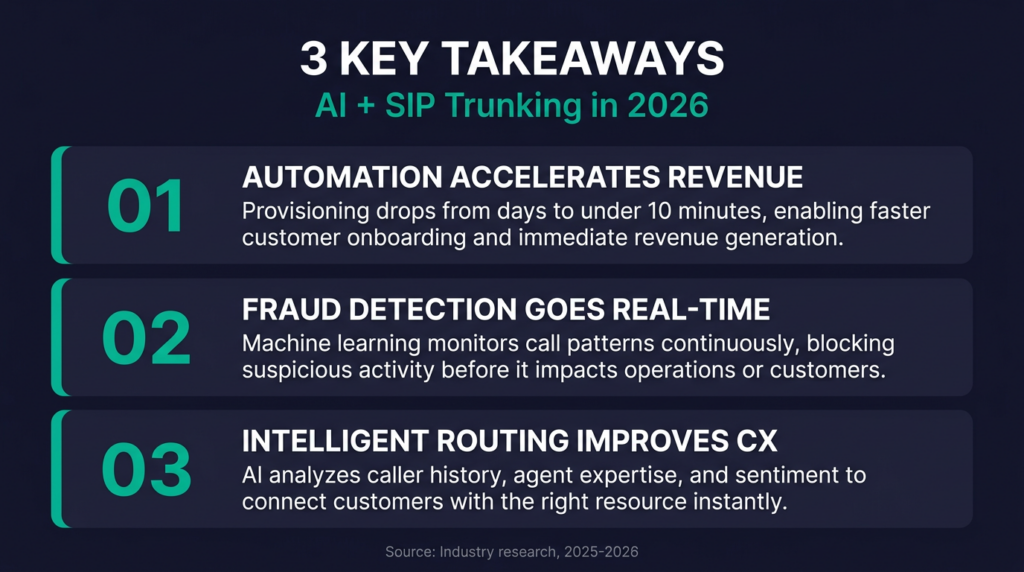
- AI-powered automation reduces provisioning time from days to minutes, enabling faster customer onboarding and accelerated revenue generation for resellers.
- Machine learning fraud detection systems now monitor call patterns in real time, protecting both resellers and their customers from telecom fraud schemes that cost the industry over $41 billion annually.
- Intelligent call routing and virtual agents are transforming customer support, with conversational AI reducing contact center labor costs by 50% per call.
- Resellers who adopt AI-enhanced platforms gain measurable competitive advantages through operational efficiency, enhanced security positioning, and superior customer experiences.
The time to evaluate AI SIP trunking capabilities is now, as these technologies are rapidly becoming standard expectations rather than premium differentiators.
Artificial intelligence has become an operational necessity across the telecommunications industry. For telecom agents, VARs, MSPs, and IT consultants who resell SIP trunking services, this shift creates both opportunity and urgency. The SIP trunking market continues its expansion, with industry analysts projecting growth to $181.58 billion by 2031.
Resellers who understand how AI enhances their SIP trunking platforms and operations will capture a disproportionate share of this expanding market, while those who dismiss these capabilities as marketing terminology risk falling behind competitors offering genuinely differentiated services.
How Is AI Reshaping SIP Trunking for Resellers?
AI integration in SIP trunking incorporates machine learning algorithms that analyze call patterns, predict network demands, optimize voice quality in real time, and identify suspicious activity before it impacts operations. These capabilities translate directly into operational benefits that resellers can pass along to their customers while improving their own efficiency.
The transformation affects every aspect of how resellers operate. Provisioning that once required manual intervention and lengthy wait times now happens automatically. Fraud detection that relied on static rules and after-the-fact analysis now operates in real time with adaptive learning. Customer support that demanded extensive staffing now leverages intelligent routing and virtual agents to efficiently handle routine inquiries.
What’s Driving the AI and SIP Trunking Revolution?
Several factors are accelerating AI adoption within SIP trunking platforms. The hybrid workforce trend has changed how businesses approach communication infrastructure. Organizations require systems that function seamlessly across locations and devices while adapting to fluctuating demand patterns. AI-powered platforms deliver this adaptability through intelligent resource allocation and predictive scaling.
Legacy phone system infrastructure is reaching end-of-life status across industries. Traditional PBX systems have become increasingly expensive to maintain, while AI-enhanced SIP solutions offer superior features at a lower total cost of ownership. This transition creates immediate opportunities for resellers who can guide businesses through modernization while demonstrating the tangible benefits of intelligent automation.
Customer expectations have also evolved. Businesses expect communication platforms to provide actionable insights, automated administration, and proactive issue resolution. AI capabilities meet these expectations while reducing the operational burden on resellers and their customers.
What Does SIP Trunk Automation Mean for Daily Operations?
SIP trunk automation powered by artificial intelligence addresses many of the operational challenges that have historically constrained reseller growth. Manual processes consume time, introduce errors, and limit scalability. AI-driven automation throughout the reseller workflow transforms capacity to serve customers efficiently while maintaining healthy margins.

How Does Automated Provisioning Change the Game?
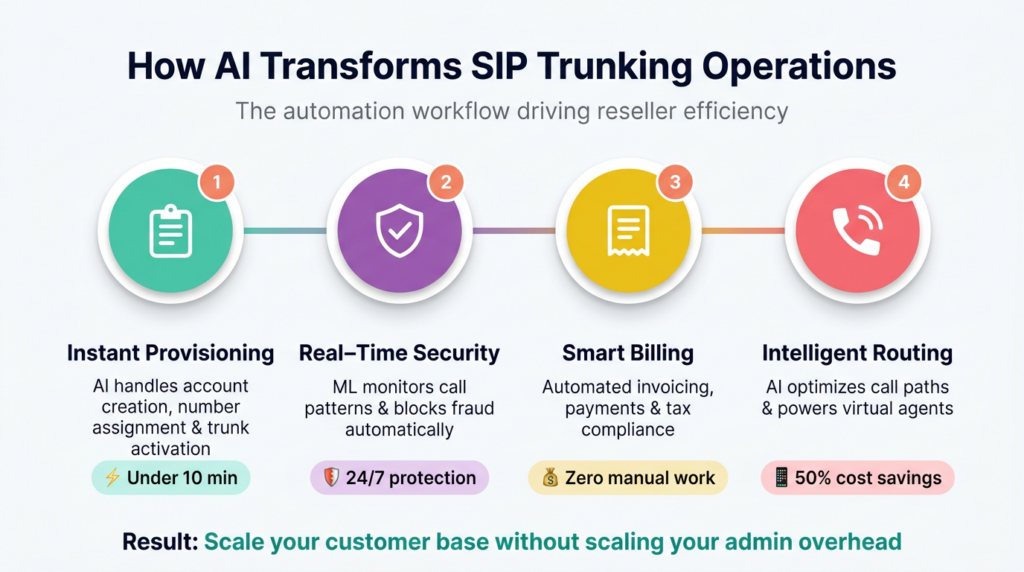
Provisioning automation enables resellers to activate new services within minutes of closing a sale. Rather than submitting requests and waiting for manual configuration, automated systems handle account creation, number assignment, and trunk activation through simple control panel actions. This speed impresses customers and reduces administrative burden on reseller teams.
A reliable platform should provision services in under 10 minutes, enabling the delivery of telecom solutions quickly, even at scale. Instant number provisioning allows businesses to immediately acquire new phone numbers without waiting for traditional processes. This capability supports rapid business expansion, new location setup, and quick response to changing communication requirements.
Real-time configuration capabilities are another advancement. Resellers and their customers can adjust settings on the fly to accommodate changing business needs without submitting support tickets or waiting for manual intervention. Geographic number coverage through comprehensive DID inventories enables businesses to quickly establish local presence in markets, supporting customer acquisition strategies.
Can AI Handle Billing and Tax Compliance?
Billing automation handles invoicing, payment processing, and revenue recognition without manual intervention. For resellers managing dozens or hundreds of customer accounts, automation eliminates countless hours of administrative work while reducing billing errors that damage customer relationships.
Tax compliance automation deserves particular attention. Telecom services face federal, state, and local taxes that vary by jurisdiction and change frequently. Providers that calculate, collect, and remit these taxes automatically reduce compliance risk and administrative burden. This feature alone often justifies platform selection, as managing telecom taxation and compliance manually requires specialized expertise and constant vigilance.
The combination of automated provisioning, billing, and tax handling creates operational leverage that enables resellers to scale their customer base without proportionally increasing administrative overhead. This efficiency directly impacts profitability and growth potential.
How Are VoIP AI Tools Transforming Fraud Detection?
Telecommunications fraud remains one of the most pressing threats. Global telecom fraud losses reached $41.82 billion in 2025, up from $38.95 billion in 2023. This nearly $3 billion increase in two years underscores the escalating sophistication of fraud schemes and the critical importance of advanced detection capabilities.
Traditional fraud detection systems relied on static rules and manual review processes. These approaches struggle to keep pace with evolving tactics, particularly as fraudsters leverage generative AI to enhance the realism of voice and text fraud. VoIP AI tools enable real-time analysis of vast datasets to identify and prevent fraudulent activities before they impact operations.
Modern secure SIP trunking platforms incorporate machine learning algorithms that identify suspicious patterns faster than rule-based systems. These AI-driven tools continuously adapt to new attack techniques, providing protection against emerging threats. Integration with threat intelligence feeds adds another defensive layer by automatically blocking known malicious IP addresses and attack signatures.
For resellers, fraud detection capabilities impact customer retention and profitability. Customers who experience toll fraud, service disruption, or compliance violations rarely remain loyal to the provider they hold responsible. Investing in platforms with sophisticated fraud detection protects recurring revenue by preventing incidents that drive customers to competitors.

Effective fraud monitoring establishes behavioral baselines for normal traffic and flags deviations warranting investigation. When suspicious activity is detected, automated systems can instantly terminate active calls, disable international calling capabilities, and alert both the customer and the network operations center. This rapid response prevents costly fraud incidents that can result in thousands of dollars in unauthorized charges.
What Role Does AI Play in Customer Support and Call Routing?
AI in SIP trunking transforms how businesses interact with their customers through voice communication. These advancements create differentiation opportunities for resellers who can articulate the value of intelligent communication features.
Intelligent Call Routing Explained
AI call routing is the evolution of call distribution. Rather than forcing callers through predetermined menu options or routing based solely on agent availability, intelligent systems analyze multiple data points in real time to determine the optimal path for each interaction.
Smart algorithms analyze caller history, agent availability, agent expertise, and business priorities to automatically optimize connections. Voice recognition authentication and natural language processing enable sophisticated auto-attendant interactions that improve customer experiences while reducing operational overhead. Pre-call information delivered through CRM integration means agents begin conversations with context rather than asking customers to repeat themselves.
These capabilities translate into measurable business outcomes. Customers reach the right person faster, reducing frustration and improving satisfaction scores. Agents receive calls matching their skills and expertise, improving both efficiency and job satisfaction. Organizations handle volume spikes that would overwhelm traditional systems without proportionally increasing staffing.
How Do AI Virtual Agents Support Reseller Operations?
Virtual assistants powered by AI have evolved from simple automated attendants into conversational agents capable of handling complex interactions independently. Modern smart assistants integrated with communication systems perform tasks that previously required human agents, including scheduling appointments, processing payments, answering product questions, and guiding customers through troubleshooting steps.
AI agents deployed in contact centers have reduced cost per call by 50% while simultaneously increasing customer satisfaction scores. This dual improvement reflects the scale of efficiency gains possible when AI handles straightforward inquiries, freeing human agents for interactions requiring judgment and empathy.
For resellers serving customers with contact center operations, these capabilities are compelling value propositions. Businesses can maintain service levels during peak periods without excessive staffing costs, provide consistent 24/7 availability, and capture insights from every interaction through automated transcription and analysis.
Understanding SIP trunking fundamentals positions resellers to explain how AI-enhanced platforms deliver these benefits while maintaining the reliability and call quality that businesses require.
Five Ways AI SIP Trunking Benefits Resellers
The practical advantages of AI-enhanced SIP trunking translate into specific benefits for resellers building sustainable telecommunications practices.
- Faster time-to-revenue with automated provisioning. Instant account creation and number activation eliminate delays between closing sales and generating revenue. Customers begin using services immediately, accelerating cash flow and improving customer satisfaction with the onboarding experience.
- Reduced operational overhead through intelligent automation. Automated billing, tax compliance, and routine administration free reseller teams to focus on sales, customer relationships, and growth initiatives rather than manual administrative tasks.
- Enhanced security positioning for regulated industries. AI-powered fraud detection and compliance capabilities enable resellers to confidently serve healthcare, financial services, and other regulated sectors. These customers often pay premium prices for providers demonstrating sophisticated security postures.
- Improved customer satisfaction through intelligent routing. Customers of reseller clients experience better service when calls reach appropriate agents faster, wait times decrease, and issues are resolved on first contact. This satisfaction translates into customer retention and referral opportunities.
- Competitive differentiation with modern capabilities. Resellers offering AI-enhanced platforms stand out from competitors who are still selling basic connectivity. The ability to demonstrate real-time analytics, predictive maintenance, and intelligent automation creates compelling differentiation in competitive sales situations.
What Does the Future of SIP Trunking Look Like?
The trajectory of AI in SIP trunking points toward increasingly sophisticated capabilities that will further transform telecom operations.
AI-native SIP stacks are emerging where signaling can evolve in real time, guided by artificial intelligence. Instead of following rigid routing rules, these intelligent stacks adapt to current context, including call quality, intent, fraud risk, and user profiles. This means smarter decisions at the session level before, during, and after calls without external systems needing to intervene.
Predictive capacity management is another frontier. By analyzing historical usage patterns, seasonal trends, marketing calendars, and external factors, AI systems can accurately predict future capacity requirements. These predictions allow for dynamic resource allocation, automatically scaling capacity up or down based on anticipated needs without overpaying for unused resources.
The boundaries between SIP trunking and unified communications platforms continue to dissolve. Modern providers integrate with collaboration tools like Microsoft Teams, CRM systems, and business applications. The future of SIP trunking involves communication intelligence that adapts to specific business needs while providing actionable insights previously unavailable from basic telephone services.
Resellers who develop expertise in these emerging capabilities position themselves as trusted advisors guiding customers through ongoing telecommunications evolution rather than simply selling connectivity.
Frequently Asked Questions About AI and SIP Trunking
How does AI improve SIP trunk security? AI enhances security through continuous monitoring that identifies anomalies in call patterns, automatic blocking of suspicious activity, and adaptive learning that recognizes new fraud techniques. Machine learning algorithms analyze multiple factors simultaneously, detecting threats that static rule-based systems miss. Modern platforms implement AI-powered fraud detection alongside encryption protocols and session border controllers to create comprehensive security frameworks.
What training is required to use AI-powered SIP platforms? Most AI capabilities operate automatically without requiring specialized training from resellers or end users. The intelligence is built into the platform itself, handling provisioning automation, fraud detection, and call optimization behind the scenes. User interfaces remain intuitive, with AI working to simplify rather than complicate daily operations. Resellers benefit from understanding AI capabilities for sales conversations but don’t need technical AI expertise to deliver services.
Can small resellers benefit from AI SIP trunking tools? Absolutely. AI-powered automation levels the playing field by enabling smaller resellers to operate efficiently without large administrative teams. Automated provisioning, billing, and compliance handling allow small operations to serve more customers with existing resources. The security and quality improvements benefit customers of any size, making AI-enhanced platforms compelling regardless of reseller scale.
Position Your Business for the AI-Driven Future
Resellers who understand and leverage AI-enhanced SIP trunking platforms gain measurable advantages in efficiency, security, and customer satisfaction. Those who dismiss AI as marketing terminology risk falling behind competitors offering genuinely differentiated services.
Evaluating potential providers requires attention to specific AI capabilities, including automated provisioning, fraud detection, billing automation, and intelligent routing. The right platform combines these capabilities with reliable network infrastructure, transparent pricing, and genuine partnership support.
SIPTRUNK delivers a white-label SIP trunking platform designed specifically for resellers seeking to capitalize on AI-driven telecommunications. With built-in automation, rapid provisioning, hands-off billing, and comprehensive fraud protection, the platform enables resellers to focus on growth while technology handles operational complexity. Get started today and position your business at the forefront of intelligent communications.

Mitch leads the Sales team at BCM One, overseeing revenue growth through cloud voice services across brands like SIPTRUNK, SIP.US, and Flowroute. With a focus on partner enablement and customer success, he helps businesses identify the right communication solutions within BCM One’s extensive portfolio. Mitch brings years of experience in channel sales and cloud-based telecom to every conversation.