

Why Use SIP Trunks? Benefits, Costs, & Business Use Cases
Businesses use SIP trunks to slash telecom spend, scale voice capacity on demand, and unify communications across distributed teams.
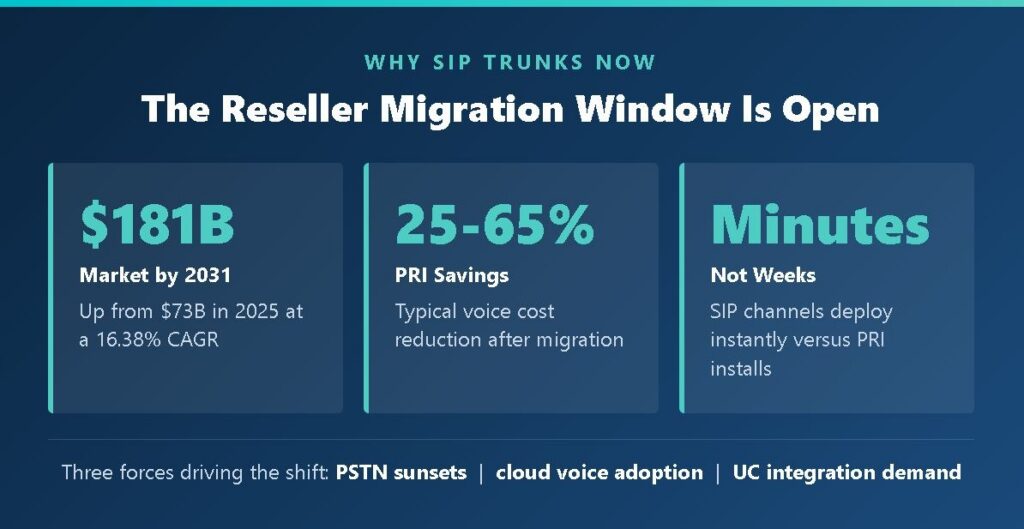
- The SIP trunking market is on track to grow from $73.14 billion in 2025 to over $181 billion by 2031, fueled by PSTN retirements and cloud voice adoption.
- Organizations migrating from PRI typically cut voice costs between 25% and 65%, with the largest savings going to high-volume, multi-site operations.
- SIP trunks add channels in minutes instead of weeks, integrate with Microsoft Teams and modern PBX systems, and support remote and hybrid workforces.
- For telecom agents, IT consultants, and VARs, reselling SIP trunk service creates a high-margin, recurring revenue stream with low infrastructure overhead.
If your customers are still running PRI circuits, you’re sitting on one of the easiest cost-reduction conversations in B2B telecom. The case for SIP is no longer a debate. It’s a deadline.
Why use SIP trunks? In short, the economics, technology, and regulatory timelines have all turned against legacy phone systems. According to Mordor Intelligence, the SIP trunking market reached $73.14 billion in 2025 and is forecast to grow at a 16.38% CAGR through 2031, reaching over $181 billion. Businesses are actively pulling copper out of the wall and replacing it with virtual voice infrastructure that’s faster, cheaper, and easier to manage.
For resellers, every PRI circuit your customers retire is a recurring-revenue opportunity for someone. The question is whether that someone is you or a competitor. This guide walks through the business case for SIP, compares the real costs of SIP versus PRI, and lays out a migration path you can actually use in customer conversations.
Why Use SIP Trunks for Business?
A SIP trunk is a virtual phone line that connects a business’s private branch exchange (PBX) to the public telephone network using an internet connection instead of physical copper wiring. SIP stands for Session Initiation Protocol, the signaling standard that establishes, manages, and terminates voice, video, and messaging sessions over IP networks.
Businesses use SIP trunks for one fundamental reason: they deliver everything a traditional phone line does at a fraction of the cost with vastly more flexibility. That single value proposition unlocks a cascade of secondary benefits, from remote work enablement to unified communications integration.
How Does SIP Trunking Work?
When a user picks up a SIP-connected phone and dials a number, the audio is converted into data packets and routed over the internet to the destination. The SIP protocol handles the call setup, holds the session open during the conversation, and tears it down at the end. Each SIP trunk supports multiple concurrent calls through individual “channels,” and a business pays only for the channels it actually needs. Compare that to PRI, which sells voice capacity in fixed bundles of 23 channels, whether you use them or not.
Who Benefits Most from SIP Trunk Service?
Many organizations are asking why use SIP trunks, but which ones should you target? Small businesses gain access to enterprise-grade voice features without enterprise-grade budgets. Mid-market companies use SIP to consolidate multiple locations under a single voice platform. Enterprises lean on SIP for scale, redundancy, and tight integration with unified communications platforms like Microsoft Teams. For telecom resellers, SIP trunk service hits a sweet spot of high customer demand, recurring revenue, and minimal infrastructure investment.
What Are the Top SIP Trunking Benefits?
The SIP trunking benefits that drive adoption fall into seven categories. Each one matters in its own right, but they compound when stacked together, which is why SIP has become the default choice for modernizing business voice infrastructure.
- Significant cost reduction. SIP eliminates per-line rental fees, long-distance charges in many markets, and most of the hardware overhead that comes with traditional telephony. Industry data from Mordor Intelligence puts savings versus PRI between 25% and 65%, depending on call volume and footprint.
- Instant scalability. Adding channels takes minutes through a web portal. PRI requires a technician visit, a circuit order, and a multi-week wait.
- Geographic flexibility. Direct Inward Dialing (DID) numbers can be issued in markets where a business has no physical presence, supporting local customer experiences without local offices.
- Built-in business continuity. Failover routing sends calls to backup numbers, mobile devices, or secondary locations during outages. Some platforms layer dual-network redundancy for additional resilience.
- Unified communications integration. SIP trunks feed voice into UCaaS platforms, CRM systems, and contact center software, enabling click-to-dial, automated call logging, and analytics.
- Future-proof infrastructure. Copper-based services are being phased out across major markets. SIP positions businesses ahead of those deadlines instead of scrambling to catch up.
- Modern security and compliance. Encrypted signaling (TLS) and media (SRTP), combined with carrier fraud monitoring, support HIPAA, PCI, and other compliance frameworks.
For resellers, future-proofing carries particular weight. In the UK, for example, the legacy phone network isscheduled to shut down by 31 January 2027, and similar transitions are underway in other markets. Customers who delay this decision are shrinking the window they have to plan it properly.
How Does SIP Compare to PRI in Cost and Capability?
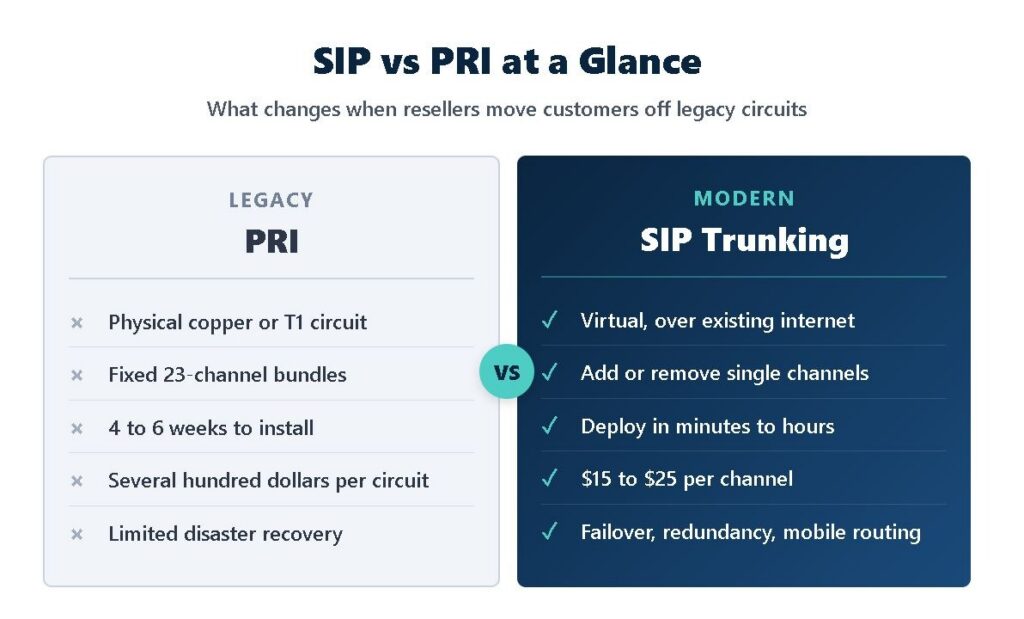
The SIP vs PRI comparison comes down to four variables that resellers should be ready to walk customers through: how the connection works, what it costs, how it scales, and how quickly it deploys. PRI was the gold standard for decades and still has legitimate use cases in environments without reliable broadband, but for the majority of businesses, the decision is now decisive.
| Factor | PRI | SIP Trunking |
| Connection type | Physical copper or T1 circuit | Virtual, over existing internet |
| Channel structure | Fixed 23-channel bundles | Add or remove single channels |
| Typical monthly cost | Several hundred dollars per circuit | $15 to $25 per channel |
| Setup time | 4 to 6 weeks | Minutes to hours |
| Hardware required | T1 cards, channel banks, dedicated PBX hardware | Standard IP PBX or SIP-enabled phones |
| Scalability | New circuits required for growth | Limited only by available bandwidth |
| Disaster recovery | Limited; tied to physical line | Failover, geographic redundancy, mobile routing |
A Real-World Cost Comparison
Consider a 25-seat business that runs about 10,000 minutes of voice traffic per month with 20 concurrent call paths during peak hours. On PRI, that company typically needs two circuits to cover 25 lines, plus per-minute long-distance charges and a fresh hardware bill every few years. On SIP trunks at the lower end of typical per-channel pricing, the same business pays a fraction of that monthly cost, with long-distance often included in flat-rate plans.
When you stretch the math across a five-year contract cycle, the SIP vs PRI difference can cover a meaningful portion of a customer’s entire IT modernization budget. For a deeper breakdown, our definitive guide to SIP trunking vs PRI walks through additional scenarios and feature comparisons resellers can use directly in client conversations.
How Should a Business Migrate from Legacy PRI to SIP?
A successful migration is less about technology and more about sequencing. Customers panic when voice service is at stake, so the resellers who win these deals present a calm, phased plan that minimizes risk and lets the customer test the waters before committing fully.

Step 1: Assess the Current Environment
Inventory existing circuits, contracts, PBX hardware, and call patterns. Identify contract end dates so the migration aligns with natural cancellation windows. Document peak concurrent call counts to right-size SIP channel capacity.
Step 2: Confirm Network Readiness
SIP voice quality depends on bandwidth and network configuration. Each call uses roughly 85 to 100 Kbps of bandwidth on standard codecs, and you should plan for about 20% overhead for call quality. Verify the customer’s internet connection has the headroom, and recommend Quality of Service (QoS) configuration on the local network to prioritize voice traffic.
Step 3: Pilot with a Single Location or Department
Start small. Port a test set of numbers to SIP, run parallel service for a few weeks, and validate call quality, failover behavior, and integration with existing systems. This step builds customer confidence and surfaces issues before they affect the whole business.
Step 4: Phased Number Porting
Port DIDs in batches rather than all at once. This separation reduces risk if any individual port hits a snag, and it lets the customer maintain operational continuity throughout the transition. Most carriers handle ports in 7 to 14 business days per batch.
Step 5: Decommission and Document
Once all numbers are migrated and the new system has run cleanly for 30 to 60 days, cancel the PRI circuits and remove the legacy hardware. Document the final configuration, failover paths, and support procedures so the customer can confidently manage day-to-day operations.
Why Is Now the Right Time to Resell SIP Trunk Service?
The market timing for SIP trunk resellers is favorable. Three forces are converging at the same moment: forced migration deadlines as copper networks retire, accelerating cloud adoption across every business segment, and customer demand for unified communications that legacy systems simply can’t deliver.
SIP trunking is one of the faster growing categories in business telecom, and resellers who establish themselves now will capture recurring revenue from migrations that will continue rolling through the rest of the decade. Our guide on how to become a SIP trunk provider covers the operational side of building a reselling practice, and the wholesale SIP trunking guide digs into the economics in more depth.
For agents, dealers, VARs, and IT consultants, the appeal is straightforward. You already have customer relationships and credibility on telecom and technology decisions. Adding SIP trunk service to your portfolio means turning those conversations into recurring monthly revenue without taking on infrastructure, billing operations, or tier-1 carrier negotiations yourself.
Frequently Asked Questions
How much bandwidth do SIP trunks require?
A standard SIP call uses approximately 85 to 100 Kbps of bandwidth, depending on the codec. Plan for about 20% additional overhead to maintain call quality during peak usage. Most modern business internet connections can support dozens of concurrent SIP calls without issue, but Quality of Service configuration is essential to prevent voice degradation when the network is busy.
How many SIP channels does a business need?
The general guideline is one channel for every three to four phone-using employees, based on typical concurrent call ratios. A 30-person office usually runs comfortably on 8 to 10 channels. Call centers and high-volume sales operations need a higher ratio, often one channel per active agent, because their concurrent call rate is much higher than a general office environment.
Is SIP trunking call quality as good as PRI?
On a properly configured network, yes. SIP calls on modern codecs deliver clear voice quality that’s comparable to PRI in most listening conditions. Where SIP can struggle is on under-provisioned or congested internet connections without QoS, which is why network assessment is a critical part of any migration.
What about STIR/SHAKEN and security compliance?
Reputable SIP trunk providers implement STIR/SHAKEN call authentication, which is required for U.S. carriers and helps protect against caller ID spoofing and robocall fraud. Beyond that, encrypted signaling and media, fraud monitoring, and compliance with frameworks like HIPAA and PCI are standard offerings from carrier-grade platforms.
How long does a typical PRI-to-SIP migration take?
Most migrations run three to six months from initial assessment through full decommissioning of legacy circuits. Single-location small businesses can move faster, often in 30 to 60 days. Multi-site enterprises with complex integrations should plan for the longer end of that range to allow for pilot phases, batch porting, and parallel operation.
Ready to Build a Recurring Revenue Stream with SIP Trunks?
The answer to why use SIP trunks for business is settled. The remaining question for resellers is whether you’re positioned to capture the migration revenue as your customers move off legacy infrastructure over the next several years. SIPTRUNK gives telecom agents, IT consultants, VARs, and managed service providers the reseller platform with Tier-1 network reliability, white-label flexibility, and the back-end infrastructure already handled for you. Get started with SIPTRUNK today and start turning your customer conversations into a recurring revenue stream that grows with every account you add.

Mitch leads the Sales team at BCM One, overseeing revenue growth through cloud voice services across brands like SIPTRUNK, SIP.US, and Flowroute. With a focus on partner enablement and customer success, he helps businesses identify the right communication solutions within BCM One’s extensive portfolio. Mitch brings years of experience in channel sales and cloud-based telecom to every conversation.