
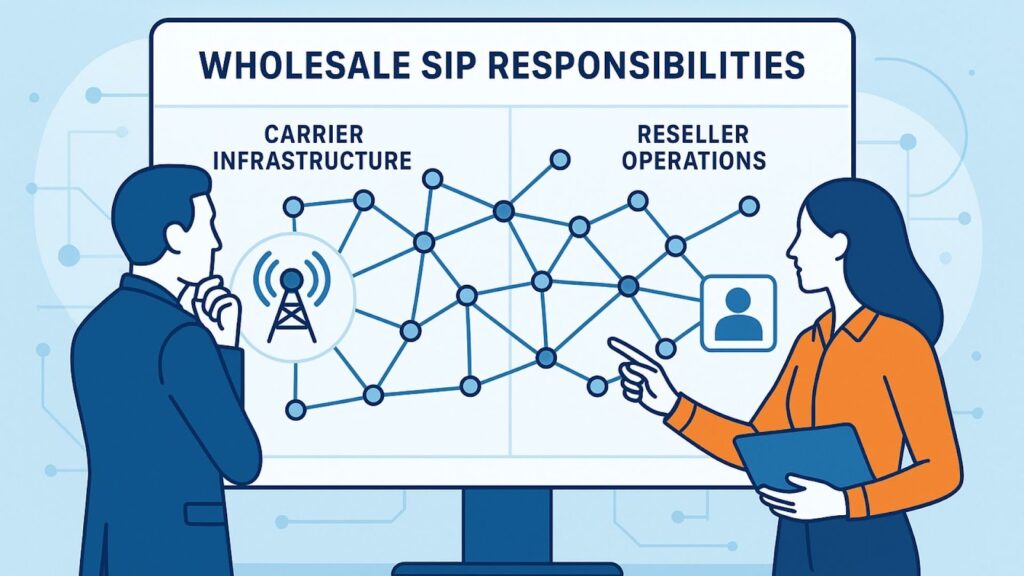
Carrier vs Reseller: Who Handles What in Wholesale SIP?
Wholesale SIP success depends on understanding distinct carrier and reseller responsibilities in the telecommunications supply chain.
- Carriers handle network infrastructure, routing, and regulatory compliance, while resellers manage customer relationships and billing.
- Service Level Agreements must clearly define performance metrics, response times, and penalty structures for both parties.
- Choosing provider partnerships involves evaluating technical capabilities, financial stability, and support quality.
Choose partners based on proven Tier-1 network access, transparent SLA terms, and demonstrated compliance with current FCC regulations.
As businesses increasingly abandon traditional phone systems for internet-based communications, understanding wholesale SIP responsibilities is vital for resellers navigating this expanding opportunity.
The distinction between carrier vs reseller roles directly impacts service quality, compliance obligations, and revenue potential. Businesses are switching to VoIP services for the tremendous savings on telecommunication costs and access to advanced features beyond what legacy systems can offer.
For resellers entering the wholesale SIP market, the stakes are high. The wrong partnership can result in compliance violations, service disruptions, and lost customers. The right partnership creates a foundation for sustainable growth in a market where SIP trunking services are projected to reach $290.3 billion by 2035.
What Are the Core Differences Between Carriers and Resellers in Wholesale SIP Responsibilities?
Understanding wholesale SIP responsibilities begins with recognizing that carriers and resellers operate at different levels of the telecom infrastructure. Each plays a distinct role in delivering voice services to end customers, with specific obligations that impact service quality and compliance.
How Do Carriers Handle Network Infrastructure and Routing?
Carriers own and operate the fundamental network infrastructure that enables voice communications. These wholesale SIP providers maintain relationships with Tier-1 network operators, ensuring direct access to the highest quality voice routing available.
Network ownership responsibilities include maintaining redundant data centers across multiple geographic regions, implementing advanced session border controllers for call quality management, and operating 24/7 network operations centers for continuous monitoring. Carriers invest millions in infrastructure to deliver 99.99% uptime standards.
Termination provider responsibilities extend beyond basic call routing. Modern carriers must implement comprehensive STIR/SHAKEN compliance protocols, maintaining provider-owned certificates for call authentication. The FCC’s enhanced regulations, effective September 18, 2025, require carriers to make independent attestation decisions and sign all calls using their own digital certificates.
Call routing optimization involves algorithms that balance cost, quality, and reliability across multiple carrier relationships. Leading wholesale providers maintain connections with dozens of upstream carriers, enabling dynamic route selection based on real-time performance metrics and destination-specific quality requirements.
What Responsibilities Do Resellers Take On?
Resellers bridge the gap between wholesale carriers and end customers, handling the customer-facing aspects of telecom services. Their primary responsibilities include customer acquisition, relationship management, and first-level technical support, which keep businesses connected and productive.
Customer relationship management is the foundation of successful reseller operations. They must understand specific business communication requirements, design appropriate SIP trunking solutions, and provide ongoing account management that ensures customer satisfaction and retention.
Billing and payment processing typically fall under reseller control; however, many wholesale SIP providers offer white-label billing solutions. Resellers must handle service provisioning requests, coordinate number porting activities, and manage customer support escalations when technical issues arise.
Sales and marketing activities distinguish successful resellers from their competition. They develop targeted marketing strategies, maintain technical expertise sufficient to educate customers, and build relationships within specific industry verticals or geographic markets.
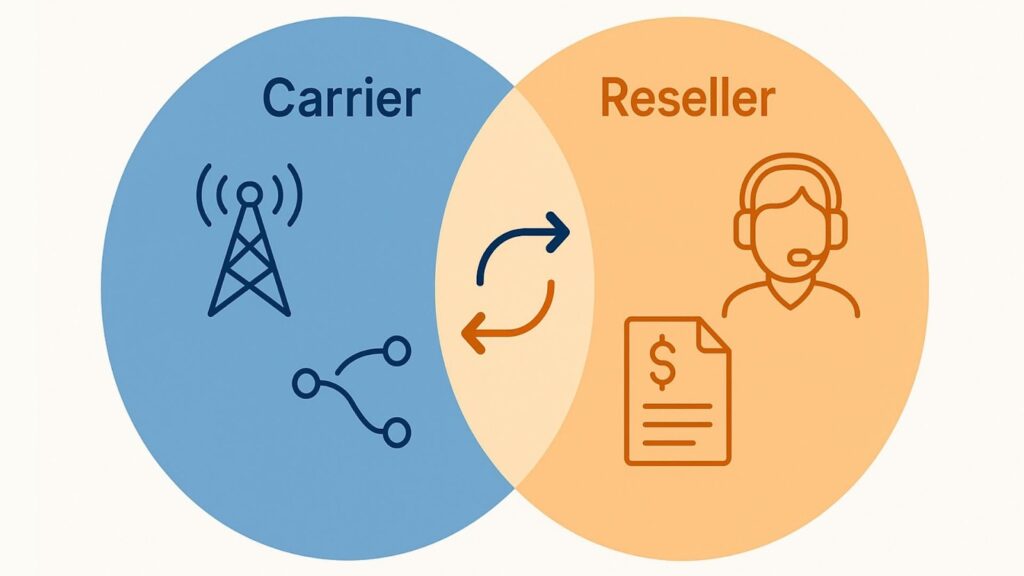
Where Do Responsibilities Overlap?
Quality assurance creates the most significant overlap between carriers and resellers in wholesale SIP operations. While carriers monitor network performance and call completion rates, resellers must verify that service quality meets customer expectations and contractual commitments.
Compliance coordination now requires active collaboration between carriers and resellers. Carriers must maintain valid STIR/SHAKEN certificates and up-to-date Robocall Mitigation Database listings, while resellers are responsible for verifying the compliance status of their upstream partners under the FCC’s expanded “Know Your Upstream and Downstream Provider” rules. Both parties must ensure all calls are digitally signed end-to-end in accordance with the 2025 attestation requirements, maintain documented due diligence demonstrating lawful traffic management, and respond to traceback requests within 48 hours. These shared obligations underscore the need for transparent communication, clear recordkeeping, and continuous monitoring to safeguard service integrity and regulatory compliance.
Performance optimization benefits from collaborative effort. Carriers provide network-level statistics and routing recommendations, while resellers contribute customer usage patterns and quality feedback that helps optimize service delivery for specific business requirements.
What Should Be Included in Wholesale SIP Service Level Agreements?
Wholesale SIP service level agreements form the foundation of successful carrier-reseller partnerships. These agreements must clearly define performance expectations, measurement methodologies, and remediation procedures that protect both parties while ensuring consistent service delivery.
Which Performance Metrics Matter Most?
Uptime guarantees are the most critical SLA component for wholesale SIP services. Industry-standard agreements specify 99.99% uptime availability, which translates to no more than 52.6 minutes of downtime annually. Leading wholesale providers often exceed this standard, offering 99.995% uptime commitments backed by comprehensive redundancy and failover capabilities.
Call completion rates and quality metrics provide measurable standards for voice service performance. Professional-grade SLAs include specific thresholds for answer seizure ratio (ASR) percentages, typically exceeding 95% for domestic traffic and 90% for international destinations. Post-dial delay measurements ensure calls connect within industry-acceptable timeframes.
Response time requirements vary based on issue severity levels. Critical issues affecting service availability typically require initial response within 15 minutes, while routine configuration requests may allow 4-hour response windows. Comprehensive SLA frameworks should clearly define escalation procedures and define different priority levels for various types of service requests.
Network performance specifications include jitter, latency, and packet loss thresholds that ensure voice quality meets business communication standards. Professional SLAs specify a maximum one-way latency of 150 milliseconds, jitter below 30 milliseconds, and packet loss rates under 1% for optimal voice quality.
How Should Penalties and Remedies Be Structured?
Service credits provide financial remediation when wholesale SIP providers fail to meet SLA commitments. Effective penalty structures typically offer monthly service credits calculated as percentages of monthly charges, with credit amounts increasing based on the severity and duration of SLA violations.
Escalation procedures ensure that service issues receive appropriate attention and resolution resources. Well-structured SLAs include multiple escalation tiers, involving technical support managers for prolonged issues and executive-level contacts for critical service failures affecting multiple customers.
Contract termination rights protect resellers from wholesale providers who consistently fail to meet service commitments. Professional SLAs typically allow contract termination without penalty when providers experience repeated SLA violations within specified timeframes, such as three major outages within a six-month period.
Force majeure clauses acknowledge that certain circumstances beyond provider control may impact service delivery. These provisions typically exclude natural disasters, government actions, and infrastructure failures caused by third-party internet service providers from SLA penalty calculations.
7 Essential SLA Components Every Wholesale SIP Agreement Must Include
- Uptime Guarantees with Specific Metrics – 99.99% minimum availability with clear measurement methodologies and monitoring procedures that exclude planned maintenance windows and customer-caused outages.
- Call Quality Standards – Specific thresholds for answer seizure ratio, post-dial delay, and voice quality metrics, including acceptable levels for jitter, latency, and packet loss.
- Response Time Commitments – Tiered support response requirements based on issue severity, including initial acknowledgment times and resolution targets for different categories of service requests.
- Financial Penalties and Credits – Clearly defined service credit calculations tied to specific SLA violations, with credit amounts that increase based on outage duration and service impact.
- Compliance and Security Requirements – Specific obligations related to STIR/SHAKEN implementation, robocall mitigation, and data protection standards that both parties must maintain.
- Escalation and Communication Procedures – Detailed processes for issue escalation, including specific contact information for different support tiers and notification requirements for service-affecting events.
- Contract Termination and Modification Terms – Clear conditions under which either party may terminate the agreement, modification procedures, and protection clauses that prevent arbitrary service changes.

How Do You Choose Between Different Provider Types?
Selecting the right wholesale SIP provider requires evaluating multiple factors that impact service quality, operational complexity, and long-term business success. The decision between different provider types should align with your technical capabilities, customer requirements, and growth objectives.
When Should You Partner with Direct Carriers?
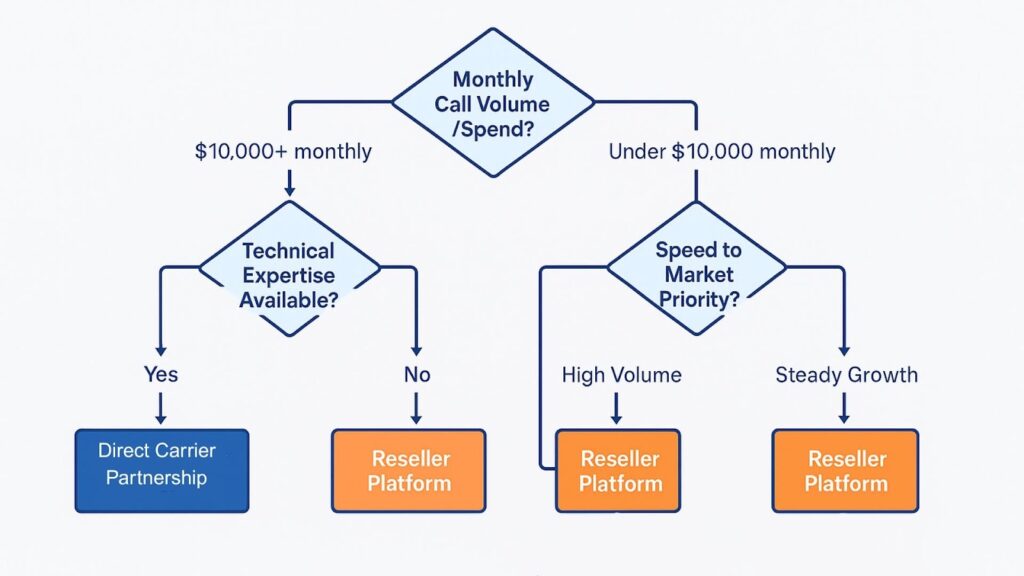
Direct carrier partnerships make sense for resellers with significant call volume and technical expertise to manage complex relationships. These partnerships typically offer the best wholesale pricing and maximum control over service quality and routing decisions.
Volume requirements for direct carrier relationships usually begin around $10,000 monthly spend or equivalent traffic levels. Carriers prefer partners who can demonstrate consistent usage patterns and long-term growth potential that justifies dedicated account management resources.
Technical complexity increases with direct carrier partnerships. You’ll need technical staff capable of managing SIP trunk configurations, understanding network routing protocols, and troubleshooting complex interconnection issues that may arise between different carrier networks.
Financial benefits of direct carrier relationships include better margin opportunities and volume discounts that improve profitability as your business scales. However, these benefits require significant monthly commitments and may include minimum usage agreements that guarantee revenue to the carrier.
When Are Reseller Partnerships More Appropriate?
Reseller partnerships through established wholesale platforms work best for businesses new to telecommunications or those seeking simplified operations. These partnerships typically offer faster time-to-market and reduced technical complexity while maintaining competitive pricing.
Lower minimum commitments make reseller partnerships accessible to smaller businesses testing the wholesale SIP market. Many platforms require no minimum monthly usage, allowing you to grow gradually while learning the market dynamics and developing customer relationships.
Support and management advantages include access to technical expertise, automated provisioning systems, and comprehensive billing platforms. Quality wholesale platforms provide training resources, marketing support, and dedicated partner management that accelerate business development.
Implementation timelines for reseller partnerships typically range from days to weeks rather than the months required for direct carrier relationships. This speed advantage allows faster response to market opportunities and customer requirements.
Choosing Between Direct Carrier and Reseller Partnerships
Choosing between a direct carrier and a reseller platform depends on your operational capacity, growth goals, and how you manage your wholesale SIP responsibilities. The table below highlights key differences to help determine which partnership model aligns best with your business.
| Evaluation Factor | Direct Carrier Partnership | Reseller Platform Partnership |
| Minimum Commitment | Typically requires $10,000+ monthly spend or high traffic volumes. | No or low minimum usage requirements; ideal for smaller or growing businesses. |
| Technical Complexity | Requires in-house telecom expertise to manage routing, provisioning, and troubleshooting. | Simplified setup with automated provisioning and support handled by the platform. |
| Compliance Control | Full responsibility for STIR/SHAKEN, robocall mitigation, and regulatory filings. | Shared responsibility: provider maintains compliance infrastructure, reseller ensures proper customer communication. |
| Pricing Flexibility | Volume discounts and custom rates available for large-scale deployments. | Transparent, predictable pricing with scalable subscription options. |
| Speed to Market | Longer onboarding timeline due to network configuration and testing requirements. | Rapid deployment: services can be activated in minutes. |
| Support Resources | Internal staff must manage customer service and technical escalations. | Platform provides ongoing technical support and billing management. |
| Ideal For | Experienced telecom resellers with high call volumes and dedicated technical teams. | New or diversified service providers focused on growth and customer experience. |
What Are the Key Evaluation Criteria for Wholesale SIP Providers?
Evaluating potential providers is an important step in effectively managing your wholesale SIP responsibilities. The right partner should demonstrate technical reliability, regulatory compliance, and financial stability to ensure seamless service delivery and long-term business growth.
How Do You Assess Technical Capabilities?
Network redundancy evaluation should focus on geographic diversity of data centers, multiple carrier relationships, and automatic failover capabilities. Leading providers maintain facilities in multiple regions with diverse network paths that eliminate single points of failure.
Compliance verification requires confirming current STIR/SHAKEN implementation status, robocall mitigation database listings, and adherence to evolving FCC regulations. Recent enforcement actions demonstrate the importance of working with providers who maintain proactive compliance programs.
Integration capabilities determine how easily you can connect customer systems and automate service delivery. Look for providers offering comprehensive APIs, real-time provisioning capabilities, and compatibility with popular PBX platforms and unified communications systems.
Quality monitoring systems should provide real-time visibility into call performance, routing statistics, and network health metrics. Advanced providers offer customer portals with detailed analytics and reporting tools that help optimize service delivery and troubleshoot issues.
What Financial Factors Should You Consider?
Pricing transparency eliminates hidden costs and unexpected charges that can damage customer relationships. Professional wholesale providers offer clear rate schedules, straightforward billing practices, and detailed usage reporting that enables accurate customer billing and margin calculations.
Financial stability assessment involves evaluating provider credit ratings, years in business, and customer references that speak to long-term viability. The telecom industry has experienced significant consolidation, making provider stability a critical selection criterion.
Contract flexibility includes terms related to volume commitments, pricing adjustments, and termination rights. The best wholesale partnerships offer scalable pricing models that grow with your business without penalizing early-stage operations.
Payment terms and credit requirements vary between providers. Some require significant deposits or personal guarantees, while others offer net-30 payment terms that improve cash flow management for growing reseller businesses.
FAQ
What happens if my wholesale SIP provider fails compliance requirements?
Non-compliant providers face immediate FCC enforcement action, including potential service shutoffs and substantial fines. As a reseller, you could experience sudden service interruptions affecting all customers. Establishing backup provider relationships and maintaining current compliance documentation helps minimize these risks.
How long does it typically take to switch wholesale SIP providers?
Implementation timelines vary based on complexity and scale, but most deployments are completed within two to four weeks for standard configurations. Providers offering structured onboarding programs can often accelerate this timeline, with some enabling service launch within 7–10 business days for simple deployments.
What’s the difference between Tier-1 and Tier-2 carrier networks?
Tier-1 carriers own and operate their network infrastructure with direct relationships to other major carriers worldwide. Tier-2 carriers purchase network access from Tier-1 providers, potentially introducing additional routing complexity and quality variables. For consistent call quality and reliability, partnering with providers who maintain direct Tier-1 relationships typically delivers superior results.
Choose the Right Wholesale SIP Partnership
Success in wholesale SIP reselling depends on choosing the right partners who understand both the technical complexities and business realities of modern telecommunications. The distinctions between carrier vs reseller roles create opportunities for businesses willing to invest in understanding wholesale SIP responsibilities and building strong provider relationships.
The telecom industry’s rapid evolution toward cloud-based communications creates opportunities for resellers who position themselves as trusted advisors. With proper partner selection and clear service level agreements, resellers can build sustainable businesses while helping customers modernize their communication infrastructure.
SIPTRUNK provides the wholesale SIP platform that handles both carrier-grade infrastructure and reseller-friendly tools, offering the best of both worlds for partners ready to succeed in this growing market. Get started today and discover how the right wholesale partnership can accelerate your telecom business.

Mitch leads the Sales team at BCM One, overseeing revenue growth through cloud voice services across brands like SIPTRUNK, SIP.US, and Flowroute. With a focus on partner enablement and customer success, he helps businesses identify the right communication solutions within BCM One’s extensive portfolio. Mitch brings years of experience in channel sales and cloud-based telecom to every conversation.