

How to Choose White-Label SIP Trunking Providers: A Decision Guide for Resellers
The right white-label SIP trunking providers help you build brand equity, capture recurring revenue, and scale on your own terms. The wrong ones cost you margin, time, and customer trust.
- The SIP trunking market is on pace to more than double between 2026 and 2031, creating sustained demand for reseller-led communication services.
- Compliance infrastructure, particularly STIR/SHAKEN and Robocall Mitigation Database recertification, has become a non-negotiable evaluation criterion in 2026.
- Tier-1 network ownership, automated billing and tax handling, and genuine white-label capabilities separate platform partners that protect your margin from those that erode it.
- The strongest reseller relationships combine transparent commission structures, dedicated support, and brand control that keeps you front and center with every customer interaction.
Prioritize platforms built specifically for channel partners rather than retail-first carriers that treat resellers as an afterthought.
Selecting a reseller platform is one of the most consequential decisions you will make as a telecom agent, IT consultant, VAR, or managed service provider. The white-label SIP trunking providers you partner with shape your margins, your operational workload, and how customers perceive your brand for years to come. According to Mordor Intelligence, the SIP trunking market stands at roughly $85 billion in 2026 and is forecast to reach $181.58 billion by 2031 at a 16.38% CAGR. That kind of expansion creates real opportunity, but it also raises customer expectations and tightens the standards for what a quality SIP reseller platform must deliver.
This guide walks through how the model works, what to look for in 2026, how white-label compares to other reseller arrangements, and the trust signals that separate exceptional partners from adequate ones.
What Is White-Label SIP Trunking, and How Does it Work for Resellers?
White-label SIP trunking is a partnership model where a platform provider supplies the technical infrastructure, carrier network connectivity, and backend systems required to deliver SIP trunk services, while you sell those services under your own brand. Your customers experience your company at every touchpoint, including the sales conversation, control panel, invoice, and support call. The platform provider operates behind the scenes.
Session Initiation Protocol (SIP) trunking replaces traditional copper phone lines with virtual channels that carry voice, video, and messaging over IP networks. A SIP trunk is a digital pipeline connecting your customer’s PBX or IP phone system to the public telephone network. Instead of paying for dedicated physical circuits, businesses pay for the concurrent call capacity they actually use.
The reseller economics are straightforward. You purchase SIP trunking services at wholesale rates from your platform partner, then sell them to your customers at prices you set. The margin between those two numbers is yours to keep. Unlike traditional agent programs that pay fixed commissions, white-label arrangements give you full control over pricing strategy, service packaging, and customer relationships. This partnership approach to reselling SIP trunks allows independent telecom businesses to build durable brand equity rather than acting as middlemen for someone else’s product.
Why Evaluate White-Label SIP Trunking Providers Now?
Three trends make 2026 a great year for choosing a reseller program.
First, the legacy phone system sunset is accelerating. Carriers across North America continue retiring copper-based PSTN infrastructure, pushing remaining holdouts toward IP-based voice services. Adoption has already reached high levels, with a 2024 industry survey reporting that approximately 65% of North American companies have adopted SIP trunking as part of their communication strategy. That figure leaves a meaningful population of remaining prospects actively shopping for modern voice solutions.
Second, regulatory pressure has intensified. The FCC’s Eighth Report and Order, which took effect in September 2025, requires voice service providers with STIR/SHAKEN obligations to obtain their own certificates and make independent attestation decisions for every call.
Third, artificial intelligence is reshaping what businesses expect from their communications stack, with new capabilities like real-time call analytics, sentiment detection, and fraud monitoring entering the market.
For resellers, these trends create real opportunity. The market favors providers that can clear higher compliance and quality bars, while cost savings between 25% and 65% over legacy PRI lines remain the strongest economic argument for migration. Choosing a platform partner that has invested in compliance, AI-enhanced fraud detection, and modern integrations protects you from regulatory exposure and positions your offering as forward-looking rather than reactive.

What Should You Look For in White-Label SIP Providers?
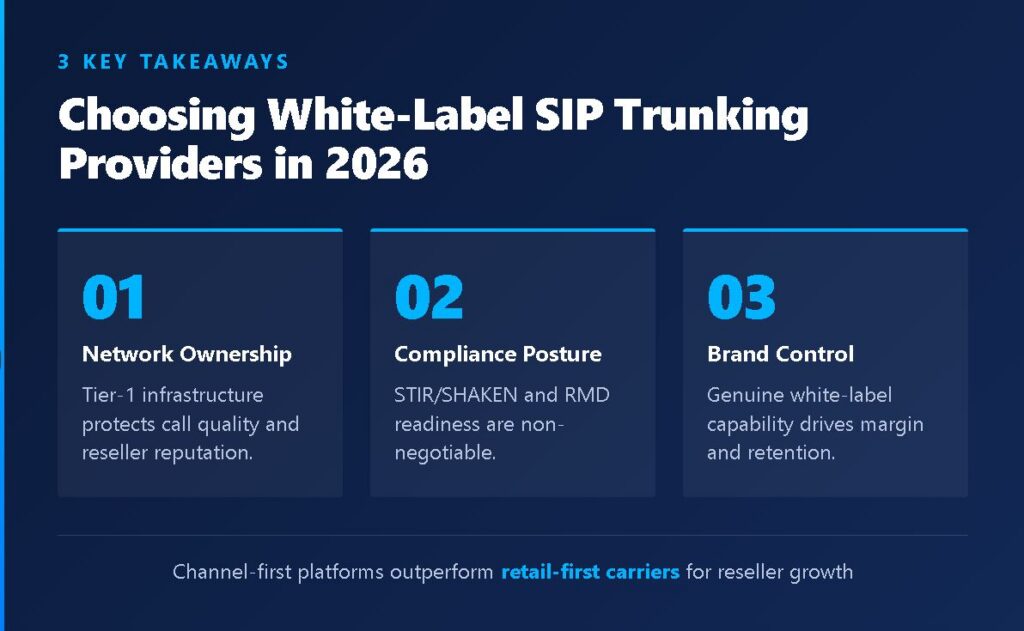
The right platform partner combines five core capabilities. Each of these factors directly affects your operational efficiency, customer satisfaction, and long-term profitability.
Does the Provider Own and Operate a Tier-1 Network?
Network ownership directly determines call quality, reliability, and how quickly issues get resolved. Tier-1 providers own their infrastructure and connect directly to the public switched telephone network without relying on intermediate carriers. Tier-2 and Tier-3 providers resell access through Tier-1 networks, which introduces additional points of failure and slows response when problems arise.
When you evaluate white-label SIP trunking providers, ask specifically about network architecture, data center locations, and upstream carrier relationships. Look for documented uptime backed by service level agreements with meaningful credits for failures. Georedundant infrastructure, where calls automatically reroute across geographically separated facilities, is essential for serving customers with business continuity requirements.
How Does the Provider Handle STIR/SHAKEN and Robocall Mitigation Database Compliance?
Compliance has shifted from a back-office concern to a front-line evaluation criterion. As of 2026, voice service providers with STIR/SHAKEN obligations must sign all calls using their own certificates and make their own attestation decisions, regardless of whether a third party performs the technical signing. The FCC also requires annual recertification in the Robocall Mitigation Database by March 1 each year. Providers that can’t demonstrate compliant infrastructure expose you and your customers to enforcement risk and call labeling problems that damage customer trust.
Ask prospective partners how they handle attestation decisions, what their fraud-detection capabilities look like, and how they communicate compliance updates to resellers. Providers with mature compliance programs handle these obligations transparently, so you can focus on growing your customer base instead of tracking regulatory changes.
Are Billing and Telecom Taxes Fully Automated?
Telecom taxation is notoriously complex. Rates and rules vary across federal, state, county, and municipal jurisdictions, and miscalculations create compliance exposure that can damage your reputation and your bottom line. The strongest SIP reseller providers automate billing, tax calculation, and remittance entirely, removing administrative burden from your operation.
Resellers who try to handle telecom tax manually often discover that the cost of compliance, in staff time and software, eats into their margins. Hands-off billing and taxes let you focus on customer acquisition and retention rather than back-office reconciliation.
Does the Platform Offer Genuine White-Label Branding and Private-Label SIP Trunk Capabilities?
Not every program marketed as white-label actually delivers full brand control. The best programs include customizable reseller portals, branded documentation, and the ability to set your own pricing without exposing wholesale rates to your customers. Some platforms support co-branded support arrangements where the technical team answers calls using your company name.
A genuine private-label SIP trunk transforms you from a referral source into a real communications provider in your customers’ eyes. That distinction shows up in customer lifetime value, retention rates, and your ability to command premium pricing for specialized expertise.
How Fast and Flexible Is the Platform Itself?
Provisioning speed affects how quickly you can convert sales into revenue. Look for platform features that include instant account activation, real-time DID number provisioning, and self-service control panels that let you manage customer accounts without opening support tickets. Compatibility matters too. The platform should integrate with all major IP PBX systems, IP gateways, and open-source PBX projects so that your customers can keep their existing hardware investment.
How Do White-Label, Wholesale, and Agent Reseller Models Differ?
Resellers entering the SIP trunking market generally choose between four distinct models. Each carries different implications for brand control, profit potential, and operational involvement.
- White-label SIP trunking. You sell SIP trunk services entirely under your own brand. The platform provider remains invisible to your customers. You set retail pricing, own the customer relationship, and capture the full margin between wholesale and retail. This model offers the highest profit potential and the strongest path to building lasting business equity.
- Private-label SIP trunk arrangements. These programs sit close to white-label but often involve additional customization or exclusivity arrangements. Functionally, the customer experience is the same: your brand stays front and center. The term is sometimes used interchangeably with white-label, though private-label can imply a deeper level of platform customization.
- Wholesale SIP trunk programs. You receive favorable wholesale pricing without the white-labeling layer. Customers know they are using another provider’s service, even if they purchase through you. Wholesale arrangements suit resellers focused on volume and price competition rather than brand building.
- Agent and referral programs. You refer customers to a provider and receive a commission, typically a fixed percentage of monthly recurring revenue. These programs offer the lowest barrier to entry but cap your earnings and give the platform provider ownership of the customer relationship. They work well for supplemental income but limit your ability to build a substantial standalone business.
For most telecom agents, IT consultants, and MSPs serious about long-term growth, white-label or private-label SIP trunk arrangements deliver the strongest combination of control, margin, and durability.
What Trust Signals Separate Exceptional SIP Reseller Providers From Average Ones?
The differences between a good and great platform partner often only show up after you have committed. These trust signals help you evaluate partners before signing on, and they offer meaningful indicators of how the relationship will play out over years rather than months.
Look for documented partner outcomes that map to your business profile. Established resellers in the SIP trunking space have reported building hosted voice practices into their fastest-growing service lines within the first year of joining a quality platform, filling voice solution gaps that previously required heavy capital investment to address. Resellers with limited prior SIP experience have also reported that streamlined provisioning and responsive technical support made account setup straightforward, even without deep telecom backgrounds. These kinds of outcomes are what you should be asking prospective partners to demonstrate with references and documented results.
Beyond customer stories, evaluate the structural commitments a provider makes to its reseller channel:
- Transparent commission structure. Look for programs that pay residual commissions for the duration of each subscription, with no minimum revenue thresholds and clear tracking through a reseller portal.
- 24/7 expert support. Quality providers offer round-the-clock support staffed by technicians who understand reseller scenarios.
- No contracts or upfront costs. The best programs let you scale at your own pace without forcing long-term commitments or capital outlays before you generate revenue.
- Documented compliance track record. Providers should be able to walk you through their STIR/SHAKEN implementation, attestation policies, and Robocall Mitigation Database status without hedging.
Reseller-specific testimonials matter more than generic customer satisfaction scores. Ask for references from active resellers operating in similar segments, and pay close attention to how partners describe the support experience, the onboarding process, and how the provider has handled regulatory shifts.
How Can Resellers Evaluate White-Label SIP Trunking in Five Steps?
A structured evaluation process protects you from marketing claims that don’t survive contact with reality. The following five-step framework gives you a repeatable way to compare any white-label SIP trunking provider against your business requirements.
- Validate the network. Confirm Tier-1 ownership, ask for documented uptime metrics, and request information on georedundancy and failover architecture. Run test calls if possible to assess audio quality firsthand.
- Test the compliance posture. Ask how the provider handles STIR/SHAKEN attestation, what their fraud detection looks like, and how they communicate regulatory changes.
- Examine the economics. Get clear documentation on wholesale rates, residual commission structure, billing automation, and any minimum requirements. Calculate your projected margin across realistic customer scenarios.
- Evaluate the platform experience. Sign up for a demo or trial account if available. Test provisioning speed, control panel usability, and how easily you can manage customer accounts without contacting support.
- Verify the support. Request reseller references, ask about typical response times during real incidents, and confirm what tiers of support are available around the clock.
This framework reveals real differences between providers within a few hours of focused diligence. Skipping any of these steps can lead to problems six months into the partnership.

Frequently Asked Questions About White-Label SIP Trunking Providers
What is the difference between white-label and private-label SIP trunk services?
The terms are often used interchangeably in the telecom industry. White-label typically refers to a service that is rebranded as your own with minimal customization beyond logo and pricing. Private-label can imply deeper customization, exclusivity arrangements, or feature configuration tailored to your customer base. In practical terms, both allow you to sell SIP trunk services under your own brand.
How quickly can resellers start earning revenue?
With a platform that offers automated provisioning and instant account activation, you can technically begin offering services within minutes of signing up. The realistic path to meaningful recurring revenue usually takes a few months as you onboard your first customers, complete training, and refine your sales process. Providers offering fast-track programs and dedicated onboarding support can accelerate this timeline for qualified resellers.
Do you need technical expertise to resell SIP trunking?
No deep technical background is required. White-label SIP reseller programs handle the technical infrastructure, network operations, and compliance management on your behalf. Many successful resellers come from sales, IT consulting, or telecom agent backgrounds and rely on their platform partner’s technical resources for implementation support. Familiarity with PBX systems and basic networking concepts helps, but you can build expertise as you go.
What margins can SIP reseller providers realistically expect?
Margins vary based on your pricing strategy, customer mix, and the wholesale rates negotiated with your platform partner. White-label arrangements enable higher margins than commission-only agent programs because you control retail pricing. Resellers who focus on customer success, value-added services, and retention generally achieve stronger long-term margins than those competing primarily on price. The most important driver of profitability is usually the support overhead and operational efficiency the platform delivers, not the headline wholesale rate.
Build Lasting Revenue With the Right White-Label SIP Trunking Partner
The SIP trunking opportunity for resellers is larger and more durable than at any prior point in the technology’s history. Capturing it requires choosing a platform partner that combines Tier-1 network reliability, automated billing and compliance, genuine white-label branding, and the support structure to help you grow without operational drag.
SIPTRUNK is built specifically for telecom agents, dealers, VARs, MSPs, and IT consultants who want a reseller platform designed around channel partner success rather than retail-first carrier economics. With Tier-1 georedundant network access, hands-off billing and taxes, no contracts or upfront costs, and a control panel that gets new customers up and running in minutes, the platform removes the friction that slows reseller growth. Get started today with a free Dealer Account.

Mitch leads the Sales team at BCM One, overseeing revenue growth through cloud voice services across brands like SIPTRUNK, SIP.US, and Flowroute. With a focus on partner enablement and customer success, he helps businesses identify the right communication solutions within BCM One’s extensive portfolio. Mitch brings years of experience in channel sales and cloud-based telecom to every conversation.