

Enterprise SIP Trunking: Scaling SIP for Large Organizations
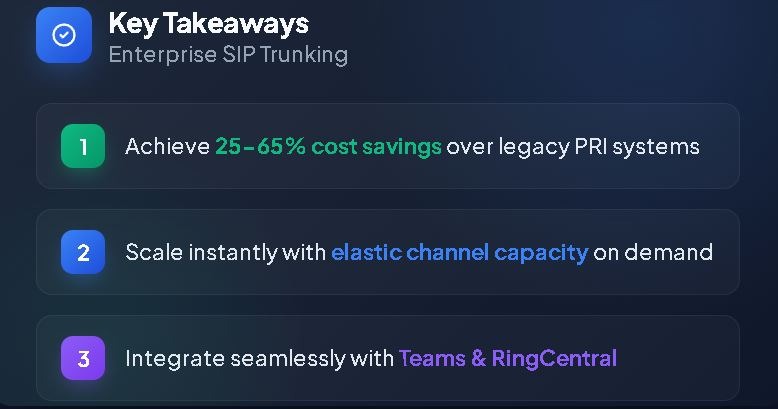
Enterprise SIP trunking enables large organizations to consolidate voice communications across multiple locations while reducing costs by 25–65% compared to legacy systems.
- Multi-site enterprises can centralize call management through a single IP-based connection, eliminating the need for separate phone infrastructure at each location.
- Integration with platforms like Microsoft Teams and RingCentral transforms existing collaboration tools into full-featured phone systems.
- Elastic scaling allows organizations to add or remove channels instantly during seasonal peaks, acquisitions, or workforce changes without hardware investments.
- Built-in failover and geographic redundancy ensure 99.999% uptime for business-critical communications.
For resellers serving enterprise clients, understanding how trunking solutions scale across complex environments positions you as a strategic advisor rather than a commodity vendor.
Large organizations face a challenge: maintaining reliable, cost-effective voice communications across distributed locations, remote teams, and evolving business requirements. Traditional phone systems built on physical lines and on-premises hardware struggle to keep pace with modern operational demands. The limitations become apparent when enterprises need to scale rapidly, integrate with collaboration platforms, or maintain business continuity during disruptions.
SIP trunking is the solution to these challenges. The SIP trunking market is projected to reach $181.58 billion by 2031, growing at a compound annual rate of 16.38%. This expansion reflects enterprises recognizing that internet-based voice communications deliver the flexibility, reliability, and integration capabilities their operations require.
This guide explores how enterprise SIP trunking addresses the unique communication needs of large organizations, from multi-location scalability to seamless integration with unified communications platforms. Whether you serve healthcare networks managing hundreds of concurrent calls or manufacturing operations coordinating across multiple facilities, understanding VoIP for large businesses strengthens your ability to deliver genuine value.
What Is Enterprise SIP Trunking?
Enterprise trunking presents a different way of managing voice communications for large businesses. Rather than maintaining separate phone systems and carrier relationships at each location, enterprises can consolidate their voice infrastructure through internet-based connections that span their entire operation.
How Does Enterprise Trunking Connect Business Networks?
Enterprise trunking uses Session Initiation Protocol to connect an organization’s internal communication systems to the Public Switched Telephone Network. This connection replaces physical phone lines with internet-based transmission, allowing voice data to travel as packets over existing infrastructure.
The practical impact for enterprises is substantial. A healthcare network with facilities in multiple states can route all voice traffic through a centralized system, managing call routing, monitoring quality, and adjusting capacity from a single interface. IT teams gain visibility into communication patterns across the entire organization rather than managing fragmented systems at each site.
What Role Do Trunks Play in Multi-Location Communication?
For organizations with distributed operations, trunks function as the communication highways connecting all locations to a unified voice network. Each trunk can carry multiple simultaneous conversations through a process called multiplexing, which allows numerous calls to share a single connection. This architecture eliminates the need for dedicated lines at each facility and enables resources to be shared across the entire organization.
Consider a retail operation with 50 store locations. Traditional phone systems would require each store to maintain its own carrier relationship and local lines. With enterprise SIP trunking, the organization purchases capacity based on total concurrent call requirements, then allocates channels dynamically based on demand. This pooling approach reduces total channel requirements compared to location-by-location provisioning because resources are shared across the entire organization rather than sitting idle at individual sites.
Why Is SIP the Foundation of Modern Enterprise Communications?
SIP has become the dominant protocol for business voice communications because it addresses limitations that constrained earlier technologies. Understanding why SIP works for enterprise environments helps resellers articulate its value to decision-makers evaluating communication investments.
How Does SIP Trunking Reduce Costs for Large Businesses?
Cost reduction remains the most immediate benefit enterprises realize when migrating to SIP-based communications. Organizations typically achieve 25–65% savings compared to traditional PRI circuits.
These savings come from multiple sources. VoIP for large businesses eliminates per-line charges that accumulate with physical connections, as organizations pay for concurrent call capacity rather than individual lines. Long-distance and inter-office calling expenses decrease because calls between locations travel over existing data networks. Maintenance costs decline when physical phone infrastructure is replaced with software-based systems requiring no on-site technician visits for routine changes.
For resellers, understanding how to calculate SIP trunk pricing across different organizational sizes helps develop accurate proposals that demonstrate a clear return on investment.
What Makes SIP a Unified Communications Enabler?
Modern enterprises rarely use voice in isolation. Teams collaborate through video conferencing, instant messaging, and shared workspaces. SIP serves as the foundation connecting voice communications with these broader collaboration ecosystems.
This integration means organizations can embed calling directly into business applications. A customer service representative can initiate a call from within their CRM system, with call data automatically logged to the customer record. A project team can escalate a chat conversation to a voice call without switching applications. The protocol’s flexibility also supports emerging AI tools for call transcription, sentiment analysis, and automated routing.
How Do Enterprise Trunking Solutions Scale Across Multiple Locations?
Scalability is one of the most compelling advantages of SIP-based communications for enterprise environments. Unlike physical infrastructure that requires weeks of planning and installation to expand, SIP trunk capacity can be adjusted in minutes to match changing requirements.

What Does Elastic Scaling Look Like in Practice?
Elastic SIP trunking allows organizations to increase or decrease channel capacity on demand without infrastructure changes. This flexibility proves valuable across several common enterprise scenarios.
Seasonal businesses face dramatic fluctuations in communication volume. A tax preparation firm might need triple its normal capacity during filing season, then scale back to baseline for the remainder of the year. Elastic SIP trunking lets the organization add channels in January and release them in May, paying only for capacity actually used.
Growth through acquisition creates similar challenges. SIP trunking allows acquiring organizations to provision capacity for new locations within hours, then migrate users to centralized systems over time without disrupting operations.
Distributed workforces operating across time zones benefit from dynamic capacity allocation. An organization with contact centers in multiple regions can route calls to whichever center has available agents, using “follow-the-sun” models that provide live support during business hours without requiring 24/7 staffing at any single location.
How Do Enterprises Determine Capacity Requirements?
Proper capacity planning ensures organizations have sufficient channels for peak demand without overprovisioning. The calculation begins with analyzing concurrent call patterns rather than total call volume or employee count.
Most enterprises find that one channel per three to four employees provides adequate capacity for typical office environments. However, call-intensive operations like contact centers may require a one-to-one ratio, while environments where employees primarily communicate through email or messaging might need only one channel per eight to ten staff members.
For detailed guidance on capacity planning and cost modeling, reviewing real-world pricing structures helps resellers develop accurate projections that align with client operational patterns.
What Platform Integrations Should Enterprises Consider?
Enterprise communication strategies increasingly center on unified platforms that bring voice, video, and messaging together. A SIP trunk for enterprises connects these platforms to public telephone networks, extending their capabilities beyond internal collaboration to external business communications. This integration has driven widespread adoption, with approximately 65% of North American companies now using SIP trunking as part of their communication strategy.
How Does Microsoft Teams Integration Work?
Microsoft Teams has become the dominant collaboration platform, and organizations naturally want to use Teams as their phone system. SIP trunking for enterprises enables this connection through Direct Routing, which connects Teams to the PSTN via a certified Session Border Controller.
Direct Routing offers several advantages over Microsoft Calling Plans for enterprise deployments. Organizations retain the flexibility to choose their SIP trunk provider based on pricing, coverage, and service requirements. Phone numbers from existing carriers can be ported, maintaining business continuity. Advanced call routing, recording, and analytics capabilities integrate directly with Teams.
The integration transforms Teams from a collaboration tool into a complete enterprise phone system. Users make and receive calls from the Teams application on any device, with call history, voicemail, and presence status synchronized across platforms.
What About RingCentral and Other UCaaS Platforms?
Organizations using other unified communications platforms can similarly benefit from SIP trunk connectivity. RingCentral, Zoom Phone, and similar solutions support SIP integration that extends their capabilities to PSTN calling.
The key consideration is ensuring compatibility between the SIP trunk provider and the UCaaS solution. Providers with validated integrations have tested their services against specific platforms, reducing implementation risk and ensuring support teams can troubleshoot issues effectively.
Understanding how SIP trunking fundamentals apply to different architectures helps identify solutions aligned with your clients’ existing technology investments.
What Are the Key Benefits of Enterprise SIP Trunking?
Large organizations realize value from SIP trunking across multiple dimensions. Understanding these benefits helps resellers build compelling business cases.
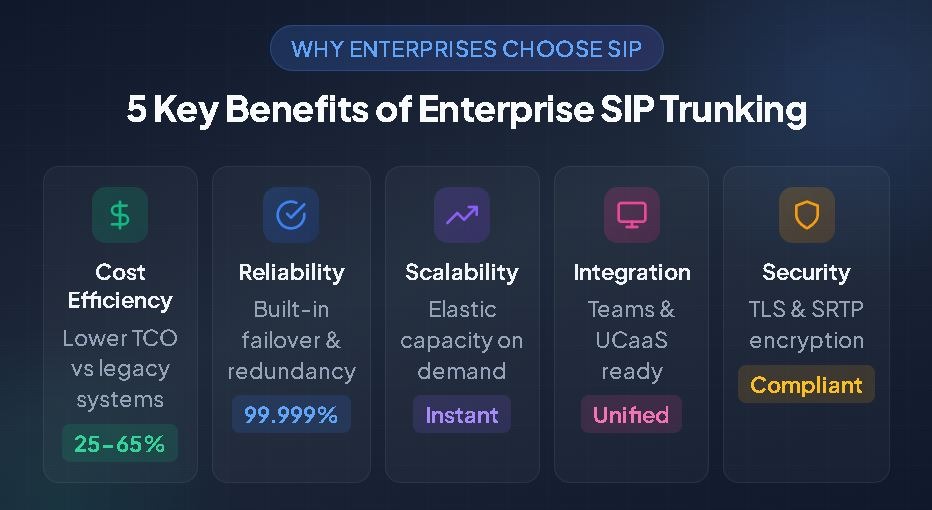
Cost Efficiency Beyond Per-Minute Savings: Direct cost reductions from lower per-channel rates represent only part of the financial benefit. Enterprises also save through reduced infrastructure maintenance, eliminated equipment leasing, and decreased IT administration time. Total cost of ownership analyses often reveal additional savings beyond what appears on monthly invoices when factoring in reduced hardware, fewer vendor relationships, and lower administrative overhead.
Reliability Through Redundancy: Enterprise-grade SIP trunking includes built-in failover capabilities. Calls automatically route through backup paths if primary connections fail, and geographic redundancy ensures regional outages do not interrupt communications. These capabilities deliver 99.999% uptime commitments, protecting business continuity.
Scalability Without Boundaries: Adding capacity requires no physical installation, no waiting for carrier appointments, and no hardware purchases. Organizations can provision additional channels in minutes to handle unexpected demand, support new locations, or accommodate acquisitions.
Unified Communication Enablement: SIP provides the foundation for integrating voice with video, messaging, and collaboration tools, simplifying user experience and ensuring communication data flows into business systems.
Security and Compliance Support: Modern SIP implementations include TLS encryption for signaling and SRTP for voice media. Compliance features like call recording, retention policies, and audit logs help organizations meet regulatory requirements in healthcare, financial services, and other regulated industries.
How Should Resellers Position Trunking Solutions for Enterprise Clients?
Serving enterprise accounts requires a consultative approach addressing complex requirements across multiple stakeholders. IT leaders focus on technical integration and reliability. Finance teams scrutinize the total cost of ownership. Operations managers care about call quality. Security officers evaluate encryption and compliance.
Successfully positioning your trunking solutions starts with thorough discovery. Understanding the enterprise’s current infrastructure, pain points, and strategic priorities enables resellers to craft proposals that speak directly to each stakeholder’s concerns.

Building a wholesale SIP practice that can serve enterprise clients requires investing in technical knowledge and support capabilities. The margin potential justifies the investment, as enterprise deployments generate substantial recurring revenue over extended relationships.
Frequently Asked Questions
How many SIP channels does a typical enterprise need? Enterprise channel requirements depend on concurrent call patterns rather than employee count or total call volume. Most organizations find that one channel per three to four employees provides adequate capacity, though call-intensive environments like contact centers may require higher ratios. Analyzing historical concurrent call data from existing phone systems provides the most accurate baseline for capacity planning.
Can enterprise SIP trunking integrate with existing phone systems? Yes. SIP trunking works with most IP-PBX systems manufactured since the early 2000s, including solutions from Cisco, Avaya, Mitel, and open-source platforms like Asterisk and FreePBX. Organizations with legacy analog systems can use gateways to enable SIP connectivity without complete infrastructure replacement.
What happens to enterprise communications during internet outages? Enterprise-grade SIP providers offer multiple failover mechanisms, including automatic rerouting through backup internet connections, cellular failover for critical locations, and geographic redundancy that routes calls through alternate data centers if regional connectivity fails. Service level agreements typically guarantee 99.999% uptime, equating to less than five minutes of downtime annually.
How does enterprise SIP trunking support compliance requirements? SIP infrastructure supports compliance through encrypted communications, call recording with configurable retention policies, detailed call logging for audit trails, and integration with archiving systems. Providers serving healthcare, financial services, and government clients maintain certifications demonstrating compliance with industry-specific regulations.
Position Your Reseller Practice for Enterprise Success
Enterprise SIP trunking represents a substantial opportunity for resellers who invest in understanding how large organizations evaluate and deploy communication infrastructure. The combination of cost efficiency, scalability, platform integration, and reliability creates a compelling value proposition for businesses seeking to modernize their voice communications.
SIPTRUNK provides the reseller-focused platform, wholesale pricing, and technical support that enable you to confidently serve enterprise clients. With Tier-1 network connectivity, seamless integration with platforms like Microsoft Teams and RingCentral, and dedicated partner support, you gain the foundation needed to compete for and retain enterprise accounts. Get started today and discover how partnering with an established platform accelerates your path to enterprise success.

Mitch leads the Sales team at BCM One, overseeing revenue growth through cloud voice services across brands like SIPTRUNK, SIP.US, and Flowroute. With a focus on partner enablement and customer success, he helps businesses identify the right communication solutions within BCM One’s extensive portfolio. Mitch brings years of experience in channel sales and cloud-based telecom to every conversation.