

How to Become a SIP Trunk Service Provider: A Complete Guide for Resellers
The SIP trunk service market is creating attractive opportunities for resellers ready to enter the telecommunications space.
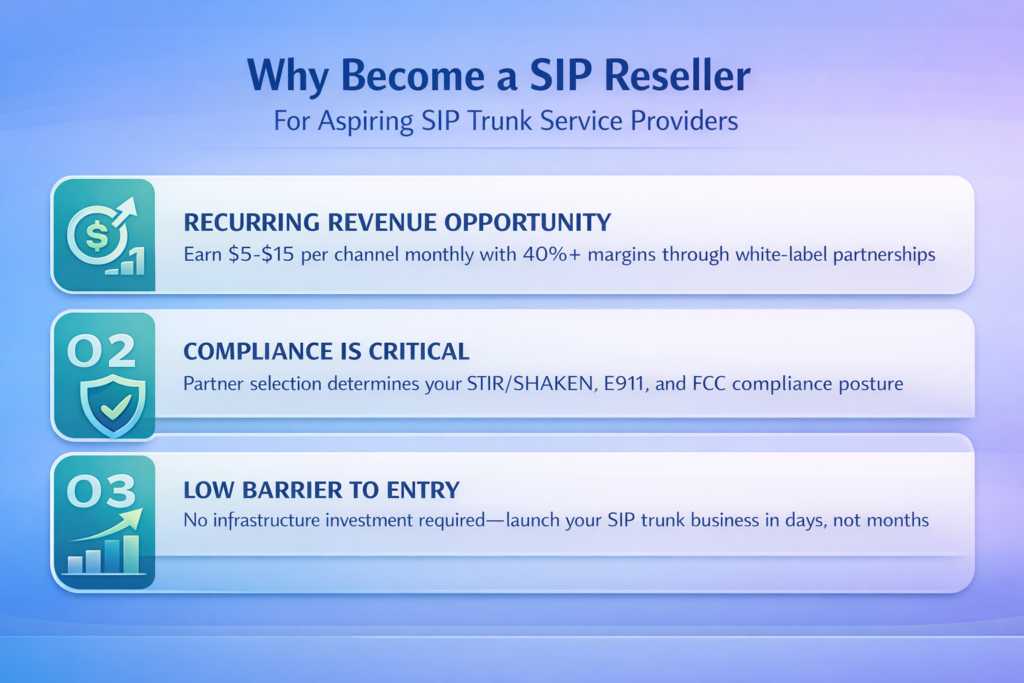
- White-label reseller programs eliminate the need for infrastructure investment, allowing you to launch a SIP trunk service under your own brand within days.
- FCC compliance requirements, including STIR/SHAKEN authentication and Robocall Mitigation Database registration, now require careful partner selection to avoid service disruptions.
- Successful SIP resellers can earn $5 to $15 per customer channel in monthly recurring revenue, building predictable income streams that compound over time.
- Choosing a wholesale partner that handles billing, taxes, and technical support lets you focus on customer acquisition rather than operational complexity.
2026 presents an ideal entry point as businesses accelerate their migration from legacy phone systems to internet-based communications.
Telecom agents, IT consultants, VARs, and managed service providers increasingly recognize SIP trunking as one of the most accessible paths to building recurring revenue in the telecommunications space. SIP trunking replaces traditional phone lines with virtual connections that transmit voice calls over the internet, delivering cost savings and flexibility that legacy systems can’t match.
The SIP trunking market is growing at a compound annual rate of 11.48%, driven by businesses abandoning legacy telephone infrastructure in favor of cloud-based communications. Hybrid work arrangements have become permanent, requiring communication systems that support distributed teams. And regulatory developments, while adding complexity, have simultaneously raised the bar for service quality in ways that benefit legitimate providers and their customers.
This guide walks through everything you need to know about becoming a SIP trunk service provider, from understanding the business model and selecting the right wholesale partner to navigating compliance requirements and maximizing your revenue potential.
What Is a SIP Trunk Service Provider?
A SIP trunk service provider delivers voice and unified communications capabilities to business customers, replacing traditional telephone lines with virtual connections. Session Initiation Protocol is the technical foundation that establishes, maintains, and terminates voice calls transmitted as data packets across IP networks. Business customers gain lower costs, greater flexibility, and access to advanced features.
The role of a SIP provider has evolved over the past decade. Initially, businesses needed existing IP PBX infrastructure to take advantage of SIP trunking. Today, hosted PBX options and cloud-based solutions have opened the market to organizations of all sizes, creating demand across virtually every industry vertical.
How Does a White-Label SIP Reseller Model Work?
Becoming a SIP service provider no longer requires massive capital investment in switching equipment, network infrastructure, or technical staff. The white-label reseller model allows telecom agents, IT consultants, VARs, and managed service providers to offer SIP trunk services under their own brand while leveraging a wholesale partner’s infrastructure.
In this arrangement, your wholesale SIP trunk provider handles the technical complexity: network operations, call routing, emergency services compliance, and system maintenance. You handle customer relationships, sales, and support at whatever level you choose. The result is a business model where your brand appears on invoices and customer portals while enterprise-grade telecom infrastructure operates behind the scenes.
This approach reduces both risk and time-to-market. Rather than spending months building infrastructure and obtaining certifications, you can begin serving customers within days of partnering with an established wholesale provider.
Why Become a SIP Service Provider in 2026?
Several trends make 2026 particularly attractive for entering the SIP reseller market. Hybrid work arrangements require communication systems that support distributed teams. Cloud adoption continues to accelerate across industries, and SIP trunking integrates naturally with cloud-based unified communications platforms. Meanwhile, legacy phone system vendors are sunsetting older products, pushing customers toward modern alternatives whether they planned the transition or not.
What Revenue Can SIP Resellers Expect?
The recurring revenue model is one of the most compelling aspects of becoming a SIP trunk provider. Unlike project-based IT services or one-time hardware sales, SIP trunking generates predictable monthly income for as long as customers maintain their service. This financial stability enables long-term business planning and creates compounding value as your customer base grows.
Successful resellers can earn between $5 and $15 in monthly recurring revenue per customer channel. The exact figure depends on your pricing strategy, the competition in your market, and the value-added services you bundle with basic connectivity. A reseller with 100 customers averaging 10 channels each could generate $5,000 to $15,000 in monthly recurring revenue from SIP services alone.
Opportunities exist to increase margins through complementary services. Implementation consulting, network assessments, system optimization, and ongoing managed services all represent additional revenue streams that strengthen customer relationships while improving your economics per account.
What Are the Steps to Becoming a SIP Trunk Provider?
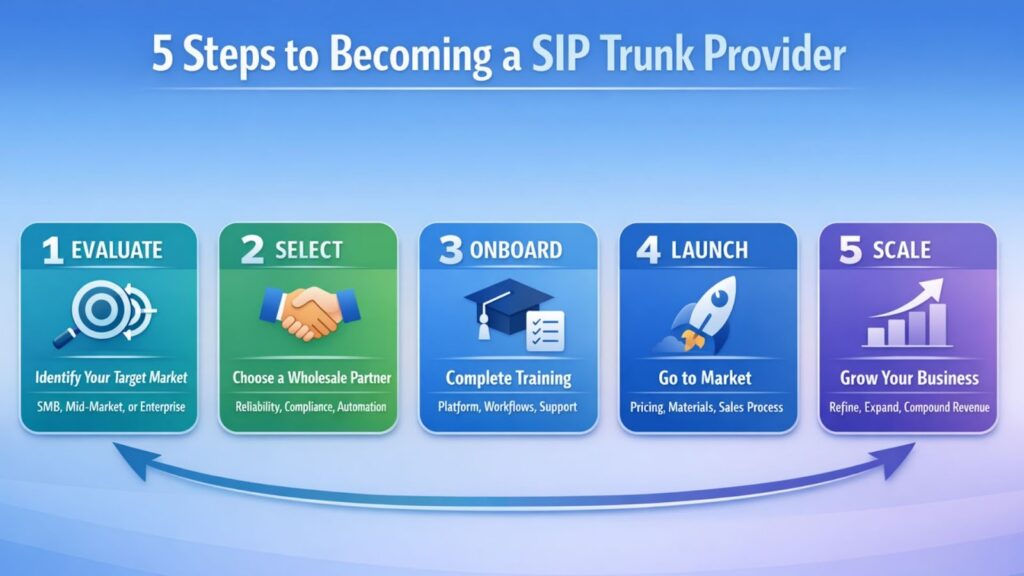
The pathway to becoming a SIP trunk provider follows a straightforward sequence. Understanding this workflow helps you plan your market entry strategy and allocate resources appropriately.
Step 1: Evaluate your target market. Before selecting a wholesale partner, identify the customer segments you intend to serve. Are you targeting small businesses seeking basic cost savings, mid-market companies requiring unified communications features, or enterprise accounts with complex multi-location needs? Your answer shapes partner requirements, pricing strategies, and marketing approaches.
Step 2: Select a wholesale SIP trunk provider. This decision determines your operational capabilities, customer experience, and profit margins. Evaluate potential partners against criteria including network reliability, compliance, automation capabilities, pricing transparency, and reseller support.
Step 3: Complete onboarding and training. Reputable wholesale providers offer structured onboarding programs that familiarize you with their platform, provisioning workflows, and support escalation procedures. Invest time in understanding these systems thoroughly before bringing on customers.
Step 4: Establish your go-to-market approach. Develop pricing packages, marketing materials, and sales processes tailored to your target segments. Consider how you will differentiate your offering from competitors and communicate value to prospective customers.
Step 5: Launch and scale. Begin acquiring customers through your established channels while refining your processes based on real-world experience. As you develop operational confidence, expand your marketing efforts and potentially broaden your target market.
How Do You Choose the Right Wholesale Partner?
Partner selection affects nearly every aspect of your SIP trunk business. The wrong choice can mean unreliable service that damages your reputation, compliance gaps that create legal exposure, or unfavorable economics that undermine profitability.
Network reliability should top your evaluation criteria. Look for providers operating Tier-1 redundant networks with documented uptime exceeding 99.99%. Request information about geographic redundancy, failover capabilities, and disaster recovery procedures. Your customers depend on voice communications for critical business operations, and outages directly impact their perception of your service.
Compliance capabilities have become increasingly important as FCC regulations tighten. Verify that potential partners maintain current certifications in the Robocall Mitigation Database, implement STIR/SHAKEN call authentication using their own certificates, and handle E911 requirements appropriately. Partners that fall short on compliance can expose your business to service disruptions and potential liability.
Evaluate automation and self-service capabilities that enable efficient operations as you scale. The best platforms allow you to provision new services, manage customer accounts, and resolve common issues without submitting support tickets or waiting for manual intervention. Consider whether the platform integrates with your existing business systems and workflows.
Finally, assess the partner’s commitment to reseller success. Some wholesale providers treat the channel as an afterthought, while others build their entire business model around partner success. Look for dedicated channel support, marketing resources, training programs, and transparent commission structures that align incentives.
What Compliance and Licensing Requirements Apply to SIP Providers?
Regulatory compliance is a defining concern for anyone entering the SIP trunk service market. The Federal Communications Commission has increased enforcement actions against providers failing to meet telecommunications regulations, with penalties reaching into the millions of dollars. Understanding these requirements helps you select compliant partners and avoid operational disruptions.
All VoIP service providers, including resellers, must register with the FCC using Form 499-A and maintain current registration status. This requirement applies regardless of business size or customer base. Registration triggers additional obligations, including Universal Service Fund contributions and ongoing reporting requirements.
STIR/SHAKEN call authentication is the most impactful compliance development. As of September 2025, providers with STIR/SHAKEN obligations must use their own certificates to sign calls rather than relying on third-party authentication services. Your wholesale partner must maintain their own certification infrastructure and can’t simply pass through authentication from upstream carriers.
Emergency services compliance involves two critical components. Kari’s Law requires direct 911 access without requiring users to dial prefixes, while Ray Baum’s Act mandates transmission of precise location information with every emergency call. Your wholesale provider must deliver accurate dispatchable location data, including street address and room-level details for multi-line telephone systems.
How Can Resellers Ensure Compliance?
As a reseller, your compliance strategy centers on partner selection and ongoing verification. You are not directly responsible for implementing STIR/SHAKEN infrastructure or maintaining FCC certifications, but you bear responsibility for ensuring your wholesale provider meets all applicable requirements.
During partner evaluation, request documentation confirming current Robocall Mitigation Database certification, STIR/SHAKEN implementation status, and E911 compliance capabilities. Verify that the provider holds their own SPC token and certificate rather than relying on third-party signing arrangements that no longer satisfy FCC requirements.
Establish contractual provisions requiring your wholesale partner to maintain compliance and notify you promptly of any regulatory changes affecting your business. Include language addressing liability allocation and service continuity in the event of compliance failures.
Monitor regulatory developments through industry associations and legal resources. The FCC continues evolving its approach to robocall mitigation and caller authentication, and staying informed helps you anticipate changes that might affect your operations or require partner discussions.
Consider working with providers that offer comprehensive compliance support as part of their reseller program. The best partners handle compliance complexity on your behalf, allowing you to focus on customer relationships rather than regulatory minutiae.
What Business Benefits Does SIP Trunking Offer Your Clients?
Understanding the value proposition you deliver to customers strengthens your sales conversations and helps you effectively position SIP trunk services. Business customers evaluating SIP trunking typically care most about cost reduction, operational flexibility, and access to modern communication features.
Businesses switching from traditional phone systems to SIP trunking commonly achieve significant reductions in telecommunications expenses. These savings derive from several sources: elimination of per-line charges, reduced long-distance and international calling costs, consolidated voice and data infrastructure, and flexible capacity that scales with actual usage rather than requiring over-provisioning.
Scalability addresses a persistent challenge with legacy telephone systems. Traditional approaches required purchasing physical lines and circuits months in advance of anticipated growth, often resulting in either excess capacity or scrambling to provision additional service. SIP trunking allows businesses to add or remove capacity within hours, aligning telecom resources with actual business needs.
Network consolidation simplifies IT infrastructure by eliminating separate voice and data networks. Organizations running unified communications platforms benefit from SIP trunking that integrates natively with their collaboration tools, enabling features like click-to-call from CRM systems, presence-aware call routing, and unified messaging across voice, video, and text channels.
Disaster recovery and business continuity capabilities are important benefits as organizations recognize communications resilience as a priority. SIP trunking supports sophisticated failover configurations, including geographic redundancy, automatic rerouting during outages, and seamless integration with backup systems that keep businesses connected during disruptions.
How Does SIP Trunking Compare to Traditional Phone Systems?
When helping customers evaluate their options, positioning SIP trunking against traditional alternatives clarifies the value proposition. Legacy phone systems, including PRI lines and analog circuits, served businesses adequately for decades but can’t match the flexibility and economics of modern internet-based communications.
Traditional systems require dedicated physical infrastructure that creates fixed costs regardless of actual usage. Businesses pay for circuit capacity whether they use it or not, and expanding service requires lead time for installation and often involves high per-line charges. International and long-distance calling typically incurs premium rates that add to monthly expenses.
SIP trunking inverts this model by delivering voice as a service over existing internet connections. Businesses pay for capacity they actually use, scale instantly based on demand, and benefit from lower per-minute rates for domestic and international calls. The elimination of physical infrastructure also simplifies moves, adds, and changes that often prove expensive and time-consuming with traditional systems.
SIP trunking enables capabilities that legacy systems can’t provide. Integration with unified communications platforms, support for remote and hybrid workers, advanced call analytics, and programmable voice features all depend on IP-based connectivity that traditional phone systems can’t deliver.
How Do You Maximize Revenue as a SIP Reseller?
Building a profitable SIP trunk business requires strategic thinking about pricing, service packaging, and customer development. The following strategies help resellers maximize their revenue potential:
- Develop tiered pricing packages that address different customer segments. Basic packages emphasizing cost savings appeal to price-sensitive small businesses, while premium tiers bundling advanced features and dedicated support capture higher margins from customers willing to pay for enhanced service levels.
- Bundle complementary services that increase average revenue per customer. Implementation consulting, network assessments, ongoing optimization, and managed services all represent natural additions to base SIP trunk connectivity. These services also strengthen customer relationships and improve retention.
- Pursue vertical market specialization where regulatory or operational requirements create demand for expertise. Healthcare organizations need HIPAA-compliant communications, financial services firms require specific security and compliance features, and contact centers demand sophisticated call handling capabilities. Developing deep expertise in specific verticals justifies premium pricing while simplifying marketing and sales efforts.
- Implement systematic referral programs that leverage satisfied customers as sales channels. Happy customers are your most credible advocates, and structured incentives encourage them to introduce colleagues and business contacts to your services.
- Focus on customer success as a retention strategy. The recurring revenue model only creates value when customers remain on service month after month. Proactive account management, regular business reviews, and prompt issue resolution reduce churn and protect your revenue base.
Frequently Asked Questions
Do I need technical experience to become a SIP trunk provider? Technical expertise certainly helps but is not required for success as a SIP reseller. Many resellers come from sales, business development, or general IT backgrounds rather than telecommunications engineering. The key is selecting a wholesale partner whose platform and support resources compensate for any gaps in your technical knowledge.
How long does it take to start offering SIP trunk services? With the right wholesale partner, you can begin offering SIP trunk services within days of completing your reseller agreement. Modern platforms feature automated provisioning that activates new services in minutes rather than days, eliminating the traditional delays associated with telecommunications service delivery. The primary time investment involves learning the platform, developing your go-to-market strategy, and preparing sales materials for your target market.
What margins can SIP resellers achieve? Margin potential varies based on your pricing strategy, competitive environment, and cost structure, but experienced resellers commonly achieve margins of 40% or higher on SIP trunk services. The white-label model allows you to set your own pricing above wholesale rates, capturing the difference as gross margin. Adding value-added services further improves economics by increasing revenue per customer while deepening relationships that improve retention.
Do SIP trunking resellers need FCC registration? Yes, all VoIP service providers, including resellers, must register with the FCC and maintain current registration status. Your wholesale partner handles the infrastructure-level compliance requirements, but you remain responsible for appropriate business registration and may have reporting obligations depending on your specific business model.
Build Your SIP Trunk Service Business with the Right Partner
The opportunity to become a SIP trunk service provider has never been more accessible or more promising. Market growth projections, technology trends, and changing business requirements all point toward continued expansion of demand for internet-based voice communications.
Success in this market requires selecting a wholesale partner that combines reliable infrastructure, comprehensive compliance, efficient automation, and genuine commitment to reseller success. The right partnership eliminates barriers to entry, reduces operational complexity, and positions you to focus on what matters most: building customer relationships and growing your business.
SIPTRUNK provides the platform, tools, and support that resellers need to succeed in the SIP trunk market. With no contracts, automated provisioning, hands-off billing and taxes, and dedicated reseller support, you can start building recurring revenue immediately. Get started today and discover how the right partnership accelerates your growth in this expanding market.

Mitch leads the Sales team at BCM One, overseeing revenue growth through cloud voice services across brands like SIPTRUNK, SIP.US, and Flowroute. With a focus on partner enablement and customer success, he helps businesses identify the right communication solutions within BCM One’s extensive portfolio. Mitch brings years of experience in channel sales and cloud-based telecom to every conversation.