

How to Start and Scale a VoIP Reseller Business: A Step-by-Step Guide
Starting a VoIP reseller business is one of the clearest paths to recurring telecom revenue, provided you choose the right platform and build a deliberate pricing and customer acquisition strategy.
- The SIP trunking market is projected to grow from roughly $85 billion in 2026 to $181.58 billion by 2031, creating sustained demand for reseller services.
- White-label resellers typically capture 50% or higher margins compared with the 15% to 25% commissions earned by traditional telecom agents.
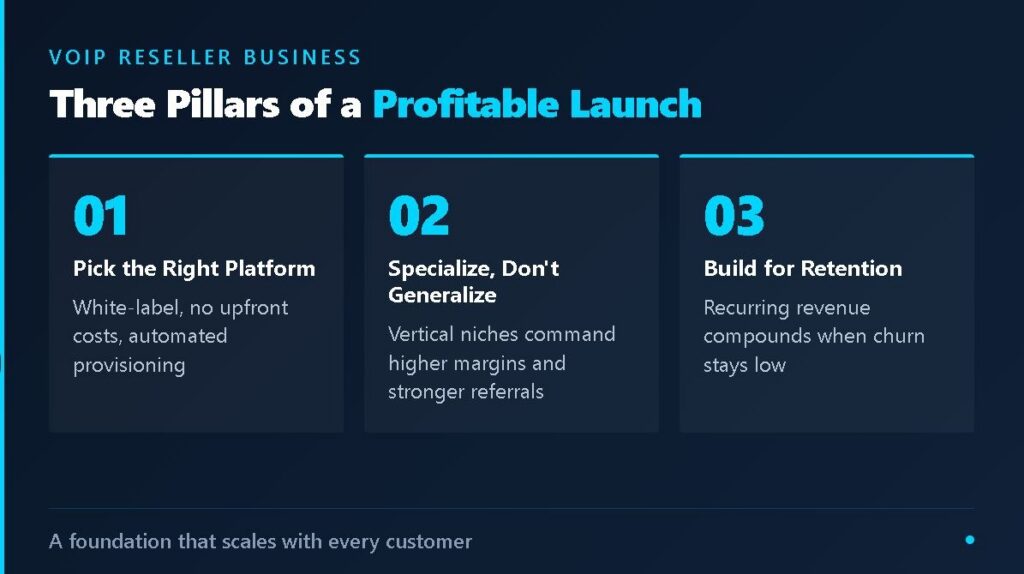
- A successful VoIP reseller model depends on five core pillars: platform selection, pricing strategy, target market definition, tools stack, and customer success.
- Real revenue math shows that a modest book of 30 customers averaging $200 in monthly recurring revenue can generate $72,000 annually before scaling.
If you are evaluating whether to enter the telecom reseller space in 2026, the conditions have rarely been more favorable.
The opportunity to start a VoIP reseller business has expanded as legacy phone infrastructure ages out and businesses migrate to internet-based voice systems. According to Mordor Intelligence market data, the global VoIP services market reached $172.49 billion in 2025 and is forecast to grow at a 12.32% CAGR through 2030. That growth translates into a steady stream of customers actively seeking reliable voice solutions, and resellers are well-positioned to capture that demand without the overhead of building infrastructure from scratch.
This guide walks through how to start a reseller business from the ground up, with detailed coverage of pricing strategy, the tools stack you will need, and the revenue math that determines whether the VoIP reseller model works for you. The foundation of any successful telecom reseller business is partnering with a reliable white-label platform that handles the technical complexity while you focus on building customer relationships.
How Does a VoIP Reseller Business Work?
A VoIP reseller business purchases voice services at wholesale rates from a platform provider, then resells them to end customers under the reseller’s own brand. You own the customer relationship, set your own pricing, and capture the margin between wholesale and retail rates as recurring revenue.
This model differs from the traditional telecom agent arrangement. Agents refer customers to a provider and earn a fixed commission, typically in the 15–25% range. Resellers, by contrast, purchase services at wholesale and set retail prices independently, which uncaps earning potential. You take on more operational responsibility (customer support, account management, and billing in some cases), but you also build a business asset rather than a referral income stream.
The reseller arrangement works because the platform provider handles the infrastructure that would otherwise require massive capital investment. That includes Tier-1 carrier interconnections, softswitch operation, number porting, regulatory compliance, and 24/7 network monitoring. You focus on sales, support, and growth.
Why Is Now the Right Time to Start a Telecom Reseller Business?
Three market forces have aligned to make 2026 a favorable year to start a VoIP reseller business. First, traditional copper telephone networks are being decommissioned, forcing businesses to migrate. Second, hybrid and remote work has become permanent in many organizations, creating demand for flexible voice systems that work regardless of employee location. Third, businesses adopting VoIP typically save 30% to 50% on communication costs, which keeps demand strong even during economic uncertainty.
The SIP trunking segment, which underpins most business VoIP deployments, is growing fast. Industry research from Mordor Intelligence projects SIP trunking will expand at a 16.38% CAGR through 2031. For resellers, that growth represents thousands of small and mid-sized businesses entering the market for voice services each month, most of whom prefer to work with a knowledgeable local partner rather than a faceless national carrier.
The barriers to entry have also fallen. Modern reseller platforms eliminate the upfront capital requirements that historically gated this market, which means you can launch with minimal infrastructure spend and scale based on customer acquisition rather than equipment purchases.
What Are the 7 Steps to Launching a VoIP Reseller Business?
Building a reseller business requires a sequence of decisions, each of which affects the others. Take the following seven steps in order to lay a foundation that can scale.
1. Choose a White-Label SIP Trunking Platform
Your platform partner determines margin potential, customer experience, technical reliability, and how quickly you can launch. As you evaluate options, prioritize platforms that offer:
- No upfront costs or long-term contracts that lock you in before you have validated the model
- Automated provisioning so you can activate new customers in minutes rather than days
- Hands-off billing and tax management, which removes one of the most time-consuming operational burdens
- White-label branding that lets you present services under your own name
- Multi-platform compatibility with major IP PBX systems, so you can serve customers regardless of their existing equipment
- Tier-1 network access for voice quality and uptime that your customers can rely on
- 24/7 technical support to back you up when issues arise
Treat this decision with the seriousness it deserves. Switching platforms after you have onboarded customers is disruptive and damages trust. Take your time, ask hard questions about uptime guarantees and support response times, and request references from existing resellers.
2. Define Your Target Market and Niche
The temptation when you start a VoIP reseller business is to pursue every potential customer. Resist it. Resellers who specialize in a vertical or geographic niche consistently outperform generalists because they develop deeper expertise, build referral networks more efficiently, and command premium pricing.
Effective niches typically combine three characteristics: communication-heavy operations, predictable budget cycles, and limited internal IT capacity. Healthcare practices, legal firms, insurance agencies, real estate brokerages, and multi-location retail operations all fit this profile. Each has specific compliance, integration, or feature requirements that reward specialized knowledge.
Begin with thorough market research to understand pain points, buying processes, and decision-maker demographics within your chosen segment. Document what you learn and revisit it quarterly as you accumulate firsthand customer insight.
3. Research Your Competition
Identify three to five direct competitors in your target market and systematically study them. Search for terms like “business phone provider” or “VoIP services” in your geographic area and within your vertical. Visit competitor websites, request quotes when possible, and review their marketing materials.
Pay particular attention to what they emphasize: pricing, features, support, industry expertise, or ease of switching. Their messaging reveals what their customers care about, which informs your own positioning. Note where competitors are weak, such as slow response times, limited support hours, or generic pitches, and use those gaps to differentiate your offering.
Social media is another underutilized intelligence source. Review competitors’ LinkedIn presence, the content they publish, the customer reviews they receive, and how they publicly handle complaints. This research informs how you should show up to your own market.
4. Build Your Pricing Strategy
Pricing is where many new resellers leave money on the table. The most successful telecom resellers use value-based pricing tied to customer outcomes rather than cost-plus calculations that treat voice as a commodity.
Your pricing strategy should account for a base monthly fee per channel or seat, usage charges for any minutes that exceed bundled allowances, and add-on services that increase average revenue per customer. As a reference point, wholesale channel pricing often runs around $12 per channel for resellers, while retail rates commonly land between $20 and $30. That spread produces strong gross margins depending on how you package the service.

The pricing model you choose affects which customers you attract:
- Per-channel flat rate. Best for small businesses that want predictable monthly costs and unlimited domestic calling. Easy to quote and easy to bill.
- Per-seat pricing. Works well for office-based businesses where every employee needs a phone. Scales naturally as the customer grows.
- Usage-based pricing. Suits call centers, BPOs, and seasonal businesses with variable call volume. Higher administrative complexity but better for high-volume customers.
- Hybrid bundles. Combine a base channel or seat fee with included minutes and overage rates. The most flexible approach and the model most resellers eventually adopt.
Bundling adjacent services (E911, fax-to-email, business texting, video conferencing) into tiered packages increases monthly recurring revenue per customer and reduces churn because customers face higher switching costs.
5. Assemble Your Tool Stack
Running a VoIP reseller business requires several categories of supporting software, and many resellers underestimate this layer until operations start to creak. Plan your tool stack before you onboard your first customer.
- CRM platform. HubSpot, Zoho, or Pipedrive to manage prospects, customer accounts, and renewal dates.
- Quoting and proposal software. PandaDoc or Proposify to send professional quotes and contracts quickly.
- Helpdesk and ticketing. Freshdesk, Zendesk, or HubSpot Service Hub to track customer issues and measure response times.
- Project management. Asana, Monday, or ClickUp to coordinate onboarding and migration projects.
- Accounting and invoicing. QuickBooks or Xero for financial management and tax reporting.
- Marketing automation. Mailchimp, HubSpot, or ActiveCampaign for lead nurturing and customer communications.
- Website and SEO tools. WordPress or Webflow paired with SEMrush or Ahrefs to drive organic discovery.
Most quality reseller platforms handle billing, tax calculation, and customer provisioning natively, which removes the need for separate billing software. Confirm this capability when evaluating partners.
6. Build Your Customer Acquisition Engine
Customer acquisition for a telecom reseller typically blends digital marketing, direct outreach, and referral generation. The right mix depends on your niche and your strengths, but most successful resellers run all three channels in parallel.
A professional website is non-negotiable. It should explain your services in plain language, document your industry expertise, and include clear calls to action for quotes or consultations. Invest in search engine optimization for terms your prospects actually use, which are typically long-tail queries like “VoIP provider for medical practices in [city]” rather than generic phrases. Cold outreach via LinkedIn and email works well in B2B markets when paired with relevant case studies. Referral programs that reward existing customers for introductions consistently produce some of the highest-quality leads at the lowest acquisition cost.
Track your customer acquisition cost (CAC) against customer lifetime value (LTV) from day one. Healthy reseller businesses build a substantial gap between the two, which gives the recurring revenue model its long-term financial power.
7. Establish a Customer Success Framework
Recurring revenue businesses live and die by retention. Even small improvements in churn produce large changes in long-term profitability, which is why customer success deserves the same attention as customer acquisition.
Build a structured onboarding process that delivers value in the first 30 days. Schedule check-ins at 90 days and at one year. Monitor account health metrics like usage trends, support ticket volume, and payment history to identify at-risk customers before they cancel. Respond quickly when issues arise. Research from McKinsey on customer service expectations found that 40% of consumers expect brands to respond within the first hour, a benchmark that has reshaped what customers consider acceptable across every service channel.
What Pricing Models Work Best for the VoIP Reseller Model?
The pricing model you choose shapes everything from the customers you attract to the operational complexity you carry. Most experienced resellers gravitate toward hybrid models after a year or two in the market, but starting simple is often the smarter early move.
Per-channel flat-rate pricing is the easiest to sell and bill. A small business owner can instantly understand “five channels for $125 per month with unlimited domestic calling.” That clarity reduces the friction in your sales process and accelerates close rates. The tradeoff is that you leave money on the table with high-volume customers who would happily pay more for additional capacity or features.
Value-based pricing, which ties your rates to the business outcomes you deliver, captures the most revenue per customer but requires a more sophisticated sales conversation. You need to quantify the savings the customer will achieve versus their existing system and price relative to that value. For resellers serving regulated industries or specialized verticals, value-based pricing works well because customers care more about reliability and compliance than they do about per-channel cost.
The best advice for new resellers: start with a per-channel flat-rate model for your first 10 to 20 customers, then layer in usage-based and value-based components as you accumulate data on customer behavior and willingness to pay.
What Does Revenue Look Like for a VoIP Reseller?
Realistic revenue projections help you decide whether to start a VoIP reseller business and what scale to target. The math is straightforward once you fix a few variables.
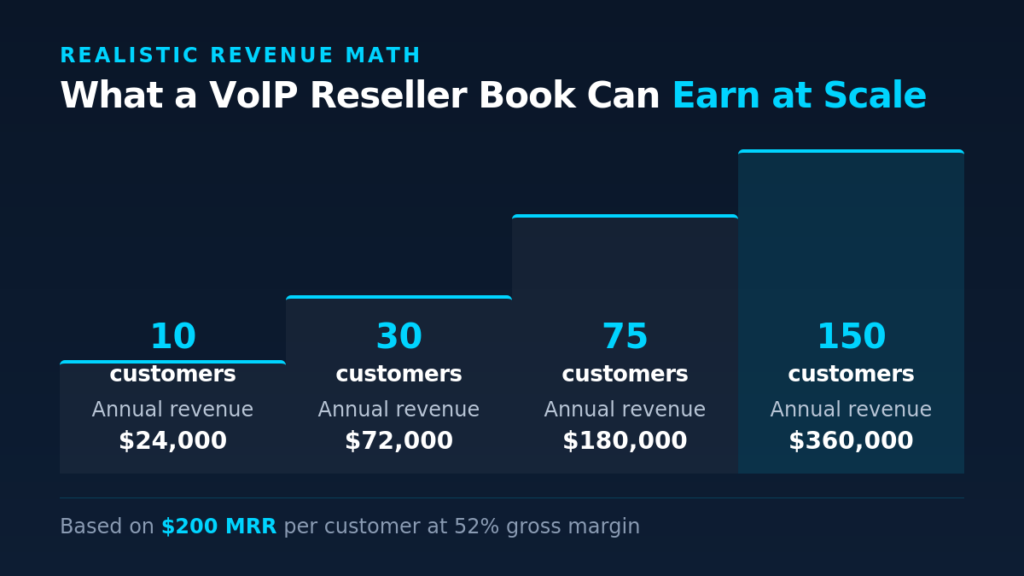
Assume an average customer with eight channels at $25 per channel per month, which produces $200 in monthly recurring revenue. If your wholesale cost is $12 per channel, your gross margin per customer is approximately $104 per month, or roughly 52%.
Now run the customer count scenarios:
- 10 customers generate $2,000 in monthly recurring revenue and roughly $24,000 annually in gross revenue. Achievable in the first six to twelve months for a focused reseller.
- 30 customers generate $6,000 in monthly recurring revenue and roughly $72,000 annually in gross revenue. A realistic year-two milestone with consistent sales effort.
- 75 customers generate $15,000 in monthly recurring revenue and roughly $180,000 annually in gross revenue. The point at which most resellers can hire their first dedicated salesperson or support staff.
- 150 customers generate $30,000 in monthly recurring revenue and roughly $360,000 annually in gross revenue. A mature reseller business with multiple referral sources and predictable growth.
These numbers assume average customer profiles. Resellers serving larger organizations or bundling additional services routinely double their per-customer MRR. The compounding effect of recurring revenue is the entire point of the VoIP reseller model: every customer you retain adds permanently to your monthly baseline.
What Are the Most Common Mistakes New Telecom Resellers Make?
Five mistakes account for most early failures in the reseller space:
- Choosing a platform based on price alone. Cheap wholesale rates often come with poor support, unreliable provisioning, and hidden fees that erode margins.
- Pursuing every customer. Generalists struggle to differentiate. Specialists build defensible businesses.
- Under-pricing services. New resellers frequently quote below market rates to win business, then can’t sustain operations on the resulting margins.
- Neglecting customer success. Acquisition gets the attention while retention gets ignored. The math always favors retention.
- Skipping the tools stack. Trying to manage 50 customers in spreadsheets eventually breaks the business.
Avoid these mistakes, and you’ll be ahead of most of your competition in the first 24 months.
Frequently Asked Questions
How much does it cost to start a VoIP reseller business?
Startup costs are minimal when you partner with a reseller platform that requires no upfront investment. Expect to budget for business registration, website development, basic marketing, and your tools stack.
Do I need technical expertise to start a VoIP reseller business?
Deep technical expertise is not required. Quality reseller platforms handle the infrastructure and provide training on the control panel and provisioning process. A basic understanding of networking, VoIP concepts, and PBX systems improves your effectiveness but is not a barrier to entry.
How long does it take to become profitable as a VoIP reseller?
Most focused resellers reach break-even within 6 to 12 months, depending on their existing network and sales efforts. Resellers who already have an MSP or IT consulting business often reach profitability faster because they can offer VoIP to their existing customer base.
What is the difference between a VoIP reseller and a wholesale VoIP provider?
A wholesale provider operates infrastructure and sells capacity at scale to resellers and large enterprises. A reseller purchases that capacity and sells it to end customers under their own brand, typically with added support and value-added services.
Can I resell VoIP alongside other services?
Yes, and the most successful telecom resellers bundle VoIP with adjacent services like managed IT, cybersecurity, internet access, and unified communications. Bundling increases customer lifetime value and reduces churn.
Ready to Start Your VoIP Reseller Business?
Starting a VoIP reseller business in 2026 offers a clear path to recurring revenue, defensible customer relationships, and a scalable model that grows with your effort. The market conditions support new entrants, the technology has matured, and the right platform partner removes the operational burdens that historically limited this opportunity.
SIPTRUNK gives you the foundation to build a profitable reseller business with no upfront costs, automated provisioning, hands-off billing and tax management, and Tier-1 network reliability your customers can count on. Built by telecom experts with decades of combined experience, our white-label SIP trunking platform is designed specifically for telecom agents, IT consultants, VARs, and MSPs who want to expand their service offerings without infrastructure overhead. Get started with SIPTRUNK today and begin building your recurring revenue stream.

Mitch leads the Sales team at BCM One, overseeing revenue growth through cloud voice services across brands like SIPTRUNK, SIP.US, and Flowroute. With a focus on partner enablement and customer success, he helps businesses identify the right communication solutions within BCM One’s extensive portfolio. Mitch brings years of experience in channel sales and cloud-based telecom to every conversation.