

SIP Trunking and UCaaS: How MSPs Sell Hybrid Cloud Voice
Treating SIP trunking and UCaaS as an either/or decision costs you revenue in accounts you already control.
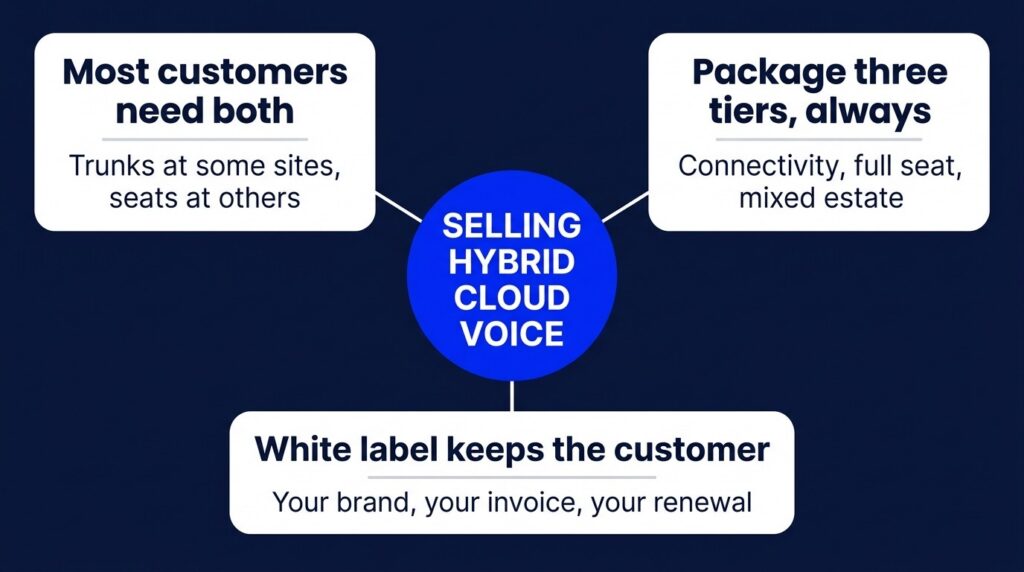
- Most customers need both, just not at the same sites. One organization can run trunks into a headquarters PBX while branch offices and remote staff sit on hosted seats.
- Trigger events arrive on a schedule. Copper retirement, PBX end-of-life, and site consolidation each force a voice decision, and whoever is in the room keeps the account.
- Packaging beats picking. Partners presenting connectivity-only, full-seat, and mixed options close more of the deal than partners arriving with a single product.
- White-label delivery protects the relationship. Branding, billing, and customer-of-record control decide whether you own the customer or merely refer them.
Stop qualifying customers into one product and start qualifying them into a migration sequence you control from first trunk to final seat.
Your client just signed a three-year cloud phone contract. You didn’t sell it. You’ve managed their network for six years, you know every wiring closet in the building, and a voice provider walked past you to take the recurring revenue because voice wasn’t on your line card. That scenario repeats weekly across the channel, and it traces back to one error: treating SIP trunking and UCaaS as rival products rather than two positions on the same migration path. The reseller-focused SIP trunking platform model exists so partners can hold both positions. Demand supports the effort, with the UCaaS market projected to grow from $70.56 billion in 2026 to $221.14 billion by 2031, a compound annual growth rate of 25.67%.
Why Are SIP Trunking and UCaaS Converging Inside the Same Account?
SIP trunking and UCaaS converge because businesses rarely modernize in a single event. They modernize in stages, site by site, and each stage produces a different technical requirement. A manufacturer might replace its front-office phone system this year while leaving a hardened plant platform untouched for another five. Both are voice revenue, and only a partner carrying both products can serve both.
What’s Driving Demand for Hybrid Cloud Voice?
Three forces push customers toward a hybrid cloud voice posture rather than a clean cutover. Sunk investment comes first. Organizations that bought premises equipment recently want to protect that capital, and connecting an existing system to modern voice service extends its life at a fraction of replacement cost. Workforce distribution comes second because staff working from home or client sites need mobility features that a legacy platform can’t deliver. Risk tolerance comes third, since finance departments resist migrating an organization’s entire dial tone in one weekend.
Market data reflects the fragmentation. Cloud telephony demand spans UCaaS, cloud PBX, and SIP trunking simultaneously, with the category valued at $29.17 billion in 2026 and forecast to reach $45.57 billion by 2031. Those segments grow together, not at each other’s expense.
Why Does a Single-Service Portfolio Cap Your Account Value?
Every phone system needs a connection to the public network. Sell hosted seats without connectivity, and you leave trunk revenue for someone else. Sell trunks without seats, and you have no answer when the customer’s PBX dies, so the replacement conversation happens without you. A SIP trunk reseller program supporting both delivery models turns each modernization event into an expansion rather than a defense.
When Does a Customer Need SIP Trunks, UCaaS, or Both?
The qualification question is not which technology is better. It’s what the customer already owns, how much life is left in it, and how their people actually work. The table below maps common customer profiles to the recommendation that fits.
| If the customer looks like this | Recommend | Because |
| IP-capable PBX under five years old, single site, staff mostly on-premises | SIP trunks only | Connectivity modernizes call delivery without stranding the equipment investment |
| Aging or end-of-life PBX, no appetite for new hardware, distributed staff | Full UCaaS seats | Replacement is unavoidable, so move the whole system rather than extending it |
| Existing cloud PBX with bundled calling plans, cost pressure on usage | SIP with cloud PBX | Separating carrier from application lowers usage cost and preserves the platform |
| Headquarters plus branches, mixed equipment ages, uneven site readiness | Hybrid cloud voice | Trunks hold the sites that aren’t ready, seats serve the sites that are |
| Contact center or specialty integrations tied to on-premises hardware | SIP trunks plus selective seats | Specialized routing stays local while general staff move to hosted |
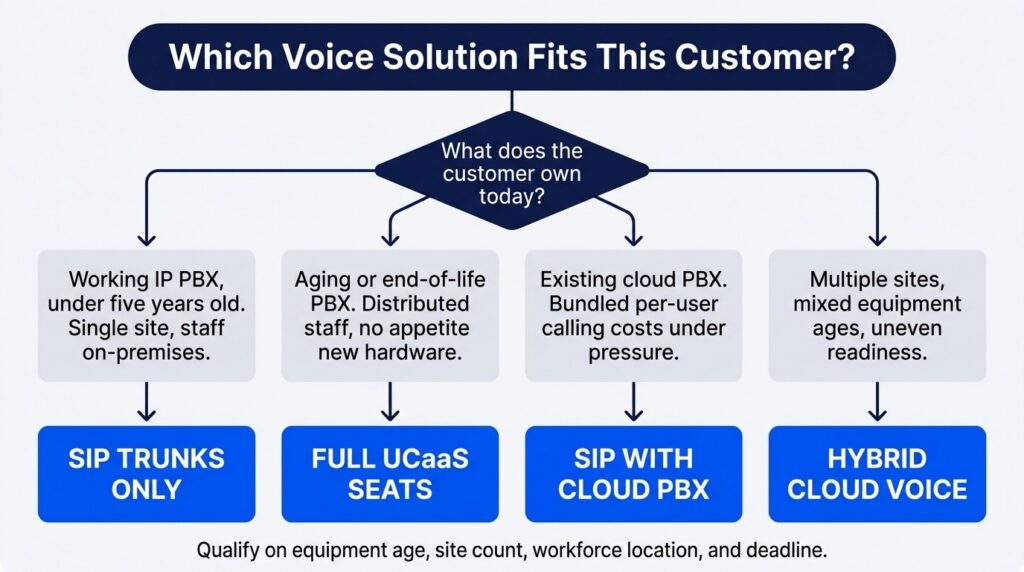
Run four qualifying questions in order, and the recommendation resolves itself:
- What is the age and support status of the current system?
- How many sites are involved, and are they on the same refresh cycle?
- What share of users work outside a fixed office?
- Is a hard deadline forcing action, such as a lease expiration or a carrier notice?
When SIP Trunking Alone Is the Correct Recommendation
Trunking alone fits customers whose phone system works and whose people sit in one place. These accounts want lower call costs, number flexibility, and failover routing without touching handsets or retraining staff. The sale is short, and the customer sees an immediate reduction in monthly spend. For a deeper breakdown, compare SIP and hosted deployment before recommending either.
When a Full UCaaS Deployment Is the Correct Recommendation
Full seat migration fits customers whose equipment has reached end of support, whose workforce has scattered, or whose feature demands have outrun an older platform. The tell is a support conversation rather than a cost conversation. When a customer describes what they cannot do, meaning video meetings, softphone access, and integrated messaging, they have already decided to replace the system. Your job is holding the replacement.
When the Hybrid Cloud Voice Model Wins
Hybrid wins whenever the answer to “Are all your sites ready?” is no. That describes most multi-location customers and nearly every organization mid-acquisition. Trunks serve locations with working equipment, hosted seats serve locations without it, and both sit under one partner relationship and one invoice. The customer gets a phased path with a predictable budget. You get two revenue lines and a reason to revisit the account each time a site comes due. To sharpen the distinctions, review how hosted PBX differs from trunk-based delivery.
What Do UCaaS Migration Paths Look Like for Different Customer Types?
A UCaaS migration is a sequence, not an event. The sequence changes depending on where the customer starts, and naming the correct path early separates a consultative partner from a vendor reading a datasheet.

Legacy PBX Customers Facing Copper Retirement
Customers still running services over copper are operating on a regulatory clock. The FCC requires incumbent carriers to notify customers before retiring copper facilities, and copper retirement notice requirements run at least 180 days for interconnecting entities and non-residential retail customers, with 90 days for residential customers. Six months sounds generous until you account for number porting, alarm and elevator circuits, and testing across a live business. Inventory every analog line, flag the ones tied to life-safety systems, and stage the migration before the letter arrives.
Existing Cloud PBX Customers
Customers already on a hosted platform look like closed opportunities. They aren’t. Many pay bundled per-user calling rates set by their platform vendor, and replacing that bundle with SIP with cloud PBX separates the carrier decision from the application decision. The customer keeps the interface that their staff knows, reduces usage cost, and gains portability if they later change platforms. It’s one of the fastest technical wins available, and it opens the broader account. Customers with heavier volume should understand how carrier-grade wholesale SIP trunking supports higher concurrent call demand.
Multi-Location Businesses
Multi-site customers offer the richest opportunity and the messiest starting conditions because sites differ in equipment age, bandwidth quality, and staffing model. Sequence these migrations by readiness rather than size. Begin with the site that has the newest network and the most cooperative manager, then use that result to move the remaining locations. Each completed site becomes internal proof that shortens the next approval cycle.
How Should a SIP Trunk Reseller Package SIP Trunking and UCaaS?
Packaging is where most partners lose margin. Arriving with one product forces a yes-or-no answer. Arriving with three tiers turns the conversation into a scoping exercise, which is far easier to win. The tiers below are defined by business model.
| Package tier | What it includes | Best-fit customer | Revenue profile |
| Connectivity | Trunks, numbers, porting, emergency services routing | Working PBX, single or few sites | Lower monthly value, very high retention |
| Full seat | Hosted seats, devices, features, admin portal, connectivity | End-of-life system, distributed staff | Highest monthly value per user |
| Mixed estate | Trunks at some sites, seats at others, unified invoicing | Multi-location, phased budget | Compounding value as sites convert |
Present all three every time, even when you know the answer. Customers who see the range understand your reasoning, and the tier you expect them to decline often becomes the tier they buy in year two. Partners formalizing this motion should review the fundamentals of building a trunk resale practice before setting pricing.
What Belongs in a Connectivity-Only Package
Keep this tier deliberately simple: trunk capacity, direct inward dial numbers, porting management, emergency services configuration, and a clear escalation path. Resist line items that inflate the quote because the appeal here is speed. A customer who accepts a connectivity package in two weeks is a customer you’ll still be serving when their PBX fails.
What Belongs in a Full-Seat Package
The seat tier carries your services value, so build it with onboarding, training, device procurement, and ongoing administration alongside the platform. Customers don’t compare seat prices in isolation. They compare the total experience of replacing a phone system, and the partner who removes the operational burden wins even at a higher rate.
How Does White-Label UCaaS Protect Customer Ownership and Margin?
White-label delivery determines who owns the customer relationship when something goes wrong. Under a referral or agent arrangement, the platform provider holds billing, support, and often the contract. Under a white-label UCaaS arrangement, you brand the portal, issue the invoice, and remain the customer of record. That distinction decides whether your voice practice is an asset with enterprise value or a commission stream that ends when the agreement does.
Branding matters more than partners expect. When the admin portal, statement, and support contact all carry your name, the cost of leaving you rises considerably. It also lets you set pricing rather than accept a fixed spread. SkySwitch voice services operate on this model, providing a full-stack white-label platform that partners deliver under their own brand to small and midsize business customers. Pairing SkySwitch voice for hosted seats with your own trunk supply gives you one portfolio covering both ends of the migration path. Partners weighing this option should spend time evaluating white-label voice platforms against their existing service model.
Two operational items deserve attention before launch. Telecom billing and taxation are more complex than software billing, so confirm how your platform handles surcharges and jurisdictional tax. Emergency location and messaging registration obligations apply once you become the provider of record.
What Are the Six Steps to Launching a Hybrid Cloud Voice Practice?
- Audit your base for voice signals. Flag PBX age, copper dependency, site count, and current voice vendor across every managed account. Most partners find qualified opportunities without a single cold call.
- Choose your delivery model deliberately. Decide now whether you’re branding the service or referring it because reversing that later means migrating customers twice.
- Certify one technical resource fully. One person who understands trunk provisioning, porting, and seat configuration outperforms five who each know a fragment.
- Build the packaging before the first sales call. Pricing improvised in front of a customer is pricing you’ll regret at renewal.
- Run one full UCaaS migration end to end. Document every step and every surprise, then turn that document into your standard operating procedure.
- Attach voice to every network renewal. The highest-yield habit for a SIP trunk reseller is raising the voice question during infrastructure conversations you’re already having.
Frequently Asked Questions
Can a business run SIP trunking and UCaaS at the same time? Yes, and many do. Trunks connect existing phone systems to the public network, while hosted seats serve users or sites without on-premises equipment. Both operate under one provider relationship and one invoice, which defines a hybrid cloud voice deployment.
Does adding UCaaS cannibalize my trunk revenue? No. Trunk and seat customers are usually different sites in one organization or the same site at different stages of its refresh cycle. Partners carrying both typically expand total account revenue because they capture modernization events that would otherwise go elsewhere.
What is the difference between reselling and white-label UCaaS? In a standard resale or agent model, the platform provider generally holds the billing and support relationship. In a white-label UCaaS model, you brand the service, invoice directly, and remain the customer of record, preserving both margin control and the relationship.
How long does a typical UCaaS migration take? A single-site migration under 50 users commonly runs two to four weeks, with number porting as the longest dependency. Multi-site projects run considerably longer and should be sequenced by site readiness rather than attempted simultaneously.
Do I need my own infrastructure to offer both services? No. Wholesale trunk supply and SkySwitch voice seats are both available through partner platforms that handle switching, routing, and network operations. Your investment goes into sales capability and support rather than capital equipment.
Building a Voice Practice That Holds the Whole Account
The partners winning voice business right now are the ones who can walk into any customer environment, diagnose whether that customer needs trunks, seats, or both, and deliver whichever answer is true. That capability compounds, and every site you convert makes the next conversation easier.
SIPTRUNK gives resellers the platform, provisioning tools, and support to build exactly that practice, with no contracts, no upfront costs, and hands-off billing and taxes. Start building your voice practice and turn your next modernization conversation into recurring revenue.

Mitch leads the Sales team at BCM One, overseeing revenue growth through cloud voice services across brands like SIPTRUNK, SIP.US, and Flowroute. With a focus on partner enablement and customer success, he helps businesses identify the right communication solutions within BCM One’s extensive portfolio. Mitch brings years of experience in channel sales and cloud-based telecom to every conversation.