
Wholesale VoIP Solutions: How Resellers Scale for Profit
Wholesale VoIP solutions pay off for established partners when voice runs as a repeatable practice instead of a string of one-off SIP sales.
- Platform-based delivery lets you add customers without buying a softswitch, negotiating carrier interconnects, or staffing a 24/7 network team.
- SIP reseller margins come from two sources: recurring revenue on the voice service and the services you already bill around each trunk.
- Provisioning, porting, billing, and taxes need standardized workflows before added volume stops adding headcount.
- Retention and multi-location accounts drive more wholesale voice growth than new logos alone.
If you’ve closed a handful of SIP deals and each one still feels like a custom project, it’s time to build the practice.
Most dealers and MSPs don’t struggle to sell their first few SIP trunks. The strain shows up later, when every new account still needs a custom build and a manually tracked port. Wholesale VoIP solutions fix that by giving you carrier-grade voice you can sell, provision, and support at volume through a SIP trunk reseller platform instead of infrastructure you own.
The timing works in your favor. A 2026 channel study found that 49% of IT service providers still run a mix of recurring and project-based revenue, while only 13% operate as pure managed service providers. This guide is for partners who already sell voice and want to turn it into a practice: where the margin comes from, what to automate, how to keep customers, and when the shift makes sense.
What Are Wholesale VoIP Solutions for an Established Reseller?
Wholesale VoIP solutions give you access to carrier-grade SIP trunking, phone numbers, and provisioning tools through a platform, so you can sell and manage voice without operating the network behind it. For a partner with an existing customer base, voice becomes another recurring line in the portfolio rather than a separate company to build.
The distinction that matters at this stage is operational. Occasional SIP sales treat each account as a project; a wholesale practice treats voice as a product with a standard build and support path. If you want the fundamentals of pricing models, routing quality, and how the wholesale model works, the Wholesale SIP Trunking Guide: Pricing, Routing, Margins covers them in depth. This article picks up where that guide stops: what it takes to scale.
When Should You Move From One-Off SIP Sales to a Wholesale Practice?
You should move to a repeatable wholesale practice once voice demand shows up in your pipeline on its own and each deal still costs you custom work. At that point, standardizing pays back on every account you add, and it’s the move that lets you scale VoIP reseller business operations without scaling payroll at the same rate. Here are seven signs you’re ready:
- Customers keep raising voice with you. PBX renewals and copper disconnect notices are showing up in your tickets.
- You keep rebuilding the same configuration. Slightly different builds of the same PBX cost you support hours later.
- Porting lives in someone’s inbox. Number transfers without a tracked process are where cutover days go wrong.
- Voice revenue is invisible in your reporting. If you can’t see voice revenue by account, you can’t manage it as a product line.
- Multi-site customers are buying one location at a time. Each site is handled as though it were a new customer.
- Your managed agreements skip the phone line. Contracts that cover endpoints and security but exclude voice leave a recurring line on the table.
- You’re passing on deals because of support load. When capacity, not demand, limits voice sales, the problem is the process.
If three or more sound familiar, the next step is to build the practice rather than push more deals through the current process.
How Do You Add Customers Without Building Carrier Infrastructure?
You add customers without carrier infrastructure by letting a platform carry the network, compliance, and back office while you own the sale, relationship, and on-site work. Building those functions yourself moves you into the carrier business, with capital and staffing commitments that rarely fit a dealer or MSP model. Here’s how the responsibilities are split:
| Function | If you build it yourself | Typical platform model |
| Softswitch and session border controllers | Purchase, host, patch, and scale | Included in the platform |
| Carrier interconnects | Negotiate and maintain contracts | Accessed through the platform’s upstream carriers |
| Network monitoring | Staff a round-the-clock operations team | Handled by the platform |
| Call authentication and robocall compliance | Register, sign traffic, and keep filings current | Handled at the platform level |
| Billing and telecom taxes | Build systems and calculate surcharges | Handled by the platform in hands-off billing models |
| Customer relationship and on-site work | Yours | Yours |
Wholesale VoIP for resellers works best when the partner treats the platform as its network team and invests its own people in sales, deployment, and account management, which is how wholesale VoIP solutions keep overhead from rising in step with volume. Once you’re ready to commit volume, review carrier-grade wholesale SIP trunking options built for partners as the next step.
Where Do SIP Reseller Margins Actually Come From?
SIP reseller margins come from the recurring revenue on the voice service itself and the services you wrap around it. The first one compounds with every month an account stays. The second draws on skills your business already has, and it’s often where reseller profitability is won or lost.
How Program Structure Shapes Your Margin
Your margin on the voice line is set by the program type: a referral commission, a recurring platform commission, or a retail spread you bill yourself. Referral and agent programs pay a commission for introducing the customer, and the provider owns the account from there. Platform-based reseller programs pay a recurring commission for each customer while the platform sets pricing and handles billing, taxes, and collections. Self-billing arrangements let you set retail prices, but you also take on invoicing, tax calculation, and collections risk.
Each option trades control for workload, and none is wrong for every partner. For a dealer or MSP whose core business is equipment or IT services, the platform model usually fits best because wholesale VoIP for resellers shouldn’t turn your team into a billing department. Before you model pricing for customers, SIP Trunk Pricing Explained: Costs by User Type breaks down per-channel, metered, and unlimited structures by customer size.
The Revenue Layers Around Every Trunk
A single voice account can carry six revenue layers, and four of them recur every month. The table below shows each layer and how it contributes to reseller profitability:
| Revenue layer | Revenue type | What drives it |
| Voice service (channels or usage) | Recurring | Account size and retention |
| Additional numbers and toll-free | Recurring | Customer growth and new campaigns |
| PBX or phone hardware | One-time | Refresh cycles and new sites |
| Installation and cutover | One-time project | Migrations and new locations |
| Managed voice support | Recurring, under your contract | Bundling voice into managed agreements |
| Secondary trunk for failover | Recurring | Continuity requirements |
Reseller profitability improves fastest when an account carries several layers at once. A customer paying for voice, managed support, and a failover trunk is worth more each month and harder to pull away, since switching means unwinding three relationships instead of one.
How Do You Provision at Volume Without Adding Headcount?
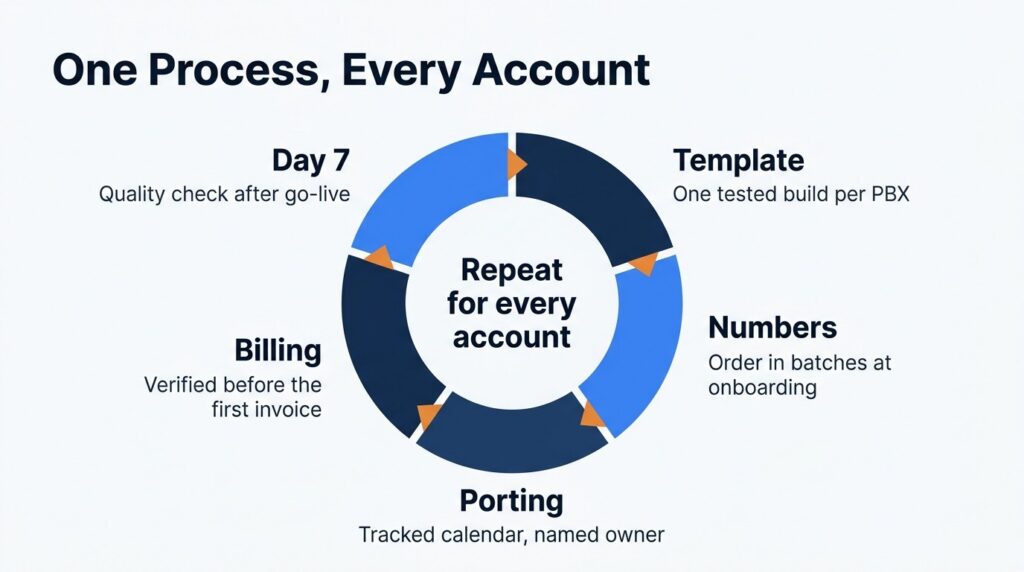
You provision at volume by standardizing every step that repeats: the build, the port, the billing handoff, and the first-week check. Platform automation only helps if your own process is consistent enough to use it. These workflows are worth locking down first:
- One template per supported PBX. Document a tested configuration so that any technician can build it the same way.
- Bulk number ordering. Order numbers in batches during onboarding instead of one at a time when a ticket arrives.
- A porting calendar. Track every transfer from submission to completion, with a named owner.
- A clean billing handoff. Confirm that each new account appears correctly in billing before the first invoice, not after a customer calls.
- A day-seven quality check. Review call quality and open tickets a week after go-live, while fixes are still simple.
Partners who scale VoIP reseller business lines this way find that the tenth account takes less effort than the second. This is also the point where choosing a SIP trunk reseller program with automated provisioning and a self-service portal starts saving real labor.
What Should You Measure as Volume Grows?
Measure the handful of numbers that tell you whether the practice is healthy: monthly recurring revenue per account, churn, time from order to live service, support tickets per account, and ports completed on the first attempt. Review them monthly because problems usually trace back to a skipped step. If you want to scale your VoIP reseller business revenue without surprises, these metrics show the next bottleneck before customers notice it.
Why Is Retention the Real Engine of Wholesale Voice Growth?
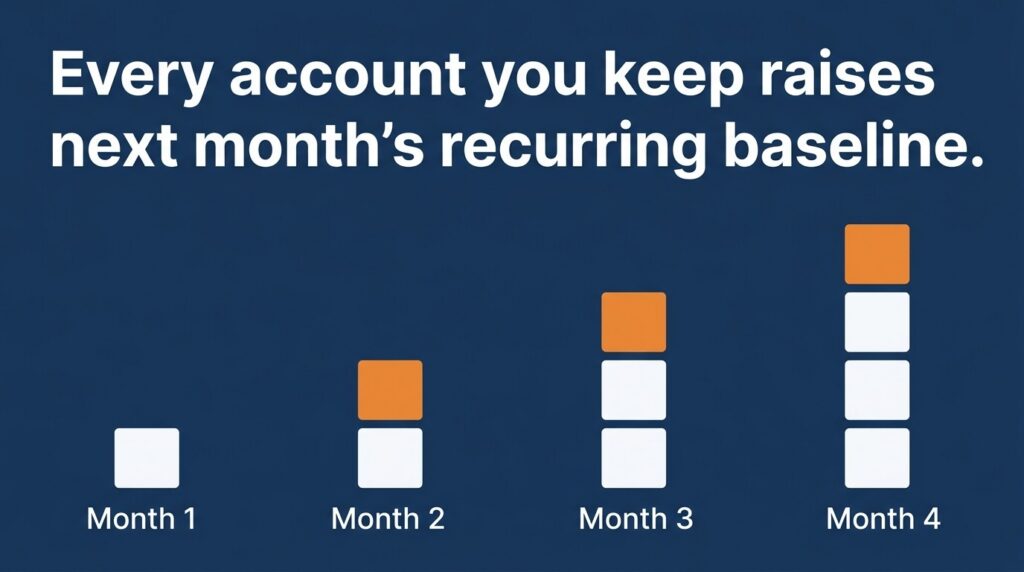
Retention drives wholesale voice growth because every account you keep raises next month’s recurring baseline before you close anything new. Lose accounts as fast as you add them, and even a busy sales team produces a flat line. Building a recurring revenue VoIP practice depends on keeping customers long enough for that baseline to compound.
Make Voice Part of the Managed Agreement
Write voice into your managed services agreement so it renews with everything else instead of standing alone as an easy line to replace. Add it to your standard agreement tiers so every new managed customer gets a voice conversation by default. That gives your account managers one renewal to protect and strengthens reseller profitability across the book.
Offer Continuity Before They Ask
A secondary trunk on a separate network keeps calls flowing if the primary path fails, and customers who’ve seen failover work tend to stay put. Bring it up in quarterly reviews alongside call volume and resolved tickets, so the customer sees the value you’re delivering. It’s also an add-on that raises account value, which makes recurring revenue VoIP accounts more resilient on both sides.
How Do Multi-Location Customers Change the Math?
Multi-location customers multiply the value of a single sale because one relationship can add trunks, numbers, and support at every site. They also raise the stakes on standardization and compliance, so they reward partners with a repeatable practice.
Site-by-site migrations are becoming more common as copper goes away. Federal rules adopted March 26, 2026 streamline how carriers retire legacy copper networks, and one of the largest incumbent carriers reported that its switched access lines fell to 2.1 million at the end of 2025, down from 2.7 million a year earlier, a drop of roughly 22% in 12 months. Every disconnect notice at a branch office is a conversation you want to start before someone else does.
Plan 911 Location Data Site by Site
Every location needs compliant 911 calling from day one. Federal 911 rules for multi-line systems require direct 911 dialing with no prefix, notification to a central point such as a security desk, and dispatchable location details such as the street address, floor, and room of the caller. Confirm each site’s emergency address during onboarding and add it to your build template, so compliance scales along with the account.
Standardize Once, Deploy Many Times
Design the build at the first location, then reuse it everywhere. Keep one configuration, one porting plan, and one support path, adjusting only for local numbers and addresses. That consistency turns wholesale VoIP solutions into a recurring revenue VoIP model you can repeat at every site instead of a new project each time.
Frequently Asked Questions
Do I Need My Own Network to Offer Wholesale VoIP Solutions?
No. Platform-based wholesale VoIP for resellers supplies the switching, carrier connections, monitoring, and compliance, while you handle sales, deployment, and customer support. That platform lets an MSP or dealer add wholesale VoIP solutions without becoming a carrier.
How Is Scaling a Wholesale Practice Different From Starting a Reseller Business?
Starting a reseller business is about choosing a model and closing your first accounts, while scaling is about running voice as a repeatable product once demand already exists. That means standardized builds, tracked porting, retention, and account expansion. Many partners start with one-off sales and build the practice only after the workload makes the need obvious.
Can I Set My Own Retail Prices?
Only in a self-billing arrangement, where you also take on invoicing, taxes, and collections. Platform-based programs set pricing and handle billing for you, and you earn a recurring commission on each customer instead. For many dealers and MSPs, giving up pricing control is worth removing the billing workload.
Can I Sell Wholesale Voice Under My Own Brand?
Usually, yes, though the depth of branding varies by program. Some platforms provide rebrandable collateral, landing pages, and customer portals, while full white-label arrangements hide the underlying provider entirely. Decide how much of the customer experience you want to own before you standardize your build because branding choices shape your onboarding and support path.
How Quickly Does Recurring Voice Revenue Build?
Revenue starts the month your first accounts go live, which is fastest for partners selling into an existing customer base. Growth after that depends on how steadily you add accounts and how well you keep them. Retention matters as much as sales velocity because every retained account becomes part of next month’s baseline.
Get Started Building a Repeatable Wholesale Voice Practice
You already have the customers and the technical skills. What turns voice into a scalable business is a platform that carries the network and back office, plus a process your team repeats at every account and site. SIPTRUNK gives dealers, MSPs, and telecom agents a SIP trunk reseller platform with Tier-1 networks, no contracts, no upfront costs, hands-off billing and taxes, and 24/7 expert support, plus the fastTRACK program for certified dealers ready to migrate an existing customer base. Get started with SIPTRUNK and make your next voice deal the first account in a practice built to scale.

Mitch leads the Sales team at BCM One, overseeing revenue growth through cloud voice services across brands like SIPTRUNK, SIP.US, and Flowroute. With a focus on partner enablement and customer success, he helps businesses identify the right communication solutions within BCM One’s extensive portfolio. Mitch brings years of experience in channel sales and cloud-based telecom to every conversation.