

How to Start a VoIP Business: Models, Costs & Growth
Starting a VoIP business today is a business model decision rather than an infrastructure project, and the reseller path reaches first revenue fastest.
- The VoIP market is on track to more than double by 2034 as businesses retire legacy phone circuits.
- Reseller and white-label VoIP models remove the capital cost of softswitches, carrier interconnects, and around-the-clock network staff.
- SIP trunk resale offers the shortest path to first revenue because it attaches to the phone systems your customers already own.
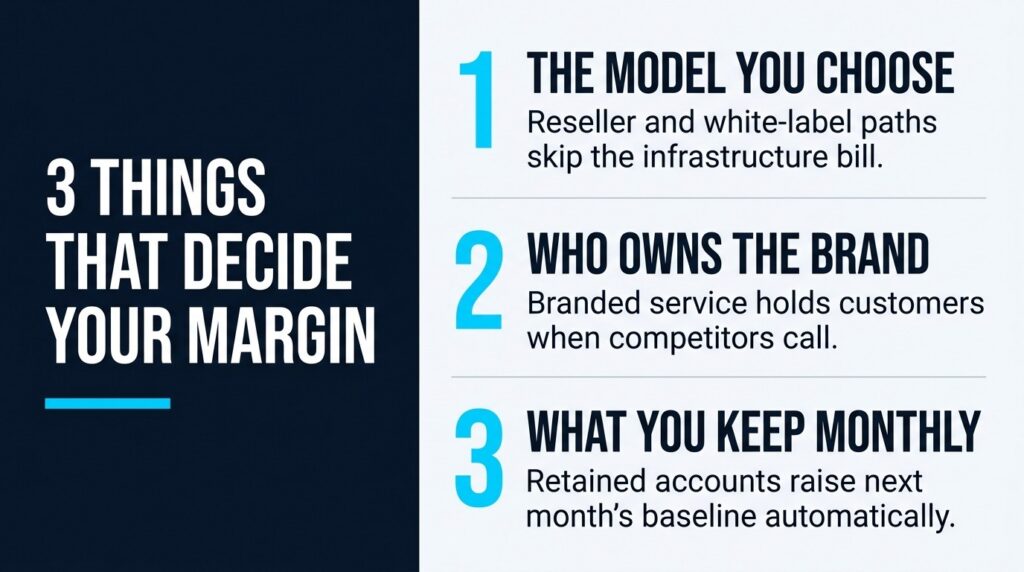
- Recurring revenue compounds, so every account you retain raises next month’s baseline before you sell anything new.
Choose your business model before you choose your technology because the model determines your margins, your workload, and how long it takes to reach profitability.
Voice has become one of the most dependable revenue lines available to technology providers, and the barrier to entry is far lower than most people assume. If you’re researching how to start a VoIP business, your first decision is structural. You’ll decide whether to build infrastructure, resell an established platform, or brand a partner’s service as your own, and that choice sets your startup costs, margins, and time to profitability.
The demand side supports the effort. Current VoIP market growth projections put the market at $176.16 billion in 2025, rising to $388.97 billion by 2034 at a 10.4% compound annual growth rate. Behind that number is a steady replacement cycle, as businesses decommission copper lines and legacy PBX circuits on a timeline that isn’t slowing. Every one of those migrations needs a provider to scope, quote, and support it. A SIP trunk reseller platform lets you serve that demand without owning a network.
How to Start a VoIP Business: What Does It Actually Cost?
Startup cost varies depending on the model you select, and this is where most planning goes wrong. Entrepreneurs price out a facilities-based buildout, see the number, and abandon the idea entirely. Most successful entrants never touch that cost structure.
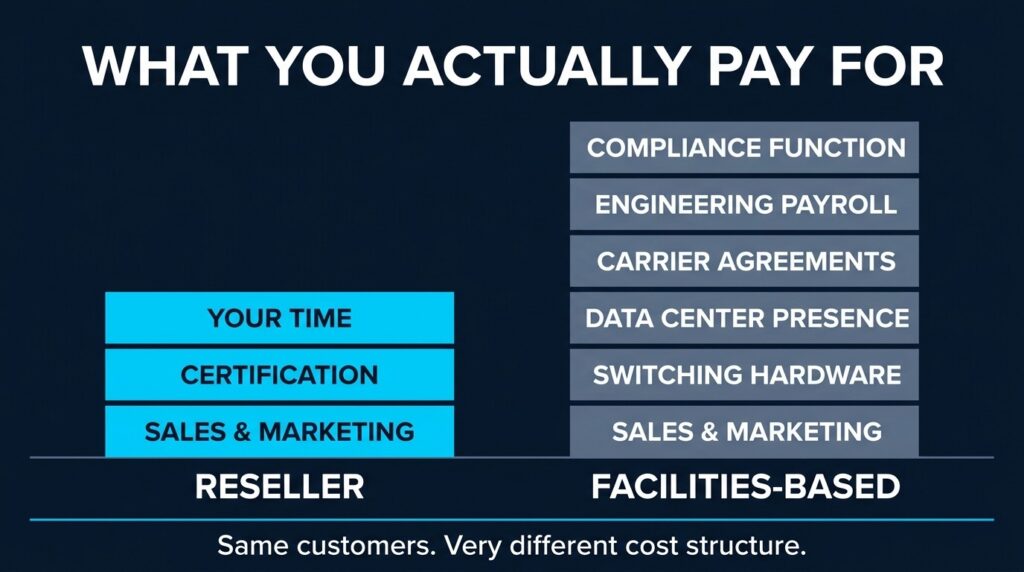
A reseller launch requires working capital for sales and marketing, a modest certification investment, and time. There’s no softswitch to purchase, no carrier interconnect to negotiate, and no network operations team to staff. Your primary expense becomes customer acquisition, a variable cost you control rather than a fixed obligation you carry.
Building your own carrier infrastructure is a different proposition. You’re financing switching hardware, redundant data center presence, carrier agreements, engineering salaries, and a compliance function, usually well before your first invoice goes out.
Which VoIP Business Model Should You Choose?
Four models dominate this market, and each trades capital intensity against control. Before comparing them, it helps to see how they stack up against the metrics that determine whether your business survives its first two years.
| Model | Upfront Investment | Technical Burden | Margin Control | Time to First Revenue |
| Reseller | Low | Minimal | Moderate | Weeks |
| White-Label | Low to moderate | Minimal | High | Weeks to months |
| Facilities-Based Provider | High | Substantial | Highest | 12 to 18 months |
| Hybrid | Moderate | Growing | High | Months |
The VoIP Reseller Model
Reselling means you sell service delivered on a partner’s network while owning the customer relationship, the quote, and the support experience. Your partner handles switching, number management, carrier redundancy, and monitoring. You handle everything the customer actually sees, which is where the relationship value lives. Most providers start here because a structured SIP trunk reseller program removes the operational risk that sinks new entrants.
The White-Label VoIP Model
White-label VoIP takes the reseller model further by putting your brand on the entire experience. Customers see your company name on the portal, invoice, and support interaction, with no visible trace of the platform provider. That control directly affects retention. A customer who knows your brand as their phone company is far less likely to shop the account when a competitor calls. When evaluating white-label VoIP providers, examine how much of the experience you genuinely control versus how much carries a logo swap.
The Facilities-Based Provider Model
Facilities-based providers own and operate their own network. The advantage is complete control over routing, feature development, and cost structure at scale. The disadvantage is a capital-intensive telecom operation carrying regulatory obligations, engineering payroll, and uptime accountability. This model rewards specialists with deep operational experience.
The Hybrid Approach
A hybrid entry means starting as a reseller and building internal capability as volume justifies it. You might begin on a partner platform, add your own provisioning tooling once demand is proven, then bring specific functions in-house. That progression lets you learn customer requirements before committing capital, which is a safer sequence than guessing at the outset.
Why Is SIP Trunk Resale the Fastest Entry Point?
SIP trunk resale reaches revenue faster than any other voice offering because it works with the phone systems your customers already have. Rather than asking a business to replace a functioning PBX, you connect that PBX to a modern IP voice service. The objection you’d normally face, meaning the cost and disruption of a full system replacement, never arises.
Recent SIP trunking forecasts place the market at roughly $85 billion in 2026, expanding toward $181.58 billion by 2031 at a 16.38% compound annual growth rate. The same research identifies cost savings between 25% and 65% over legacy PRI lines as the strongest driver behind that expansion.
That savings range is your entire sales conversation. When you can show a documented reduction against a customer’s current telecom invoice while improving flexibility, the deal largely closes itself. Our guide to reselling SIP trunks covers how these deals get structured and priced.
How Does Recurring Revenue Work in a VoIP Reseller Business?
Recurring revenue is the reason voice deserves a place in your portfolio. In a project-based business, January’s revenue disappears on February 1st, and you rebuild from zero. In a subscription business, January’s revenue becomes February’s floor. Add 10 accounts a month at a steady average, and by month 12, you’re carrying the accumulated weight of every prior month’s work.
Voice retention makes that compounding unusually reliable. Phone service is embedded in daily operations, tied to published numbers, and disruptive to change, so customers rarely switch over a small price difference. Margins depend on your partner’s wholesale terms, which means understanding the reseller pricing and margin structure you’re working with should precede any pricing decision you make.

Layering Revenue Beyond the Trunk
The trunk is a starting point rather than a ceiling. Additional channels, direct inward dial numbers, failover configurations, and managed support all attach naturally to an existing voice account. Because the relationship and billing infrastructure already exist, each addition carries a better margin than the original sale did. Providers who expand within accounts consistently outperform those chasing new logos alone.
What Infrastructure and Compliance Requirements Apply?
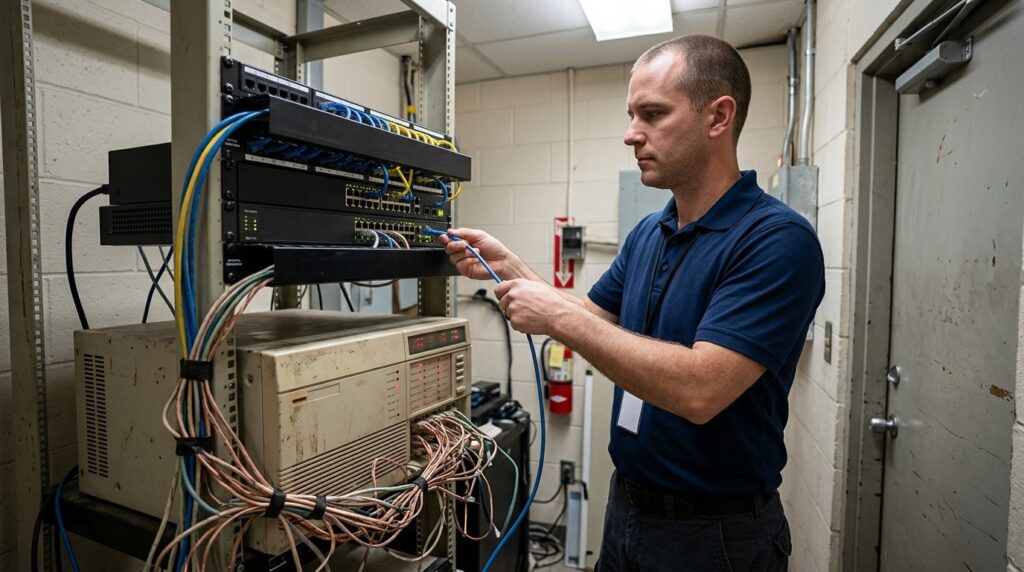
You’ll need less technical infrastructure than expected and more compliance attention than most new entrants anticipate. The technical side is manageable. The regulatory side is where avoidable mistakes get expensive.
Network and Quality Requirements
Voice quality depends on the connection between your customer and the carrier network, so bandwidth assessment belongs in every pre-sale conversation. Quality of service configuration that prioritizes voice over general data prevents most complaints. Session border controllers or properly configured firewalls handle security and protocol translation, and certified PBX platforms clearly document these requirements.
Regulatory and Tax Obligations
Voice services carry obligations that general technology services don’t. The FCC rules for VoIP providers require interconnected providers to deliver 911 service, comply with the Communications Assistance for Law Enforcement Act, and contribute to the Universal Service Fund. Telecommunications taxes vary by jurisdiction and service type in ways that catch new providers off guard. This is a strong argument for the reseller model, since established platforms typically absorb tax calculation, remittance, and regulatory filing for you.
Who Are Your Best Customers as a New VoIP Business?
Managed service providers and IT consultants hold the strongest position here because they already have the relationship and the credibility. If you manage a client’s network, servers, and endpoints, you’re the obvious candidate to manage their phone service too. The sales cycle shortens considerably when you extend an existing relationship rather than establish a new one.
Beyond that, three customer profiles convert reliably:
- Businesses still running PRI or analog lines. The savings case is documented and immediate.
- Multi-site operations. Centralized voice management delivers visible operational relief.
- Growing companies adding headcount. Traditional circuits scale poorly, and they feel that constraint every quarter.
Vertical specialization compounds these advantages because a provider who understands the call flow requirements of medical practices competes on expertise rather than price.
How to Start a VoIP Business That Scales: 7 Growth Moves
Reaching your first ten customers and reaching your first hundred require different disciplines. These seven moves separate providers who plateau from those who keep compounding.
- Standardize onboarding. Document provisioning, porting, and training as a repeatable sequence so that quality holds as volume grows.
- Price for margin, not for the win. Undercutting creates accounts that consume support without funding it.
- Sell voice as part of a bundle. Voice attached to managed IT services churns less than voice sold alone.
- Build a porting playbook. Number porting causes more customer anxiety than any other step, and handling it smoothly builds trust.
- Track monthly recurring revenue weekly. Churn is easier to correct early than at quarter close.
- Expand within accounts before hunting new ones. Existing customers convert at several times the rate of cold prospects.
- Choose partners by support quality. When something breaks at 2 a.m., your partner’s response time becomes your reputation.
What Mistakes Do New VoIP Businesses Make Most Often?
Underestimating customer acquisition is the most common failure. Many new providers assume market growth will generate inbound demand, then discover that buyers need education before they’ll move. Budget realistic time for sales and expect a consultative cycle.
Overcommitting on support is a close second because promising instant response to every customer quickly becomes unsustainable. Define service levels honestly and structure escalation through your platform partner. Neglecting contracts is the slower-burning version of the same problem, since clear terms covering service levels, payment, and cancellation protect the recurring revenue you’ve built.
Frequently Asked Questions
How much money do you need to start a VoIP business? It depends almost entirely on the model. A reseller launch requires working capital for sales, marketing, and certification rather than infrastructure. Building your own network moves the requirement into the hundreds of thousands.
Do you need technical expertise to start a VoIP business? Basic networking knowledge helps, but you don’t need carrier-grade engineering experience to enter through the reseller or white-label path. Established platforms provide certification and support that cover the gaps. If you already manage business networks, you have most of what you need.
How long does it take to become profitable? Providers with an existing business customer base often reach profitability within the first several months, since they’re selling into established relationships. Building from scratch commonly takes 6 to 12 months because the acquisition curve starts flat.
What’s the difference between a VoIP reseller and a white-label VoIP provider? Both sell services delivered on a partner’s network. The distinction is branding. A white-label VoIP arrangement puts your brand on the portal, the invoice, and the support experience, while a standard reseller arrangement may leave the platform provider visible.
Can you start a VoIP business alongside an existing IT company? Yes, and that’s typically the strongest launch position. Voice attaches naturally to managed services and IT consulting, deepening client relationships while adding a predictable revenue line. Many providers begin this way before deciding to scale a VoIP reseller business into a standalone practice.
Ready to Build Your Voice Practice?
Learning how to start a VoIP business comes down to a sequence of decisions rather than a technical hurdle. Choose the model that matches your capital and expertise, select a platform partner whose support you’d stake your reputation on, target customers whose phone bills make the savings case obvious, and let recurring revenue accumulate. Businesses replacing legacy circuits right now want a provider who understands their systems and answers the phone.
SIPTRUNK gives resellers, MSPs, and IT consultants a platform built for exactly this opportunity, with no contracts, no upfront costs, and billing, taxes, and 24/7 support handled for you. Explore the platform and get started today to begin building your recurring revenue stream.

Mitch leads the Sales team at BCM One, overseeing revenue growth through cloud voice services across brands like SIPTRUNK, SIP.US, and Flowroute. With a focus on partner enablement and customer success, he helps businesses identify the right communication solutions within BCM One’s extensive portfolio. Mitch brings years of experience in channel sales and cloud-based telecom to every conversation.