

How to Select the Best SIP Trunk Providers
Choosing the right SIP trunk provider determines whether your reseller business thrives or struggles with margin erosion and compliance headaches.
- The SIP trunking market is projected to grow to over $181 billion by 2031, creating worthwhile opportunities for telecom agents, IT consultants, and MSPs.
- AI-enhanced fraud detection, STIR/SHAKEN compliance support, and automated billing have become essential differentiators among providers of SIP trunking.
- White-label platforms designed specifically for resellers offer fundamentally different economics than retail-focused VoIP providers.
Evaluate potential partners based on compliance infrastructure, margin protection, and operational support before comparing per-minute rates.
Business owners and IT decision-makers continue moving away from legacy phone lines toward cloud-hosted voice communication. The SIP trunking market stood at $73.14 billion in 2025 and is projected to reach $181.58 billion by 2031, advancing at a 16.38% CAGR. This sustained growth reflects enterprises shifting toward IP-based voice services, accelerating PSTN decommissioning, and bundling voice with unified communications platforms.
For telecom agents, IT consultants, VARs, and MSPs, this expansion offers a significant revenue opportunity. Rather than building complex infrastructures from scratch, resellers are partnering with established SIP trunk providers and branding white-label services under their own names. The challenge lies in selecting the right SIP reseller platform from dozens of available options, each with different pricing structures, compliance capabilities, and support models.
This guide examines what distinguishes exceptional providers of SIP trunking from adequate ones, with particular attention to the regulatory changes, AI capabilities, and operational features that matter most for reseller profitability in 2026.
What Is the Technology Behind SIP Trunk Providers?
SIP stands for Session Initiation Protocol, the signaling technology used to initiate, maintain, and terminate voice calls transmitted over IP networks. Approved by the Internet Engineering Task Force in 1996 and standardized in 1999, SIP was designed to overcome early challenges of managing real-time voice communication between IP-based telephone systems. The protocol converts analog voice signals to digital packets and works alongside other real-time communication protocols for activities such as automated callbacks and message-waiting prompts.
Understanding SIP at a foundational level helps resellers explain the technology to prospective clients who remain unfamiliar with how internet-based voice communication differs from traditional telephony. A single SIP session can transmit any combination of digital media, including voice, video, and data, which is why SIP trunking has become the backbone for modern unified communications deployments.
How SIP Trunking Differs from Legacy Phone Service
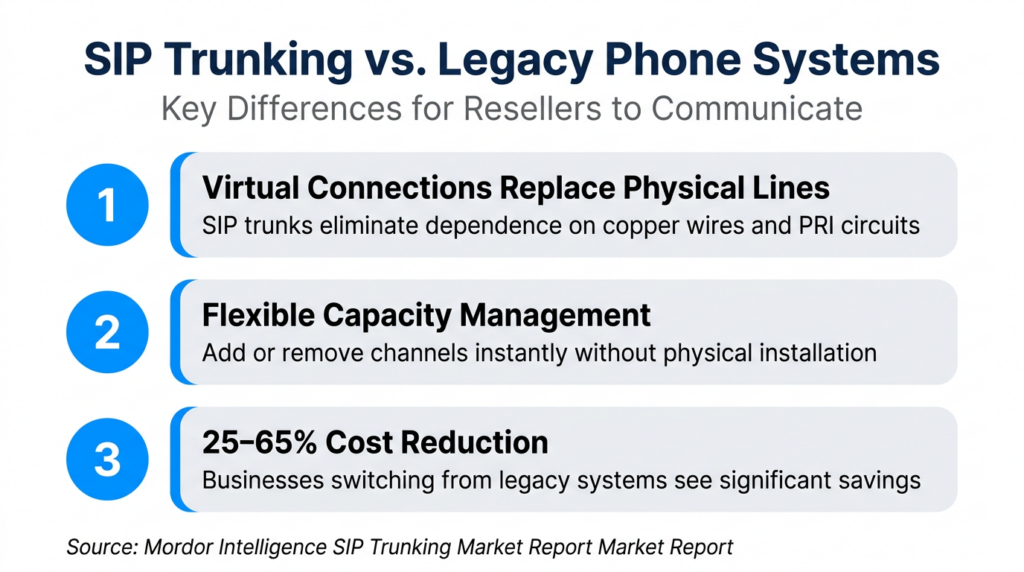
Traditional voice communication relies on a complex network of physical wires and cables connecting a business phone system, known as a private branch exchange (PBX), with the public switched telephone network (PSTN). When businesses need additional connectivity, they must absorb the high costs of installing and maintaining extra circuits. Each primary rate interface (PRI) circuit supports only 23 simultaneous calls plus one data channel.
SIP trunks create virtual connections that eliminate or reduce dependence on physical infrastructure. Voice communication travels over high-speed internet connections rather than bundled copper wires. This architectural difference enables SIP trunk providers to offer far more flexible capacity management, since adding channels requires no physical installation. Businesses can scale their voice capacity up or down based on actual usage patterns, rather than purchasing fixed-circuit bundles.
How Do SIP Providers Deliver Cost-Effective Voice Communication?
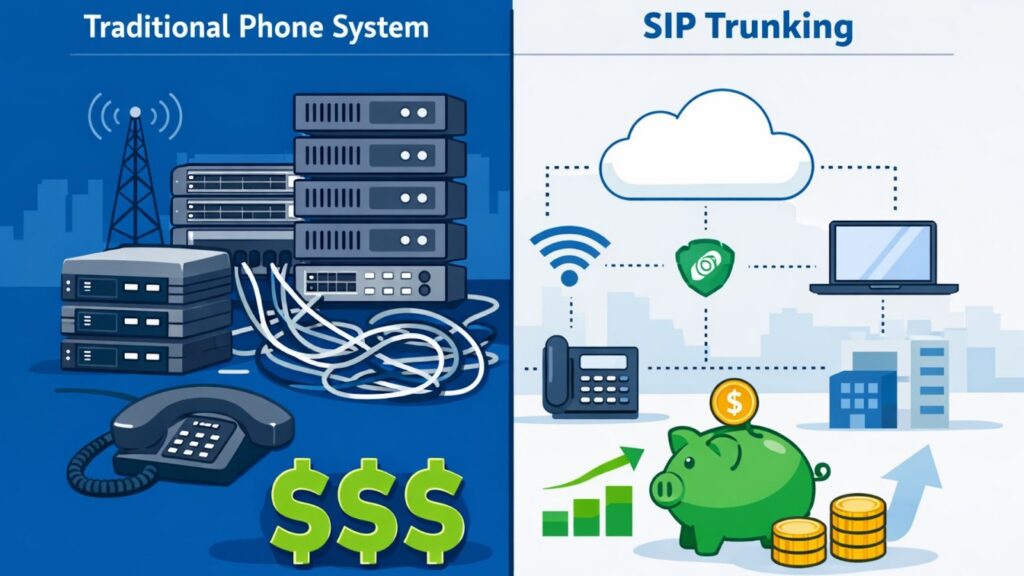
Providers of SIP trunking meet business demands by offering cloud-hosted access to communication solutions that cost far less than legacy phone service while expanding available features. The cost advantages stem from several structural differences in how services are delivered and priced.
Most companies still using legacy phone service pay monthly fees based on active phone lines assigned to their accounts. Many also pay additional charges for long-distance service and international calling, regardless of actual usage. SIP trunking replaces this model with channel-based pricing, where each channel handles one simultaneous incoming or outgoing call. Businesses can choose between paying a flat monthly fee per channel with unlimited domestic calling or paying for shared minute pools across unlimited channels.
Legacy systems require dedicated hardware rooms, ongoing maintenance contracts, and specialized technicians for repairs. Cloud-hosted SIP trunking shifts infrastructure management to the provider, freeing businesses from equipment maintenance. When internet service is interrupted, calls can be automatically forwarded to alternative numbers, providing business continuity that legacy systems can’t match without expensive redundant circuits.
For resellers, these cost advantages translate directly into sales conversations. Businesses switching from traditional phone systems to SIP trunking commonly reduce communication expenses by 25% to 65%, creating a compelling value proposition that essentially sells itself once prospects understand the comparison.
What Are the Key 2026 Trends Reshaping SIP Trunking?
The SIP trunking services segment alone grew from $16.60 billion in 2025 to $18.44 billion in 2026 and is expected to reach $36.28 billion by 2032. Several trends now shape how resellers should evaluate potential provider partners and position services to their clients.
AI Integration Across Voice Infrastructure
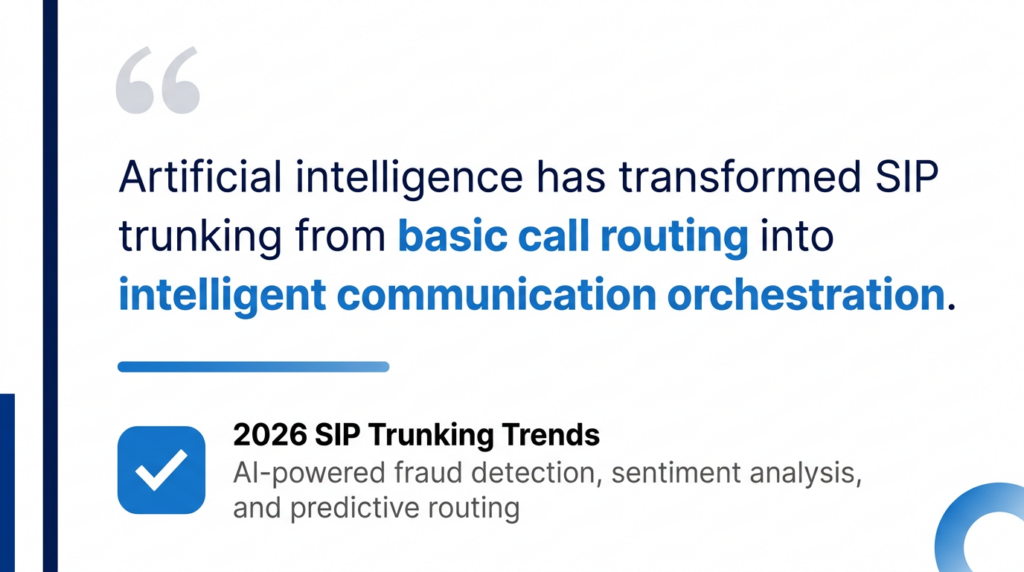
Artificial intelligence has transformed SIP trunking from basic call routing into intelligent communication orchestration. Leading VoIP providers now offer real-time sentiment analysis during calls, automated transcription services, and predictive call routing that considers caller history, agent expertise, and current workload distribution.
Fraud detection has become more sophisticated. AI systems continuously monitor call patterns to identify suspicious activity before it impacts operations. Voice recognition authentication and natural language processing enable auto-attendant systems that provide more intuitive customer interactions while reducing operational overhead. These capabilities, once available only to enterprise contact centers, are now accessible to small and mid-sized businesses through modern SIP trunking platforms.
Microsoft Teams Direct Routing
Integration with Microsoft Teams has become standard functionality rather than a premium add-on. Direct Routing capabilities enable businesses to leverage existing Teams investments while maintaining carrier-grade voice quality for external calls. Organizations can use their preferred collaboration tools while relying on SIP infrastructure for PSTN connectivity, eliminating the complexity of managing separate communication systems.
For resellers, Teams integration represents both a sales opportunity and a qualification criterion when evaluating SIP trunk providers. Businesses already using Microsoft 365 expect their voice services to integrate with their collaboration environment.
5G Network Support
The rollout of 5G networks influences SIP trunking services by enabling faster, more reliable communication with higher bandwidth and lower latency. Providers are adapting their platforms to support the increased speed and capacity that 5G offers, enhancing both voice and video quality. This network evolution also supports advanced applications that benefit from real-time data processing and improved mobile connectivity.
Regulatory Compliance Evolution
FCC regulations governing caller ID authentication have undergone changes that directly affect provider selection. The STIR/SHAKEN framework, designed to combat robocalls and caller ID spoofing, now includes stricter requirements for how calls are authenticated and signed. These compliance obligations have become an essential factor for resellers choosing wholesale partners.
Why Should Resellers Consider White-Label SIP Trunking Services?
White-label arrangements allow resellers to upload logos and branding information to cloud-hosted platforms and market services under their own company names. This model differs fundamentally from referral or commission-only arrangements where the underlying provider maintains direct customer relationships.
Benefits Your Clients Receive
Resellers offering white-label SIP trunking can help clients address several common communication challenges.
No expensive equipment upgrades. Many business owners hesitate to invest in cloud-hosted voice because they assume it requires purchasing new VoIP phone systems. With SIP trunking, many existing business phones are already SIP-enabled or can connect through inexpensive telephone adapters, eliminating the equipment barrier that stalls many modernization projects.
Flexible subscription models. Digital solutions from SIP trunk providers are sold by the channel rather than by fixed-circuit bundles. Clients can choose between paying one monthly fee per channel regardless of minutes used or paying for shared minute pools across unlimited channels. This flexibility allows businesses to match their communication costs to actual usage patterns.
Access to modern add-on services. SIP trunking subscribers can choose from services including toll-free numbers, business texting, fax-to-email, and Direct Inward Dialing (DID). The DID capability allows staff to work from nearly any location while maintaining a local presence, supporting hybrid and remote work arrangements.
Exceptional call quality and reliability. Outdated legacy infrastructure increases the risks of poor call quality and service disruptions. Modern SIP trunk providers deliver consistent call quality through redundant network infrastructure. If a client’s internet service is interrupted, calls automatically transfer to alternative numbers, maintaining business continuity.
Benefits for Your Reseller Business
Beyond client-facing advantages, reselling SIP trunks creates structural benefits for reseller operations.
Brand equity accumulation. When customers interact with your branded portal, receive invoices under your company name, and contact your support team, they build loyalty to your business rather than the underlying platform provider. This brand equity becomes a genuine business asset over time.
Pricing control. White-label arrangements typically allow resellers to set their own retail pricing without exposing wholesale rates. This flexibility enables you to compete on value rather than racing to the bottom on price.
Recurring revenue streams. Unlike one-time equipment sales, SIP trunking generates monthly subscription revenue for as long as customers remain active. Each customer added to your portfolio increases automatic monthly income, creating compounding returns as your customer base grows.
What Factors Should Resellers Evaluate When Comparing SIP Trunk Providers?
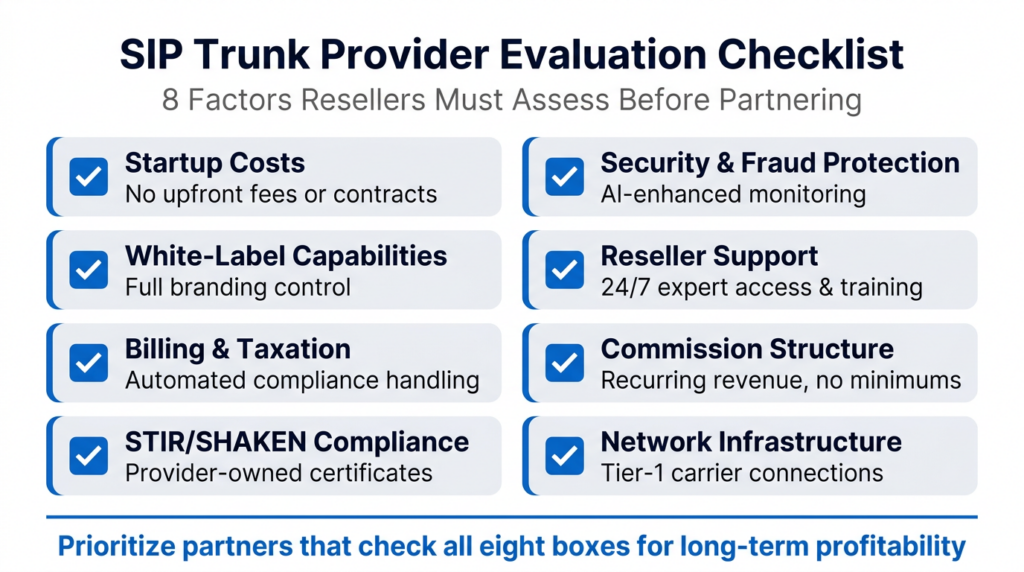
Although a quick search reveals multiple providers offering reseller opportunities, the differences between programs impact long-term profitability. Consider these factors carefully before committing to a partnership.
What Are the Startup Costs and Contract Requirements?
Some SIP trunk providers charge substantial startup fees to offset onboarding and training costs. With this arrangement, generating positive returns may take months or years. Others minimize startup fees but require long-term contracts that limit flexibility if the partnership proves unsatisfactory.
The most reseller-friendly providers require no upfront payment, offer contract-free service terms, and pay commissions for every sale without minimum revenue thresholds. Your subscribers similarly benefit from contract-free arrangements, knowing they can adjust or cancel service without incurring penalties.
Does the Provider Offer True White-Label Capabilities?
Not all reseller programs provide equivalent branding control. Some allow only minimal customization while prominently displaying the wholesale provider’s identity. Genuine white-label platforms enable complete branding of customer-facing portals, billing statements, documentation, and support interactions.
Evaluate whether you can customize the administrative portal with your logos and color schemes, generate invoices under your company name, and present a consistent brand experience throughout the customer lifecycle.
How Does the Provider Handle Billing and Taxation?
Reseller arrangements that add significant administrative burden to your workload can undermine profitability. Telecommunications billing involves complex tax calculations that vary by jurisdiction, and errors create compliance exposure.
Confirm that potential partners offer automated service quoting, invoicing, and a taxation engine that handles regulatory requirements. The best VoIP providers deposit commissions directly to your bank account monthly and provide portal access for tracking earnings in real time.
What STIR/SHAKEN Compliance Support Does the Provider Offer?
The FCC’s Eighth Report and Order introduced changes to caller ID authentication requirements. As of September 2025, voice service providers with STIR/SHAKEN obligations must use their own certificates obtained from approved authorities rather than relying on third-party authentication. Providers must make independent attestation decisions for every call.
Resellers must evaluate whether wholesale partners have implemented compliant infrastructure. Providers lacking proper SIP trunking compliance support expose resellers and their customers to enforcement risk. The March 2026 deadline for Robocall Mitigation Database recertification adds another compliance checkpoint that quality providers will navigate transparently.
What Security and Fraud Protection Features Are Available?
Protecting your brand reputation requires partnering with a platform capable of detecting connection failures within milliseconds and rerouting transmissions in real time. The best SIP trunk providers incorporate AI-enhanced security features that identify and deter suspicious activity and unauthorized access before damage occurs.
Toll fraud protection has become particularly important as sophisticated attackers target business phone systems. Ask potential providers about their fraud detection capabilities, monitoring practices, and response procedures when anomalies are detected.
What Reseller Support and Training Resources Exist?
Quality SIP providers recognize that reseller success drives their own growth. They invest accordingly in support, including 24/7 access to telecom experts, comprehensive onboarding programs, and ongoing training resources.
Evaluate the depth of available support by asking about escalation procedures for complex technical issues, availability of co-branded marketing materials, and access to sales training that helps you effectively position services. Providers genuinely committed to channel partner success offer these resources proactively rather than as premium add-ons.
How Is the Commission Structure Designed?
Commission arrangements vary across providers. Some pay a fixed amount for each new account activated and nothing more. Others require resellers to reach targeted sales goals before qualifying for any payment.
The most favorable arrangements pay commissions throughout each subscription’s duration, have no minimum revenue requirements, and provide transparent tracking through reseller portals. This structure aligns provider and reseller incentives around customer retention rather than just acquisition.
What Network Infrastructure Supports the Service?
SIP trunking providers connect business PBX systems to the PSTN through different network tiers. Tier-2 and Tier-3 providers connect subscribers indirectly through networks operated by Tier-1 carriers (the network owners). Reselling services on a Tier-1 network ensures optimal call quality, network reliability, and faster response times when issues arise.
Additionally, confirm that potential partners allow flexibility in carrier selection. Some providers require resellers and subscribers to switch broadband carriers as a service condition, which can complicate sales conversations and limit your addressable market.
How Do FCC Compliance Requirements Affect Provider Selection?
Regulatory compliance has become a decisive factor in provider evaluation. The telecommunications industry faces its most significant compliance transformation since the original STIR/SHAKEN framework launched in 2020.
Understanding the September 2025 Rule Changes
The FCC’s updated requirements eliminated previous workarounds that allowed providers to rely on third-party authentication services. Voice service providers with STIR/SHAKEN obligations must now obtain their own certificates from approved Certificate Authorities. Each provider must independently evaluate every call and assign appropriate attestation levels based on their own analysis and customer relationships.
Your wholesale provider’s compliance status directly affects your ability to operate. Calls signed with improper attestation levels face increased blocking by downstream carriers, potentially disrupting your customers’ business communications.
Why Resellers Must Verify Provider Compliance
Non-compliant wholesale providers create cascading problems for resellers and their subscribers. Calls may be blocked or flagged as potential spam, damaging your customers’ ability to reach their own clients. Regulatory enforcement actions against non-compliant SIP trunk providers can disrupt service entirely.
When evaluating providers, request documentation of their STIR/SHAKEN implementation status, certificate ownership, and Robocall Mitigation Database filings. Quality providers share this information and proactively communicate about regulatory developments that affect their partners.
March 2026 Recertification Requirements
The FCC now requires annual recertification in the Robocall Mitigation Database by March 1 each year. This ongoing obligation means compliance is a continuous operational requirement. Providers with robust compliance infrastructure handle these requirements seamlessly, while those lacking dedicated compliance resources may create uncertainty for their reseller partners.
Frequently Asked Questions
What is the difference between SIP trunking and VoIP?
VoIP (Voice over Internet Protocol) is the broader technology category encompassing any voice communication transmitted over IP networks. SIP trunking is a specific implementation that uses Session Initiation Protocol to connect business PBX systems to the public telephone network. SIP trunking enables businesses to maintain existing phone system investments while gaining VoIP benefits, making it attractive for organizations that want modern capabilities without complete infrastructure replacement.
How many SIP channels does a typical business need?
Channel requirements depend on concurrent call volume rather than total employees. Most businesses need far fewer channels than traditional phone lines because calls naturally stagger throughout the day. The most reliable approach is reviewing current phone system reports to identify peak simultaneous call volumes, then adding modest headroom for growth. Quality SIP trunk providers allow easy capacity adjustments as actual usage patterns become clear, so starting conservatively and scaling up is often the most cost-effective strategy.
Can SIP trunking work with existing phone systems?
Yes, SIP trunking integrates with most existing PBX systems, including legacy equipment. IP-enabled PBX systems connect directly, while older analog systems work through session border controllers or analog telephone adapters. This compatibility allows businesses to modernize their voice connectivity incrementally rather than replacing entire phone infrastructures simultaneously.
What happens to SIP service during internet outages?
Quality providers of SIP trunking include automatic failover capabilities that redirect calls to alternative numbers when primary internet connections fail. This process typically involves forwarding to mobile phones, secondary office locations, or voicemail systems. The specific failover configuration depends on the provider’s capabilities and the customer’s business continuity requirements.
Partner with the Right SIP Trunk Provider to Scale Your Business
The SIP trunking market continues to expand as businesses recognize the cost savings, flexibility, and feature advantages over legacy phone systems. For resellers, this growth creates substantial opportunity, but capturing that opportunity requires partnering with providers built specifically for channel success.
The evaluation criteria outlined here, from compliance infrastructure to commission structures, separate providers that will support your long-term profitability from those that treat resellers as an afterthought. Prioritize partners offering genuine white-label capabilities, transparent billing, robust compliance support, and operational tools designed for scale.
SIPTRUNK offers a private-label reselling platform compatible with all major IP PBX systems, IP Gateways, and open-source PBX projects. With no upfront fees, contract-free service terms, and automated provisioning that gets subscribers running in minutes, the platform removes barriers that slow reseller growth. When you’re ready to generate consistent monthly revenue as a trusted provider of reliable SIP trunking services, get started with a free Dealer Account.

Mitch leads the Sales team at BCM One, overseeing revenue growth through cloud voice services across brands like SIPTRUNK, SIP.US, and Flowroute. With a focus on partner enablement and customer success, he helps businesses identify the right communication solutions within BCM One’s extensive portfolio. Mitch brings years of experience in channel sales and cloud-based telecom to every conversation.