

How to Choose the Best Wholesale SIP Provider for Your Reseller Business
Selecting the best wholesale SIP provider determines reseller success in the telecommunications market.
- Market growth projections show SIP trunking services expanding at a 16.64% CAGR.
- Key evaluation criteria include pricing transparency, white-label capabilities, Tier-1 network infrastructure, and comprehensive reseller enablement programs.
- North America holds the largest market share for SIP trunking, creating substantial demand for knowledgeable reseller partners.
- Successful resellers earn monthly recurring revenue per customer channel with proper provider partnerships.
Resellers who prioritize providers offering contract-free terms, transparent pricing, and dedicated support will capture the greatest share of this market opportunity.
The widespread shift from legacy phone systems to internet-based communications creates exceptional opportunities for resellers who understand how to evaluate and select wholesale SIP providers that deliver both technical excellence and business value.
Market dynamics strongly favor resellers entering the SIP trunking space now. The SIP trunking services market is projected to grow to $157.91 billion by 2030, representing a compound annual growth rate of 16.64%. North America holds the highest market share at 62.7%, creating substantial demand for knowledgeable resellers who can guide implementation and optimization.
For telecommunications resellers, choosing the best wholesale SIP provider impacts customer satisfaction, profitability, and long-term growth potential. The right partnership provides access to enterprise-grade infrastructure, competitive pricing, and comprehensive support that enables resellers to compete against larger providers.
What Makes a Wholesale SIP Provider Right for Resellers?
Successful reseller partnerships require providers specifically designed to support channel partners rather than competing for direct customers. Understanding the distinction between wholesale and white-label models helps resellers identify providers aligned with their business objectives.
Wholesale SIP trunking typically involves purchasing services at volume discounts with limited branding customization. While pricing advantages exist, wholesale arrangements often restrict resellers’ ability to build brand equity and customer relationships. Resellers essentially become sales agents for the provider’s brand rather than developing their own market presence.
White-label SIP solutions offer complete branding control, allowing resellers to present services as their own offerings. This model enables stronger customer relationships, better profit margins, and greater control over pricing and service delivery. White-label partnerships provide resellers with the tools needed to build sustainable recurring revenue streams while maintaining competitive differentiation.
The market opportunity justifies careful provider selection. SIP trunking accounts for 32.2% of the broader VoIP services market, which itself is projected to grow to $725.41 billion by 2034. This expansion reflects businesses’ recognition that internet-based communications deliver superior flexibility, cost savings, and feature capabilities compared to traditional telephony.
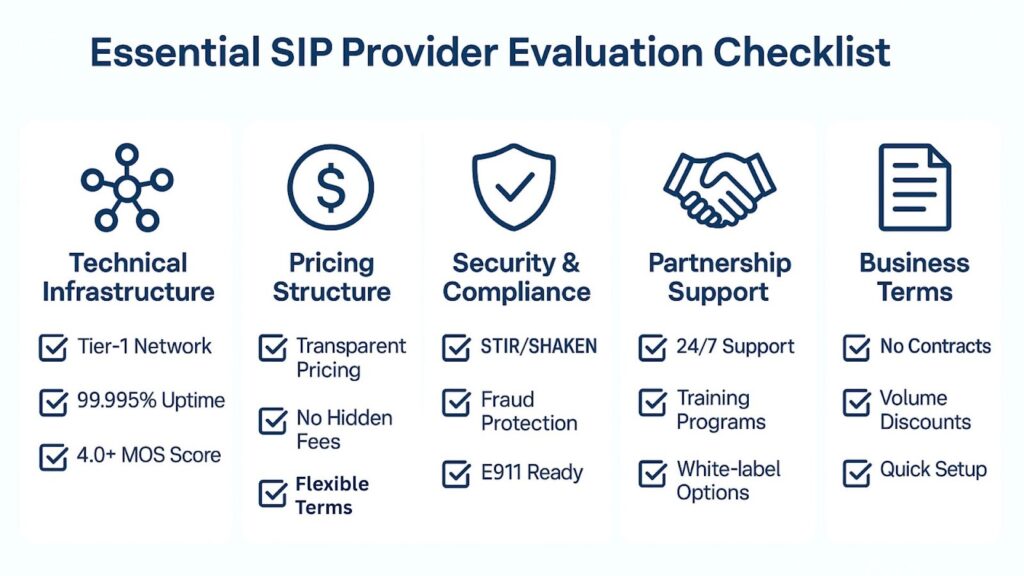
Understanding technical requirements helps resellers evaluate providers objectively. SIP trunk vendors must deliver consistent call quality, reliable connectivity, and seamless integration capabilities that meet modern business needs. The best providers offer Tier-1 network infrastructure, redundant routing, and advanced security features that protect against fraud and ensure regulatory compliance.
How Do You Evaluate SIP Provider Pricing Structures?
Pricing models impact reseller profitability and competitive positioning. The most successful reseller partnerships offer transparent, predictable pricing that enables accurate customer proposals and sustainable margin development.
Per-Minute vs. Per-Channel Models: Traditional per-minute pricing charges for actual usage, creating cost uncertainty for customers with variable call volumes. While this model works for businesses with predictable, low-volume communication needs, most companies prefer the budget predictability of per-channel pricing. Per-channel models charge fixed monthly fees regardless of minutes used, simplifying customer budgeting while providing resellers with consistent recurring revenue.
Unlimited Plans and Hybrid Options: Advanced pricing structures combine the benefits of both approaches. Unlimited channel plans allow customers to purchase blocks of minutes shared across multiple lines, optimizing costs for businesses with fluctuating usage patterns. Wholesale trunk options offer extreme flexibility with per-minute rates and unlimited channels, perfect for organizations with highly variable call volumes.
Hidden Costs and Fee Transparency: Careful evaluation of pricing includes understanding setup fees, regulatory charges, number porting costs, and international rate structures. The best wholesale SIP providers offer transparent pricing without hidden charges that erode customer satisfaction and reseller margins. Contract-free arrangements provide additional flexibility, reducing customer acquisition barriers while eliminating long-term commitment risks.
Volume Discounts and Scaling Benefits: Providers offering tiered pricing based on aggregate reseller volume enable better margins as businesses grow. These structures reward successful resellers with improved pricing that can be passed along to customers or retained for enhanced profitability. Understanding breakpoints and qualification requirements helps resellers plan growth strategies and customer acquisition targets.
What Technical Capabilities Should You Prioritize?
Technical infrastructure directly impacts service quality and customer satisfaction. The best wholesale SIP providers invest heavily in network reliability, security, and integration capabilities that enable resellers to deliver enterprise-grade communications to customers of all sizes.

Network Quality and Redundancy Requirements
Tier-1 network infrastructure provides the foundation for superior call quality and reliability. Unlike Tier-2 and Tier-3 providers that depend on other networks, Tier-1 providers own and operate their infrastructure, ensuring consistent performance and rapid issue resolution. Geographic redundancy protects against outages while intelligent routing optimizes call quality based on real-time network conditions.
Voice quality metrics matter for business communications. Providers achieving 99.995% uptime and 4.0+ MOS ratings deliver the reliability expected by professional users. Automated failover capabilities ensure service continuity even during maintenance or unexpected disruptions.
Security and Fraud Protection
Modern SIP trunking platforms require comprehensive security measures protecting against sophisticated threats. Advanced encryption, intrusion detection, and fraud monitoring defend against unauthorized access and toll fraud. AI-enhanced security features detect and deter suspicious activity in real time.
Regulatory compliance becomes increasingly important as communication regulations evolve. STIR/SHAKEN compliance, E911 capabilities, and data protection measures ensure providers meet current and emerging requirements without exposing resellers to compliance risks.
Integration and Compatibility Features
Seamless integration with existing business systems enhances the value proposition for customers while reducing implementation complexity. The best SIP trunk vendors support popular PBX platforms, including Asterisk, FreePBX, and commercial systems from major manufacturers. APIs enable custom integrations while pre-built connectors simplify common implementations.
Modern businesses expect unified communications capabilities that integrate voice, video, messaging, and collaboration tools. Providers offering these integrated platforms enable resellers to deliver comprehensive solutions rather than point products, increasing customer value and revenue opportunities.
Which Business Terms Matter Most for Reseller Success?
Partnership terms impact reseller profitability and operational flexibility. Understanding key contractual elements helps resellers negotiate arrangements that support sustainable business growth while minimizing operational constraints.

Contract Flexibility and Commitments
The most reseller-friendly providers operate without long-term contracts or minimum commitments, reducing barriers to entry and customer acquisition risks. This flexibility enables resellers to offer competitive terms to customers while maintaining operational agility. Contract-free arrangements also simplify customer onboarding and reduce the sales cycle complexity that can slow revenue development.
Revenue-sharing structures vary among providers. Commission-based models typically offer percentage-based compensation for ongoing customer revenue, creating aligned incentives for customer success and retention. Fixed markup arrangements provide predictable margins but may limit profitability as resellers scale their operations.
Territory and Exclusivity Considerations
Geographic restrictions and exclusivity provisions impact market opportunity and competitive positioning. Providers offering flexible territory arrangements enable resellers to pursue opportunities wherever they exist rather than constraining growth to specific regions. Non-exclusive arrangements allow multiple resellers in markets while preventing artificial scarcity that might limit customer choice.
Understanding competitive restrictions helps resellers evaluate partnership compatibility with existing business relationships. SIP trunking partners should avoid conflicts with other technology partnerships while enabling resellers to offer comprehensive communication solutions.
Financial Terms and Payment Processing
Payment terms and billing arrangements impact cash flow and operational efficiency. Providers offering net-30 terms with automated billing reduce administrative overhead while improving predictable revenue recognition. Integration with popular accounting and CRM systems streamlines financial management and customer relationship tracking.
Credit requirements and financial guarantees can create barriers for newer resellers. The most accessible providers offer flexible qualification criteria that enable capable resellers to participate without excessive financial prerequisites.
How Important Is Platform Usability and Support?
Operational efficiency depends on provider platforms and support capabilities. The best wholesale SIP providers invest in reseller-facing tools and support infrastructure that enable partner success rather than creating operational burdens.
Reseller Portal Functionality
Comprehensive management portals allow resellers to provision services, manage customers, and access billing information through intuitive interfaces. Real-time provisioning allows immediate service activation, improving customer satisfaction while reducing support overhead. Automated number porting tools streamline customer migrations while maintaining service continuity.
Advanced platforms offer white-label customization for resellers to present portals under their own branding. This capability strengthens customer relationships while maintaining professional presentation throughout the service lifecycle.
Training and Onboarding Programs
Comprehensive training programs accelerate reseller competency development and reduce time-to-revenue. The best providers offer a structured curriculum covering technical implementation, sales techniques, and ongoing account management. Reseller enablement programs include marketing support, lead generation assistance, and ongoing education that helps partners develop expertise and competitive differentiation.
Certification programs validate reseller competency while providing credible differentiation in competitive situations. Ongoing education ensures resellers stay current with technology developments and regulatory changes that impact customers.
Technical Support and Escalation Procedures
Multi-tiered support provides appropriate assistance levels for different situations. Level 1 support handles routine inquiries and basic troubleshooting while specialized technical teams address complex integration and performance issues. Clear escalation procedures ensure critical issues receive appropriate attention without unnecessary delays.
24/7 support is essential for resellers serving customers with mission-critical communication. The best providers offer dedicated reseller support that prioritizes partner needs while maintaining high service quality standards.
What Questions Should You Ask Potential SIP Partners?
Due diligence requires evaluating provider capabilities, business practices, and partnership compatibility. Structured questioning reveals critical information that impacts long-term success while identifying potential concerns before making commitments.
Technical Infrastructure Assessment
Network architecture questions should address redundancy, geographic diversity, and carrier relationships that impact service quality and reliability. Understanding whether providers operate Tier-1 infrastructure or depend on other carriers helps evaluate potential service quality and issue resolution.
Security and compliance inquiries should cover encryption, fraud monitoring, and regulatory compliance. Providers should demonstrate comprehensive security measures and provide clear documentation of compliance with relevant regulations, including STIR/SHAKEN, E911, and data protection requirements.
Financial and Business Stability
Understanding provider ownership, funding sources, and financial performance helps evaluate the likelihood of continued operations and investment in platform development. Public companies provide more financial transparency, while private companies may require additional due diligence.
Reference customers and case studies provide insight into provider performance and customer satisfaction. Speaking directly with existing reseller partners reveals practical experiences that may not appear in marketing materials. Understanding customer retention rates and satisfaction metrics provides objective performance indicators.
Partnership Terms and Growth Support
Pricing escalation procedures and volume discount structures impact long-term profitability as reseller businesses grow. Understanding how providers handle pricing changes and volume milestone achievements helps resellers plan sustainable growth strategies and customer pricing models.
The best partners offer co-branded marketing materials, lead generation programs, and sales training that accelerate reseller revenue development. Understanding available support helps you evaluate the total value proposition beyond basic service delivery.
How Do You Make the Final Decision?
Creating a systematic approach to provider selection ensures you choose a partner that supports both immediate needs and long-term growth objectives. Use this practical framework to move from evaluation to implementation.

The 30-60-90 Day Evaluation Process
Start with a shortlist of three providers that meet your basic requirements. Request 30-day trial periods or pilot programs that allow direct testing with real customer scenarios. During this period, evaluate call quality, platform usability, and support responsiveness under actual operating conditions.
Use the second month to test integration capabilities with your existing tools and customer onboarding processes. Assess how quickly you can provision new services, port numbers, and resolve technical issues. Document any friction points that could impact customer satisfaction or operational efficiency.
The final month should focus on scalability testing and financial modeling. Understand how pricing changes as volumes increase and evaluate the provider’s ability to support your growth trajectory. Calculate the total cost of ownership, including hidden fees, support costs, and operational overhead.
Red Flags That Should Eliminate Providers
Avoid providers requiring large upfront payments, long-term contracts, or exclusive territory restrictions that limit your market opportunities. Providers unable to demonstrate current regulatory compliance or lacking transparent pricing should be eliminated immediately.
Technical red flags include reliance on Tier-2 or Tier-3 networks, limited redundancy, or inability to provide specific performance metrics. Support limitations, such as business-hours-only availability or outsourced technical support, often indicate insufficient reseller focus.
Making the Commitment and Next Steps
Once you’ve selected a provider, establish clear performance benchmarks and review schedules. Successful partnerships require ongoing communication about market developments, customer feedback, and growth opportunities.
Begin with a limited customer pilot to validate your service delivery processes before scaling operations. Document best practices for customer onboarding, technical support, and account management that can be systematized as your business grows.
Frequently Asked Questions
What’s the difference between wholesale and white-label SIP trunking for resellers? Wholesale SIP trunking provides volume discounts but limited branding control, while white-label solutions allow complete service customization under your brand. White-label partnerships typically offer better profit margins and stronger customer relationships, making them preferable for resellers focused on building sustainable businesses.
How much technical expertise do I need to become a successful SIP trunk reseller? While technical knowledge helps, many successful resellers start without telecommunications backgrounds. The best SIP trunk vendors provide comprehensive training, technical support, and automated tools that enable resellers to deliver professional services regardless of their initial technical expertise.
What profit margins can SIP trunk resellers typically expect? Successful resellers earn monthly recurring revenue per customer channel. With proper customer acquisition and retention, resellers can build substantial recurring revenue streams. Margins depend on pricing models, customer mix, and value-added services that differentiate offerings from basic connectivity.
How do I evaluate SIP provider reliability and call quality? Look for providers offering Tier-1 network infrastructure, 99.995% uptime guarantees, and 4.0+ MOS scores. Request trial periods or pilot programs that enable direct quality assessment. References from existing reseller partners provide practical insights into real-world performance and reliability.
What should I look for in SIP provider contract terms? Prioritize contract-free arrangements without minimum commitments or upfront costs. Flexible terms reduce customer acquisition barriers while maintaining operational agility. Transparent pricing without hidden fees enables accurate customer proposals and sustainable margin development.
Grow Your Reseller Business with Wholesale White-Label SIP
The telecommunications industry transformation creates unprecedented opportunities for resellers who choose providers offering the right combination of technical excellence, competitive pricing, and comprehensive partnership support.
SIPTRUNK offers a proven platform designed specifically for partner success. Our comprehensive reseller program combines enterprise-grade infrastructure, flexible pricing models, and dedicated support that enables sustainable recurring revenue development. Get started today and discover how our platform can accelerate your SIP trunking business growth.

Mitch leads the Sales team at BCM One, overseeing revenue growth through cloud voice services across brands like SIPTRUNK, SIP.US, and Flowroute. With a focus on partner enablement and customer success, he helps businesses identify the right communication solutions within BCM One’s extensive portfolio. Mitch brings years of experience in channel sales and cloud-based telecom to every conversation.