

IP Trunking vs SIP Trunking: What’s the Difference?
The terms IP trunking and SIP trunking are often used interchangeably, but they represent different layers of the same technology stack.
- SIP trunking is a specific, standardized form of IP trunking that uses Session Initiation Protocol to manage voice, video, and messaging sessions.
- IP trunking is the broader category describing any voice transmission over internet protocol networks, including proprietary systems.
- With the SIP trunking market growing rapidly, understanding these distinctions positions resellers to educate clients and close more deals.
For most business applications in 2026, SIP trunking delivers the flexibility, compatibility, and cost savings that modern organizations require.
Telecommunications resellers encounter these terms constantly when advising clients on modern communication infrastructure. The confusion between IP trunking vs SIP trunking creates real challenges during sales conversations, particularly when clients have done their own research and arrive with misconceptions about what each technology offers.
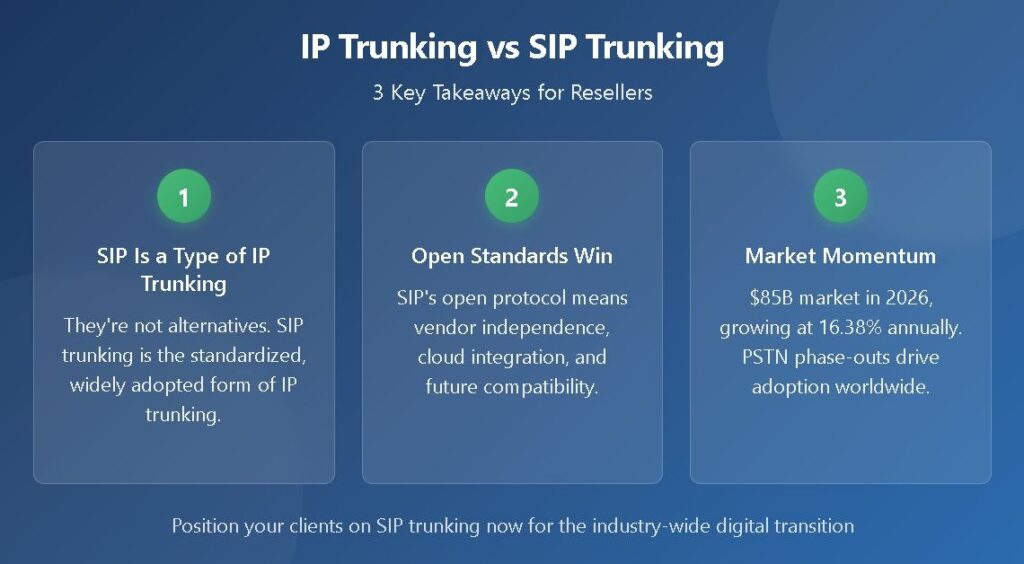
Here is the critical distinction that changes how you approach these conversations: SIP trunking and IP trunking are not competing alternatives. SIP trunking is a specific implementation of IP trunking that has become the industry standard due to its open protocol architecture and broad compatibility. The SIP trunking market currently stands at $85.07 billion in 2026 and is projected to reach $181.58 billion by 2031, advancing at a 16.38% CAGR. When clients ask about the difference between IP and SIP trunking, they are really asking whether standardized or proprietary approaches better serve their communication needs.
This guide breaks down both technologies, explains how PBX trunking fits into the conversation, and provides the clarity resellers need to recommend the right solutions with confidence.
What Is IP Trunking vs SIP Trunking?
The relationship between IP trunking vs SIP trunking technologies becomes clearer when you think of IP trunking as the category and SIP trunking as the most widely adopted method within that category.
IP trunking describes any system that transmits voice communications as data packets over an internet protocol network rather than traditional copper telephone lines. This broad definition encompasses multiple approaches, including proprietary vendor systems that may use different signaling protocols.
SIP trunking specifically uses Session Initiation Protocol to establish, manage, and terminate communication sessions. This standardized approach has become dominant because it works across different vendors, integrates with cloud platforms, and supports multimedia communications beyond voice alone.
The practical difference for your clients comes down to interoperability and future flexibility. A proprietary IP trunking system might work well today but create vendor lock-in that complicates future upgrades. SIP trunking’s open standards mean clients can switch providers, integrate new tools, and scale their systems without rebuilding their entire communication infrastructure.
What Are IP Trunking and VoIP Trunking?
IP trunking and VoIP trunking are terms that often appear together in client conversations. VoIP (Voice over Internet Protocol) specifically refers to transmitting voice data over IP networks. IP trunking is the infrastructure that makes large-scale VoIP deployments possible within organizations.
How Does IP Trunking Work?
Traditional telephone systems relied on dedicated copper lines connecting business locations to the public switched telephone network. Each line could handle one call at a time, making scaling expensive and time-consuming.
IP trunking replaces these physical connections with virtual pathways that transmit voice as digital data packets. The voice signal is converted to data at one end, travels across the IP network, and is converted back to audio at the destination. This approach allows multiple simultaneous calls over a single internet connection, with capacity limited only by available bandwidth rather than physical infrastructure.
Organizations implementing IP trunking typically connect their internal phone system to the broader telephone network through a media gateway or session border controller. These devices handle the conversion between internal IP traffic and external networks.
Benefits of IP Trunking
Cost reduction stands as the most immediate benefit clients recognize. Eliminating dedicated phone lines removes recurring charges for circuits that often sit underutilized. Long-distance calls travel over the internet rather than expensive carrier networks, reducing per-minute costs.
Scalability appeals to growing organizations frustrated by traditional telecom limitations. Adding phone capacity no longer requires scheduling technician visits or waiting weeks for new line installations. IT teams can provision additional capacity through software configuration, often within minutes.
Network simplification reduces ongoing management burden. Running voice and data over a single network eliminates the complexity of maintaining separate infrastructures with different support requirements and vendor relationships.
Limitations of IP Trunking
Proprietary IP trunking implementations can create compatibility challenges. Systems built on vendor-specific protocols may not integrate easily with third-party applications, cloud services, or future communication platforms. This limitation becomes problematic as businesses adopt unified communications tools that require interoperability across multiple systems.
Quality of service depends entirely on network performance. Unlike dedicated phone lines with guaranteed bandwidth, IP-based voice competes with other data traffic. Without proper network configuration and sufficient bandwidth, call quality suffers during periods of heavy data usage.
What Is SIP Trunking Specifically?
SIP trunking has emerged as the preferred method for connecting business phone systems to external networks. The technology uses Session Initiation Protocol, an open standard that defines how communication sessions are established, modified, and terminated across IP networks.

How Does SIP Trunking Work?
A SIP trunk functions as a virtual connection between an organization’s phone system and an Internet Telephony Service Provider. Unlike traditional trunk lines that required physical circuits, SIP trunks exist entirely as software-defined connections over internet infrastructure.
When someone places a call through a SIP-enabled system, the protocol handles the signaling that sets up the connection. SIP messages travel between the caller’s system and the provider’s network, establishing parameters for the call, including codec selection, call routing, and session management. The actual voice data then flows through the established path until either party ends the call.
Each SIP trunk can support multiple simultaneous calls through individual channels. A business needing to handle 20 concurrent calls simply provisions 20 channels on its SIP trunk rather than installing 20 separate phone lines.
Benefits of SIP Trunking
Standardization delivers the flexibility that modern businesses require. Because SIP follows published specifications rather than proprietary designs, systems from different vendors can communicate without compatibility issues. Clients can choose their preferred phone hardware, software applications, and service providers without worrying about integration problems.
Multimedia support extends SIP’s value beyond voice calls. The same protocol handles video conferencing, instant messaging, and presence information showing colleague availability. This capability positions SIP trunking as the foundation for unified communications rather than a simple phone line replacement.
Geographic flexibility enables businesses to establish a local presence anywhere without physical offices. Organizations can obtain local phone numbers in any market and route those calls to centralized call centers or distributed teams. For clients with remote workers or multiple locations, this capability simplifies communication management.
Cost structures typically favor SIP trunking over traditional alternatives. Businesses achieve savings between 25% and 65% compared to legacy PRI lines, with the strongest economic benefits for high-volume, multi-site users. Reviewing SIP trunk pricing structures helps resellers demonstrate specific savings for each client situation.
Limitations of SIP Trunking
Internet dependency creates potential vulnerability during outages. While traditional phone lines often maintained service during power failures, SIP trunking requires functioning internet connectivity and powered equipment. Businesses with critical communication requirements need redundancy planning, including backup internet connections and failover configurations.
Initial configuration requires technical expertise. While ongoing management is straightforward, properly deploying SIP trunks involves configuring session border controllers, setting appropriate codecs, and ensuring that network quality of service settings prioritize voice traffic. Resellers who provide deployment support differentiate themselves from competitors offering self-service configurations.
Security considerations require attention since SIP traffic traverses internet connections. Encryption protocols like TLS and SRTP protect call signaling and audio content, but implementation requires proper configuration. Session border controllers provide additional security by hiding internal network topology and filtering malicious traffic.

How Does PBX Trunking Fit Into the Picture?
PBX trunking refers to the connection between a Private Branch Exchange system and external telephone networks. Understanding this relationship helps resellers explain how SIP trunking modernizes existing infrastructure rather than requiring complete system replacement.
Traditional PBX systems connected to the telephone network through physical trunk lines, typically T1 or PRI circuits. These connections provided reliable service but came with high costs and scaling limitations. Adding capacity meant ordering additional circuits, scheduling installation appointments, and waiting for carrier provisioning.
SIP trunking transforms this relationship by providing PBX connectivity through internet-based connections. Modern IP-PBX systems connect directly to SIP trunk providers. Legacy PBX systems can gain SIP capabilities through media gateways that convert between older protocols and SIP standards.
This compatibility makes SIP trunking valuable for clients with existing PBX investments. Rather than replacing functional equipment, they can modernize their external connectivity while preserving internal systems and user training. The transition typically involves lower risk and faster deployment than complete system replacements.
For resellers, PBX trunking conversations often reveal upgrade opportunities. Clients maintaining aging PBX systems may be ready for hosted alternatives once they experience the flexibility of SIP-based connectivity. The initial SIP trunk deployment builds relationships that lead to broader communication modernization projects.
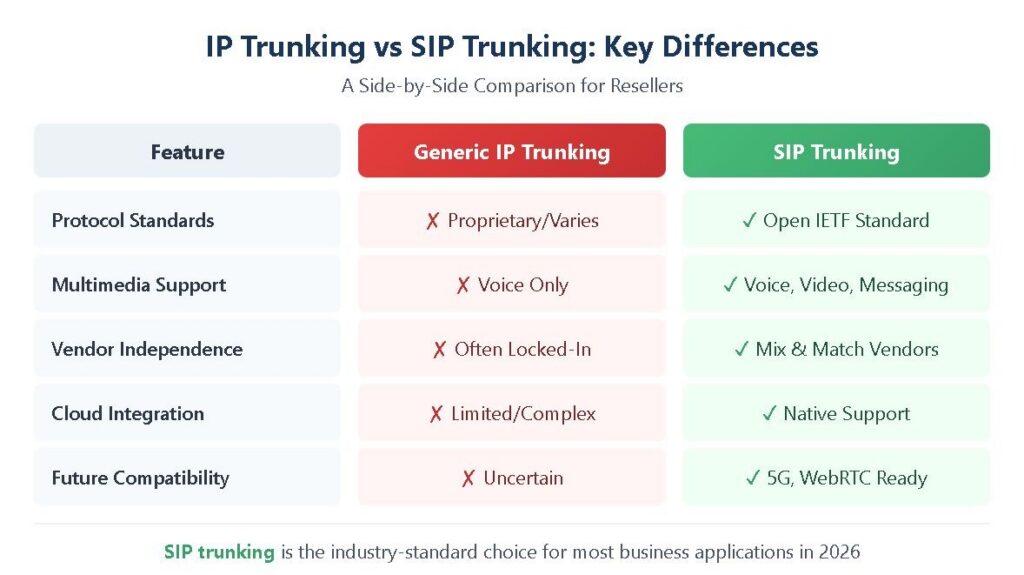
What Are the Key Differences Between IP Trunking and SIP Trunking?
When clients ask directly about the difference between IP and SIP trunking, these distinctions provide clear talking points:
Protocol standardization separates SIP from generic IP trunking. SIP follows published standards maintained by the Internet Engineering Task Force, ensuring consistent behavior across implementations. Proprietary IP trunking systems may use custom protocols that limit interoperability.
Multimedia capabilities extend SIP beyond voice-only applications. While basic IP trunking transmits voice data, SIP trunking handles video, messaging, and presence information within the same framework. This versatility supports unified communications strategies that integrate multiple channels.
Vendor independence gives SIP trunking users the freedom to select best-of-breed components. Clients can choose their preferred PBX platform, phone hardware, and trunk provider without compatibility constraints. Proprietary IP systems often require matching components from a single vendor.
Cloud integration favors SIP trunking in modern deployments. Major cloud communication platforms use SIP for connectivity, making integration straightforward. Microsoft Teams Direct Routing, for example, relies on SIP trunks to connect enterprise phone systems to the Teams platform.
Future compatibility positions SIP trunking for emerging technologies. As 5G networks expand and WebRTC enables browser-based communications, SIP’s standardized approach adapts more readily than closed proprietary systems.
Which Solution Is Right for Your Clients?
Recommending between IP trunking approaches requires understanding each client’s specific situation. Several factors guide these conversations toward appropriate solutions.
- Existing infrastructure often determines the practical path forward. Clients with IP-PBX systems ready for SIP connectivity can deploy quickly. Those with legacy PBX equipment need gateway solutions or may benefit from evaluating hosted alternatives.
- Integration requirements favor SIP trunking for organizations using cloud services. Businesses adopting Microsoft 365, Salesforce, or other platforms find SIP trunking integrates more smoothly than proprietary alternatives.
- Growth expectations matter for capacity planning. SIP trunking’s channel-based scaling suits businesses anticipating expansion. Organizations with stable, predictable call volumes may find any IP trunking approach sufficient.
- Technical resources influence deployment decisions. Clients with capable IT teams can manage SIP trunk configurations directly. Those preferring managed services benefit from providers handling technical complexity on their behalf.
The broader market context supports SIP trunking for most new deployments. Traditional telephone networks continue their transition toward all-IP infrastructure, with PSTN phase-outs progressing across multiple regions. In the UK, for example, the PSTN will be permanently switched off by January 31, 2027, requiring every phone line to move to a fully digital network that uses Internet Protocol. Similar transitions continue worldwide. Positioning clients on SIP trunking now prepares them for this industry-wide shift.
Frequently Asked Questions
Is SIP trunking the same as VoIP?
SIP trunking and VoIP are related but distinct concepts. VoIP describes the broad technology category of transmitting voice over internet protocol networks. SIP trunking is a specific service that uses Session Initiation Protocol to connect business phone systems to VoIP networks and the public telephone system. SIP provides the signaling that enables VoIP calls to happen.
Can SIP trunking work with my client’s existing phone system?
Most modern phone systems support SIP trunking directly. Legacy PBX equipment can gain SIP connectivity through media gateways that translate between older protocols and SIP standards. This compatibility allows businesses to modernize their external connections without replacing internal phone systems that still function well.
How many SIP channels does a typical business need?
Channel requirements depend on concurrent call volume rather than employee count. A general guideline suggests one channel for every three to four employees, though businesses with call centers or high phone usage may need higher ratios. SIP trunking’s flexibility allows adjusting channel counts as actual usage patterns become clear.
What happens to SIP trunk calls during internet outages?
Internet outages interrupt SIP trunk service since the technology relies on data connectivity. Businesses with critical communication requirements should implement redundancy through secondary internet connections, cellular failover, or arrangements with providers offering automatic call forwarding to backup numbers during outages.
Position Your Reseller Business for Communication Modernization
The distinction between IP trunking vs SIP trunking shapes how you advise clients navigating their communication infrastructure decisions. SIP trunking’s standardized approach, multimedia capabilities, and vendor independence make it the appropriate choice for most business applications in 2026.
Resellers who articulate these differences clearly build credibility with clients evaluating their options. Rather than presenting competing technologies, you can explain how SIP trunking represents the mature, widely adopted implementation of IP-based voice services that delivers the flexibility modern businesses require.
SIPTRUNK provides the platform and support that enables resellers to offer enterprise-grade SIP trunking services under their own brand. With no upfront investment required and comprehensive technical resources, building a recurring revenue stream through SIP trunk reselling becomes accessible for VARs, IT consultants, and telecom dealers ready to expand their service offerings. Get started today and transform how you serve clients seeking modern communication solutions.

Mitch leads the Sales team at BCM One, overseeing revenue growth through cloud voice services across brands like SIPTRUNK, SIP.US, and Flowroute. With a focus on partner enablement and customer success, he helps businesses identify the right communication solutions within BCM One’s extensive portfolio. Mitch brings years of experience in channel sales and cloud-based telecom to every conversation.